Showing posts with label Front national. Show all posts

Thursday, November 23, 2017

Terra Nostra, for how long?


Giorgia Meloni, president of Terra Nostra. (Wikicommons: Niccolò Caranti)


A nationalist bloc of nations now extends across much of eastern and central Europe, but Italy seems like another world. In the Italian parliament the leading nationalist party, the Lega Nord (LN), has lost seats at each general election since 1994, except for the one in 2008. The party is also under pressure from members to distance itself from Marine Le Pen and Geert Wilders, particularly after both failed to make major electoral gains this year. Finally, by its very nature, the LN is limited in its potential for growth—it’s a regional party whose support is confined to northern Italy.

Ironically, Italy had once been Europe’s epicenter of political change, as novelist and literary critic Umberto Eco pointed out:

Italian fascism was the first right-wing dictatorship that took over a European country, and all similar movements later found a sort of archetype in Mussolini's regime. Italian fascism was the first to establish a military liturgy, a folklore, even a way of dressing—far more influential, with its black shirts, than Armani, Benetton, or Versace would ever be. It was only in the Thirties that fascist movements appeared, with Mosley, in Great Britain, and in Latvia, Estonia, Lithuania, Poland, Hungary, Romania, Bulgaria, Greece, Yugoslavia, Spain, Portugal, Norway, and even in South America. It was Italian fascism that convinced many European liberal leaders that the new regime was carrying out interesting social reform, and that it was providing a mildly revolutionary alternative to the Communist threat. (Eco 1995)

What would have happened if Italy had stayed out of the Second World War? Would fascism have remained an “interesting” alternative not only to Communism but also to liberal democracy? Probably not. It would have fallen prey to dry rot and eventually collapsed, like in Spain and Portugal. There were fundamental problems with fascism besides the obvious one of stupid jingoism. There was also the problem of maintaining traditional values in an increasingly urban and anonymous mass culture, and this mission was assigned to a state/clerical bureaucracy that might, one day, have other ideas …

As a credible postwar movement, fascism persisted longer in Italy than elsewhere. Indeed, a neo-fascist party was represented in the Italian parliament throughout the postwar era. This was the Movimento Sociale Italiano (MRI), which held seats in both the Chamber of Deputies and the Senate from 1948 until its dissolution in 1995, when the MRI rebranded itself as the Alleanza Nazionale (AN) in a bid to gain mainstream support. 

Although it was for a long time preoccupied with the debate of fascism and anti-fascism, the party distanced itself from this in the early 1990s to rather focus on contemporary Italian issues. [...] When the party transformed itself into the AN, it outspokenly rejected fascism, as well as "any kind of totalitarianism and racism." In contrast to other far-right parties in Europe which increased their power in the late 1980s, the MSI chose to not campaign against immigration, because [there] was less than [in] other European countries. (Wikipedia 2017a)

This transformation paid off, electorally. In 1996 the AN peaked at 16% of the popular vote, and in 2001 it joined a coalition government with its leader as Deputy Prime Minister and Silvio Berlusconi as Prime Minister. Finally, in 2009 it was absorbed into a new party created by Berlusconi, Il Popolo della Libertà (PdL).

There is a lesson in this. If you imitate the mainstream in order to gain power, you may destroy your reason for seeking power, which is to promote your ideas and make them public policy. The end becomes cannibalized by the means.

And yet ...

One may conclude that nothing points to a nationalist breakthrough in Italy, at least not in the near future. Yet things aren't necessarily what they seem. Although the Lega Nord has lost support at the national level, it has gained support at the regional level, particularly in the 2015 regional elections. A party member, Luca Zaia, was elected president of the Veneto region with 50% of the vote, the combined score for the LN and Zaia lists being 41%. The party came second in Liguria (22%) and Tuscany (16%) and third in Marche (13%) and Umbria (14%). These were record successes.

One doesn't have to look far for the reason. Over the past three years half a million migrants, mostly from Africa, have poured into Italy. And the end isn't in sight. The migrant wave is being driven by population pressure in Africa, and not by specific events like the civil war in Syria:

While irregular crossings in the Mediterranean to reach Europe have been growing for a number of years, 2015 marked the sharpest rise in sea arrivals to the EU with a four-fold increase from 2014.

[...] There has been a rapid decline in the presence of Syrian nationals who went from 24% of arrivals in 2014 to just 5% in 2015. While Eritreans were the largest single nationality group in 2015, it is the presence of young single men from a wide range of African countries that truly characterises the Central Mediterranean route in 2015. (Crawley et al. 2016)

Meanwhile, an alternative to the Lega Nord has been taking shape. In 2012 the Fratelli d'Italia (FdI) was founded with Giorgia Meloni as president and a membership drawn largely from the old AN. Its ideology is described as follows:

[The basic principles are] nationalism, national conservatism, and the Social Right [a French movement of social conservatism].

In economic matters, these [principles] mean abandoning the euro, implementing protectionism for products made in Italy, and repealing the European Fiscal Compact.

On the issue of taxation, the electoral program calls for a "family quotient" [taxation that takes the size of the nuclear family into account], a lower sales tax of 4% on goods for young children, and tax deductions substantiated with receipts for such goods.

The party also calls for a social mortgage, i.e., establishment of a publicly funded institution to build housing and living quarters for sale to families who do not already own a home. Mortgage payments will not exceed one fifth of family income, and an eligible family must have at least one gainfully employed member.

At the international level the party declares that it is close to the Front National of Marine Le Pen and the Law and Justice party in Poland. (Wikipedia 2017b)

The party is opposed to birthright citizenship and decriminalization of illegal immigration, and it supports a naval blockade in the Mediterranean. Finally, in the field of civil rights, it opposes gay marriage and parenting, stating that it wants to safeguard the traditional family.

Although the FdI won only 2% of the popular vote in the 2013 general election, it has done better in subsequent municipal and regional elections. In the 2016 election in Rome it received 12% of the popular vote. In the 2017 regional election in Sicily, a politician close to the party was elected president. In preparation for the 2018 general election, the FdI is working to form a broader nationalist front called Terra Nostra (TN) (Wikipedia 2017c).

Conclusion

At first glance, Italy’s nationalist scene looks moribund. Over the past twenty years the Lega Nord has steadily lost support in general elections. In the 1990s the Movimento Sociale Italiano lost its raison d'être and eventually disappeared into the political mainstream. A closer look, however, shows that the LN has been increasing its support at the regional and municipal levels. The last few years have also seen a new nationalist party come into being: the Fratelli d'Italia, now renamed Terra Nostra. Time will tell, but it has already shown promising growth in municipal and regional elections. The TN is partly a response to electoral successes by similar parties in other countries, notably the Front National in France and the Law and Justice party in Poland, but its main impetus seems to be events in Italy itself, particularly the sharp rise in immigration from Africa over the past three years.

Both parties will have to overcome several barriers to electoral success:

- The Lega Nord cannot fully mobilize the nationalist vote. Its support is confined to northern Italy and is fueled by a perception that the north is subsidizing the south and an overgrown central government. It has in fact tried to build support in southern and central Italy, but with little success.

- Terra Nostra is new, and new parties are prone to problems that plague any new team of people: disagreement over vision and ideology, uncertainty over direction and strategy, etc. Since many of its founding members had formerly belonged to the AN, and previously to the MRI, they will tend to follow old visions and old ideology. In particular, belief in a strong central state will block cooperation with the LN.

- There is a lack of time. Immigration to Italy has reached high levels. With a fertility rate of 1.2 children per native-born woman, the most likely scenario will be rapid demographic replacement. Indeed, this fate awaits the entire southern tier of Europe.

Although both parties may do very well in the upcoming 2018 general election, they will probably not do well enough to form a coalition government on their own. The outcome will likely be a three-way coalition: Lega Nord, Terra Nostra, and Forza Italia, i.e., Berlusconi's party. This raises the prospect of absorption into the political mainstream, as was the case a decade ago. This time, however, the tail might wag the dog; there are signs that Forza Italia voters are realizing that Italy, like Europe as a whole, is facing an existential crisis. On the other hand, their party is still a mix of liberal and traditionalist tendencies:

In October 2014 Berlusconi personally endorsed Renzi's proposals on civil unions for gays and a quicker path to citizenship to Italian-born children of immigrants. However, recent developments proved the party more socially conservative. FI clarified that it considers marriage solely as the union between a man and a woman. The majority of its members voted against civil unions, whereas the NCD voted in favour. Moreover, the party is critical of teaching gender studies in schools. Party members are generally pro-life and therefore seek to limit abortion and euthanasia. The party has criticized illegal immigration and the way it has been managed by centre-left coalition governments. It has also declared itself against the introduction of jus soli in Italy. In addition, the party is opposed to drug liberalization, which it considers potentially negative for health and not useful for solving criminal matters. When FI's predecessors were in power, they restricted the legislation on the matter, with the Fini-Giovanardi law. Finally, FI considers Italy as a country with a Christian civilization and, thus, favours displaying Christian symbols in public places. (Wikipedia 2017d)

This is typical conservatism, and on several points it is vulnerable to the sort of manipulation by outside interests that we have seen with conservative parties elsewhere. If, for example, only illegal immigration is problematic, why not solve the problem by legalizing it? Perhaps Berlusconi has learned his lesson, but the example of conservatives elsewhere isn't reassuring. Again, time will tell.


References

Crawley, H., F. Duvell, N. Sigona, S. McMahon, and K. Jones (2016).  Unpacking a rapidly changing scenario: migration flows, routes and trajectories across the Mediterranean. Unravelling the Mediterranean Migration Crisis (MEDMIG) Research Brief No.1 March 2016
http://www.compas.ox.ac.uk/media/PB-2016-MEDMIG-Unpacking_Changing_Scenario.pdf  

Eco, U. (1995). Ur-Fascism, The New York Review of Books, June 22
http://www.nybooks.com/articles/1995/06/22/ur-fascism/  

Wikipedia (2017a). Italian Social Movement.
https://en.wikipedia.org/wiki/Italian_Social_Movement  

Wikipedia (2017b). Fratelli d'Italia - Alleanza Nazionale.
https://it.wikipedia.org/wiki/Fratelli_d%27Italia_-_Alleanza_Nazionale

Wikipedia (2017c). Brothers of Italy
https://en.wikipedia.org/wiki/Brothers_of_Italy  

Wikipedia (2017d). Forza Italia.
https://en.wikipedia.org/wiki/Forza_Italia_(2013)#Ideology_and_factions  


Thursday, October 26, 2017

Why they can and we can't


Emmanuel Macron (Wikicommons: French government)


This week, Bill 62 became law in Québec. People now have to show their faces when giving or receiving public services. And that last term is interpreted broadly. If you're riding on a bus or going to a clinic, you're using a public service. Although the words niqab and burqa appear nowhere in the legislation, the intent is to remove the most extreme forms of Islamic dress from public space.

Elsewhere in North America such a law would be unthinkable, even among conservatives. Indeed, the leader of the Ontario Progressive Conservatives, Patrick Brown, condemned it in the strongest terms. So it is all the more surprising that this law was passed by the Liberal Party of Québec, whose electorate, membership, and campaign donors overlap considerably with those of the Liberal Party of Canada ... led by Justin Trudeau. This was undoubtedly a factor in his muted response.

So what's going on? What makes such a law possible in Québec but impossible in English Canada? One reason is language. The French language reduces the inflow of American cultural norms via books, magazines, movies, videos, TV programming—all of which condition us to think that some things are possible and others aren't.

Conversely, the French language makes Quebec much more open to the cultural norms of the Francophone world. And those norms have been increasingly hostile to niqabs and burqas. In 2011, France banned them in all public places, after passage of a similar law in Belgium the year before. Similar bans have been imposed or are being debated in francophone Africa, including some Muslim-majority countries (Chad and Senegal). There is a real fear in France and elsewhere that Islamic dress, like public prayers in the street, is part of a conscious effort by Islamists to dominate public space—to create the impression that this is their space and that "strangers" must act accordingly.

And the current French president, Emmanuel Macron? What does he think?

The burqa must be banned. I don't think it's necessary to go further. I'm for secularism. A complete ban at school and in public services, and in society a ban on some signs like the burqa that disrespect gender equality and the civility that exists between men and women in French society. (Coquaz 2017).

Secularism is there to say, "I don't want society to be submitted to a religion's hegemonic temptations." Yesterday, the Catholic religion. Today, for many of our fellow citizens, the Muslim religion. It's very important to enforce the neutrality of the public service. Religion cannot be present at school. Nonetheless, I hear few people upset when the consequences of this debate send more and more children to faith-based schools that teach them hatred of the [French] Republic, dispense teachings essentially in Arabic or, elsewhere, teach the Torah more than basic skills. (Dély 2016)

Respectable opinion in Québec tends to follow respectable opinion in France. If a goodthinker like Macron1 thinks the burqa should be banned, who's to argue?

Another factor is the social distance between the elites and the common people. It's a lot smaller in Québec, the rich and powerful being no more than one or two generations away from Jos Bleau and Johanne Bleau. So they feel a stronger sense of commonality with the average man and woman. And if they don't, they soon get told to remember who they are and where they come from. This is, incidentally, a common complaint among Québec celebrities. No matter how famous you become, you’ll always be that snotty kid who had trouble tying up his hockey skates.

So when the governing party does an about-face on a controversial issue, it's not because some policy wonk told them to do so. It's because they've been harassed by their constituents, including friends, relatives, and neighbors. In this case, there was a groundswell of feeling to get burqas off the streets. In English Canada, politicians would simply turn a deaf ear. In Québec, they tried doing that but were brought into line by public opinion.

Societally speaking, Québec is more like Israel or Eastern Europe, where the elites are less differentiated from the common people, either because the country itself is recent (Israel) or because the original elites were eradicated by socialist regimes (Eastern Europe).

As coincidence has it, this past week also saw the election of a nationalist party in Czechia, on the heels of a similar election win in Austria (October 15). There is now a large bloc of like-minded countries in central and eastern Europe: Poland, Czechia, Slovakia, Austria, and Hungary. The thinking used to be that nationalists would first come to power in France. After all, they're stronger and better organized there, aren't they? Well, yes, but so are the elites. And those elites have strong links to elites elsewhere.

Some people will attribute Québec's Burqa ban to a third factor: Québec nationalism, specifically the nationalist movement that reached its peak back in the 1970s. To be honest, not much remains of that movement even within the Parti Québécois, which has become a post-national party like the SNP in Scotland. In any case, the Burqa ban is supported by 73% of people in Québec, whereas support for the Parti Québécois is only about a third of the popular vote (TVA Nouvelles 2010). This is an issue that seems to transcend traditional party loyalties.

In sum, it looks like nationalist parties have a better chance where:

- English isn't widely used

- Culture is locally produced

- Elites are more strongly linked to the local population than to elites in other countries, particularly the globalist elite based in the United States and the United Kingdom.

In other countries, nationalists may have better luck advancing their arguments outside the political process. In France, the Front National has failed to gain power but it has widened the bounds of acceptable discourse and acceptable policy, as seen in Macron's position on the burqa.

Note

1. During the election campaign, Macron criticized another law that banned wearing of the hijab (which covers only the hair and not the face) in public primary schools, middle schools, and secondary schools. To date, he has not tried to repeal that law.


References

Brown, P. (2017). Neutrality is not enough. If feds won't lead Canada, and this racist law passes, ON must support a Charter challenge. October 20
https://twitter.com/brownbarrie/status/921344747263758336

Coquaz, V. (2017). Hortefeux invente une ambiguïté de Macron sur la " burqa ", Libération, May 23
http://www.liberation.fr/desintox/2017/05/23/hortefeux-invente-une-ambiguite-de-macron-sur-la-burqa_1571738

Dély, R. (2016). Emmanuel Macron : " La République est ce lieu magique qui permet à des gens de vivre dans l'intensité de leur religion " Marianne, October 1
https://www.marianne.net/politique/emmanuel-macron-la-republique-est-ce-lieu-magique-qui-permet-des-gens-de-vivre-dans-l

TVA Nouvelles (2010). Les Québécois contre la burqa en public, July 28
http://www.tvanouvelles.ca/2010/07/28/les-quebecois-contre-la-burqa-en-public

Saturday, December 19, 2015

A look back over 2015


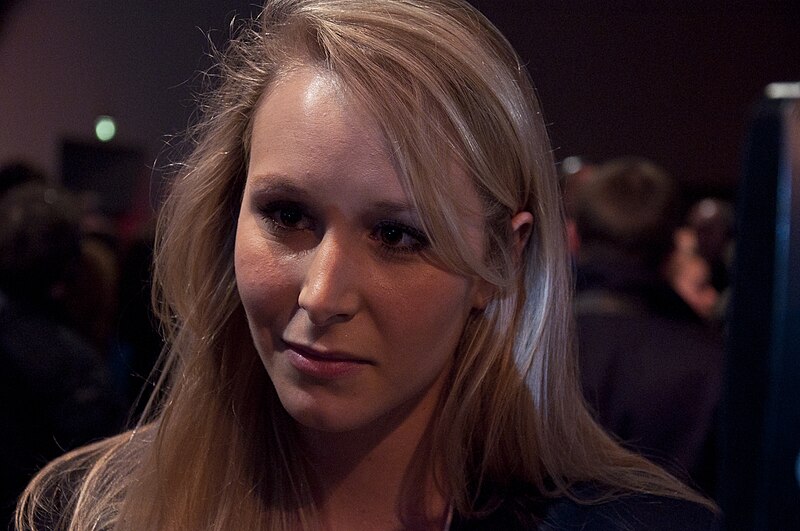
Marion-Maréchal Le Pen (Wikicommons - Remi JDN). This year, she received 45% of the popular vote in one of France's regions, as a Front National candidate.


We must act now to bring anti-globalist parties to power: the UKIP in Britain, the Front national in France, the Partij voor de Vrijheid in the Netherlands, the Alternative für Deutschland in Germany, and the Sverigedemokraterna in Sweden. How, you may ask? It's not too complicated. Just go into the voting booth and vote. You don't even have to talk about your dirty deed afterwards.

I wrote the above last January, fearing that Europe would see an acceleration of the massive demographic change already under away—the Great Replacement, to use a term coined by Renaud Camus:

Oh, the Great Replacement needs no definition. It isn't a concept. It's a phenomenon, as obvious as the nose on your face. To observe it, you need only go out into the street or just look out the window. A people used to be there, stable, occupying the same territory for fifteen or twenty centuries. And all of a sudden, very quickly, in one or two generations, one or more other peoples have substituted themselves for it. It's been replaced. It's no longer itself.  We should note that the tendency to consider individuals, things, objects, and peoples replaceable or interchangeable is fairly widespread and in line with a threefold movement whereby people have become industrialized, deprived of their spirituality, and dumbed down. Call it a later and more generalized stage of Taylorism. At first, we replace only the parts of manufactured goods. Then, we replace workers. Finally, we replace entire peoples. (Camus, 2012)

Two breaches have been made in the dike that used to hold back this process of replacement: one in Libya and the other in Syria. Through them is pouring the demographic overflow that has been building up in Africa and the Middle East. Meanwhile, there has been an incredible loss of will among Europe's leaders to do anything, other than hectoring recalcitrant nations like Hungary for not taking their "fair share."

I'm not using the word "incredible" lightly. This wave of immigrants won't be a one-time-only thing. It won't come to an end when conditions improve in their home countries. Indeed, once it gets under way it can only increase in magnitude, and spreading it over a wider area will do nothing to stop the increase. Instead of being confined to Western and Southern Europe, the Great Replacement will be extended to Eastern Europe. Swell. You call that a solution?

Instead of replacing native Europeans, why not replace their leaders? Why not vote them out of office? That was the solution I advocated back in January and still do. Political change is more certain when done by peaceful means at the ballot box, as opposed to being imposed by coercion and illegal acts. Unfortunately, this option faces a number of obstacles.

The obstacles are threefold:

Unwillingness to play by the rules

In this, the problem lies not so much with Europe's nationalist parties as with their opponents. It's the latter who are not willing to play by the rules.

This was the case in Belgium, where in 2004 a court ruling shut down the Vlaams Blok, a party that had won 24% of the popular vote for the Flemish parliament the same year.

In October 2000, the Centre for Equal Opportunities and Opposition to Racism, together with the Dutch-speaking Human Rights League in Belgium registered a complaint at the Correctional Court, in which they claimed that three non-profit organisations connected to the Vlaams Blok (its education and research office and the "National Broadcasting Corporation") had violated the 1981 anti-racism law. The publications which were referred to included its 1999 election agenda and 1997 party platform. The challenged passages included those where the party called for a separate education system for foreign children, a special tax for employers employing non-European foreigners, and a restriction of unemployment benefits and child allowances for non-European foreigners. (Wikipedia - Vlaams Blok, 2015)

Elsewhere, nationalist parties have faced a combination of judicial and extrajudicial harassment. Indeed, when antifas commit brazen acts of violence that go unpunished, one cannot help but wonder whether the correct term is "quasi-judicial." The antifas are functioning as a kind of secret police that is allowed to do what the regular police cannot do.

Even without the antifas, the level of harassment is considerable. In 2013, for example, the European Parliament stripped Marine Le Pen of her parliamentary immunity for having denounced the illegal blocking of French streets for Muslim prayers:

For those who want to talk a lot about World War II, if it's about occupation, then we could also talk about it (Muslim prayers in the streets), because that is occupation of territory. ...It is an occupation of sections of the territory, of districts in which religious laws apply. ... There are of course no tanks, there are no soldiers, but it is nevertheless an occupation and it weighs heavily on local residents (Wikipedia - Marine Le Pen, 2015)

For that comment, she was dragged before the courts, being finally acquitted this year. Compare that with the indulgence reserved for the magazine Le Nouvel Observateur when it featured a tweet on its twitter page that called for the mass rape of women who vote FN. The tweet was removed but there was no apology, and there certainly won't be any prosecution by the Minister of Justice—as was the case with Marine's comment.

This is the reality of political debate in Western Europe. One side can speak with impunity, whereas the other has to watch what it says.

Extremist image of nationalism

In 2015, the progress of nationalist parties was not uniform. In Greece, Chrysí Avgí (Golden Dawn) seems to have stalled at 7% of the popular vote. In Norway, Fremskrittspartiet (Progress Party) lost support in local elections, this being part of a decline that began in 2011 … with Breivik's terrorist attacks.

In Norway, it is now difficult to be a nationalist without being associated with Anders Breivik or church burnings by black metallists. In Greece, nationalism is tarred with Nazi-like rhetoric and imagery—this, in a country that Nazi Germany had occupied during the last war. It is a sign of just how bad things are that so many Greeks are still willing to vote for a party that revels in an extremist image.

This problem is inevitable with any movement that begins on the fringes among people who feel alienated. As nonconformists they tend to be lone wolves, and as lone wolves they tend to act without restraint, sometimes mindlessly. Such people are both a help and a hindrance for any new political movement.

Assimilation into the dominant political culture

There is also the reverse problem. In the Venice state election, the Liga Veneta received 41% of the popular vote. This might seem to be good news, since the Liga Veneta is part of the Lega Nord, which in turn is allied with the Front National in France.

Unfortunately, things are not as they might seem. When a new party comes closer to power, it tends to assimilate mainstream values because its leaders now have to navigate within that culture—daily encounters with the media, meetings with campaign donors, invitations to wine and cheese parties ... The result may be seen in the Liga Veneta’s political platform for 2010-2015:

The challenges that Veneto should face in the next decades, said the party, were to enhance "internationalization" in the era of globalization, to overcome the traditional Venetian policentrism and interpret Veneto as a united and cohesive region: a "European region in Italian land". The program stressed also concepts such as "Europe of the regions", "Europe of citizens", "global Veneto", "openness toward the world", "green economy", "urban planning" in respect of the environment, "respect for diversity" and "integration" of immigrants, along with the more traditional "think globally, act locally". (Wikipedia - Liga Veneta)

It is not enough for nationalist parties to gain power. They must also have confidence in their ideas and change the way other people think. Otherwise, they'll end up assimilating into the dominant political culture.

But there was progress in 2015

Despite these problems—harassment, lack of discipline, ideological assimilation—most nationalist parties are moving forward. In the first round of France's recent regional elections, the Front National took first place in six of the thirteen regions in Europe (four others are overseas). Yes, it was shut out in the second round, when left-wing parties threw their support behind the main right-wing party, but this defeat was only a partial one. While not securing the office of president in any region, the FN is now represented on all regional councils of European France, ranging from a high of 34% of council seats in Provence-Alpes-Côte d'Azur to a low of 8% in Corsica. Imagine a similar situation in the United States: a nationalist party with at least 8% of the seats in every state legislature.

This year saw gains for nationalist parties elsewhere. In Poland, Prawo i Sprawiedliwosc (Law and Justice) took power with 38% of the vote, in large part because of its opposition to immigration. In Switzerland, Schweizerische Volkspartei (Swiss People's Party) became the leading party, receiving 29% of the popular vote, up from 27%. In Denmark, Dansk Folkeparti (Danish People's Party) earned 21% of the popular vote, up from 12%.

Outside Europe, in other European-descended societies, the picture is more mixed. In the United States, Donald Trump has shattered the phoney consensus on massive demographic change, but even if elected he will face a long uphill battle against opposition from the bureaucracy and from entrenched factions in society at large, particularly the business community—which has long been a source of funding for the Republican Party.

In Canada, the Conservative Party lost power in Ottawa and the Parti Québécois lost power in Quebec City. To be honest, I feel little regret for either loss. In their earlier incarnation, as the Reform Party, the Conservatives were committed to a sharp reduction in immigration. But that promise fell by the wayside once they took power, and they instead chose a neo-con policy of "Invade the world! Invite the world!" They followed that recipe to the letter and—Surprise! Surprise!—it wasn’t what their own voters wanted, let alone the rest of the electorate. Well, good riddance.

As for the Parti Québécois, it began in the 1960s as an alliance of the traditional left and the traditional right. Over time, both factions withered away, being replaced by the new synthesis of globalism and post-nationalism. The PQ became an anti-nationalist nationalist party. They lost power largely because they could no longer energize their natural constituency while failing to make inroads into others. Well, good riddance.

*****************************************************

This will be my last column for 2015, and I wish all of you a very Merry Christmas! Although I no longer go to church, I still consider Christmas to be a very important time of year when we can spend more time with our loved ones and enjoy the traditions of this mid-winter celebration.

I don't know whether I will resume my column in the new year. The legal environment in Canada has changed over the past few months, especially with the adoption of Bill 59. If need be, I will concentrate on writing papers for academic journals.

References 

Camus, R. (2012). " Renaud Camus à L'AF : " J'ai une conception lazaréenne de la patrie " ", L'Action française, no 2832,
http://www.actionfrancaise.net/craf/?Entretien-Renaud-Camus-a-L-AF-J-ai 

Wikipedia - Liga Veneta. (2015)
https://en.wikipedia.org/wiki/Liga_Veneta 

Wikipedia - Marine Le Pen (2005).
https://en.wikipedia.org/wiki/Marine_Le_Pen 

Wikipedia - Vlaams Blok. (2015).
https://en.wikipedia.org/wiki/Vlaams_Blok#Court_of_Cassation_ruling_.282004.29