Showing posts with label Emil Kirkegaard. Show all posts

Monday, September 26, 2022

Is intelligence all that matters for a successful society?


If we consider intelligence to be the only worthy mental attribute, we’ll end up with an elite that is not only intelligent but also narcissistic … and indifferent to the rest of us.


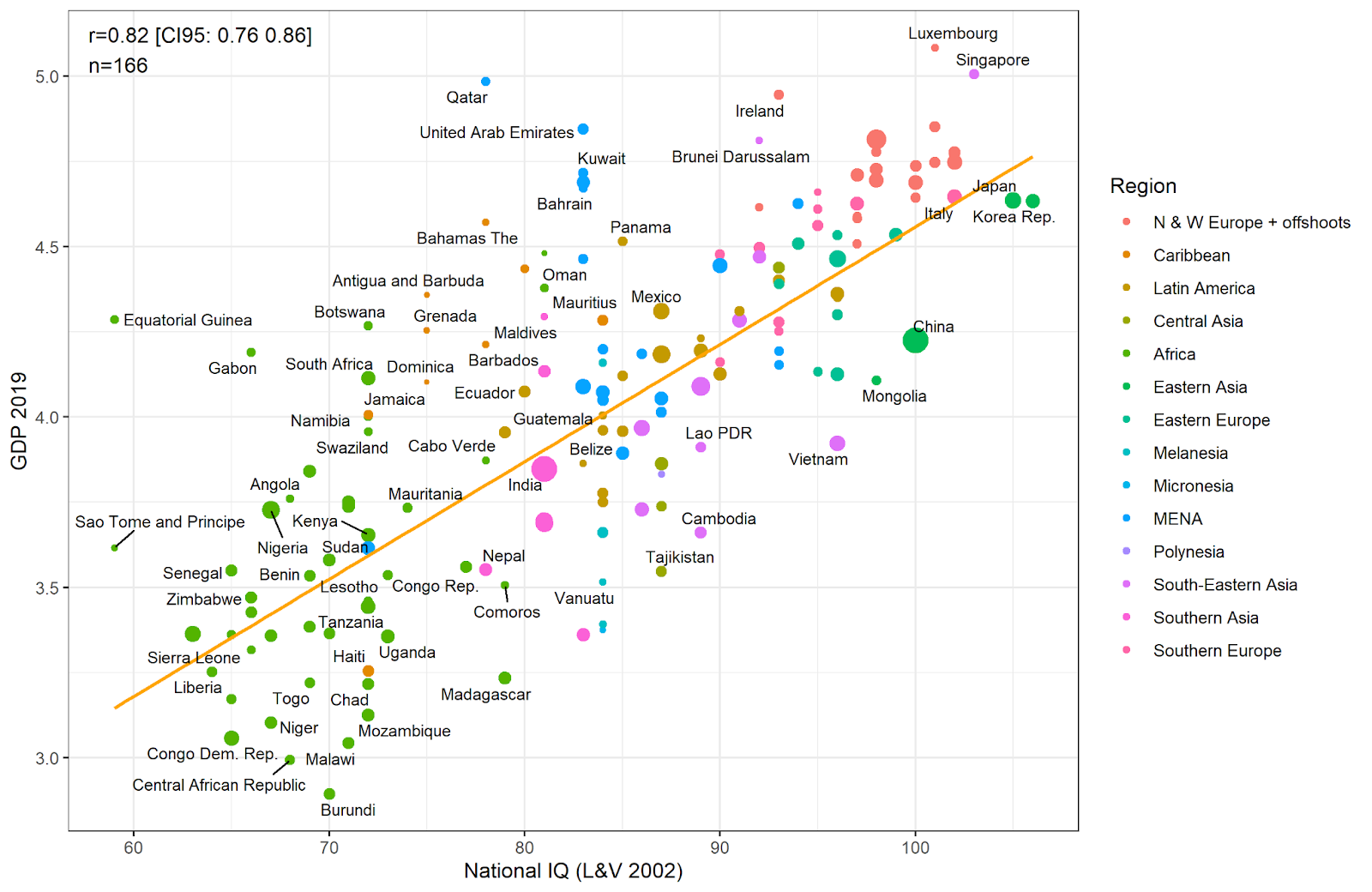
George Francis and Emil Kirkegaard have come out with a study that shows a strong correlation between IQ and wealth creation. The higher the mean IQ, the more a nation can create wealth:


We find national IQ to be the “best predictor” of economic growth, with a higher average coefficient and average posterior inclusion probability than all other tested variables (over 67) in every test run. Our best estimates find a one point increase in IQ is associated with a 7.8% increase in GDP per capita (Francis and Kirkegaard 2022)


The study is essentially an update of an earlier one by Richard Lynn and Tatu Vanhanen (2002). It’s better done, and I agree more or less with the conclusion. Wealth is not created in a vacuum. It’s created by flesh-and-blood humans who possess certain mental and behavioral attributes, one of which is high cognitive ability.


I do, however, have two criticisms.


Criticism #1: On a societal level, cognitive ability is confounded with other mental and behavioral attributes


Yes, high cognitive ability is important. But sustainable creation of wealth also requires other mental and behavioral attributes, notably:


·         propensity to identify social rules, obey them, and enforce them on others

·         feelings of guilt when one breaks the rules, even when there are no witnesses

·         empathy for others and a desire to understand how one’s behavior affects them

·         inhibition against using violence to settle disputes

·         high degree of future time orientation (also known as low time preference)


High IQ + high trust + low violence + low time preference = sustainable creation of wealth (Clark 2007; Clark 2009a; Clark 2009b; Frost 2020). Some will argue that intelligence goes hand in hand with high trust and low time preference (Carl 2014; Kirkegaard and Karlin 2020). That is true on a societal level: the same selection pressures that favor high intelligence usually favor the entire mental and behavioral package. On an individual level, however, intelligent sociopaths do exist, and they can prosper while others suffer. If they become too numerous or too influential, they will eventually destroy their host society. But that can take time.


In all fairness, Francis and Kirkegaard did investigate social trust and time preference. Unfortunately, those attributes are confounded with IQ: successful societies tend to have people who are not only intelligent but also trustworthy and future-oriented. That’s survivorship bias: if a society lacks the full mental and behavioral package, it usually goes extinct, and extinct societies get overlooked by cross-national studies. To be precise, societal extinction happens when the intelligent are unrestrained in their contempt for the less intelligent in their midst; they thus prey on them by any means possible, and the resulting strife leads to societal collapse.


IQ, social trust, and time preference are normally confounded with each other, at least in most existing societies. Therefore, if you control for IQ, the other two variables will go away, and you’ll think: “Aha! The key variable must be IQ!”


And you’ll feel all the more certain because IQ is not just equal to social trust or time preference in predicting wealth creation. It’s actually better! That greater predictive power, however, has a simple explanation: measurement of IQ is based on less subjective data. In this study, social trust is measured by self-report, and time preference is measured by an amalgam of survey responses and credit risk.


Criticism #2: The correlation is driven largely by unreliable African data


This study has another weak point: the correlation between wealth creation and IQ is driven largely by economic and cognitive data from Africa. If you remove Africa from the chart, the correlation becomes a lot weaker.


How reliable is the African data? Not very. First, a lot of African economic activity is “off the books.” That is particularly true for subsistence farming in the countryside, but it’s also true for many businesses in the towns and cities. GDP thus tends to be underestimated.


Second, even HBD writers disagree among themselves on mean African IQ, as pointed out by Heiner Rindermann:


The [cognitive] ability levels for Africans in Africa are the subject of strong disagreement. Rushton studied positively selected samples (South African university engineering students; Rushton, Skuy, & Fridjhon, 2003), but the mean differences between Africans and Europeans (14 IQ points) were similar to the ones found in Western countries. Lynn and Vanhanen (2006) estimated that sub-Saharan African countries had a mean IQ of 70. Wicherts, Dolan, and Maas (2010) using a different selection procedure came to a mean IQ of 82.


Rindermann’s “best guess” is 75. He concludes: “Given the quality of the data, it is not possible to come to a really precise result” (Rindermann 2013, p. 3). If we look at the chart from Lynn and Vanhanen (2002), we see that most sub-Saharan African countries are assigned mean IQs lower than 75. In fact, 75 seems to be the upper limit. That’s the IQ dataset of the new study.


Francis and Kirkegaard (2022, pp. 22-23) are aware that the IQ/GDP correlation is a lot weaker without the African IQ data, and they defend the validity of that dataset at some length. I’m still unimpressed, for two reasons:


·         If mean African IQ is 70, one must conclude that Africans are much less intelligent than African Americans, whose mean IQ is usually estimated at 85. Such a large difference cannot be explained by European admixture, heterosis, or nutrition.


·         The Yoruba of Nigeria have about the same polygenic score as that of African Americans (Piffer 2021, Fig. 7). Their mean IQ should therefore be 85. Yet, according to Lynn and Vanhanen, Nigerians have a mean IQ of 67. Since Nigeria is 18% Igbo, and since the Igbo show high academic achievement, mean Yoruba IQ should therefore be much less than the presumed Nigerian average of 67 (Chisala 2015; Frost 2022). The numbers don’t seem to add up.


Please don’t get me wrong. I agree that mean IQ is lower in Africa than in Eurasia, but the Lynn and Vanhanen estimates seem too low. In any case, they are not widely accepted even by researchers who accept that cognitive ability varies among human populations.


Similarly, I agree that more wealth is created per capita in Eurasia than in Africa. The difference, however, is overstated because so much of African GDP goes unreported. Furthermore, I don’t believe that lower IQ largely explains Africa’s economic underperformance. There is also the excessive use of violence to achieve one’s goals, both by the State and by private individuals. There is also the low level of trust that people have in each other—for the most part, Africans trust only their immediate family and friends. Finally, because family ties are so important, nepotism is widespread, and successful entrepreneurs end up being plundered by greedy relatives. The market economy cannot realize its full potential because the logic of the market has to compete with the logic of kinship.


Edit: George Francis has informed me that the correlation between IQ and GNP per capita remains unchanged if African cognitive and economic data are excluded. Without the African data, GDP per capita would increase 7.7% with each one point increase in IQ, rather than 7.8%.


Conclusion


Cognitive ability is only one of several mental and behavioral attributes that are key to building successful economies and societies. If we focus on it to the exclusion of others, we will be talked into supporting policies that have unintended consequences. A good example is the idea of reorienting immigration policy toward recruitment of high-IQ individuals.


That idea has the support of many conservatives throughout the West, but the consequences are very un-conservative. In short, we would be selecting immigrants who excel at creating wealth for themselves, by hook or by crook. The eventual result: an elite of rich narcissists who feel little sympathy for common people and who see them as objects to be used, when useful, and thrown away, when not.


Please don’t get bamboozled by reassurances that IQ correlates with trustworthiness and low time preference. That’s true only at the societal level. Those three attributes align with each other because they have to: otherwise, society would become dysfunctional and collapse. That’s survivorship bias: we get data from societies that have survived, and not from those that haven’t. If we cherry-pick high IQ immigrants from all over the world, we will create a new kind of society that has not stood the test of time.


Actually, that kind of society has arisen in the past:


And you should know that all the Cathayans [Chinese] detested the Grand Khan's rule because he set over them governors who were Tartars, or still more frequently Saracens, and these they could not endure, for they were treated by them just like slaves. You see the Great Khan had not succeeded to the dominion of Cathay [China] by hereditary right, but held it by conquest; and thus having no confidence in the natives, he put all authority into the hands of Tartars, Saracens, or Christians who were attached to his household and devoted to his service, and were foreigners in Cathay [China].

            The Travels of Marco Polo, Book 2, Chapter 23


Why do you think revolutions happen? It was precisely to avoid such a prospect that elite schools sought to develop not only intellect but also character, including the idea that the powerful have a duty to rule wisely and fairly. That view of higher education has given way to “meritocracy” throughout the West, with results that could have been predicted.


References


Carl, N. (2014). Does intelligence explain the association between generalized trust and economic development? Intelligence 47: 83-92. https://doi.org/10.1016/j.intell.2014.08.008


Chisala, C. (2015). The IQ gap is no longer a black and white issue. The Unz Review, June 25. http://www.unz.com/article/the-iq-gap-is-no-longer-a-black-and-white-issue/     


Clark, G. (2007). A Farewell to Alms. A Brief Economic History of the World. Princeton University Press: Princeton and Oxford.


Clark, G. (2009a). The indicted and the wealthy: surnames, reproductive success, genetic selection and social class in pre-industrial England.

http://www.econ.ucdavis.edu/faculty/gclark/Farewell%20to%20Alms/Clark%20-Surnames.pdf    


Clark, G. (2009b). The domestication of man: The social implications of Darwin. ArtefaCTos 2: 64-80. 

https://www.researchgate.net/publication/277275046_The_Domestication_of_Man_The_Social_Implications_of_Darwin  


Francis, G., and E.O.W. Kirkegaard. (2022). National Intelligence and Economic Growth: A Bayesian Update. The Mankind Quarterly 63(1). http://dx.doi.org/10.46469/mq.2022.63.1.2  


Frost, P. (2020). The large society problem in Northwest Europe and East Asia. Advances in Anthropology 10(3): 214-134. https://doi.org/10.4236/aa.2020.103012     


Frost, P. (2022). Recent cognitive evolution in West Africa: the Niger’s role. Evo and Proud, April 30. https://evoandproud.blogspot.com/2022/04/recent-cognitive-evolution-in-west.html  


Kirkegaard, E.O.W., and A. Karlin. (2020). National intelligence is more important for explaining country well-being than time preference and other measured non-cognitive traits. Mankind Quarterly 61: 339-370. http://doi.org/10.46469/mq.2020.61.2.11  


Lynn, R. and T. Vanhanen. (2002). IQ and the Wealth of Nations. Westport, Conn: Praeger


Piffer, D. (2021). Divergent selection on height and cognitive ability: evidence from Fst and polygenic scores. OpenPsych https://openpsych.net/files/submissions/14_Divergent_selection_on_height_and_cognitive_ability_evidence_from_Fst_and_13c3ICJ.pdf     


Rindermann, H. (2013). African cognitive ability: Research, results, divergences and recommendations. Personality and Individual Differences 55: 229-233. https://doi.org/10.1016/j.paid.2012.06.022     

Monday, August 15, 2022

Comparing an incomparable?


Stigmata Siciliana (1964), David McLure (Wikicommons)


What is the mean IQ of sub-Saharan Africans? There’s no clear answer. Current estimates come from an early stage of the Flynn effect and are also distorted by qualitative differences in cognition. Furthermore, mean IQ differs among African groups.


At present, there is little consensus on the mean IQ of sub-Saharan Africans. Estimates have ranged from a low of 66 to a high of 82 (Lynn 2010; Wicherts et al. 2010). Rindermann (2013) put forward a "best guess" of 75, which is inexplicably much lower than the estimated African American mean of 85. Yes, African Americans are about 20% European by ancestry, but that degree of admixture would not cause a 10-point difference. Malnutrition? That might depress IQ scores in some African countries but not most.


Noah Carl (2022) has reopened the debate by inferring mean IQ from harmonized test scores and GDP per capita. Sub-Saharan Africa looks somewhat better on the first measure and somewhat worse on the second. Both measures correlate roughly with mean IQ, but the correlation isn’t strong enough to tell us whether the mean is 62, 75, or 82. Moreover, the first measure suffers from the same problem that plagues IQ tests: Africa is just starting to experience the secular increase in mean IQ that the West experienced during the 20th century, i.e., the Flynn effect. By how much should we increase the estimate of mean African IQ to adjust for Africa being at an earlier stage of the Flynn effect?


As for the second measure, GDP per capita, the ability to create wealth is determined not only by cognitive ability but also by other mental traits: future time orientation (also known as time preference), willingness to follow rules and enforce them, feelings of guilt over breaking rules, reluctance to use violence to settle disputes, tendency toward individualism rather than nepotism and familialism, and so on.


In a reply to Carl’s article, Emil Kirkegaard (1922) infers mean IQ from the Social Progress Index. But that measure is no less problematic than GDP per capita. Social progress is driven by a basket of mental qualities, of which cognitive ability is only one. Emil himself makes that point:


One cannot just impute IQs reliably from non-IQ data in order to get some kind of unbiased estimates of a region's IQ because the regions themselves may under- or overperform on international rankings for whatever reason, [including] legacy of or current communism, nonWEIRDness, low individualism, or any other difference you can imagine.


Emil concludes: “There’s no avoiding having to collect more African IQ data.”


More data would be nice, but no amount of data will provide us with a mean African IQ that can be usefully compared with the mean IQs of other populations. There are several reasons:


·        Again, estimates of African IQ come from an early stage of the Flynn effect. They are not comparable with estimates of IQ that come from a later stage in other populations.

·        The genetic architecture of cognition is not the same. Sub-Saharan Africans seem to have alleles for cognitive ability that do not exist in other populations. To date, such alleles have been identified only in people of European descent.

·       Recent cognitive evolution, particularly in societies near the Niger, has created differences in mean cognitive ability among African groups. It is no more meaningful to talk about a single mean African IQ than it is to talk about a single mean European IQ.


Differences in the stage of the Flynn effect


IQ data from Western societies are not comparable with IQ data from African societies. The latter are just beginning to experience the rise in mean IQ that took place earlier in the West, specifically the increase of 13.8 points between 1932 and 1978 (Flynn 1984). The Flynn effect seems to be not so much an increase in cognitive ability as an increase in familiarity with the “test paradigm” at school and, more broadly, in society. Flynn (2013) situates the cause in the modernist paradigm: “We freed ourselves from fixation on the concrete and entered a world in which the mass of people began to use logic on abstractions and universalize their moral principles.”


Keep in mind that competitive exams began to appear in the West only in the late 19th century, first for entry into the civil service and then more generally for the educational system (Wikpedia 2022). Previously, people entered the civil service through patronage appointments, and education took the form of apprenticeship and imitation of role models. In those days, people were less inclined to formulate questions and look for the answers. The answers were already known, and you had to learn them. In fact, there was a stigma attached to asking too many questions, especially in rapid-fire succession.


Differences in the genetic architecture of cognition


As a means to estimate cognitive ability, the IQ test is becoming superseded by the educational polygenic score. This measure is based on SNPs that have been shown to be associated with educational attainment. Your polygenic score is higher to the extent that the alleles at those SNPs are associated with higher educational attainment. It is thus a measure of innate cognitive ability. At present, we have identified 1,271 SNPs that are associated with educational attainment and which, together, explain 11-13% of the variance in educational attainment among individuals (Lee et al. 2018). The educational polygenic score has shown good reliability in predicting the IQ of individuals and even better reliability in predicting the mean IQ of populations.


Again, we have identified alleles associated with educational attainment only in people of European descent. For this reason, the educational polygenic score is five times worse at predicting the cognitive ability of African Americans (Lasker et al. 2019). The loss of predictive power seems greatest in the domain of language ability, according to two studies:


·        Guo et al. (2019, p. 27) found that the educational polygenic score is ten to eighteen times worse at predicting the verbal ability of African Americans, in comparison to White, Asian, and Hispanic White Americans. They attributed this difference to the smaller size of the African American sample, to gene-environment interactions, and to “significantly less than full coverage of African genetic variants related to cognitive ability.”

·        With a sample of school-age African Americans, Rabinowitz et al. (2019) found that the educational polygenic score fails to predict performance on a standardized reading test but does predict pursuit of postsecondary education, getting a criminal record (only among boys), and performance on a standardized math test (only for one of the three cohorts).


When modern humans began to spread out of Africa some 60,000 years ago, those left behind began to pursue their own trajectory of cognitive evolution. The evolutionary change seems to have been greatest in the domain of language, i.e., the ability to express oneself in speech and writing. Polygenic scores cannot predict innate reading ability because too many of the relevant alleles are exclusive to the African gene pool and remain unidentified. Other relevant alleles may simply be more important or less important in other gene pools.


Although the educational polygenic score is based on alleles identified in Europeans, it can still be used for rough predictions of cognitive ability among people of African descent. Lasker et al. (2019, pp. 444-445) were able to increase its predictive power for African Americans by almost a factor of three, i.e., an increase from 20% to 54% of its predictive power for European Americans. They achieved this improvement by using alleles from a much smaller subset of SNPs that are less sensitive to decay of linkage disequilibrium.


Differences among African groups in the trajectory of cognitive evolution


Within the larger African trajectory of cognitive evolution, various African populations have pursued their own sub-trajectories. This has been especially true for populations in West Africa over the past millennium and a half. Their educational polygenic scores vary as you go from west to east, being lowest among the Mende (Sierra Leone) and progressively higher among Gambians, the Esan (Nigeria), and the Yoruba (Nigeria). The Yoruba have almost the same educational polygenic score as that of African Americans, who nonetheless are about 20% admixed with Europeans (Piffer 2021, see Figure 7).


Before European contact, West African societies were more complex in the north and the east, i.e., in the Sahel and the Nigerian forest. Those areas saw the creation of towns, the formation of states, and an increasing use of metallurgy and luxury goods from the fourth century onward. The increase in social complexity seems to have been driven by the development of trade along the Niger, which served as the main trading route between the coast and the interior (Frost 2022).


In West Africa, cognitive evolution seems to have gone the farthest among the Igbo of the Niger delta. We have no educational polygenic data on them, but their record of academic achievement in Nigeria, the UK, and elsewhere indicates an unusually high level of cognitive ability (Chisala 2015).


Conclusion


We should get more data, while recognizing the limits of what the data may tell us. IQ tests will always be problematic, and future research should focus on educational polygenic scores. In particular, we need to identify relevant alleles in non-European populations. Some of those alleles may be population-specific, and others may be universal but more important in some populations than in others. Finally, Africa is not a monolith. Different African populations have pursued different trajectories of cognitive evolution.


References


Carl, N. (2022). How useful are national IQs? Noah’s Newsletter, July 13. https://noahcarl.substack.com/p/how-useful-are-national-iqs  


Chisala, C. (2015). The IQ gap is no longer a black and white issue. The Unz Review, June 25.

http://www.unz.com/article/the-iq-gap-is-no-longer-a-black-and-white-issue/   


Flynn, J.R. (1984). The mean IQ of Americans: Massive gains 1932–1978. Psychological Bulletin 95(1):29–51. https://psycnet.apa.org/doi/10.1037/0033-2909.95.1.29  


Flynn, J.R. (2013). The “Flynn Effect” and Flynn’s paradox. Intelligence 41: 851-857. http://dx.doi.org/10.1016%2Fj.intell.2013.06.014   


Frost, P. (2021). Polygenic scores and Black Americans. Evo and Proud, April 27. https://evoandproud.blogspot.com/2021/04/polygenic-scores-and-black-americans.html   


Frost, P. (2022). Recent cognitive evolution in West Africa: the Niger’s role. Evo and Proud, April 30. https://evoandproud.blogspot.com/2022/04/recent-cognitive-evolution-in-west.html  


Guo, G., Lin, M.J., and K.M. Harris. (2019). Socioeconomic and Genomic Roots of Verbal Ability. bioRxiv, 544411. https://www.biorxiv.org/content/10.1101/544411v1  


Kirkegaard, E.O.W. (2022). African IQs without African IQs: it’s complicated. Just Emil Kirkegaard Things. August 7. https://kirkegaard.substack.com/p/african-iqs-without-african-iqs-its?utm_source=substack&utm_medium=email  


Lasker, J., B.J. Pesta, J.G.R. Fuerst, and E.O.W. Kirkegaard. (2019). Global ancestry and cognitive ability. Psych 1(1). https://doi.org/10.3390/psych1010034  


Lee, J. J., Wedow, R., Okbay, A., Kong, E., Maghzian, O., Zacher, et al. (2018). Gene discovery and polygenic prediction from a genome-wide association study of educational attainment in 1.1 million individuals. Nature Genetics 50(8): 1112-1121. https://doi.org/10.1038/s41588-018-0147-3


Lynn, R. (2010). The average IQ of sub-Saharan Africans assessed by the Progressive Matrices: A reply to Wicherts, Dolan, Carlson & van der Maas. Learning and Individual Differences 20(3): 152-154. https://doi.org/10.1016/j.lindif.2010.03.009   


Piffer, D. (2021). Divergent selection on height and cognitive ability: evidence from Fst and polygenic scores. OpenPsych. https://openpsych.net/files/submissions/14_Divergent_selection_on_height_and_cognitive_ability_evidence_from_Fst_and_13c3ICJ.pdf     


Rabinowitz, J.A., S.I.C. Kuo, W. Felder, R.J. Musci, A. Bettencourt, K. Benke, ... and A. Kouzis. (2019). Associations between an educational attainment polygenic score with educational attainment in an African American sample. Genes, Brain and Behavior, e12558. https://doi.org/10.1111/gbb.12558   


Rindermann, H. (2013). African cognitive ability: Research, results, divergences and recommendations. Personality and Individual Differences 55: 229-233. https://doi.org/10.1016/j.paid.2012.06.022   


Wicherts, J.M., C.V. Dolan, and H.L.J. van der Maas. (2010). A systematic literature review of the average IQ of sub-Saharan Africans. Intelligence 38: 1-20. https://doi.org/10.1016/j.intell.2009.05.002   


Wikipedia. (2022). Imperial examination – Influence - West. https://en.wikipedia.org/wiki/Imperial_examination#West  

Monday, March 7, 2022

John Fuerst's latest paper


The Igbo used their location on the Niger Delta to become traders between the coast and the interior. In the 18th century, they were already described as high achievers with a strong commercial sense. Cognitive ability seems to be higher in populations that specialize in trade, probably because the cognitive demands are likewise higher.

(Map of Niger - Wikicommons)


I was asked to comment on a recent study by John Fuerst, Emil Kirkegaard, and Davide Piffer. This study is well worth reading. It provides the strongest evidence to date for differences in mean cognitive ability between human populations, specifically by showing how cognitive ability correlates with alleles for educational attainment and with degree of European / African / Amerindian ancestry in European Americans, African Americans, and Hispanic Americans. Also worth reading is a related paper by John Fuerst, Meng Hu, and Gregory Connor.


The following is the abstract of my commentary:


Human populations may differ genetically not only in their anatomy but also in their mental characteristics. Our species is not too young for such differentiation. In fact, human genetic evolution has proceeded faster over the past 10,000 years than over the previous million. With the rise of farming, and social complexity, humans were no longer adapting solely to a limited range of natural environments. They were adapting to an ever-widening range of cultural environments, each of which imposed its demands on mind and body.


Thus, mental characteristics do not have the same adaptive value in all environments, and differences in adaptive value will lead, over time, to genetic differences. Are the latter large enough to explain IQ differences between human populations? That question has led to studies of people who are ancestrally diverse but raised in the same environment, such as transracial adoptees. Unfortunately, the environment can never be fully equalized. We should measure genetic differences directly, and a promising step in that direction has come with research to identify alleles associated with educational attainment. There is no need to identify all of them, just a large enough sample. These “witnesses” can then be questioned to determine the strength and direction of natural selection, and its consequences.


Also promising is the study of IQ and ancestry in ethnically mixed groups. This research instrument is not without problems. Large continental populations often have high-achieving minorities who may contribute disproportionately to the founding of new groups or to admixture with old ones. In addition, natural selection can alter the distribution of alleles within a new group, even after a few generations.


References


Frost, P. (2021). Commentary on Fuerst et al: Do Human Populations Differ in Their Mental Characteristics? Mankind Quarterly 62(2): 366-380.

http://doi.org/10.46469/mq.2021.62.2.9

https://www.academia.edu/73260728/Commentary_on_Fuerst_et_al_Do_Human_Populations_Differ_in_Their_Mental_Characteristics


Fuerst, J., Hu, M. & Connor, G. (2021). Genetic ancestry and general cognitive ability in a sample of American youths. Mankind Quarterly 62(1): 186-216.

https://www.researchgate.net/profile/John-Fuerst/publication/354766492_Genetic_Ancestry_and_General_Cognitive_Ability_in_a_Sample_of_American_Youths/links/614bbacaa595d06017e4bdbc/Genetic-Ancestry-and-General-Cognitive-Ability-in-a-Sample-of-American-Youths.pdf


Fuerst, J., Kirkegaard, E.O.W. and Piffer, D. (2021). More research needed: There is a robust causal vs. confounding problem for intelligence-associated polygenic scores in context to admixed American populations. Mankind Quarterly 62(1): 151-185.

https://www.researchgate.net/profile/John-Fuerst/publication/354767141_More_Research_Needed_There_is_a_Robust_Causal_vs_Confounding_Problem_for_Intelligence-associated_Polygenic_Scores_in_Context_to_Admixed_American_Populations/links/614bc1dfa595d06017e4c017/More-Research-Needed-There-is-a-Robust-Causal-vs-Confounding-Problem-for-Intelligence-associated-Polygenic-Scores-in-Context-to-Admixed-American-Populations.pdf  

Thursday, June 17, 2021

Getting the message


Gaps between perceived and actual crime rates, by immigrant group in the Netherlands. Dutch people underestimate the crime rate of immigrants from sub-Saharan Africa and the Caribbean while overestimating the crime rate of lighter-skinned immigrants, including Roma, Turks, and Chinese. The latter don’t benefit from the messaging of modern culture.


The crime news is unfair to Negroes, on the one hand, in that it emphasizes individual cases instead of statistical proportions [...] and, on the other hand, in that all other aspects of Negro life are neglected in the white press which gives the unfavorable crime news an undue weight. Sometimes the white press "creates" a Negro crime wave where none actually exists. (Myrdal 1944, pp. 655-656)


Gunnar Myrdal wrote An American Dilemma during the early years of the civil rights movement. He won over many young educated people, particularly when he argued that prejudice was making Black American criminality seem worse than it really was:


The popular belief that all Negroes are inherently criminal operates to increase arrests, and the Negro's lack of political power prevents a white policeman from worrying about how many Negro arrests he makes. Some white criminals have made use of these prejudices to divert suspicion away from themselves onto Negroes: for example, there are many documented cases of white robbers blackening their faces when committing crimes. (Myrdal 1944, p. 968)


The theme of the "framed Black man" would be central to a work of fiction, To Kill a Mockingbird. Since its publication in 1960 it has never been out of print. In 2006, it was the book most often mentioned when British librarians were asked: "Which book should every adult read before they die?" (Pauli 2006). Thus, for at least six decades, there has been a social norm of downplaying Black crime.


This norm has spread not only within the United States but also to all countries where English is widely used, particularly among the university-educated. In fact, it has spread to countries that never had black slavery or Jim Crow, or even a substantial African minority until recent times.


Perceptions and realities of crime in the Netherlands


One such country is the Netherlands. In a recent survey, 615 Dutch adults were given the following instructions:


There are many different immigrant groups in the Netherlands. For each of the groups, adjust the slider to your estimation of the crime rate relative to Dutch natives. This means you should adjust the slider to two (2) if you think the crime rate of this group is twice that of natives. (Kirkegaard and Gerritsen 2021, p. 4)


The actual crime rate of each immigrant group is known from public data published by the government. It was thus possible to measure how much the survey respondents overestimated or underestimated the criminality of each immigrant group. The respondents were chosen by two polling firms. A little over two-thirds of them came from a firm that tended to select younger and more university-educated people.


The findings are shown in the above graph. On the y-axis, the crime rate is overestimated at values higher than zero and underestimated at values lower than zero. The x-axis shows the percentage of Muslims in the immigrants' home country.


Kirkegaard and Gerritsen (2021, pp. 12-17) argue that the results show a pro-Muslim bias: the respondents tended to underestimate the crime rate of Muslim immigrants. But the bias was not favorable toward all Muslims. In fact, the crime rate was overestimated for immigrants from Indonesia, Syria, Turkey, Pakistan, and Afghanistan and more or less correctly estimated for those from Egypt, Iran, and Iraq. In addition, the respondents showed much larger gaps between perception and reality when estimating the crime rates of different non-Muslim groups.


For source countries less than 25% Muslim, the crime rate was greatly underestimated (by a factor of 1 or more) for people from Congo, Angola, Cape Verde, the Netherlands Antilles, and the Dominican Republic. Conversely, it was greatly overestimated for people from Hungary, Poland, Romania, and Mexico.


Do you see a pattern? The respondents were underestimating the crime rate of immigrants from sub-Saharan Africa and the Caribbean. Their pro-Black bias was much stronger than their supposed pro-Muslim bias. In fact, it was so strong that it affected their perceptions of different Muslim groups. The respondents perceived North Africans and Somalis as being better than they really are, while perceiving Turks as being worse than they really are.


It looks like people in the Netherlands, and probably throughout the West, are being conditioned to view the Black African phenotype positively and the White European phenotype negatively. This bias caused the respondents to overestimate the arrest rate not only of European immigrants but also of any group that deviates too far from the Black African phenotype, including Chinese, Mexicans and, apparently, Roma.(1)


What about the respondents who voted for Nationalist parties? You know, the “far right.” Although Nationalist voters were more inclined to overestimate the crime rate of Muslim immigrants, they were just as inclined to underestimate the crime rate of sub-Saharan African and Caribbean immigrants. The pro-Black bias seems very pervasive.


Note


1. Roma in Western Europe identify themselves to the authorities by their country of origin, not by their ethnicity. The Dutch respondents greatly overestimated the crime rate of immigrants from Romania, and the recent wave of Romanian migrants is widely perceived to be mostly Roma:


In these figures, the number relating to the Roma is indeterminate since the ethnicity of asylum seekers is not recorded. Nonetheless, the assumption is that the majority of these applications were made by Roma. Certainly, the press is of this view. Articles discussing Czech or Romanian asylum seekers refer frequently to the Roma. As a result, it is easy for the ordinary member of the public to assume that such groups of applicants are of Roma extraction (Stevens 2003, p. 440)


References


Kirkegaard, E.O.W., and A. Gerritsen. (2021). A study of stereotype accuracy in the Netherlands: immigrant crime, occupational sex distribution, and provincial income inequality. OpenPsych, June 14 https://openpsych.net/paper/60/  

https://doi.org/10.26775/OP.2021.06.14


Myrdal, G. (1944). An American Dilemma. The Negro Problem and Modern Democracy. New York: Harper and Row.


Pauli, M. (2006). Harper Lee tops librarians' must-read list. The Guardian, March 2

https://www.theguardian.com/books/2006/mar/02/news.michellepauli  


Stevens, D.E. (2003). The Migration of the Romanian Roma to the UK: A Contextual Study. European Journal of Migration and Law 5(4): 439-461.

https://doi.org/10.1163/157181603322849343  


Sunday, January 3, 2021

The mental qualities that make a society workable


A questionnaire survey found very low levels of altruism in Czechs and very high levels in Moroccans, Egyptians, and Bangladeshis. Do these results show differences in actual behavior or differences in socially desired response? (GPS 2020)


Emil Kirkegaard and Anatoly Karlin have written a paper on the relative importance of intelligence versus other mental traits in determining national well-being. Their conclusion? Intelligence contributes a lot more to national well-being than do time preference, reciprocity, altruism, and trust.


We find that overall, national IQ is a better predictor of outcomes than (low) time preference as well as the five other non-cognitive traits measured by the Global Preference Survey (risk-taking, positive reciprocity, negative reciprocity, altruism, and trust). We find this result across hundreds of regression models that include variation in the inclusion of controls, different measures of time preference, and different outcomes. Thus, our results appear quite robust. Our results do show some evidence of time preference's positive validity, but it is fairly marginal, sometimes having a small p value in one model but not in the next. (Kirkegaard and Karlin 2020)


The two authors especially focus on time preference, i.e., the willingness to defer gratification in exchange for long-term gains. While acknowledging previous studies, which show that time preference has a strong effect on national well-being, they argue that this effect is only apparent. If a society has low time preference (i.e., a strong orientation toward the future), it almost always has a high mean IQ. So the relationship between national well-being and time preference is largely spurious.


If true, this is a significant finding. But is it true?


I see one big problem: the paper compares datasets with very different levels of error. Intelligence was measured by IQ tests under controlled conditions. On an IQ test you cannot make yourself seem more intelligent than you really are, unless someone has provided you with the right answers.


This is not the case with the method for measuring the other mental traits: a questionnaire, on which the "right answer" is whatever the respondent chooses to write down. The difference between the two methods is thus the difference between direct measurement and self-report. The level of error is much higher with the latter, and this difference can explain the findings by Kirkegaard and Karlin, specifically why national well-being correlates more with intelligence than with time preference:


The median ß across the indicators was 0.11 for time preference but 0.39 for national IQ. We replicated these results using six economic indicators, again with similar results: median ßs of 0.15 and 0.52 for time preference and national IQ, respectively. Across all our results, we found that national IQ has 2-4 times the predictive validity of time preference.


What will happen to the same correlations if intelligence is measured by a questionnaire? Let's survey a thousand people and ask them: "How smart do you think you are?" The result will correlate with their performance on an IQ test, but far from perfectly. So the correlation between self-reported intelligence and national well-being will be lower than the correlation between IQ and national well-being. Instead of getting the correlation of 0.39 that Emil and Anatoly found, we now have something closer to 0.11, i.e., the correlation they found between time preference and national well-being.


The problems with questionnaire data are especially apparent if we look at the results of the Global Preference Survey for altruism (see map at the top of this post). We see considerable differences even between neighboring countries that are culturally similar. For some reason, Czechs are at the low end of human variation in altruism, whereas Moroccans, Egyptians, and Bangladeshis are at the high end.


What’s going on here? The results are based on the following two questions of the Global Preference Survey:


1. (Hypothetical situation:) Imagine the following situation: Today you unexpectedly received 1,000 Euro. How much of this amount would you donate to a good cause? (Values between 0 and 1000 are allowed.)


2. (Willingness to act:) How willing are you to give to good causes without expecting anything in return? (Falk et al. 2016, p. 15)


The first problem is that the respondents will answer the above questions in a way that is viewed favorably by others and by their own conscience. This is called “social desirability bias,” and it’s stronger in a society with a high level of religious belief, like Morocco, than in one with a low level, like the Czech Republic.


Second problem: the term “good cause” has different connotations in different places. In the Western world, it generally refers to a non-religious organization that may endorse controversial views on political or social issues. As a result, many Westerners have mixed feelings about donating to “good” causes. This is not the case in the Muslim world, where “good causes” are explicitly Islamic or at least compliant with Islamic teachings. There is a similar problem with the term “donate.” It usually means the act of giving money to an organization, whereas the corresponding word in another language may simply mean “give.”


I wrote to Emil Kirkegaard about my criticisms:


In my opinion, you're comparing apples and oranges. Cognitive ability is difficult to fake on an IQ test - unless somebody has provided the participant with the right answers. On a questionnaire, anyone can give the "right" answer. It's entirely self-report. It's like measuring intelligence by asking people how smart they think they are.


His reply:


Your stance on this seems to imply you are unhappy with any kind of comparison of self-rated data vs. objectively scored cognitive data. One difficulty for you here is that people can also cheat on cognitive tests, namely by scoring low on purpose. Furthermore, while you may disapprove, such comparisons are the norm everywhere. I don't know any other person who refuses to do this comparison. There are also other-rated personality data, and these show even more validity than self-rate ones. https://emilkirkegaard.dk/en/?p=6457  There is a lot of research on faking good on personality tests, generally showing that subjects are not very good at this, presumably owing to lack of understanding of how the tests work.


I checked out the link he provided. This is what I found:


Self-rating measures of personality suffer from not just regular, random measurement error, but also have systematic measurement error (bias): people are not able to rate their own personality as well as other people who know them can. They introduce self-rating method variance into the data, and this variance is not so heritable. There is a twin study that used other-ratings of personality and when they used them or combined them with self-ratings, the heritabilities went up:


So with self-report they found H 42-56%, mean = 51%. Other-report: 57-81, mean = 66%, combined: 66-79, mean = 71%. (I used the AE models' results when possible.) In fact, these analyses did not correct for regular measurement error either, so the heritabilities are higher still according to these data, likely into the 80%s area. This is the same territory as cognitive ability. (Kirkegaard 2017)


Parting thoughts


Emil and Anatoly are right when they argue that intelligence is confounded with other mental traits. If, on average, a human population is high in intelligence, it is almost always low in time preference and high in altruism. This doesn't mean, however, that the latter are secondary expressions of intelligence. Many individuals are high in intelligence but low in altruism, sometimes pathologically low. They're called "sociopaths."


Few, if any, populations are both sociopathic and highly intelligent because such a combination can succeed only at the level of individuals, and not at the level of an entire population. The same pressures of selection that increase the mean intelligence of a population will also increase the average level of altruism and the average future time orientation. Consequently, all of these traits correlate with each other at the population level.


Will we ever be able to parcel out the relative importance of each mental trait in determining national well-being? In others words, will we ever find out how much of national well-being is due to intelligence, how much to time preference, and how much to altruism?


Not for a while. First, because these traits correlate with each other at the population level, it would be difficult to separate them and measure the relative importance of each one. They’re confounded. Second, they probably interact with each other. Altruism, for instance, is not a successful group strategy unless other mental or behavioral mechanisms are in place, in particular mechanisms to exclude non-altruists, i.e., the “free rider problem.” Intelligence, likewise, does not exist in a vacuum.


References


Falk, A., A. Becker, T. Dohmen, B. Enke, D. Huffman, and U. Sunde. (2016). Online Appendix: Global Evidence on Economic Preferences.

https://oup.silverchair-cdn.com/oup/backfile/Content_public/Journal/qje/133/4/10.1093_qje_qjy013/5/qjy013_supplemental_file.pdf?Expires=1611916150&Signature=Bc-zlE8jYXQUPteS3fbcNvbEI60jZ0VRXsPC0xkiG3G-5xgW9K2N4hn0LUJ2i-2oxn1BIE9wLMSNdf5-nlMTHf4Hf78TZcsUV-7yGui72UCFz-e7OrcCyiZpzhy-P6LIKXaAqWhIMva5ZKi0Rcf2wuIt195WSSWE7Y2hq9ilWKMuR~xqjHlkMkiq9Exq9D2xS4EIQX3O96IpRm-oMYpEbaCDaehxRA4BinqbuGhWcUcK9i3ocb5kxe2ZjF7OqDDiVZuaRAtDRYezLe8oQciZf4skXuLTfM5aSkNarWkOh617x0kcc1jOBgzrVUZYZ9FeWZY0r9OvHsDQNs6Z2CDp-A__&Key-Pair-Id=APKAIE5G5CRDK6RD3PGA


Global Preferences Survey (2020). https://www.briq-institute.org/global-preferences/about  


Kirkegaard, E.O.W. (2017). Getting personality right. Clear Language, Clear Mind.

https://emilkirkegaard.dk/en/2017/02/getting-personality-right/


Kirkegaard, E.O.W., and A. Karlin. (2020). National Intelligence Is More Important for Explaining Country Well-Being than Time Preference and Other Measured Non-Cognitive Traits. Mankind Quarterly 61(2): 339-370. http://doi.org/10.46469/mq.2020.61.2.11

https://www.researchgate.net/publication/347563852_National_Intelligence_Is_More_Important_for_Explaining_Country_Well-Being_than_Time_Preference_and_Other_Measured_Non-Cognitive_Traits