If we consider intelligence to
be the only worthy mental attribute, we’ll end up with an elite that is not
only intelligent but also narcissistic … and indifferent to the rest of us.
George Francis and Emil
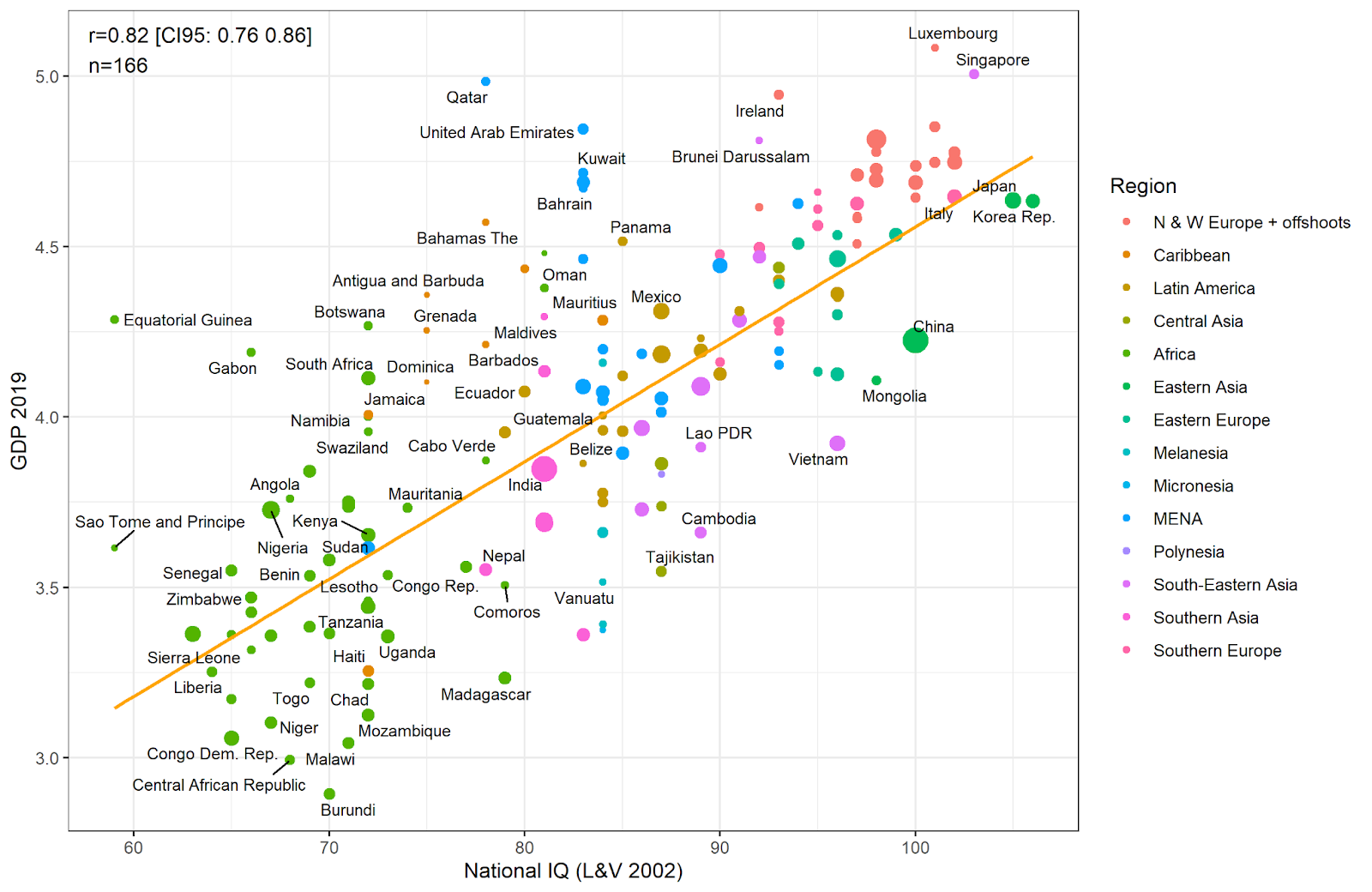
Kirkegaard have come out with a study that shows a strong correlation between
IQ and wealth creation. The higher the mean IQ, the more a nation can create
wealth:
We find national IQ to be the “best predictor” of economic growth, with
a higher average coefficient and average posterior inclusion probability than
all other tested variables (over 67) in every test run. Our best estimates find
a one point increase in IQ is associated with a 7.8% increase in GDP per capita
(Francis and Kirkegaard 2022)
The study is essentially an
update of an earlier one by Richard Lynn and Tatu Vanhanen (2002). It’s better
done, and I agree more or less with the conclusion. Wealth is not created in a
vacuum. It’s created by flesh-and-blood humans who possess certain mental and
behavioral attributes, one of which is high cognitive ability.
I do, however, have two
criticisms.
Criticism #1: On a societal level, cognitive ability is confounded with
other mental and behavioral attributes
Yes, high cognitive ability is
important. But sustainable creation of wealth also requires other mental and
behavioral attributes, notably:
·
propensity to
identify social rules, obey them, and enforce them on others
·
feelings of guilt
when one breaks the rules, even when there are no witnesses
·
empathy for others
and a desire to understand how one’s behavior affects them
·
inhibition against
using violence to settle disputes
·
high degree of
future time orientation (also known as low time preference)
High IQ + high trust + low
violence + low time preference = sustainable creation of wealth (Clark 2007;
Clark 2009a; Clark 2009b; Frost 2020). Some will argue that intelligence goes
hand in hand with high trust and low time preference (Carl 2014; Kirkegaard and
Karlin 2020). That is true on a societal level: the same selection pressures
that favor high intelligence usually favor the entire mental and behavioral package.
On an individual level, however, intelligent sociopaths do exist, and they can prosper
while others suffer. If they become too numerous or too influential, they will
eventually destroy their host society. But that can take time.
In all fairness, Francis and
Kirkegaard did investigate social trust and time preference. Unfortunately, those
attributes are confounded with IQ: successful societies tend to have people who
are not only intelligent but also trustworthy and future-oriented. That’s survivorship
bias: if a society lacks the full mental and behavioral package, it usually
goes extinct, and extinct societies get overlooked by cross-national studies. To
be precise, societal extinction happens when the intelligent are unrestrained in
their contempt for the less intelligent in their midst; they thus prey on them
by any means possible, and the resulting strife leads to societal collapse.
IQ, social trust, and time
preference are normally confounded with each other, at least in most existing
societies. Therefore, if you control for IQ, the other two variables will go
away, and you’ll think: “Aha! The key variable must be IQ!”
And you’ll feel all the more
certain because IQ is not just equal to social trust or time preference in
predicting wealth creation. It’s actually better! That greater predictive
power, however, has a simple explanation: measurement of IQ is based on less
subjective data. In this study, social trust is measured by self-report, and
time preference is measured by an amalgam of survey responses and credit risk.
Criticism #2: The correlation is driven largely by unreliable African
data
This study has another weak
point: the correlation between wealth creation and IQ is driven largely by
economic and cognitive data from Africa. If you remove Africa from the chart,
the correlation becomes a lot weaker.
How reliable is the African
data? Not very. First, a lot of African economic activity is “off the books.”
That is particularly true for subsistence farming in the countryside, but it’s
also true for many businesses in the towns and cities. GDP thus tends to be
underestimated.
Second, even HBD writers
disagree among themselves on mean African IQ, as pointed out by Heiner
Rindermann:
The [cognitive] ability levels for Africans in Africa are the subject of
strong disagreement. Rushton studied positively selected samples (South African
university engineering students; Rushton, Skuy, & Fridjhon, 2003), but the
mean differences between Africans and Europeans (14 IQ points) were similar to
the ones found in Western countries. Lynn and Vanhanen (2006) estimated that
sub-Saharan African countries had a mean IQ of 70. Wicherts, Dolan, and Maas
(2010) using a different selection procedure came to a mean IQ of 82.
Rindermann’s “best guess” is
75. He concludes: “Given the quality of the data, it is not possible to come to
a really precise result” (Rindermann 2013, p. 3). If we look at the chart from
Lynn and Vanhanen (2002), we see that most sub-Saharan African countries are
assigned mean IQs lower than 75. In fact, 75 seems to be the upper limit.
That’s the IQ dataset of the new study.
Francis and Kirkegaard (2022,
pp. 22-23) are aware that the IQ/GDP correlation is a lot weaker without the
African IQ data, and they defend the validity of that dataset at some length.
I’m still unimpressed, for two reasons:
·
If mean African IQ
is 70, one must conclude that Africans are much less intelligent than African
Americans, whose mean IQ is usually estimated at 85. Such a large difference
cannot be explained by European admixture, heterosis, or nutrition.
·
The Yoruba of
Nigeria have about the same polygenic score as that of African Americans
(Piffer 2021, Fig. 7). Their mean IQ should therefore be 85. Yet, according to
Lynn and Vanhanen, Nigerians have a mean IQ of 67. Since Nigeria is 18% Igbo,
and since the Igbo show high academic achievement, mean Yoruba IQ should therefore
be much less than the presumed Nigerian average of 67 (Chisala 2015; Frost
2022). The numbers don’t seem to add up.
Please don’t get me wrong. I
agree that mean IQ is lower in Africa than in Eurasia, but the Lynn and
Vanhanen estimates seem too low. In any case, they are not widely accepted even
by researchers who accept that cognitive ability varies among human
populations.
Similarly, I agree that more
wealth is created per capita in Eurasia than in Africa. The difference,
however, is overstated because so much of African GDP goes unreported. Furthermore,
I don’t believe that lower IQ largely explains Africa’s economic
underperformance. There is also the excessive use of violence to achieve one’s goals,
both by the State and by private individuals. There is also the low level of
trust that people have in each other—for the most part, Africans trust only
their immediate family and friends. Finally, because family ties are so
important, nepotism is widespread, and successful entrepreneurs end up being
plundered by greedy relatives. The market economy cannot realize its full
potential because the logic of the market has to compete with the logic of
kinship.
Edit: George Francis has informed me that the correlation between IQ and GNP
per capita remains unchanged if African cognitive and economic data are excluded.
Without the African data, GDP per capita would increase 7.7% with each one point
increase in IQ, rather than 7.8%.
Conclusion
Cognitive ability is only one
of several mental and behavioral attributes that are key to building successful
economies and societies. If we focus on it to the exclusion of others, we will
be talked into supporting policies that have unintended consequences. A good
example is the idea of reorienting immigration policy toward recruitment of
high-IQ individuals.
That idea has the support of
many conservatives throughout the West, but the consequences are very
un-conservative. In short, we would be selecting immigrants who excel at
creating wealth for themselves, by hook or by crook. The eventual result: an
elite of rich narcissists who feel little sympathy for common people and who
see them as objects to be used, when useful, and thrown away, when not.
Please don’t get bamboozled by
reassurances that IQ correlates with trustworthiness and low time preference.
That’s true only at the societal level. Those three attributes align with each
other because they have to: otherwise, society would become dysfunctional and
collapse. That’s survivorship bias: we get data from societies that have
survived, and not from those that haven’t. If we cherry-pick high IQ immigrants
from all over the world, we will create a new kind of society that has not
stood the test of time.
Actually, that kind of society
has arisen in the past:
And you should know that all the Cathayans [Chinese] detested the Grand
Khan's rule because he set over them governors who were Tartars, or still more
frequently Saracens, and these they could not endure, for they were treated by
them just like slaves. You see the Great Khan had not succeeded to the dominion
of Cathay [China] by hereditary right, but held it by conquest; and thus having
no confidence in the natives, he put all authority into the hands of Tartars,
Saracens, or Christians who were attached to his household and devoted to his
service, and were foreigners in Cathay [China].
The Travels of
Marco Polo, Book 2, Chapter 23
Why do you think revolutions
happen? It was precisely to avoid such a prospect that elite schools sought to
develop not only intellect but also character, including the idea that the
powerful have a duty to rule wisely and fairly. That view of higher education
has given way to “meritocracy” throughout the West, with results that could
have been predicted.
References
Carl, N. (2014). Does
intelligence explain the association between generalized trust and economic
development? Intelligence 47: 83-92. https://doi.org/10.1016/j.intell.2014.08.008
Chisala, C. (2015). The IQ gap
is no longer a black and white issue. The
Unz Review, June 25. http://www.unz.com/article/the-iq-gap-is-no-longer-a-black-and-white-issue/
Clark, G. (2007). A Farewell to Alms. A Brief Economic History
of the World. Princeton University Press: Princeton and Oxford.
Clark, G. (2009a). The indicted and the wealthy: surnames,
reproductive success, genetic selection and social class in pre-industrial
England.
http://www.econ.ucdavis.edu/faculty/gclark/Farewell%20to%20Alms/Clark%20-Surnames.pdf
Clark, G. (2009b). The
domestication of man: The social implications of Darwin. ArtefaCTos 2: 64-80.
Francis, G., and E.O.W.
Kirkegaard. (2022). National Intelligence and Economic Growth: A Bayesian
Update. The Mankind Quarterly 63(1). http://dx.doi.org/10.46469/mq.2022.63.1.2
Frost, P. (2020). The large
society problem in Northwest Europe and East Asia. Advances in Anthropology 10(3): 214-134. https://doi.org/10.4236/aa.2020.103012
Frost, P. (2022). Recent
cognitive evolution in West Africa: the Niger’s role. Evo and Proud, April 30. https://evoandproud.blogspot.com/2022/04/recent-cognitive-evolution-in-west.html
Kirkegaard, E.O.W., and A.
Karlin. (2020). National intelligence is more important for explaining country
well-being than time preference and other measured non-cognitive traits. Mankind Quarterly 61: 339-370. http://doi.org/10.46469/mq.2020.61.2.11
Lynn, R. and T. Vanhanen.
(2002). IQ and the Wealth of Nations.
Westport, Conn: Praeger
Piffer, D. (2021). Divergent
selection on height and cognitive ability: evidence from Fst and polygenic
scores. OpenPsych https://openpsych.net/files/submissions/14_Divergent_selection_on_height_and_cognitive_ability_evidence_from_Fst_and_13c3ICJ.pdf
Rindermann, H. (2013). African
cognitive ability: Research, results, divergences and recommendations. Personality and Individual Differences 55:
229-233. https://doi.org/10.1016/j.paid.2012.06.022


