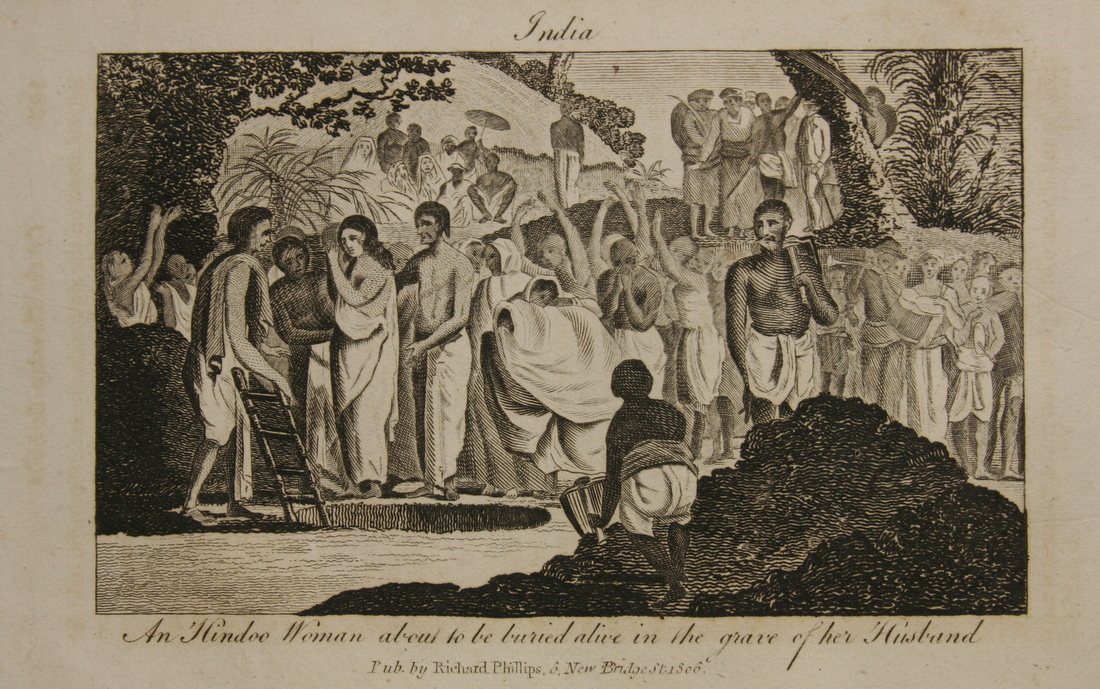
A
widow about to be buried alive in her husband's grave (Wikimedia Commons). Do
we all share the same sense of right and wrong?
What,
ultimately, is the basis for morality? In a comment on a previous post, fellow
columnist Fred Reed argued that some things are self-evidently wrong, like
torture and murder. No need to invoke the Ten Commandments or any religious
tradition. Some things are just wrong. Period.
This
is a respectable idea with a long lineage. It's the argument of Natural Law.
All people are born with a natural sense of right and wrong, and it is only
later, through vice or degeneration, that some can no longer correctly tell the
two apart.
The
idea began with the Stoics of Ancient Greece. They believed that the universe
is governed by laws and that everyone naturally wishes to live in harmony with
them, thanks to the divine spark that exists in all of us. In reply, the
Epicureans argued that the laws of the universe are indifferent to humans and
their problems. We alone define right and wrong.
The
Christian theologian Thomas Aquinas (1225-1274) worked out a compromise that
divided Natural Law into general precepts and secondary precepts. The former
are known to all men but can be hindered "on account of concupiscence or
some other passion." The latter "can be blotted out from the human
heart, either by evil persuasions [..] or by vicious customs and corrupt
habits, as among some men, theft, and even unnatural vices, as the Apostle
states (Rom. i), were not esteemed sinful" (Aquinas, Summa Theologica I-II, Q. 94, Art. 6).
Aquinas
lived at a time when Christian morality had already penetrated deeply into the
hearts and minds of Europeans. It was continually being violated, of course,
but violators typically knew they had done wrong and they typically tried to
justify their wrongdoings on Christian grounds, or seek absolution. Aquinian
Natural Law thus closely approximated moral reality, much as Newtonian physics
would long remain a good approximation of physical reality.
Things
changed from the 16th century on, as Christian Europe spread outward into
Africa, Asia, and the Americas. It became evident that notions of right and
wrong were not everywhere the same, or even similar. One example was sati, the Indian custom of burning a widow alive on her husband's
funeral pyre. Though supposedly voluntary, it usually involved the tying of her
feet or legs to prevent escape. She could also be buried alive, as a 17th
century traveler noted:
In
most places upon the Coast of Coromandel, the Women are not burnt with their
deceas'd Husbands, but they are buried alive with them in holes which the
Bramins make a foot deeper than the tallness of the man and woman. Usually they
chuse a Sandy place; so that when the man and woman both let down together, all
the Company with Baskets of Sand fill up the hole about half a foot higher than
the surface of the ground, after which they jump and dance upon it, till they
believe the woman to be stiff'd. (Tavernier, 1678, p. 171; see also Sati, 2014)
When
the British sought to ban the practice, they appealed to notions of right and
wrong, but to no avail. Defenders of sati
considered it right and even honorable. The debate was finally resolved by the
logic of force, as set forth by the British commander-in-chief:
This
burning of widows is your custom; prepare the funeral pile. But my nation has
also a custom. When men burn women alive we hang them, and confiscate all their
property. My carpenters shall therefore erect gibbets on which to hang all
concerned when the widow is consumed. Let us all act according to national
customs! (Napier, 1851, p. 35)
Enlightenment
thinkers attributed this custom and others like it to degeneration from an
original state of goodness. Thus was born the idea of the Noble Savage. Yet
this idea, too, came under attack with the realization that even simple
"uncorrupted" societies may have very different attitudes toward
human life, as seen in the torturing of captives, the abandonment of weak or
deformed children, and the killing of old men and women:
The
problems posed by limited resources and old peoples' dependence are sometimes
resolved in an extreme way: killing, abandoning, or exposure of the elderly—what
anthropologists call gerontocide. Cross-cultural studies show that such
treatment is more common than we might suppose. Maxell and Silverman found
evidence of gerontocide in a little over 20% of 95 societies in a worldwide
sample (Silverman, 1987). Glascock uncovered abandonment of the elderly in 9 of
the 41 nonindustrial societies in his sample—and reports of killing old people
in 14 of these societies. (Bengtson and Achenbaum, 1993, p. 110)
This
kind of thing may seem unfortunate but justifiable among nomads. Sometimes, the
elderly just have to be left behind. But we also see elder abandonment in
sedentary peoples, like the Hopi of the American southwest:
As
long as aged men controlled property rights, held special ceremonial offices,
or were powerful medicine men, they were respected. But "the feebler and
more useless they become, the more relatives grab what they have, neglect them,
and sometimes harshly scold them, even permitting children to play rude jokes
on them." Sons might refuse to support their fathers, telling them,
"You had your day, you are going to die pretty soon." (Bengtson and
Achenbaum, 1993, pp. 108-109)
Whenever
such accounts come up at anthropological conferences, there is a certain
malaise. Some will blame European contact for the devaluing of human life.
Others, however, will present similar facts that often predate the coming of
traders or missionaries. I remember one speaker who presented evidence of
cannibalism at an Inuit site. This wasn't an isolated case, such as might
happen in extreme circumstances of starvation. There seemed to be an
accumulation of human bones, of Indian origin, with cut marks on them. The
findings were later published:
The
remains of at least 35 individuals (women, children, and the elderly) were
recovered from the Saunaktuk site (NgTn-1) in the Eskimo Lakes region of the
Northwest Territories. Recent interpretations in the Arctic have suggested a
mortuary custom resulting in dismemberment, defleshing, chopping, long bone
splitting, and scattering of human remains. On the evidence from the Saunaktuk
site, we reject this hypothesis. The Saunaktuk remains exhibit five forms of violent
trauma indicating torture, mutilation, murder, and cannibalism. Apparently
these people were the victims of long-standing animosity between Inuit and
Amerindian groups in the Canadian Arctic. (Melbye and Fairgrieve, 1994)
When
I talked with the speaker after his presentation, he seemed apprehensive. How
would people react?
He
needn't have worried. The noble savage is still alive and well. Strangely
enough, this kind of thinking has seeped even into the missionary mindset, as I
discovered during my last few years at the United Church of Canada. I was
surprised to learn just how little our mission work involved teaching of Christian
morality:
"Do
you talk to these people about the Christian faith?"
"Not
unless they specifically request it.""Do you at least have Christian literature on display?"
"No, we're not allowed to do that."
Things
aren't much better in the fundamentalist churches. I remember attending a
Pentecostal presentation on "the cause of Third World Poverty." I
thought the talk would focus on cultural values. Instead, we were told that the
cause is ... lack of infrastructure. The Third World is poor because it doesn't
have enough roads, bridges, and buildings.
The
modern world has bought so much into the argument of Natural Law that the entire
Christian enterprise now looks like a waste of time. There was no need for
missionaries to fight barbaric customs, since there were no barbaric customs to
be fought. All of that was one big misunderstanding. Christian mission work is
now limited to good works, apparently in the belief that all humans share the
same moral framework and that it's enough to set a good example. If you act
nice, other people will get the message and likewise act nice.
A hazardous
assumption
Christianity
has been killed by its success. It has so thoroughly imposed its norms of
behavior that we now assume them to be human nature. If some people act
contrary to those norms, it's because they're "sick" or
"deprived." Or perhaps something is misleading us and they're really
acting just like everyone else.
For
two millennia, the Christian faith has profoundly shaped the culture of
European peoples, allowing very little to escape its imprint. This is
especially so in attitudes toward the taking of life. Beginning in the 11th century,
the Church allied itself with the State to punish murder, which previously had
been a private matter to be settled through revenge or compensation. At the
height of this war on murder, between 0.5 and 1.0 % of all men of each
generation were sentenced to death, and a comparable proportion of offenders
died at the scene of the crime or in prison while awaiting trial. Meanwhile,
homicide rates plummeted from between 20 and 40 per 100,000 in the late Middle
Ages to between 0.5 and 1.0 in the mid-20th century (Eisner, 2001). The pool of
violent men dried up until most murders occurred under conditions of jealousy,
intoxication, or extreme stress. Yes, people got the message to act nice, but
the message was not delivered nicely.
By
pacifying social relations, Church and State also created a culture that
rewarded men who got ahead through trade and hard work, rather than through
force and plunder. It became easier to plan for the future and develop what
came to be known as middle-class values: thrift, sobriety, and self-control.
Popular tastes changed accordingly, as seen in the decline of cock fighting,
bear and bull baiting, and other blood sports (Clark, 2007; Clark, 2009a;
Clark, 2009b).
Were
these changes in behavior purely cultural? Or was there also a steady removal
of violent predispositions from the gene pool? It's only now that a few
scholars are beginning to ask such questions, let alone answer them.
Towards a new
perspective ...
The
idea of Natural Law is true up to a point. All humans have to face certain
common problems that have to be solved in more or less the same way. Kinship,
for instance, matters in all human societies, at least traditional ones.
Marriage and family are likewise universal.
But
even these "universals" vary a lot. There are many kinds of kinship
systems, including some with relatively weak kinship and a correspondingly
stronger sense of individualism. Mating systems likewise vary a lot. Monogamy
makes sense in non-tropical societies where the mother cannot feed her children
by herself, particularly in winter. It makes less sense where the mother can
provide for her children with minimal assistance.
Human
societies similarly differ in their treatment of murder. There is a general
tendency to limit the taking of human life, but the variability is
considerable. In some societies, murder is so rare that instances of it are
thought to be pathological. The murderer is said to be "sick." In
other societies, every adult male has the right to use violence to settle
personal disputes, even to the point of killing. If he abdicates that right,
he's no longer a real man.
The
same "problem" will thus be solved in different ways in different
places. Over time, each society will develop a "solution" that favors
the survival and reproduction of certain people with a certain personality type
and certain predispositions. So there is no single human nature, any more than
a single Natural Law. Instead, there are many human natures with varying
degrees of overlap.
... and the
take-home message?
While
certain notions of right and wrong can apply to all humans, much of what we
call "morality" will always be population-dependent. What is moral in
one population may not be in another.
Take
public nudity, particularly of the female kind. This is less of a problem in
places like Finland where polygyny is rare and sexual rivalry among men less
intense. It's more of a problem where the polygyny rate is higher but men still
have to invest a lot in their offspring. In such a setting, men will be more
jealous, more fearful of cuckoldry, and more insistent on measures to ensure
exclusive sexual access. Such insistence can lead to extreme practices like sati. More generally, it leads to
demands for modesty in female dress.
This
is not to condone the dress codes that prevail in some countries, but we should
try to understand the circumstances that give rise to them. Above all, there
are limits to what we can impose on other societies. While sati has no justification anywhere on this planet, there may be
practices that are warranted in some societies but not in others.
References
Aquinas,
T. (1265-1274). Summa Theologica,
Part I-II (Pars Prima Secundae) From the Complete American Edition, Translated
by Fathers of the English Dominican Province, Project Gutenberg
http://www.gutenberg.org/cache/epub/17897/pg17897.html
Bengtson,
V.L. and W.A. Achenbaum. (1993).The
Changing Contract across Generations, Transaction publ.
Clark,
G. (2007). A Farewell to Alms. A Brief
Economic History of the World, Princeton: Princeton University Press.
Clark,
G. (2009a). The indicted and the wealthy: Surnames, reproductive success,
genetic selection and social class in pre-industrial England.
http://www.econ.ucdavis.edu/faculty/gclark/Farewell%20to%20Alms/Clark%20-Surnames.pdf
Clark,
G. (2009b). The domestication of man: The social implications of Darwin. ArtefaCTos, 2, 64-80.
http://campus.usal.es/~revistas_trabajo/index.php/artefactos/article/viewFile/5427/5465
Eisner,
M. (2001). Modernization, self-control and lethal violence. The long-term
dynamics of European homicide rates in theoretical perspective, British Journal of Criminology, 41, 618-638.
http://bjc.oxfordjournals.org/content/41/4/618.short
Melbye,
J. and S.I. Fairgrieve. (1994). A massacre and possible cannibalism in the
Canadian Arctic: New evidence from the Saunaktuk site (NgTn-1), Arctic Anthropology, 31, 57-77.
http://www.jstor.org/discover/10.2307/40316364?uid=3739448&uid=2&uid=3737720&uid=4&sid=21104564497747
Napier,
W. (1851). The History of General Sir
Charles Napier's Administration of Scinde: And Campaign in the Cutchee Hills,
London: Charles Westerton.
Sati
(practice). (2014). Wikipedia
http://en.wikipedia.org/wiki/Sati_(practice)
Tavernier,
J-B. (1678).The six voyages of John
Baptista Tavernier, London: R.L. and M.P.


