Showing posts with label antiquity. Show all posts

Tuesday, November 1, 2022

Looking beyond the data


General intelligence (g factor) as a function of alleles associated with educational attainment (Education polygenic score). (Fuerst et al. 2021, p. 165)


Among non-Hispanic European Americans, cognitive ability shows a positive correlation with Amerindian admixture. The reason is to be found in the history of European settlement.


We know that cognitive ability differs among human populations, but are those differences innate? Or are they purely cultural? The question is difficult to answer because a purely cultural difference can, over time, become innate. If you are better able to meet the demands of your culture, you will probably live longer, have more offspring, and pass on many of your characteristics. Thus, over succeeding generations, those heritable characteristics will become more and more widespread in the gene pool, and they will increasingly determine certain abilities that were initially created by culture.


This is a recurring problem when we try to distinguish between cultural and genetic determination. The two often run parallel to each other, and we can seemingly rule out the existence of genetic determination by showing that cultural determination runs in the same direction.


But there is another recurring problem in our efforts to distinguish between culture and genetics. We lack the proper tools. For a long time, we could only infer genetic influences by using twin studies or adoption studies. 


Things have changed with the advent of a new tool: genomic data. Specifically, we can now:


·         Measure ethnic ancestry in mixed populations, as opposed to using self-report or inferring from skin color.

·         Measure the genetic component of cognitive ability, by using genetic variants associated with educational attainment. Although these variants explain only 11-13% of the variance in educational attainment among individuals, they explain a much higher percentage of the variance among populations (Piffer 2019). This is because genetic variants within the same population are exposed to the same pressure of selection and will thus vary in the same direction. They act, so to speak, as “weathervanes” that tell us the strength and direction of selection in that population.

·         Measure skin color, by looking at the relevant genes. We can thus control for the effects of “colorism” in mixed populations, i.e., discrimination in favor of lighter-skinned individuals.


In my last post, I described how Bryan Pesta used these tools to understand differences in mean cognitive ability between African Americans and European Americans (Lasker et al. 2019). To that end, his research team looked at cognitive ability among African Americans in relation to European admixture and in relation to genetic variants associated with educational attainment.


They made several findings: 1) among African Americans, cognitive ability correlates with European admixture; 2) the correlation is modestly reduced, but not eliminated, when controlled for parental education; 3) controlling for skin color has no effect; and 4) the correlation seems to be largely explained by genetic variants associated with educational attainment.


The same data source was then used by Fuerst et al. (2021) to investigate cognitive ability not only in European Americans and African Americans but also in Hispanic Americans. The research team thus looked at cognitive ability in relation to Amerindian admixture, and not just in relation to European and African admixture.


Most of their findings are similar to those of the first study:


·         Among Hispanic Americans, cognitive ability shows a positive correlation with European admixture and a negative correlation with African admixture and Amerindian admixture.

·         Among Hispanic Americans, the correlations are reduced but not eliminated by controlling for parental education. Controlling for skin color has no effect.

·         The above correlations are partially explained by variants associated with educational attainment, but not by skin color.

·         Among non-Hispanic European Americans, cognitive ability shows a positive correlation with Amerindian admixture.


The last correlation may seem curious. Keep in mind that the data came from residents of Pittsburgh and that the native peoples of the Eastern U.S. intermixed mostly with early settlers of British, Dutch, or French origin. There is much less Amerindian admixture among the descendants of later immigrants from southern and eastern Europe. The correlation may thus be due not to Amerindian admixture per se but rather to variation in cognitive ability among Europeans.


Until the eleventh century, mean IQ was relatively low throughout Europe, perhaps hovering in the low 90s. It then rose during late medieval and post-medieval times through the expansion of the middle class. There was in fact a broad mental and behavioral change: "Thrift, prudence, negotiation, and hard work were becoming values for communities that previously had been spendthrift, impulsive, violent, and leisure loving" (Clark 2007, p. 166; see also Clark 2007, 2009a, 2009b). More people could better understand probability, cause and effect, and another person’s perspective, whether real or hypothetical (Rinderman 2018, pp. 49, 86-87; Oesterdiekhoff 2012). As the "smart fraction" grew in size, a point was reached when intellectuals were no longer voices crying in the wilderness. They were now numerous enough to form learned societies and collaborate in projects of various sorts (Frost 2019b, pp. 175-176).


Western Europe was where the middle class began to expand, and that was where the expansion would have its greatest impact, not only demographically but also behaviorally and cognitively. Gregory Clark (2009a) has shown that the English, even in the lower classes, are largely descended from people who were middle-class several generations earlier. The same is likely true elsewhere in Western Europe. We should therefore see a cognitive gradient between the Western European core and its periphery, as can indeed be seen between northern and southern Italy. When Piffer and Lynn (2022) looked at genomic data from that country, they found a north-south gradient in alleles associated with educational attainment. That difference corresponds to historical differences in economic development. By the 18th century, the South had already fallen behind the North; its middle class had remained small and economic relations were still structured by paternalism and familialism (De Rosa 1979).


All of that leads to an interesting corollary: the IQ gap used to be smaller between Europeans and sub-Saharan Africans. On the one hand, European mean IQ had probably remained in the low 90s until late medieval times. On the other hand, mean IQ may have been in the upper 80s among those Black African groups that Europeans had first encountered, particularly the Nubians. By the time of Classical Antiquity they had reached a high level of material culture, social complexity and State formation.


A smaller IQ gap would be in line with an observation by Jason Malloy. He noted that blacks were often described in the ancient world as having large penises but not as being less intelligent. Indeed, I have found only two Greco-Roman texts in which the writer disparaged Black Africans as being unintelligent. One of them is of doubtful authenticity, and both come from Late Antiquity (Frost 2019b). By then, blacks in the Roman world were increasingly slaves who came from farther within the African interior. Thereafter, a stereotype of low intelligence is regularly attested in Middle Eastern and European sources.


References


Clark, G. (2007). A Farewell to Alms. A Brief Economic History of the World. Princeton University Press: Princeton and Oxford.


Clark, G. (2009a). The indicted and the wealthy: surnames, reproductive success, genetic selection and social class in pre-industrial England.  http://www.econ.ucdavis.edu/faculty/gclark/Farewell%20to%20Alms/Clark%20-Surnames.pdf     


Clark, G. (2009b). The domestication of man: The social implications of Darwin. ArtefaCTos 2: 64-80. https://www.researchgate.net/publication/277275046_The_Domestication_of_Man_The_Social_Implications_of_Darwin


De Rosa, L. (1979). Property Rights, Institutional Change, and Economic Growth in Southern Italy in the XVIIIth and XIXth Centuries. Journal of European Economic History 8(3): 531-551.


Frost, P. (2019a). The Original Industrial Revolution. Did Cold Winters Select for Cognitive Ability? Psych 1(1): 166-181. https://doi.org/10.3390/psych1010012   


Frost, P. (2019b). Why that stereotype and not the other? Evo and Proud, July 28. https://evoandproud.blogspot.com/2019/07/why-that-stereotype-and-not-other.html


Frost, P. (2021). Commentary on Fuerst et al: Do Human Populations Differ in Their Mental Characteristics? Mankind Quarterly 62(2). http://doi.org/10.46469/mq.2021.62.2.9   


Fuerst, J., E.O.W. Kirkegaard and D. Piffer. (2021). More research needed: There is a robust causal vs. confounding problem for intelligence-associated polygenic scores in context to admixed American populations. Mankind Quarterly 62(1): 151-185. https://www.researchgate.net/profile/John-Fuerst/publication/354767141_More_Research_Needed_There_is_a_Robust_Causal_vs_Confounding_Problem_for_Intelligence-associated_Polygenic_Scores_in_Context_to_Admixed_American_Populations/links/614bc1dfa595d06017e4c017/More-Research-Needed-There-is-a-Robust-Causal-vs-Confounding-Problem-for-Intelligence-associated-Polygenic-Scores-in-Context-to-Admixed-American-Populations.pdf


Lasker, J., B.J. Pesta, J.G.R. Fuerst, and E.O.W. Kirkegaard. (2019). Global Ancestry and Cognitive Ability. Psych 1(1):431-459. https://doi.org/10.3390/psych1010034  


Oesterdiekhoff, G.W. (2012). Was pre-modern man a child? The quintessence of the psychometric and developmental approaches. Intelligence 40, 470–478. https://doi.org/10.1016/j.intell.2012.05.005


Piffer, D. (2019). Evidence for Recent Polygenic Selection on Educational Attainment and Intelligence Inferred from Gwas Hits: A Replication of Previous Findings Using Recent Data. Psych 1(1):55-75. https://doi.org/10.3390/psych1010005


Piffer, D., and R. Lynn. (2022). In Italy, North-South Differences in Student Performance Are Mirrored by Differences in Polygenic Scores for Educational Attainment. Mankind Quarterly 62(4), Article 2. https://doi.org/10.46469/mq.2022.62.4.2   


Rindermann, H. (2018). Cognitive Capitalism. Human Capital and the Wellbeing of Nations, 1st ed.; Cambridge University Press.
Saturday, August 8, 2015

In the eye of the ancient beholder


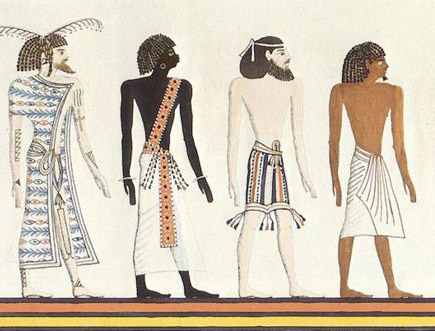
Egyptian painting of a Libyan, a Kushi, a Syrian, and an Egyptian.  In the Middle East, the Egyptians were seen as the Dark Other (Wikicommons)


Mention the term ‘skin color’ and people usually think of race or ethnicity. Yet this way of thinking became dominant only when Europeans began moving out and colonizing the rest of the world, beginning in the 16th century. Previously, physical features were less useful as ethnic markers. We knew about and quarrelled with those groups of people who lived within close range, and they tended to look a lot like us. People farther away looked more different, but we had less to do with them. Often, we didn’t even know they existed. So we separated "us" from "them” mainly on the basis of culture—language, religion, customs, and so on.

In those earlier times, skin color was used to distinguish among individuals of the same people and between the two sexes, women being paler and men ruddier and browner. A pale color also set infants apart, particularly in those societies where everyone else was much darker-skinned.

Skin color thus had meanings related to gender, age, or simply the identity of any one individual. This was true for all cultures. For example, in pre-Islamic writings from Arabia:

Human beings are frequently described by words which we might translate as black, white, red, olive, yellow, and two shades of brown, one lighter and one darker. These terms are usually used in a personal rather than an ethnic sense and would correspond to such words as "swarthy," "sallow," "blonde," or "ruddy" in our own modern usage more than to words like "black" and "white." (Lewis, 1990, p. 22)

Similarly, the Japanese would use the terms shiroi (white) and kuroi (black) to describe their gradations of skin color (Wagatsuma, 1967). The Igbo of precolonial Nigeria used ocha (white) and ojii (black) in the same way, so that nwoko ocha (white man) merely meant an African with a yellowish or reddish complexion (Ardener, 1954).

Jews of Antiquity

This older way of viewing skin color—personal, relativistic, and gender-oriented—has been studied by David Goldenberg with respect to the Jews of the ancient world.

The Jews considered their skin to be light brown. A second-century rabbi compared it to “the boxwood tree, neither black nor white, but in between" (Goldenberg, 2003, p. 95). In papyri from Ptolemaic Egypt, Jews are almost always described as "honey-colored" (Cohen, 1999, pp. 29-30).

Nonetheless, Jewish women were preferentially referred to as "white." This reflected the naturally lighter complexion of women, which was made lighter still by sun avoidance and various cosmetics. One rabbinic text advises, "He who wishes to whiten his daughter's complexion, let him give her milk and young fowl," while another recommends using olive oil as a body lotion for the same purpose. A Midrash recounts that after returning from exile in Babylon the men didn't wish to marry the women who came with them because the sun had darkened their faces on the long journey home (Goldenberg, 2003, p. 86). This preference is implicit in a rabbinic discussion of a vow "not to marry a particular woman who is ugly, but it turns out that the woman is beautiful; or black (dark; shehorah), but it turns out that she is white (fair; levanah); or short, but she is tall. Even if she was ugly, but became beautiful; or black, and became white" (Goldenberg, 2003, pp. 85-86).

"White" was also the preferred color of infants. According to a rabbinic tradition, if a woman was suspected of infidelity and found innocent, she would go through the following changes: "if she formerly bore ugly babies, she will now bear beautiful babies; if she formerly bore dark [shehorin] children, she will now bear fair [levanim] children" (Goldenberg, 2003, p. 96).

In the above cases, the terms "white" and "black" were projected onto individuals and onto the two sexes in a relative sense that is better translated by "light" and "dark." This relativism also held true when the same terms were projected onto ethnic groups. Hence, the Jews often called themselves "white" in relation to darker-skinned peoples, usually Egyptians or kushi (black Africans).

For example, in one parable a kushit maidservant claims she is the most beautiful of her household. Her matronah (a free woman of good family) replies: "Come the morning and we'll see who is black [shahor] and who is white [lavan]" (Goldenberg, 2003, p. 88). Interestingly, the Jews also considered themselves “white” in comparison to Arabs (Goldenberg,2003, pp. 120-124).

There was also the reverse semantic process: the description of an individual’s skin color by a word that originally applied to an ethnic group. A lighter-skinned Jew could for instance be called a germani, and a darker-skinned Jew a kushi. There are even cases of the word kushi being used for inanimate objects, like dark wine (Goldenberg, 2003, p. 116).

Whatever the case, use of color terms in an ethnic sense tended to carry over values from the non-ethnic sense, specifically the aesthetic ones associated with the lighter skin of women and infants. We see this in a commentary on Gen 12:11 where Abraham enters Egypt and, fearing that the Egyptians will covet his wife, says: "Now I know that you are a beautiful woman." This is explained in the commentary as meaning: "Now we are about to enter a place of ugly and dark [people]" (Goldenberg, 2003, p. 86).

The Egyptians were the Dark Other. Depreciation of their darker skin became associated with negative values, not only ugliness but also uncleanliness and servility. In rabbinic writings, Egypt is called "a house of slaves" and the Pharaoh himself is said to be a "slave." In one text, Jacob debates whether to go to Egypt: "Shall I go to an unclean land, among slaves, the children of Ham?" (Goldenberg, 2003, pp. 160-161). This view is preserved in a homily by the third-century Christian writer Origen: 

But Pharao easily reduced the Egyptian people to bondage to himself, nor is it written that he did this by force. For the Egyptians are prone to a degenerate life and quickly sink to every slavery of the vices. Look at the origin of the race and you will discover that their father Cham, who had laughed at his father's nakedness, deserved a judgment of this kind, that his son Chanaan should be a servant to his brothers, in which case the condition of bondage would prove the wickedness of his conduct. Not without merit, therefore, does the discolored posterity imitate the ignobility of the race.
Homily on Genesis XVI

Most academics argue that dark skin became mentally associated with slavery through the Atlantic slave trade of the 16th to 19th centuries. Others, like Bernard Lewis, believe this mental association goes back to the expansion of the Muslim world into Africa in the seventh century (Lewis, 1990). Actually, it seems to go even farther back, at least to the third century and perhaps even to the establishment of Roman rule over the region (Goldenberg, 2003, pp. 155-156, 168-174). From that time onward, a pigmentocracy took shape in Egypt with Greeks, Jews, and Romans forming the dominant class. Meanwhile, a trade in slaves grew and developed between sub-Saharan Africa and the Middle East. Once the Roman Empire had stopped growing, and stopped taking large numbers of prisoners of war, trade became the main source of domestic servants. It is perhaps significant that the kushit maidservant appears as a recurring motif in rabbinic literature, since that period—Late Antiquity—would correspond to the time when the black slave trade was slowly but steadily growing (Goldenberg, 2003, pp. 126-128). 

This trade may have undermined the status of Egyptians as the Dark Other. Initially, the kushi were often seen as an especially dark sort of Egyptian, perhaps because they were usually encountered in the Middle East as subjects of the Pharaoh (Goldenberg, 2003, pp. 17, 109, 301 n111). In Late Antiquity, they emerged more and more as a distinct category, probably because they were becoming more and more numerous as slaves, particularly in the eastern provinces of the Empire. It was during this time that their dark skin came to be explained as a curse on their forefather Kush, whose father Ham had sinned either by seeing Noah naked or by copulating in the Ark. In one text, Noah curses Ham with the words: "May your progeny be dark and ugly" (Goldenberg, 2003, p. 97). This is not a specifically Jewish tradition, being also attested in early Christian and early Islamic writings (Goldenberg, 2003, pp. 150-177).

Conclusion

We perceive human skin color by means of mental algorithms that originally processed non-ethnic differences in pigmentation: 1) the minor variability that exists among individuals; 2) the difference between infants (who are born with little pigmentation) and older humans; and 3) the sex difference, female skin being paler than male skin because it has less melanisation and less blood flowing through its outer layers. This is a universal sex difference, although it is most visible in humans of medium color (Frost, 2007).

Initially, these algorithms focused on the second source of variability. At some point in evolution, human skin acquired a new meaning when the adult female body began to mimic the relative lightness of infant skin, as well as other visible, audible, and tangible aspects of infants—smoother, more pliable skin, a higher-pitched voice, and a more childlike face. This mimicry arose apparently as a means to provide the adult female with the psychological effects that these traits induce in other adults, particularly males, i.e., a lower level of aggressiveness and a greater desire to provide care and nurturance (Frost, 2011).

After being a sign of age difference and then gender difference, skin color took on a third meaning within historic times—to varying degrees in Antiquity and then overwhelmingly with the expansion of the European world from the sixteenth century onward. Today, this new meaning has eclipsed the older ones, at least at the level of conscious thought.

References 

Ardener, E.W. (1954). Some Ibo attitudes to skin pigmentation, Man, 54, 71-73.
http://www.jstor.org/stable/2793760?seq=1#page_scan_tab_contents

Cohen, S.J.D. (1999). The Beginnings of Jewishness, Berkeley. 

Frost, P. (2007). Comment on Human skin-color sexual dimorphism: A test of the sexual selection hypothesis, American Journal of Physical Anthropology, 133, 779-781.
http://www.researchgate.net/publication/6480611_Human_skin-color_sexual_dimorphism_A_test_of_the_sexual_selection_hypothesis  

Frost, P. (2011). Hue and luminosity of human skin: a visual cue for gender recognition and other mental tasks, Human Ethology Bulletin, 26(2), 25-34.
http://www.researchgate.net/publication/256296588_Hue_and_luminosity_of_human_skin_a_visual_cue_for_gender_recognition_and_other_mental_tasks/file/72e7e5223eb2c3eb3b.pdf

Goldenberg, D.M. (2003). The Curse of Ham. Race and Slavery in Early Judaism, Christianity, and Islam, Princeton: Princeton University Press.

Goldenberg, D.M. (2009). Racism, Color Symbolism, and Color Prejudice, in M. Eliav-Feldon, B. Isaac, and J. Ziegler (eds.) The Origins of Racism in the West, Cambridge.
http://www.researchgate.net/profile/David_Goldenberg2/publication/263161501_Racism_Color_Symbolism_and_Color_Prejudice/links/00b7d53a09ef919429000000.pdf 

Lewis, B. (1990). Race and Slavery in the Middle East, Oxford: Oxford University Press.

Origen (2010). Homilies on Genesis and Exodus, transl. by R.E. Heine., Washington D.C.: Catholic University of America Press
https://books.google.ca/books?id=X_mSBavPcq4C&pg=PA214&source=gbs_toc_r&cad=2#v=onepage&q&f=false  

Wagatsuma, H. (1967). The social perception of skin color in Japan, Daedalus, 96, 407-443.
http://www.jstor.org/stable/20027045?seq=1#page_scan_tab_contents  

Thursday, January 14, 2010

Are empires bad for your health?

Do empires provide a higher standard of living? In theory, this might seem so. Empires allow goods, capital, and labor to circulate within a much larger land area, thus creating economies of scale and matching supply and demand more efficiently. Empires can also build public works—roads, canals, aqueducts, etc.—that are beyond the reach of smaller territorial entities.

This is still the view in much scholarly writing on the Roman Empire. Yet it is inconsistent with what physical anthropologists are discovering through analysis of skeletal remains. The latest of these studies concerns child burials from 3rd to 5th century Roman Dorchester, in southern England. The children show high levels of malnutrition and trauma: 38.5% had cribra orbitalia—a sign of iron or vitamin B12 deficiency; 12.5% had rickets—a sign of vitamin D deficiency; 4.8% had scurvy—a sign of vitamin C deficiency; and 5.4% had broken ribs (Lewis, 2010).

These rates are much higher than those for medieval England and point to a very poor diet. The incidence of rickets is interesting, since we see a similar high prevalence in industrial England (18th – early 20th centuries). The latter rickets epidemic is usually attributed to industrial smog that blocked UVB radiation and thus impaired vitamin-D synthesis in the skin. A likelier culprit is a diet made up almost wholly of bread, whose high content of phytic acid increases vitamin-D requirements by binding to calcium and phosphorus in the body, thus making these elements unusable (Lindeberg, 1997). This is also probably the cause of Roman-era rickets.

Lewis (2010) cites similar findings from other Roman sites:

Many questions remain about what impact the introduction of urban centers and the gradual economic decline at the end of the Roman Empire had on the local population. Some Roman scholars argue that “Romanization” brought about improvements to the health of the people (Mattingly, 2006, p. 323), with the writing of Roman architects such as Vitruvius conjuring up images of planned Roman cities, with marbled surfaces and flowing water, providing extensive facilities for the comfort and health of the inhabitants (Morley, 2005). Diametrically opposed is the argument that urbanization widened the divide between the rich and the poor, with many suffering hardships of poverty, social unrest, and subservience to the conquering population. The city of Rome itself is seen as overcrowded and filthy, with dogs and muggers prowling the streets, whereas the archaeological evidence calls into question the organization of the water supply and levels of sanitation, with latrines discovered near kitchen areas (Laurence, 1997; Morley, 2005). Garnsey (1999) has hypothesized that undernutrition was endemic in the urban communities of the Greco-Roman world …

Although the Roman Empire brought about an increase in economic wealth, much of this increase seems to have been either siphoned off by the elite or consumed by the large standing army. There is very little evidence that the average citizens were better off under imperial rule, and much suggests that they were worse off.

Why? One reason may be ‘diseconomies of scale.’ Empires tend to liquidate smaller communal entities that more efficiently deliver collective goods, such as community policing, high-trust social networks (for exchange of services and sharing of scarce goods), and support for family formation and child care. This is particularly evident in the Roman Empire’s high infantile mortality rate and low birth rate, with the result that natural increase became negative in late imperial times.

These smaller communal entities were liquidated by the tendency of individuals to migrate from one part of the Empire to another, either on their own or through resettlement of legionnaire veterans. This process of liquidation was also assisted by the State itself, which saw private collectivities as sources of conspiracy or rebellion. In fact, only a limited number of non-State associations were allowed, such as guilds, burial clubs, and officially recognized religions. The persecution of Christians was part of this tendency to see smaller collectivities as threats to the Empire.

Many of us, living in countries where for several centuries we have had fair liberty of association, may not realize just how recent such freedom is but realize that a civilization in which states fear their own citizens is one that recognizes its own inhumanity. Thus it cannot surprise us that in Antiquity most noncommercial associations were forbidden: the authorities realized that any social club might be a center for opposition to the régime. (source)

Empires also make life worse for the average person by fostering dependence on long-distance economic relationships that may collapse if one link in the supply chain disappears. When barbarian invasion disrupted grain shipments between North Africa and Italy in the 5th century, urban populations were suddenly without food. In general, empires create relationships between people who have no commitment to each other beyond short-term economic interest. When a crisis happens, these same people will give priority to their kinfolk … thus leaving in the cold any atomized individuals with no kinship networks to fall back on. When the Roman Empire collapsed, the latter were the ones who suffered the most.

References

Lewis, M.E. (2010). Life and death in a civitas capital: metabolic disease and trauma in the children from late Roman Dorchester, Dorset, American Journal of Physical Anthropology, early view.

Lindeberg, S. (1997), Cereal grains, Paleolithic Diet Symposium List, http://www.paleodiet.com/phytic.txt

Thursday, August 13, 2009

Was Christianity responsible?

There is a thread of thought going back to antiquity and revived by Nietzsche that blames Christianity for the fall of the Roman Empire. Christ and his followers are thus held responsible for replacing pagan virtues with ‘slave values’ of submission and pacifism.

In reality, and long before the triumph of Christianity, it was pagan Rome that strove to pacify its subjects and make them submissive. This was a deliberate and longstanding policy:


By humanitas the Romans meant two things: the adoption of the customs and the value system of the Roman people and material prosperity. The first was to be achieved by pacification, subjugation, and ‘Romanization’; the second was provided under the umbrella of the Pax Romana. By pacifying unruly elements, the Pax Romana allowed for their integration into civilization itself: it promised urbanization, cultural refinement, and in some instances, even enfranchisement. (Parchami, 2009, p. 28)

The Pax Romana did not mean peace with rival empires. Nor did it really mean peace within the empire. Indeed, it meant regular use of State violence—to quash revolts by slaves and the newly conquered and to protect life and property from brigands, bandits, pirates, and the like. Violence had become a state monopoly and anyone who transgressed this monopoly became an enemy of the State.

This ‘peace’ impressed Aristides, a 2nd-century pagan philosopher: “Now total security, universal and clear to all, has been given to the earth itself and those who inhabit it” (Parchami, 2009, p. 33). The Pax Romana didn’t simply benefit the elites by eliminating potential rivals. It benefited everyone by creating a more productive economy:


This security protected people—both their physical selves and their property—from external attack. Furthermore, the reduction of piracy and banditry meant more safety for travelers and for trade and commerce than at any previous time. Last, but not least, Roman rule prevented the eruption, into military conflict, of century-old disputes between the various provinces, or between disparate communities within a single province. (Parchami, 2009, p. 33)

These benefits came at the cost of a social contradiction. Although the use of violence was forbidden to the general population, it remained legitimate and even noble as a State prerogative. Initially, this situation seemed normal to everyone. It certainly served the purpose of the ruling elites, particularly during the early years of empire when their subjects were mostly ‘objects’—i.e., the spoils of recent conquests. Nor did the general population see anything unusual. After all, the Gods themselves behaved likewise.

In time, however, this contradiction lost its legitimacy. First, the conquered were assimilated into Roman society. Many became citizens and, as such, enjoyed certain rights and protections. Second, the State no longer had to use violence so often against its own subjects. Piracy largely disappeared following the battle of Actium in 31 BC. After the emperor Hadrian (117-138 AD), there were no new provinces to pacify and fewer rebellions in the older ones. The Pax Romana increasingly seemed irrevocable, as Plutarch noted in the first century:


The greatest blessings that cities can enjoy are peace, prosperity, populousness, and concord. As far as peace is concerned the people have no need of political activity, for all war, both Greek and foreign, has been banished and has disappeared from among us. (cited in Parchami, 2009, p. 30)

Third, a profound behavioral change was spreading through the general population. The ‘internal war’ against thugs and criminals was producing a new kind of Roman, one more submissive to authority and less willing to countenance violence. In fact, these new Romans were coming to see arrogant, violent conduct as inherently wrong. Yet such conduct characterized the Gods they were supposed to respect. Increasingly, people looked elsewhere for spiritual comfort.

Into this new behavioral landscape came Christianity. Indeed, one of the early Church fathers, Origen (185-254 AD), explicitly linked the success of his faith to the Pax Romana:


God was preparing the nations for his teaching, that they might be under one Roman Emperor, so that the unfriendly attitude of the nations to one another, caused by the existence of a large number of kingdoms, might not make it more difficult for Jesus’ apostles to do what he commanded them when he said, ‘Go and teach all nations’. It is quite clear that Jesus was born during the reign of Augustus, the one who reduced to uniformity, so to speak, the many kingdoms on earth so that he had a single empire. It would have hindered Jesus’ teaching from being spread through the whole world if there had been many kingdoms, not only for the reasons just stated, but also because men everywhere would have been compelled to do military service and to fight in defence of their own land. This used to happen before the times of Augustus and even earlier still when a war was necessary, such as that between the Peloponnesians and the Athenians, and similarly in the case of the other nations which fought one another. Accordingly, how could this teaching, which preaches peace and does not even allow men to take vengeance on their enemies, have had any success unless the international situation had everywhere been changed and a milder spirit prevailed at the advent of Jesus? [Against Celsus 2, 30]

For Eusebius (4th century), it “was not by mere human accident” but “of God’s arrangement” that the universal empire of peace came in time for the universal religion of peace (Mommsen, 1951, p. 361). Both sought to unite and pacify the world’s many peoples:


Two great powers sprang up fully as out of one stream and they gave peace to all and brought all together to a state of friendship: the Roman empire, which from that time appeared as one kingdom, and the power of the Saviour of all, whose aid was at once extended to and established with everyone. [Theophania 3,2 – cited in Mommsen (1951, pp. 361-362)]


Immediately after Augustus had established his sole rule, at the time of our Saviour’s appearance, the rule by the many became abolished among the Romans. And from that time to the present you cannot see, as before, cities at war with cities, nor nation fighting with nation, nor life being worn away in the confusion of everything. [Praeparatio Evangelica 1,4– cited in Mommsen (1951, pp. 361)]

This peace, however, was sustained by violent means—a flaw that Christian writers knew full well. Origen felt that the Empire’s enemies were better fought through prayer [Against Celsus 8, 73]. Arnobius of Sicca [4th century] thought it better to convert them:


[We] have learned from His teachings and His laws that evil should not be repaid with evil; that it is better to suffer wrong than be its cause, to pour forth one’s own blood rather than to stain our hands and conscience with the blood of another: the world, ungrateful as it is, has long had this benefit from Christ by whom the rage of madness has been softened and has begun to withhold hostile hands from the blood of fellow beings.

And if all without exception who understand that [they] are men, not through the form of their bodies but through the power of reason, would for a little while be willing to lend an ear to His wholesome and peaceful commandments, and would believe not in their own arrogance and swollen conceit but rather in His admonitions, the whole world, long since having diverted the use of iron to more gentle pursuits, would be passing its days in the most placid tranquillity and would come together in wholesome harmony, having kept the terms of treaties unbroken.
[Against the Pagans 1,6]

The 4th century gave Christians a chance to put their ideas into practice. In 313 AD, Christianity was placed on an equal standing with the old pagan religion. Then, gradually, it became the sole official religion.

This transitional period saw large numbers of barbarians enter the Empire. They were allowed in largely out of expediency: they helped meet the army’s manpower needs and it was considered preferable to have them as allies on the inside rather than as enemies on the outside. Although some feared the growing barbarian presence, these fears were calmed by Christian reassurances. In 417 AD, the theologian Orosius observed: “the barbarians [in Spain], having forsworn their swords, have turned to the plow, and now nurture the surviving Romans as allies and friends.” (cited in Mathisen, 2006, p. 33). But late pagan philosophers, like Themistius, were just as naïve. In 383 AD, he wrote that the Goths of Thrace “are now converting the iron from their swords and cuirasses into mattocks and scythes.”

Paganism lost all official status after one last clash with Christianity: the controversy over the Altar of Victory in Rome. ‘Victory’ was a Roman goddess and incense was burnt at her altar whenever the Senate met. She represented not so much a divine being as a divine principle: the imperative to fight and triumph over all enemies. The altar was first removed in the mid 4th century under Constantine but then replaced by Julian the Apostate. It was removed a second time in 382 AD. Pagan senators pleaded for its return, arguing that the altar had helped make Rome a great empire. Ambrose, the bishop of Milan, acknowledged that it might have once been useful. But the time had come to move on: “It is no disgrace to pass on to better things” [Epist. 18,7]. This argument was developed by Prudentius, who argued that pagan Romans did not fully understand why their empire had come into being:


Shall I tell you, Roman, what cause it was that so exalted your labours, what it was that nursed your glory to such a height of fame that it has put rein and bridle on the world? God, wishing to bring into partnership peoples of different speech and realms of discordant manners, determined that all the civilised world should be harnessed to one ruling power and bear gentle bonds in harmony under the yoke, so that love of their religion should hold men’s hearts in union; for no bond is made that is worthy of Christ unless unity of spirit leagues together the nations it associates. Only concord knows God; it alone worships the beneficent Father aright in peace. The untroubled harmony of human union wins his favour for the world; by division it drives Him away, with cruel warfare it makes Him wroth; it satisfies Him with the offering of peace and holds Him fast with quietness and brotherly love. [Against Symmachus 2, 583-597]

Prudentius represented the Empire as a woman, Roma, who announced that it was no longer necessary to fear conquest by barbarians:


Let those who din into my ears once more the story of past disasters and ancient sorrows observe that in your time I suffer such things no longer. No barbarian foe shatters my bars with his spear, nor with strange arms and dress and hair goes roving through my captured city, carrying off my young men to bondage across the Alps [Against Symmachus 2, 690-95]

The above words were written in 403 AD. Seven years later, Rome fell to the Visigoths, who plundered it for three days. The Empire imploded as one barbarian nation after another moved in. In 455, Rome was sacked a second time—the Vandals were allowed to enter unopposed after promising not to kill anyone. With the return of piracy and brigandage, trade sharply declined, as did food production and maintenance of roads, ports, and aqueducts. Neither life nor property was secure. It is estimated that this period saw Europe’s population shrink by about a third through war, famine, and plague. So ended the Pax Romana.

*********************************************************************************

Did Christianity destroy the Empire? Or did this destruction result from the Empire’s policy of pacifying its subjects while more and more unpacified barbarians pressed on its frontiers? The answer probably lies somewhere in-between.

It can be argued that all State societies are prone to catastrophic collapse, since they are structured around a single center of authority. As long as this central authority is maintained, the State can repress individual and communal violence, thus permitting a higher level of economic activity and ultimately a larger population. This repression in turn alters the mix of behavioral genotypes: predispositions to violence being selected out and predispositions to submission and passivity being selected in. If and when central authority falters, there will be a corresponding resurgence of non-State violence. On the one hand, the State can no longer restrain violent predispositions that have not yet been fully removed from the population. On the other, the State can no longer keep out non-pacified populations that enter from areas beyond its control. This new social environment reduces economic output, thus worsening the initial instability and creating a downward spiral that may spin out of control.

Nonetheless, when Roman central authority faltered in the fifth century it did so as never before. Earlier, in the third century, Rome had faced a similar crisis: civil war, foreign invasion, return of brigandage, and steep economic decline. Yet the Empire fought its way back and reasserted central authority. There was no such response in the fifth century. Instead, the crisis was met with a strange mixture of complacency and willful naiveté.

We cannot understand this change without considering the ideology that now shaped the Roman worldview, i.e., all humans share the same potential for peaceful and submissive behavior. This was largely true among the pacified populations inside the Roman Empire. Outside, it was largely false. Tragically so.

References

Arnobius of Sicca (1949) Arnobius of Sicca. The Case against the Pagans, transl. G.E. McGracken, Ancient Christian Writers No. 7, New York: Newman Press.

Mathisen, R.W. (2006). Violent behavior and the construction of barbarian identity in Late Antiquity, in: Drake, H.A. (ed.) Violence in Late Antiquity. Perceptions and Practices, pp. 27-35, Burlington (Vermont) and Aldershot: Absgate.

Mommsen, T.E. (1951). St. Augustine and the Christian idea of progress: The background of the City of God, Journal of the History of Ideas, 12, 346-374.

Origen. (1965). Origen: Contra Celsum, transl. H. Chadwick, London: Cambridge University Press.

Parchami, A. (2009). Hegemonic Peace and Empire. The Pax Romana, Britannica and Americana, Routledge.

Prudentius. (1953). Prudentius, Vol. II, transl. H.J. Thomson, Loeb Classical Library, London: William Heinemann.

Thursday, July 30, 2009

Genetic pacification? Part II

Natural selection has altered at least 7% of our genome over the last 40 thousand years. And it has been doing so at an accelerating rate, particularly after agriculture replaced hunting and gathering less than ten thousand years ago. At that time, the rate of genetic change may have risen over a hundred-fold (Hawks et al., 2007).

By then, our species had colonized almost every ecological niche on the planet—savanna, tropical rain forest, temperate woodland, boreal forest, and arctic tundra. It wasn’t because we were entering new ecological environments that genetic change speeded up. It was because we were entering new cultural environments.

One of them arose with the emergence of the State and its monopoly on the use of violence. This marked a sea change in human relations. Previously, men often used violence for their own advancement, and not simply in self-defense. The goal was to become a ‘big man’—someone who could dominate the local community through bluster, bullying, and charisma. Such men were more successful not only socially but also reproductively. They tended to attract more mates and sire more children.

The tables were turned with the rise of State societies. Over large territories, power increasingly fell into the hands of a few big men, often only one, and violence became a privileged instrument of their power. This left all other men with three options:

1. Forsake violence, or at least keep it under the radar screen of State detection.
2. Subordinate it to State goals, i.e., join the army.
3. Embrace it and become outlaws.

Thus, within the borders of Statist societies, survival and reproduction came to depend on one’s willingness to comply with the State, including its monopoly on the use of violence. Successful individuals were now those who had a higher threshold for expression of violent behavior, especially when acting on their own initiative. They also tended to be individuals whose relative inhibition of violence could be released only by the voice of authority. (In modern times, an American psychologist found that people are much likelier to inflict violence when told to do so by an authority figure. Does this finding hold true in all human societies? see Milgram, 1974).

This change in cultural environment is described by Liebeschuetz (2006) when he discusses Roman and barbarian societies:

In Roman law violence against individuals was treated as an offense that concerned the community. It was open to every citizen to launch a prosecution. The state provided the courts that established whether an injury had been inflicted, decided the punishment, and inflicted it. Moreover the imperial mandate to provincial governors stated, “The man in charge of a province must see to it that he clears the province of criminals.” Ulpian explains this as meaning:

“It is the duty of the … governor to see that the province he rules is peaceful. … This he will achieve if he takes careful measures [to ensure] that the province is free from criminals and searches them out. He should search out persons guilty of sacrilege, brigands, kidnappers, and thieves and punish them according to their offenses, and he should also repress them that harbor them.” (Liebeschuetz, 2006, p. 40)


In contrast, barbarians took the law into their own hands. Although law courts existed in Germanic society, their rulings had to be enforced by the aggrieved party. There was no State enforcement:

The injury was treated as an offense against the injured and his kin and it was left to the injured and/or his kin, not to the community, to compel the person who had caused the injury to give compensation for the damage he had inflicted. Unless the perpetrator or his kin paid compensation, it was the duty of the victim or his kin to take vengeance on the perpetrator or his kin. But the use of force was likely to start a chain of retaliation, in fact a feud. (Liebeschuetz, 2006, p. 39)

The threat of the feud might well have secured a reasonably stable society. But it certainly depended on a widespread readiness to answer violence with violence. It was, I would suggest, a society in which the private individual would have been more likely to have to act violently or to have experienced violence inflicted by others than he would have under Roman administration. (Liebeschuetz, 2006, p. 46)

Historiography often assumes that the Romans saw the divide between themselves and barbarians as a matter of learning and education. To a large degree, this assumption reflects a 20th century view that such a divide had to be culturally programmed. After all, many of the barbarians went on to become civilized Europeans. The picture is less clear, however, if we go back and read what Romans writers had to say. Many considered the divide to be rooted in nature:

Both explicitly and implicitly late antique writers created a generic barbarian identity that was intimately associated with violent behavior. This was only consistent with a classical literary tradition in which barbarians were associated with several violence-related traits, including crudelitas (cruelty), feritas (wildness), immanitas savagery), inhumanitas (inhumanity), impietas (impiety), ferocitas (ferocity), furor (fury), and discordia (discord). (Mathisen, 2006, p. 28)

Their violent nature also meant that barbarians were thought to be governed by their emotions rather than by their intellect. Seneca could claim that grief particularly affected “barbarians more than persons of a peaceful and learned people” and that barbarians were more likely to become angry. He also commented on barbarian lack of self-control: “Whom does one admire more than one who controls himself, who has himself under control. It is easier to rule barbarian nations and those impatient of alien rule than to contain and control one’s own mind.” Finally, Libanius suggested, “In this regard in particular I find the Greeks also to be superior to barbarians. The latter are akin to beasts in despising pity, while the Greeks are quick to pity and get over their wrath.” (Mathisen, 2006, p. 30)

To be sure, some believed that the barbarians could assimilate to Roman norms of behavior. In the 4th and 5th centuries, large numbers of them were allowed into the Empire and confident predictions were made that they would turn their swords into ploughs and scythes (Mathisen, 2006, p. 33). Events proved otherwise.

Like many of my readers, I am largely descended from barbarians who destroyed Roman Britain in the 5th century (Shaw, 2009). Maybe “destroyed” is the wrong word. They didn’t intend to destroy anything; they just wanted the same sort of things that the Romans had. Unfortunately, by their very presence, they made the continuation of those things impossible. Civilization was eventually rebuilt, but on a new foundation.

How did they become me? It was a long process stretching over some sixty generations. Like others before them, they too went on to create their own States. These States then strove to monopolize the use of violence, thus setting in motion the same behavioral evolution that has happened elsewhere.

References

Hawks, J., E.T. Wang, G.M. Cochran, H.C. Harpending, & R.K. Moyzis. (2007).
Recent acceleration of human adaptive evolution. Proceedings of the National Academy of Sciences (USA), 104, 20753-20758.

Liebeschuetz, W. (2006). Violence in the barbarian successor kingdoms, in: Drake, H.A. (ed.) Violence in Late Antiquity. Perceptions and Practices, pp. 37-46, Burlington (Vermont) and Aldershot: Absgate.

Mathisen, R.W. (2006). Violent behavior and the construction of barbarian identity in Late Antiquity, in: Drake, H.A. (ed.) Violence in Late Antiquity. Perceptions and Practices, pp. 27-35, Burlington (Vermont) and Aldershot: Absgate.

Milgram, S. (1974). Obedience to Authority. New York: Harper & Row.

Shaw, J. (2009). Who killed the men of England. The written record of history meets genomics, evolution, demography, and molecular archaeology. Harvard Magazine, July-August. http://harvardmagazine.com/2009/07/who-killed-the-men-england?page=0,1