Showing posts with label sub-Saharan Africa. Show all posts

Monday, September 26, 2022

Is intelligence all that matters for a successful society?


If we consider intelligence to be the only worthy mental attribute, we’ll end up with an elite that is not only intelligent but also narcissistic … and indifferent to the rest of us.


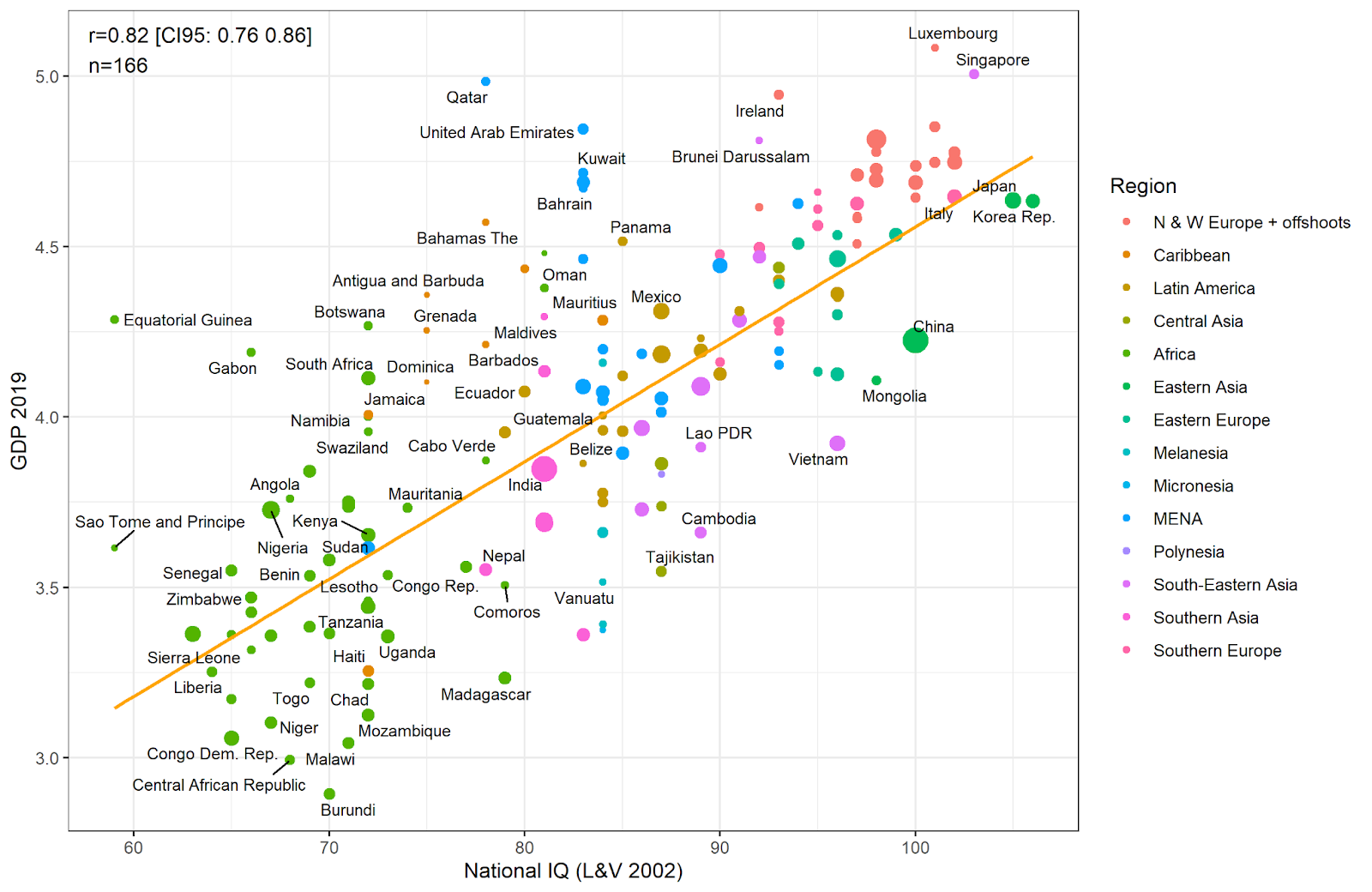
George Francis and Emil Kirkegaard have come out with a study that shows a strong correlation between IQ and wealth creation. The higher the mean IQ, the more a nation can create wealth:


We find national IQ to be the “best predictor” of economic growth, with a higher average coefficient and average posterior inclusion probability than all other tested variables (over 67) in every test run. Our best estimates find a one point increase in IQ is associated with a 7.8% increase in GDP per capita (Francis and Kirkegaard 2022)


The study is essentially an update of an earlier one by Richard Lynn and Tatu Vanhanen (2002). It’s better done, and I agree more or less with the conclusion. Wealth is not created in a vacuum. It’s created by flesh-and-blood humans who possess certain mental and behavioral attributes, one of which is high cognitive ability.


I do, however, have two criticisms.


Criticism #1: On a societal level, cognitive ability is confounded with other mental and behavioral attributes


Yes, high cognitive ability is important. But sustainable creation of wealth also requires other mental and behavioral attributes, notably:


·         propensity to identify social rules, obey them, and enforce them on others

·         feelings of guilt when one breaks the rules, even when there are no witnesses

·         empathy for others and a desire to understand how one’s behavior affects them

·         inhibition against using violence to settle disputes

·         high degree of future time orientation (also known as low time preference)


High IQ + high trust + low violence + low time preference = sustainable creation of wealth (Clark 2007; Clark 2009a; Clark 2009b; Frost 2020). Some will argue that intelligence goes hand in hand with high trust and low time preference (Carl 2014; Kirkegaard and Karlin 2020). That is true on a societal level: the same selection pressures that favor high intelligence usually favor the entire mental and behavioral package. On an individual level, however, intelligent sociopaths do exist, and they can prosper while others suffer. If they become too numerous or too influential, they will eventually destroy their host society. But that can take time.


In all fairness, Francis and Kirkegaard did investigate social trust and time preference. Unfortunately, those attributes are confounded with IQ: successful societies tend to have people who are not only intelligent but also trustworthy and future-oriented. That’s survivorship bias: if a society lacks the full mental and behavioral package, it usually goes extinct, and extinct societies get overlooked by cross-national studies. To be precise, societal extinction happens when the intelligent are unrestrained in their contempt for the less intelligent in their midst; they thus prey on them by any means possible, and the resulting strife leads to societal collapse.


IQ, social trust, and time preference are normally confounded with each other, at least in most existing societies. Therefore, if you control for IQ, the other two variables will go away, and you’ll think: “Aha! The key variable must be IQ!”


And you’ll feel all the more certain because IQ is not just equal to social trust or time preference in predicting wealth creation. It’s actually better! That greater predictive power, however, has a simple explanation: measurement of IQ is based on less subjective data. In this study, social trust is measured by self-report, and time preference is measured by an amalgam of survey responses and credit risk.


Criticism #2: The correlation is driven largely by unreliable African data


This study has another weak point: the correlation between wealth creation and IQ is driven largely by economic and cognitive data from Africa. If you remove Africa from the chart, the correlation becomes a lot weaker.


How reliable is the African data? Not very. First, a lot of African economic activity is “off the books.” That is particularly true for subsistence farming in the countryside, but it’s also true for many businesses in the towns and cities. GDP thus tends to be underestimated.


Second, even HBD writers disagree among themselves on mean African IQ, as pointed out by Heiner Rindermann:


The [cognitive] ability levels for Africans in Africa are the subject of strong disagreement. Rushton studied positively selected samples (South African university engineering students; Rushton, Skuy, & Fridjhon, 2003), but the mean differences between Africans and Europeans (14 IQ points) were similar to the ones found in Western countries. Lynn and Vanhanen (2006) estimated that sub-Saharan African countries had a mean IQ of 70. Wicherts, Dolan, and Maas (2010) using a different selection procedure came to a mean IQ of 82.


Rindermann’s “best guess” is 75. He concludes: “Given the quality of the data, it is not possible to come to a really precise result” (Rindermann 2013, p. 3). If we look at the chart from Lynn and Vanhanen (2002), we see that most sub-Saharan African countries are assigned mean IQs lower than 75. In fact, 75 seems to be the upper limit. That’s the IQ dataset of the new study.


Francis and Kirkegaard (2022, pp. 22-23) are aware that the IQ/GDP correlation is a lot weaker without the African IQ data, and they defend the validity of that dataset at some length. I’m still unimpressed, for two reasons:


·         If mean African IQ is 70, one must conclude that Africans are much less intelligent than African Americans, whose mean IQ is usually estimated at 85. Such a large difference cannot be explained by European admixture, heterosis, or nutrition.


·         The Yoruba of Nigeria have about the same polygenic score as that of African Americans (Piffer 2021, Fig. 7). Their mean IQ should therefore be 85. Yet, according to Lynn and Vanhanen, Nigerians have a mean IQ of 67. Since Nigeria is 18% Igbo, and since the Igbo show high academic achievement, mean Yoruba IQ should therefore be much less than the presumed Nigerian average of 67 (Chisala 2015; Frost 2022). The numbers don’t seem to add up.


Please don’t get me wrong. I agree that mean IQ is lower in Africa than in Eurasia, but the Lynn and Vanhanen estimates seem too low. In any case, they are not widely accepted even by researchers who accept that cognitive ability varies among human populations.


Similarly, I agree that more wealth is created per capita in Eurasia than in Africa. The difference, however, is overstated because so much of African GDP goes unreported. Furthermore, I don’t believe that lower IQ largely explains Africa’s economic underperformance. There is also the excessive use of violence to achieve one’s goals, both by the State and by private individuals. There is also the low level of trust that people have in each other—for the most part, Africans trust only their immediate family and friends. Finally, because family ties are so important, nepotism is widespread, and successful entrepreneurs end up being plundered by greedy relatives. The market economy cannot realize its full potential because the logic of the market has to compete with the logic of kinship.


Edit: George Francis has informed me that the correlation between IQ and GNP per capita remains unchanged if African cognitive and economic data are excluded. Without the African data, GDP per capita would increase 7.7% with each one point increase in IQ, rather than 7.8%.


Conclusion


Cognitive ability is only one of several mental and behavioral attributes that are key to building successful economies and societies. If we focus on it to the exclusion of others, we will be talked into supporting policies that have unintended consequences. A good example is the idea of reorienting immigration policy toward recruitment of high-IQ individuals.


That idea has the support of many conservatives throughout the West, but the consequences are very un-conservative. In short, we would be selecting immigrants who excel at creating wealth for themselves, by hook or by crook. The eventual result: an elite of rich narcissists who feel little sympathy for common people and who see them as objects to be used, when useful, and thrown away, when not.


Please don’t get bamboozled by reassurances that IQ correlates with trustworthiness and low time preference. That’s true only at the societal level. Those three attributes align with each other because they have to: otherwise, society would become dysfunctional and collapse. That’s survivorship bias: we get data from societies that have survived, and not from those that haven’t. If we cherry-pick high IQ immigrants from all over the world, we will create a new kind of society that has not stood the test of time.


Actually, that kind of society has arisen in the past:


And you should know that all the Cathayans [Chinese] detested the Grand Khan's rule because he set over them governors who were Tartars, or still more frequently Saracens, and these they could not endure, for they were treated by them just like slaves. You see the Great Khan had not succeeded to the dominion of Cathay [China] by hereditary right, but held it by conquest; and thus having no confidence in the natives, he put all authority into the hands of Tartars, Saracens, or Christians who were attached to his household and devoted to his service, and were foreigners in Cathay [China].

            The Travels of Marco Polo, Book 2, Chapter 23


Why do you think revolutions happen? It was precisely to avoid such a prospect that elite schools sought to develop not only intellect but also character, including the idea that the powerful have a duty to rule wisely and fairly. That view of higher education has given way to “meritocracy” throughout the West, with results that could have been predicted.


References


Carl, N. (2014). Does intelligence explain the association between generalized trust and economic development? Intelligence 47: 83-92. https://doi.org/10.1016/j.intell.2014.08.008


Chisala, C. (2015). The IQ gap is no longer a black and white issue. The Unz Review, June 25. http://www.unz.com/article/the-iq-gap-is-no-longer-a-black-and-white-issue/     


Clark, G. (2007). A Farewell to Alms. A Brief Economic History of the World. Princeton University Press: Princeton and Oxford.


Clark, G. (2009a). The indicted and the wealthy: surnames, reproductive success, genetic selection and social class in pre-industrial England.

http://www.econ.ucdavis.edu/faculty/gclark/Farewell%20to%20Alms/Clark%20-Surnames.pdf    


Clark, G. (2009b). The domestication of man: The social implications of Darwin. ArtefaCTos 2: 64-80. 

https://www.researchgate.net/publication/277275046_The_Domestication_of_Man_The_Social_Implications_of_Darwin  


Francis, G., and E.O.W. Kirkegaard. (2022). National Intelligence and Economic Growth: A Bayesian Update. The Mankind Quarterly 63(1). http://dx.doi.org/10.46469/mq.2022.63.1.2  


Frost, P. (2020). The large society problem in Northwest Europe and East Asia. Advances in Anthropology 10(3): 214-134. https://doi.org/10.4236/aa.2020.103012     


Frost, P. (2022). Recent cognitive evolution in West Africa: the Niger’s role. Evo and Proud, April 30. https://evoandproud.blogspot.com/2022/04/recent-cognitive-evolution-in-west.html  


Kirkegaard, E.O.W., and A. Karlin. (2020). National intelligence is more important for explaining country well-being than time preference and other measured non-cognitive traits. Mankind Quarterly 61: 339-370. http://doi.org/10.46469/mq.2020.61.2.11  


Lynn, R. and T. Vanhanen. (2002). IQ and the Wealth of Nations. Westport, Conn: Praeger


Piffer, D. (2021). Divergent selection on height and cognitive ability: evidence from Fst and polygenic scores. OpenPsych https://openpsych.net/files/submissions/14_Divergent_selection_on_height_and_cognitive_ability_evidence_from_Fst_and_13c3ICJ.pdf     


Rindermann, H. (2013). African cognitive ability: Research, results, divergences and recommendations. Personality and Individual Differences 55: 229-233. https://doi.org/10.1016/j.paid.2012.06.022     
Monday, March 9, 2020

The ghosts of West Africa


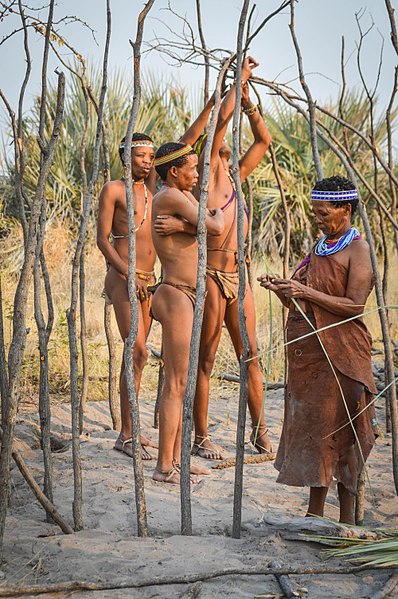
Bushmen in the Kalahari (Wikicommons, Andy Maano). When recorded history began, in Sumer and Egypt, black Africans were absent from most of Africa, even from most of West Africa. The lands south of the Sahara were largely home to various hunter-gatherers who were small, almost childlike in build, and light reddish-brown in color. 


Most Americans think of native Africans as black and of white Africans as recent intruders; and when they think of Africa's racial history they think of European colonialism and slave trading. But very different types of peoples occupied much of Africa until as recently as a few thousand years ago.

When Jared Diamond penned those words, analysis of ancient DNA was years away. Even when it began, there was a feeling that such analysis would always be impractical in Africa or anywhere else in the tropics. The climate is too warm for that stuff to last thousands upon thousands of years.

Apparently not. DNA has been retrieved from the remains of four individuals at a site in Cameroon, two of them going back 8,000 years and the other two 3,000 years. The main finding? The individuals were most similar to Pygmies, who still exist as isolated groups of hunter-gatherers in the Congo basin. There was no genetic similarity to the Bantu peoples who now predominate throughout central, eastern, and southern Africa (Lipson et al. 2020).

This finding is no surprise. Linguistic evidence has shown that the Bantu are all descended from a group of farming peoples who, some two to three thousand years ago, began to expand eastward and southward from what is now the Cameroon-Nigeria border. 

More intriguing is the discovery of admixture from an extinct West African people. These were hunter-gatherers who shared common ancestry with the Pygmies of central Africa and the Khoisans of southern Africa; however, they had intermixed much more with an archaic hominin that had diverged from ancestral modern humans at about the same time as the Neanderthals:

The West African clade is distinguished by admixture from a deep source that can be modelled as a combination of modern human and archaic ancestry. The modern human component diverges at almost the same point as Central and southern African hunter-gatherers and is tentatively related to the deep source that contributes ancestry to the Mota individual, and the archaic component diverges close to the split between Neanderthals and modern humans (Lipson et al. 2020)

This suggests that the Bantu expansion was the second leg of an earlier expansion of farming peoples who had first replaced the hunter-gatherers of West Africa. This is in line with the thinking of George Murdock, an American anthropologist who argued that black Africans originated with the spread of agriculture from the Niger's headwaters, near the Mali-Guinea border. This region was the cradle of the Sudanic food complex: sorghum, pearl millet, cow pea, and other crops.

Murdock’s scenario is supported by linguistic evidence. Speakers of proto-Niger-Congo broke up around 10,000 years ago, and the oldest group appears to be proto-Mande speakers, whose descendants inhabit the Niger's headwaters (Blench 1984, pp. 128-129; Ehret 1984; Murdock 1959, pp. 44, 64-68). Farming itself seems to have begun later. According to Harris (1976, p. 352), “the problem of dating must be left in abeyance, but it is clear that some form of seed-crop cultivation was underway in the interior at least by the second millennium B.C.”

It looks like a stable population of hunter-gatherers took shape on the Niger’s headwaters around 10,000 years ago. They gradually became proto-agricultural, i.e., more sedentary and better able to manage their food sources. By 4,000 years ago, they had become true farmers and were entering a phase of sustained demographic expansion that would see them colonize the banks of the Niger farther and farther downstream until they reached the rain forest in southern Nigeria. As they adapted to this new environment, they reached a modus vivendi with the Pygmy inhabitants, at first as tenants and then as de facto landowners who took over more and more of the land. Meanwhile, the Pygmies were pushed back farther and farther into the forest until they were no more.

In sum, farming can support a much larger population, and it was this demographic advantage that enabled farming peoples to replace hunter-gatherers, first in West Africa and eventually throughout almost all of sub-Saharan Africa.


Memories of the first West Africans

Those hunter-gatherers are remembered in the traditions of West Africa: 

Pygmies may have been the first inhabitants of Côte d'Ivoire. In their oral tradition, most of the present-day peoples, in particular the Dan-Yacouba, recount that their ancestors, on arriving in the country, found "little red men" whom they pushed back into the forest. Others speak of "little brown men", who had supernatural powers and to whom presents were given to win them over. (Mantongouine 2012)

According to some authors like Allou and Gonnin, the presence of these mysterious beings appears in the oral traditions. They are presented as short beings about 1m 44 to 1m 55 according to J.N. Loucou, with reddish skin, abundant hair, and feet pointing backward. They appear in almost all of the regions of prehistoric Côte d’Ivoire in the sense that almost all of the oral traditions of Côte d’Ivoire’s ethnic groups affirm that they found pygmies in the area before they became established. (Afri 2013; see also Gonnin and Allou 2006; Loucou 1984, p. 18)

Everywhere, but mainly in the countries from which the Pygmies have long disappeared, the Blacks who are considered to be the oldest occupants of the land say that it does not really belong to them and that, when their distant ancestors, coming from the East, established themselves, they found it in the possession of little men with reddish complexions and large heads who were the real natives and who, in exchange for fulfilment of certain agreements, permitted the Negroes who first arrived on a piece of land to enjoy its use and cultivate it. Eventually, those little men disappeared, but the memory of them has persisted. (Delafosse 1922, p. 14)

The Mano of Liberia say that the forested area used to contain only “talking chimpanzees.” These small creatures, called Lam, inhabited the area when the Mano first came. A Lam and his family would live in a hole in the ground (Riddell 1970, p. 27).


Year-round farming, polygyny. and increased stature and robustness

In addition to their means of subsistence, this expanding population of farmers differed from the hunter-gatherers in another way: a much higher rate of polygyny. Farming, especially year-round farming, makes women more self-reliant in feeding themselves and their children, thus cutting the costs, for a man, of having a second wife (van den Berghe 1979, p. 65). The result is a high polygyny rate: 20-50% of all marriages in sub-Saharan farming societies (Bourguignon and Greenbaum 1973, p. 51; Goody 1973; Pebley and Mbugua 1989; Welch and Glick 1981; White 1988).

If some men have more wives, others have to do without. In general, men must compete more keenly with each other for access to women. When such rivalry intensifies in nonhuman species, there is selection for larger, stronger, and more muscular males. This may explain the physical robustness of polygynous farming peoples in sub-Saharan Africa.

This point was studied by Butovskaya et al. (2015) in their study of two East African peoples: the polygynous Datoga and the monogamous Hadza. Datoga men were larger and more robust than Hadza men. They also scored higher on measures of physical aggression, verbal aggression, anger, and hostility. In fact, the two groups differed fundamentally in their attitudes toward aggression:

There is a negative attitude toward aggression among the Hadza but not among the Datoga. In situations of potential aggression, the Hadza prefer to leave. In contrast, aggression is an instrument of social control — both within the family and in outgroup relations — in Datoga society. Datoga men are trained to compete with each other and to act aggressively in particular circumstances.  (Butovskaya et al. 2015).

The two groups also differed at the androgen receptor gene, with the polygynous Datoga more often having an allele that correlated in men with aggressiveness and number of children fathered. Thus, through a process of gene-culture coevolution, a highly polygynous culture has produced a different sort of man, both mentally and physically.

There are other explanations for the diminutive and less robust appearance of African hunter-gatherers. O'Dea (1994) has argued that Pygmies are smaller and less robust because they are less exposed to sunlight in the rain forest and thus less able to synthesize vitamin D and maintain a large and strong skeleton. But how would this theory explain the small, gracile appearance of the Khoisan hunter-gatherers of the Kalahari, who live in an open environment with high solar radiation?


Darker skin

The polygyny rate correlates with darkness of skin, even after you control for latitude (Manning et al. 2004). This is particularly so in sub-Saharan Africa, where highly polygynous farming peoples are noticeable darker than the largely monogamous Pygmy and Khoisan hunter-gatherers. The reason may be a widespread mental association between gender and skin color. Because women are naturally lighter-skinned than men, traditional cultures tend to associate light skin with femininity and dark skin with masculinity (van den Berghe and Frost 1986). There is thus a selective compromise between natural selection for darker skin as a protection against solar radiation and sexual selection for lighter skin as a criterion of femininity (or darker skin as a criterion of masculinity). 

Because unmated women of any kind are scarce in a polygynous society, there is weaker sexual selection for women with lighter skin. This may be why farming peoples are noticeably darker-skinned in sub-Saharan Africa (Frost 2008).


Archaic admixture in West Africa

The ancient DNA study is also consistent with evidence that a partially archaic population used to live in West Africa. One piece of evidence is a skull from a Nigerian site (Iwo Eleru), which is only about 16,300 years old and yet is intermediate in shape between the skulls of modern humans on the one hand and the skulls of Neanderthals and Homo erectus on the other (Harvati et al. 2011; Stojanowski 2014). Furthermore, genomic analysis shows an apparently higher level of Neanderthal ancestry in the Yoruba of Nigeria than in the Luhya of Kenya. This admixture seems to come from a Neanderthal-like population that once lived in West Africa (Hawks 2012).


Conclusion

In the fifteenth century, Europeans discovered a continent whose inhabitants would have looked quite different a millennium earlier. Two tenth-century Arab geographers reported that "in the outer reaches of the land of the Zanj there are cool highlands in which live white Zanj" (Lewis 1990, p. 121, n. 3). The Zanj are the dark-skinned peoples of east Africa and the “white Zanj” were probably the Khoisan hunter-gatherers who once inhabited the inland plateau of southern Africa.

If we could rewind history, we would see true black Africans retreating progressively to West Africa and then to the area of the Niger’s headwaters. This leads us to a strange conclusion. When recorded history began, in Sumer and Egypt, black Africans were absent from most of Africa, even from most of West Africa. Perhaps they didn’t yet exist anywhere. The lands south of the Sahara were largely home to various hunter-gatherers who were small, almost childlike in build, and light reddish-brown in color. 


References

Afri, A. (2013). Existait-il des peuples en Côte d’Ivoire avant le XVIIIème siècle ?
http://anicetafri.over-blog.com/existait-il-des-peuples-en-cote-d’ivoire-avant-le-xviiième-siÈcle

Blench, R. (1995). Recent developments in African language classification and their implications for prehistory. In T. Shaw, P. Sinclair, B. Andah, and A. Okpoko (Eds.) The Archaeology of Africa (pp. 126-138). London: Routledge.

Butovskaya M.L., O.E. Lazebny, V.A. Vasilyev, D.A. Dronova, D.V. Karelin, A.Z.P. Mabulla, et al. (2015). Androgen receptor gene polymorphism, aggression, and reproduction in Tanzanian foragers and pastoralists. PLoS ONE 10(8): e0136208.
https://www.ncbi.nlm.nih.gov/pmc/articles/PMC4546275/ 

Delafosse, M. (1922). Les Noirs de l’Afrique. Paris: Collection Payot. 
https://www.herodote.net/Textes/delafosse_noirs_afrique.pdf

Diamond, J. (1994). How Africa Became Black. Discover, February 1
https://www.discovermagazine.com/planet-earth/how-africa-became-black

Ehret, C. (1984). Historical/linguistic evidence for early African food production. In J.D. Clark and S.A. Brandt (Eds.) From Hunters to Farmers: The Causes and Consequences of Food Production in Africa (pp. 26-35). Berkeley: University of California Press.

Frost, P. (2008). Origins of black Africans, Evo and Proud, February 10
http://evoandproud.blogspot.com/2008/02/origins-of-black-africans.html

Gonnin, G. and R.K. Allou. (2006). Côte-d’Ivoire : les premiers habitants. Abidjan: Les éditions du CERAP.

Goody, J. (1973). Polygyny, Economy and the Role of Women, in J. Goody (Ed.) The Character of Kinship, Cambridge: Cambridge University Press, pp. 175-190.

Harris, D.R. (1976). Traditional systems of plant food production and the origins of agriculture in West Africa. In J.R. Harlan, J.M.J. De Wet, and A.B.L. Stemler. (ed.) Origins of African Plant Domestication, (pp. 311-356), The Hague: Moulton.
https://books.google.ca/books?id=tGOtFegfro4C&lr=&hl=fr&source=gbs_navlinks_s

Harvati, K., C. Stringer, R. Grün, M. Aubert, P. Allsworth-Jones, C.A. Folorunso. (2011). The Later Stone Age Calvaria from Iwo Eleru, Nigeria: Morphology and Chronology. PLoS ONE 6(9): e24024. doi:10.1371/journal.pone.0024024
http://www.plosone.org/article/info%3Adoi%2F10.1371%2Fjournal.pone.0024024  

Hawks, J. (2012). Which population in the 1000 Genomes Project samples has the most Neandertal similarity? John Hawks Weblog, February 8
http://johnhawks.net/weblog/reviews/neandertals/neandertal_dna/1000-genomes-introgression-among-populations-2012.html  

Lewis, B. (1990). Race and Slavery in the Middle East. An Historical Enquiry. New York: Oxford University Press.

Lipson, M., I. Ribot, S. Mallick, et al. (2020). Ancient West African foragers in the context of African population history. Nature 577: 665-670.
https://reich.hms.harvard.edu/sites/reich.hms.harvard.edu/files/inline-files/Shum_Laka_published_online_0.pdf

Loucou, J-N. (1984). Histoire de la Côte-d’Ivoire. Tome 1 : La formation des peuples. Abidjan: Centre d’édition et de diffusion africaine (CEDA).

Manning, J.T., P.E. Bundred, and F.M. Mather. (2004). Second to fourth digit ratio, sexual selection, and skin colour. Evolution and Human Behavior 25(1): 38-50.
https://www.sciencedirect.com/science/article/abs/pii/S1090513803000825

Mantongouine. (2012). L'histoire de la Côte d'ivoire 
http://mantongouine.free.fr/index.php?option=com_content&view=article&id=66:lhistoire-de-la-cote-divoire&catid=34:description

Murdock, G.P. (1959). Africa. Its Peoples and Their Culture History. New York: McGraw-Hill.

O'Dea, J.D. (1994). Possible contribution of low ultraviolet light under the rain-forest canopy to the small stature of Pygmies and Negritos. Homo 44(3): 284-7.

Pebley, A. R., and Mbugua, W. (1989). Polygyny and Fertility in Sub-Saharan Africa. In R. J. Lesthaeghe (Ed.), Reproduction and Social Organization in Sub-Saharan Africa, Berkeley: University of California Press, pp. 338-364.

Riddell, J.C. (1970). Labor Migration and Rural Agriculture among the Gbannah Mano of Liberia. Dissertation, Department of Anthropology, University of Oregon.
https://scholarsbank.uoregon.edu/xmlui/bitstream/handle/1794/22554/Riddell_Labor%20Migration%20and%20Rural%20Agriculture.pdf?sequence=1&isAllowed=y

Stojanowski, C.M. (2014). Iwo Eleru's place among Late Pleistocene and Early Holocene populations of North and East Africa. Journal of Human Evolution 75: 80-89.
http://www.sciencedirect.com/science/article/pii/S0047248414000876

van den Berghe, P.L. (1979). Human Family Systems. An Evolutionary View. New York: Elsevier.

van den Berghe, P.L., and P. Frost. (1986). Skin color preference, sexual dimorphism and sexual selection: A case of gene-culture co-evolution? Ethnic and Racial Studies 9(1): 87-113.
https://www.tandfonline.com/doi/abs/10.1080/01419870.1986.9993516

Welch, C.E., and Glick, P.C. (1981). The incidence of polygamy in contemporary Africa: A research note. Journal of Marriage and the Family 43:191-193.

White, D. R. (1988). Rethinking polygyny. Co-wives, codes, and cultural systems. Current Anthropology 29: 529-572.

Tuesday, July 10, 2018

It's not self-hate


Long-haired Sango woman, Democratic Republic of the Congo (Friedrich 1913, Fig. 174)


A competitive mate market will reward individuals whose secondary sexual characteristics seem abnormally bigger or flashier. A "supernormal stimulus" has a stronger visual impact than a normal one, and the behavioral response is correspondingly stronger. This effect has been studied in many animal species. When, for instance, a female butterfly passes by a male, the latter is attracted to the flashing wing pattern. The same pattern on a rotating drum exercises the same power of attraction, which increases as the speed of rotation increases—up to almost ten times the speed of a normal wing-beat (Manning 1972, pp. 47-49).  

A human example? Head hair. It has become much longer than hair elsewhere on the body, apparently because it holds some power of attraction. This lengthening has been brought about by several evolutionary changes: faster rate of growth, longer growing phase, higher density, and greater resistance to physical damage (Khumalo 2005; Loussouarn 2001; Loussouarn et al. 2005). These changes have gone farther in some populations than in others. Darwin noted "the extraordinary difference in the length of the hair in the different races; in the negro the hair forms a mere curly mat; with us it is of great length, and with the American natives it not rarely reaches to the ground" (Darwin 1936[1888], p. 906).

Long hair is the "derived" form. It evolved in those modern humans who left Africa for northern Eurasia, including some who later back-migrated to the tropics, such as the Austronesians of Southeast Asia and Oceania and the Amerindians of the tropical New World.

Short, frizzy hair is the ancestral form. Today, it is seen in sub-Saharan Africans and in some remnant groups that remained in the tropical regions of South Asia, Southeast Asia, and parts of Oceania. These groups are the Andamanese of India, the Semang of Malaysia, the Aeta of the Philippines, and the natives of Australia, Papua New Guinea, and Melanesia.


Long head hair, a component of the Kindchenschema

The ancestral hair form is straight and silky in a newborn child: "[...] the majority of African babies are not born with springy tight curls, the African child at birth is either bald or has silky loose curls similar to the Jheri curls" (Ajose 2012). This physical difference was cited by Zambian students when asked to describe how Africans look. Some of the girls "noted that African babies were born with white skin and long hair" (Powdermaker 1956).

Although adults normally have loose, silky hair in most of the world, this was not so in ancestral humans. Such hair was specific to infants and thus formed part of what Konrad Lorenz dubbed the Kindchenschema—a set of visual, auditory, and tactile cues that identifies a human infant to adults, who then feel less aggressive and more willing to provide care and nurturance (Lorenz 1971, pp. 154-164). The infant seems "cute."

This has been no less true in sub-Saharan Africa, and a desire to be similarly cute has led African women to make their own hair longer, looser, and silkier. Some of their techniques predate the colonial era:

Africa as the cradle of mankind is likely to have had hair care since the beginning of human existence. Partly because of the oral tradition of passing down history, it is difficult to corroborate evidence of hair care. But probably the earliest form of hair straightening was the molding of hair into shapes using various clays and mud (e.g., indicating the station of a married woman among the Zulu's). [...] Hair was also lengthened with fibers and grasses, much as is done for braids with synthetic extensions nowadays. Although small decorative comb-like structures have been discovered with archeological finds, it is not clear whether original Africans combed their hair or if these implements were purely decorative. Although not written down, fascinating stories of more recent hair care (and hair disasters) are often told by older women about straightening hair using hot stones even before hot combs became available. (Khumalo 2008: see also Sieber and Herreman 2000)

In 1721, John Atkins provided an early description of women braiding and dressing their hair in Sierra Leone:

[The women] work hard at Tillage, make Palm-Oil or spin Cotton, and when they are free from such work, the idle Husbands put them upon braiding, and fettishing out their woolly hair, (in which Sort of Ornament they are prodigious proud and curious) keeping them every Day, for many Hours together at it. (Sieber and Herreman 2000, p. 67)

West African women still lavish much time on their hair:

"Big hair," "plenty of hair," "much hair"—West African communities, including Mende, admire a fine head of long, thick hair on a woman. Both these elements are crucial: thickness and length. Thickness equals increase in the number of individual strands, and the length is proof of strength. Growing such luxuriant hair requires a Mende woman's patience and care. Because a man's hair is kept shaved or cut close to the scalp, people say that "men don't have hair." Beautiful hair thus is a distinctly female trait; the more of it, the more feminine the woman. (Boone 1986, p. 184)

This hairdressing tradition is ancient enough to have spawned myths, such as this one among the Mende:

It is known among Mende that all the "water people," angels, have marvelous hair. The mermaid Tingoi is known by her long, wavy hair and her glamorous habit of dressing it with a golden comb while seated on a rock. A little girl with especially long hair is feared to be in danger of drowning because she will be very attractive to the "water people," who may think she is one of them and wish her to join them. (Boone 1986, p. 192)

Long-haired women appear in the folklore of other African peoples. Among the Yoruba, a folk-tale explains "why women have long hair." A woman fell into a pit and was pulled out by her hair, which thereby became as long as a man's arm. She initially felt ashamed of her new appearance and hid herself.

But after a while she realized that her long hair was beautiful, and then she felt very proud and scorned all the short-haired women, jeering at them. When they saw this, they were consumed with jealousy, and began to be ashamed of their short hair. "We have men's hair," they said to one another. "How beautiful it would be to have long hair!"

So one by one they jumped into the pit, and their friends pulled them out by the hair.

And in this way they, and all women after them, had long hair. (Ogumefu 1929, chap V)

Another Yoruba folk-tale recounts how a king had a beautiful daughter with hair "so long that it touched the ground when she walked." But she lost her hair and regained it only after a man found a tree that bore human hair. She then became his wife. (Abrahams 1983, pp. 59-63)

Lengthening of women’s hair seems to have been most common in West Africa, but it was also practiced in central and southern Africa during early colonial times. Women of the Manyema (Tanzania) were described as having “an abundance of hair” that would “flow down to the waist in masses of ringlets” (Bettany 1892, p. 661). Among the Sango (DRC), girls old enough for marriage would plait long strands of string into their hair to create long manes (Friedrich 1913, pp. 190-191). Young women of the Mbalantu (Namibia) achieved the same effect by braiding sinew extensions (Sieber and Herreman 2000, p. 65). Nonetheless, such practices seem to have been uncommon in southern Africa. When a black South African woman traveled to the United States in the 1930s, she was struck by the number of African American women who straightened and extended their hair. “What really made me feel strange [was] nearly every girl and woman has long hair and I among them looked like a boy dressed in girl’s clothes” (Thomas 2006, p. 487).

It appears that African American women were already braiding and threading their hair at an early date. Men, however, often shaved their heads—an indication that both sexes viewed long head hair as a female ornament (White and White 1995).

In sum, hair lengthening is an African tradition that precedes colonial contact with Europeans. From the beginning, the aim was to look feminine, and not "white." The motive was not self-hatred but sexual fantasy—a desire for the supernormal, a wish to become a woman with a long mane of hair. This may be an example of humans creating in one part of the world through artificial means what has been created elsewhere through biological evolution. The same desire has been satisfied in different ways.


Evolution of long head hair in Homo sapiens

African hair can revert to the loose, silky form of infancy as a result of some illnesses: AIDS, rheumatoid arthritis, systemic lupus erythematosus, pulmonary tuberculosis with cachexia, and Behçet's disease (Ajose 2012). These illnesses somehow disrupt normal hair growth, and it is plausible that a similar disruption of genetic origin, i.e., a loss-of-function allele, was the first stage in the evolution of long head hair.

Head hair began to lengthen as ancestral humans spread out of Africa and into the temperate and arctic zones. These environments shifted the pressure of sexual selection from men to women. On the one hand, male mortality increased in relation to female mortality because men had to hunt over larger expanses of land. On the other hand, the polygyny rate decreased because it became costlier to provide for a mother and her offspring, particularly during winter. Men were scarcer on the mate market, being fewer in number and less polygynous. (Frost 2006; Frost 2014; Frost 2015).

Women were now in excess supply, and the spotlight of sexual selection was on them. Their physical characteristics became flashier, bigger, or somehow exaggerated. In the case of head hair, the existing practices of artificial lengthening helped show the way for future evolution. The cultural became biological. Over succeeding generations, the infant hair form persisted more and more into adulthood while becoming ever longer and straighter, eventually reaching down to the waist if left uncut. Hair seems to have lengthened within the whole of northern Eurasia, rather than within the smaller zone of steppe-tundra where skin became white and where hair and eyes became brightly and diversely colored. Hair lengthening was thus triggered by a lower intensity of sexual selection.

This selection pressure acted primarily on women and then secondarily spilled over onto men, perhaps because most of the genes in question are weakly sex-linked, as are most genes. Nonetheless, there is some sex linkage. Scalp hairs have a greater mean diameter and hence more volume in women, even in the shorter-haired New Guineans (Walsh and Chapman 1966). Hair growth rate and final length are also somewhat greater in women than in men (Sigler 2011, p. 13). Men furthermore tend to lose their head hair, often as early as their twenties. In general, growth of head hair is under stronger hormonal inhibition in men than in women (Kondo et al. 1990).


Conclusion

Before ancestral humans began to spread out of Africa, women were already pushing the phenotypic envelope by artificially making their hair straighter, longer, and silkier. Later, outside Africa, evolution brought this fantasy to life. As Charles Darwin concluded, such hair serves an ornamental purpose in our species: "for we know that long tresses are now and were formerly much admired, as may be observed in the works of almost every poet; St. Paul says, "if a woman have long hair, it is a glory to her." (Darwin 1936[1888], p. 906).


References

Abrahams, R.D. (1983). African Folktales. Traditional Stories of the Black World. New York: Pantheon Books.
https://books.google.ca/books?id=JqJVU4XYvLYC&printsec=frontcover&hl=fr&source=gbs_ge_summary_r&cad=0#v=onepage&q&f=false

Ajose, F.O.A. (2012). Diseases that turn African hair silky. International Journal of Dermatology 51 (supp. S1): 12-16.
https://doi.org/10.1111/j.1365-4632.2012.05556.x

Bettany, G.T. (1892). The World’s Inhabitants or Mankind, Animals, and Plants. London: Ward, Lock, Bowden and Co. 
https://books.google.ca/books?id=mkBOAQAAMAAJ&printsec=frontcover&hl=fr&source=gbs_ge_summary_r&cad=0#v=onepage&q&f=false

Boone, S.A. (1986). Radiance from the Waters: Ideals of Feminine Beauty in Mende Art. New Haven and London.
https://books.google.ca/books?id=anjOC0zZ6kgC&printsec=frontcover&hl=fr&source=gbs_ge_summary_r&cad=0#v=onepage&q&f=false

Darwin, C. (1936 [1888]). The Descent of Man and Selection in relation to Sex. reprint of 2nd ed., The Modern Library, New York: Random House.

Friedrich, A. (1913). From the Congo to the Niger and the Nile. An account of the German Central African Expedition of 1910-1911 by Adolf Friedrich Duke of Mecklenburg, vol. 1. London: Duckworth and Co.
https://archive.org/stream/fromcongotonige01adol/fromcongotonige01adol#page/n5/mode/1up

Frost, P. (2006). European hair and eye color - A case of frequency-dependent sexual selection? Evolution and Human Behavior 27(2): 85-103.

Frost, P. (2014). The puzzle of European hair, eye, and skin color. Advances in Anthropology 4(2): 78-88. 

Frost, P. (2015). Evolution of long head hair in humans. Advances in Anthropology 5(4): 78-88.

Khumalo, N.P. (2005). African hair morphology: macrostructure to ultrastructure. International Journal of Dermatology 44(Suppl. 1): 10-12.

Khumalo, N.P. (2008). On the history of African hair care: more treasures await discovery. Letter to the Editor. Journal of Cosmetic Dermatology 7(3): 231.

Kondo, S., Y. Hozumi, and K. Aso. (1990). Organ culture of human scalp hair follicles: effect of testosterone and oestrogen on hair growth. Archives of Dermatological Research 282(7): 442-445.

Lorenz, K. (1971). Studies in Animal and Human Behaviour, vol. 2. London: Methuen & Co.

Loussouarn, G. (2001). African hair growth parameters. British Journal of Dermatology 145(2): 294-297.

Loussouarn, G., C.E. Rawadi, and Genain, G. (2005). Diversity of hair growth profiles. International Journal of Dermatology 44(Suppl. 1): 6-9.

Manning, A. (1972). An Introduction to Animal Behaviour. 2nd edition. London: Edward Arnold.

Ogumefu, M.I. (1929). Yoruba Legends. London: The Sheldon Press. 

Powdermaker, H. (1956). Social change through imagery and values of teen-age Africans in Northern Rhodesia. American Anthropologist 58(5): 783-813.
https://doi.org/10.1525/aa.1956.58.5.02a00030 

Sieber, R. and F. Herreman. (2000). Hair in African Art and Culture. African Arts 33(3): 54-96.
http://homework.sdmesa.edu/drogers/Art%20115/sieber%20hair%20in%20african%20art.pdf

Thomas, L.M. (2006). The modern girl and racial respectability in 1930s South Africa. Journal of African History 47(3): 461-490
https://doi.org/10.1017/S0021853706002131

Walsh, R.J., and R.E. Chapman. (1966). A study of the quantitative measurement of human head hair fibres. Man, new series. 1(2): 226-232.

White, S. and G. White. (1995). Slave Hair and African American Culture in the Eighteenth and Nineteenth Centuries. The Journal of Southern History 61(1): 45-76.


Monday, April 2, 2018

Africa's Neanderthals


Skull from Zambia, dated to 110,000 years ago. Modern humans co-existed with archaic groups in Africa, particularly in the south and west.


When and where did modern humans emerge? Anatomical evidence points to somewhere in eastern Africa some 300,000 years ago. The time of origin is different if we look at behavioral and genetic evidence. Sophisticated tool-making, detailed artwork, and other signs of “behavioral modernity” appeared only 70,000 years ago (Brown et al., 2012). Genetic evidence points to a series of demographic expansions between 80,000 and 60,000 years ago in eastern Africa, with the last one spreading throughout Africa and into Eurasia (Watson et al. 1997). At that moment, an innovation in thinking seems to have given these truly modern humans an edge over everyone else.

As these humans spread throughout the world, to what extent did they intermix with the more archaic groups they replaced? We can answer this question for Eurasia by comparing the modern human genome with reconstructed genomes of the now-extinct Neanderthals (Europe, Middle East, and Central Asia) and Denisovans (East Asia, Southeast Asia). Present-day Eurasians have relatively low levels of archaic admixture: about 2% from Neanderthals and up to 5% from Denisovans (Sankararaman et al. 2016).

What about Africa? Unfortunately, we have not yet reconstructed the genome of any archaic population from that continent. We probably never will, given that DNA tends to degrade quickly in tropical climates. In theory, there should be more admixture in Africa than in Eurasia, since many archaic Africans would have been "near-modern," i.e., much more similar in appearance, behavior, and genetic makeup to modern humans than either Neanderthals or Denisovans. Greater genetic similarity would have also made hybrid infertility less likely. Indeed, it looks like male fertility suffered from hybridization with Neanderthals or Denisovans, given that present-day humans have a lower proportion of archaic ancestry on the X chromosome and in genes disproportionately expressed in the testes (Sankararaman et al. 2016). In these parts of the genome, natural selection has stepped in to remove archaic admixture.

The above speculations seem borne out by a recent and still unpublished paper. Its authors, Sriram Sankararaman and Arun Durvasula, came up with a novel way to measure admixture from an unknown archaic group, essentially by using a machine learning algorithm (which they validated with data on Neanderthal introgression in present-day Europeans). When they applied this method to Yoruba from Nigeria, they found a level of archaic admixture higher than in any other human population known to date:

Our results suggest that Yoruban individuals trace about 7.9% of their genomes to an as yet unidentified archaic population. This is in agreement with some results from previous papers in other African populations such as the Biaka and the Baka, suggesting that there was a rich diversity of hominin species within Africa and that introgression was commonplace. (Sankararaman and Durvasula 2018)

This finding is consistent with previous archaeological and genetic evidence, particularly from western and southern Africa. Both regions seem to have had archaic populations until recent times:

- A skull from a Nigerian site (Iwo Eleru) is only about 16,300 years old and yet looks intermediate in shape between modern humans on the one hand and Neanderthals and Homo erectus on the other. It resembles the skull of a near-modern human, like the Skhul-Qafzeh hominins who lived in the Middle East some 80,000 to 100,000 years ago (Harvati et al., 2011; Stojanowski, 2014).

- Genomic analysis of 16 prehistoric Africans suggests that modern humans spread out of eastern Africa and into western Africa, where they mixed with an archaic population as divergent from modern humans as Neanderthals were, the time of separation from modern humans being 200,000 to 300,000 years ago. This archaic admixture is estimated at 9% in Yoruba and 13% in Mende (Skoglund et al. 2017)

- Genomic analysis shows an apparently higher level of Neanderthal ancestry in the Yoruba of Nigeria than in the Luhya of Kenya. This admixture seems to come from a Neanderthal-like population that formerly lived in West Africa (Hawks 2012)

- A skull from Zambia has been dated to 110,000 years ago and yet looks very much like a Homo erectus (Bada et al., 1974; Stringer, 2011). 

-  About 2% of the current African gene pool comes from a population that split from ancestral modern humans some 700,000 years ago. This archaic DNA was then picked up by modern African humans about 35,000 years ago, probably in central Africa because this admixture is highest in pygmy groups from that region (Hammer et al. 2011).

- Genomic analysis of western African pygmies (Biaka and Baka) indicates frequent, low-level interbreeding between archaic and modern humans, including an admixture event within the last 30,000 years (Hsieh et al. 2016). 

- Jawbone fragments from South Africa exhibits significant size and morphological variability, indicating admixture with an archaic population. The fragments fall within the range of 110,000 to 60,000 years ago (Malekfar, 2012)

- Sub-Saharan Africans exhibit dental traits that distinguish them from other modern humans (Sub-Saharan African Dental Complex). These traits are shared with extinct hominids and many extinct and extant nonhuman primates (Irish 1998). When dentitions are compared from western, central, eastern, and southern Africans, these ancestral traits appear to be least present in Kenyans and Tanzanians (Irish 1998). The SSADC thus seems least present in the "homeland" of modern humans (eastern Africa) and more present farther west and south.

Is the estimate of 7.9% archaic admixture a lower bound?

While the new finding of 7.9% archaic admixture is higher than what we see in other modern humans, the actual figure may be higher still. Sankararaman and Durvasula attribute this 7.9% admixture to "a deeply-diverged archaic population," while nonetheless acknowledging the "rich diversity of hominin species within Africa." Dienekes (2018) likewise notes that multiple admixture events had occurred between modern African humans and a range of "Palaeoafrican" groups.

Thus, Sankararaman and Durvasula are measuring admixture only from a highly divergent archaic group, apparently the same one that Skoglund et al. (2017) found in their study of the Yoruba. Indeed, the two studies found almost the same level of archaic admixture in the Yoruba: 7.9% versus 9%. Although Sankararaman and Durvasula validated their methodology with data on Neanderthal admixture in Europe, the two situations are not really comparable. In Europe, modern humans encountered only one archaic group over a relatively short time span, intermixture taking place essentially between 60,000 and 50,000 years ago with a second event more than 37,000 years ago (Yang and Fu 2018).  In Africa, modern humans likely encountered a range of archaic groups over a longer time, including "near-moderns" whose ancestors diverged from those of modern humans less than 200,000 years ago.

If we include introgression from these “near-moderns,” the total for archaic admixture in present-day sub-Saharan Africans should be much higher.  Indeed, 13% of the sub-Saharan gene pool seems to come from a demographic expansion that took place some 111,000 years ago and which probably brought the Skhul-Qafzeh hominins to the Middle East (Watson et al. 1997). Those hominins were anatomically modern, or almost so, but culturally Neanderthal.

Did archaic admixture help or hinder?

Mainstream evolutionary theorists have argued that admixture does more harm than good. As Ernst Mayr (1970, p. 80) wrote:

The claim has been made that species owe much of their genetic variability to introgressive hybridization. However, all the evidence contradicts this conclusion so far as animals is concerned. Not only are F1 hybrids between good species very rare, but where they occur the hybrids (even when not sterile) are demonstrably of inferior viability. The few genes that occasionally introgress into the parental species are not coadapted [...] and are selected against. Introgressive hybridization seems to be a negligible source of genetic variation in animals.

This view has been challenged by Hawks et al. (2007), who argue that gene introgression helped modern humans adapt to new environments. Instead of starting from scratch, they could cherry-pick genes that had already been tried and proven by the populations they were replacing: 

Compared with novel mutations, archaic genetic variants would have had several qualities that, in some cases, may have enhanced their selective value. Because they had long existed within human populations, these alleles had a much lower chance of being strongly deleterious. [...] Alleles with local advantages might never have been selected within the expanding modern population until it reached new climatic regimens. The spread of modern humans may have attained a burst of evolutionary change by drawing on the fruits of the existing adaptations of archaic humans. (Hawks et al. 2007)

The latest findings seem to lie between the above two views. Introgression can in some cases provide useful genes. Usually, however, it’s maladaptive.

We observe a decrease in the frequency of archaic ancestry in the Yoruban populations in more constrained regions of the genome, suggesting that these archaic alleles have been subject to the effects of purifying selection similar to the deleterious consequences of Neanderthal and Denisovan alleles in the modern human genetic background. On the other hand, we find several loci that harbor archaic haplotypes at elevated frequencies (>60%). (Sankararaman and Durvasula 2018)

Similarly, Yang and Fu (2018) note that a "gradual decline in archaic ancestry in Europeans dating from ~37 to 14 ka suggests that purifying selection lowered the amount of Neanderthal ancestry first introduced into ancient modern humans."

This pattern is consistent with findings from nonhuman species. A study of admixture in trout found sharp declines in fitness even with 20% admixture. The decline has two causes:

Hybridization can reduce fitness by either introducing alleles to a population that are not suited to the local environment (extrinsic outbreeding depression) or disrupting co-adapted gene complexes (intrinsic outbreeding depression) (Templeton 1986). These mechanisms are not mutually exclusive, and identifying the contribution of each effect is difficult. However, the high reproductive success of F1 hybrids relative to post-F1 hybrids with similar amounts of admixture suggests that some of the outbreeding depression is intrinsic. (Muhlfeld et al. 2009)

By disrupting co-adapted gene complexes, introgression causes individual genes to lose their adaptive value. Selection will thus eliminate either the introgressed alleles or the previously existing ones. In the second scenario, the complex of co-adapted genes is replaced with a simpler version.

Conclusion

Something “clicked” in eastern Africa 80,000 to 60,000 years ago. A relatively small group of humans acquired a new way of imagining themselves, each other, and the world around them, and this innovation gave them an edge over everyone else. The result: a “big bang” of population growth. They began to spread outward, first within Africa and then into Eurasia.

Their expansion within Africa seems to have proceeded more slowly than in Eurasia. Initially, these modern humans were replacing “near-moderns”—people fairly similar in appearance and genetic makeup. As they pushed farther east and south, however, they encountered populations that were much less similar. West Africa seems to have been home to a people who were as different from modern humans as Neanderthals were, perhaps being related to them. In southern Africa, modern humans encountered people even more divergent: a relic Homo erectus population. Even these highly divergent archaic groups were not rapidly replaced; they may have persisted as late as 15,000 years ago in West Africa and 30,000 years ago in central Africa. Thus, modern and archaic groups seem to have long coexisted in parts of Africa.

In general, archaic admixture reduced fitness: “archaic alleles that introgressed into the Yoruban population were deleterious on average”; neutral alleles were more likely to be retained than those that had functional impacts (Sankararaman and Durvasula 2018). A few, however, seem to have been favored by selection. This is the case with alleles located at a tumor suppressor gene, a gene involved with hormone regulation, and a gene involved with potassium channels. These are individual genes, however, and it is hard to know the impact on co-adapted gene complexes. In theory, archaic admixture should have had a disruptive effect.

Present-day Africans thus have admixture from a range of archaic groups, some being similar to modern humans and others more like Neanderthals or even Homo erectus. This admixture is highest in western and southern Africa and lowest in eastern Africa. In West Africa, admixture from a Neanderthal-like group is estimated at 7.9% by Sankararaman and Durvasula (2018) and at 9 to 13% by Skoglund et al. (2017). Admixture from “near-moderns” is harder to measure. There seems to be a 13% pan-African admixture from a population that had expanded across much of the continent some 111,000 years ago and which perhaps spilled into the Middle East, giving rise to the Skhul-Qafzeh hominins, i.e., early modern humans with Neanderthal culture (Watson et al. 1997, see L1i in Table 2).


References

Bada, J.L., R.A. Schroeder, R. Protsch, & R. Berger. (1974). Concordance of Collagen-Based Radiocarbon and Aspartic-Acid Racemization Ages, Proceedings of the National Academy of Sciences (USA) 71: 914-917.
http://www.pnas.org/content/71/3/914.short

Brown, Kyle S.; Marean, Curtis W.; Jacobs, Zenobia; Schoville, Benjamin J.; Oestmo, Simen; Fisher, Erich C.; Bernatchez, Jocelyn; Karkanas, Panagiotis; Matthews, Thalassa (2012). An early and enduring advanced technology originating 71,000 years ago in South Africa. Nature 491 (7425): 590.
https://www.researchgate.net/publication/233331522_An_early_and_enduring_advanced_technology_originating_71000_years_ago_in_South_Africa

Dienekes (2018). Statistical Palaeoafricans, Dienekes' Anthropology Blog, March 25
http://dienekes.blogspot.ca/2018/03/statistical-palaeoafricans.html

Durvasula, A., and S. Sankararaman. (2018). Recovering signals of ghost archaic admixture in the genomes of present-day Africans, BioRxiv, March 21
https://www.biorxiv.org/content/early/2018/03/21/285734  

Hammer, M.F., A.E. Woerner, F.L. Mendez, J.C. Watkins, and J.D. Wall. (2011). Genetic evidence for archaic admixture in Africa, Proceedings of the National Academy of Sciences (USA) 108: 15123-15128.
http://www.u.arizona.edu/~flmendez/papers/Hammer_2011.pdf

Harvati, K., C. Stringer, R. Grün, M. Aubert, P. Allsworth-Jones, C.A. Folorunso. (2011). The Later Stone Age Calvaria from Iwo Eleru, Nigeria: Morphology and Chronology. PLoS ONE 6(9): e24024. doi:10.1371/journal.pone.0024024
http://www.plosone.org/article/info%3Adoi%2F10.1371%2Fjournal.pone.0024024

Hawks, J. (2012). Which population in the 1000 Genomes Project samples has the most Neandertal similarity? John Hawks Weblog, February 8
http://johnhawks.net/weblog/reviews/neandertals/neandertal_dna/1000-genomes-introgression-among-populations-2012.html

Hawks, J., G. Cochran, H.C. Harpending, and B.T. Lahn. (2007). A genetic legacy from archaic Homo, Trends in Genetics 24(1): 19-23
https://s3.amazonaws.com/academia.edu.documents/46568403/A_genetic_legacy_from_archaic_Homo20160617-13508-1nt7amy.pdf?AWSAccessKeyId=AKIAIWOWYYGZ2Y53UL3A&Expires=1522259324&Signature=Ng%2FyAWbzdtcjUJ%2BDAJTY7yE8FuA%3D&response-content-disposition=inline%3B%20filename%3DA_genetic_legacy_from_archaic_Homo.pdf

Hsieh, P., A.W. Woerner, J.D. Wall, J. Lachance, S.A. Tishkoff, R.N. Gutenkunst, and M.F. Hammer. (2016). Model-based analyses of whole-genome data reveal a complex evolutionary history involving archaic introgression in Central African Pygmies. Genome Research 26(3): 291-300
https://www.ncbi.nlm.nih.gov/pmc/articles/PMC4772012/

Irish, J.D. (1998). Ancestral dental traits in recent Sub-Saharan Africans and the origins of modern humans, Journal of Human Evolution 34: 81-98.
https://www.sciencedirect.com/science/article/pii/S0047248497901913

Malekfar, L. (2012). An analysis of the Klasies River hominins using a hybrid model, American Journal of Physical Anthropology, Program of the 81st Annual Meeting of the American Association of Physical Anthropologists, p. 201.
https://s3.amazonaws.com/academia.edu.documents/33649075/anthro_poster_lily_%281%29.pdf?AWSAccessKeyId=AKIAIWOWYYGZ2Y53UL3A&Expires=1522334949&Signature=h10VLn2RDPu8HtH4X55L64S2ODU%3D&response-content-disposition=inline%3B%20filename%3DPoster_An_Analysis_of_the_Klasies_River.pdf

Mayr, E. (1970). Populations, Species, and Evolution, Belknap Press: Cambridge (Mass.)

Muhlfeld, C.C.,  S.T Kalinowski, T.E. McMahon, M.L. Taper, S. Painter, R.F. Leary, F.W. Allendorf. (2009). Hybridization rapidly reduces fitness of a native trout in the wild, Biology Letters, March 18
http://rsbl.royalsocietypublishing.org/content/early/2009/03/13/rsbl.2009.0033.short

Sankararaman, S., S. Mallick, N. Patterson, and D. Reich. (2016). The combined landscape of Denisovan and Neanderthal ancestry in present-day humans, Current Biology 26(9): 1241-1247.
https://www.sciencedirect.com/science/article/pii/S0960982216302470#bib1

Skoglund, P., J.C. Thompson, M.E. Prendergast, A. Mittnik, K. Sirak, et al. (2017). Reconstructing Prehistoric African Population Structure, Cell 171(1): 59-71
http://www.cell.com/cell/fulltext/S0092-8674(17)31008-5

Stojanowski, C.M. (2014). Iwo Eleru's place among Late Pleistocene and Early Holocene populations of North and East Africa, Journal of Human Evolution 75: 80-89.
http://www.sciencedirect.com/science/article/pii/S0047248414000876

Stringer, C. (2011). The chronological and evolutionary position of the Broken Hill cranium. American Journal of Physical Anthropology 144(supp. 52): 287

Watson, E., P. Forster, M. Richards, and H-J. Bandelt. (1997). Mitochondrial footprints of human expansions in Africa, American Journal of Human Genetics 61: 691-704. 0024024
https://www.sciencedirect.com/science/article/pii/S000292970764333X

Yang, M.A., and Q. Fu. (2018). Insights into Modern Human Prehistory Using Ancient Genomes, Trends in Genetics 34(3): 184-196
https://www.sciencedirect.com/science/article/pii/S016895251730210X