Showing posts with label Broken Hill. Show all posts

Saturday, October 4, 2014

Making the big time ... elsewhere


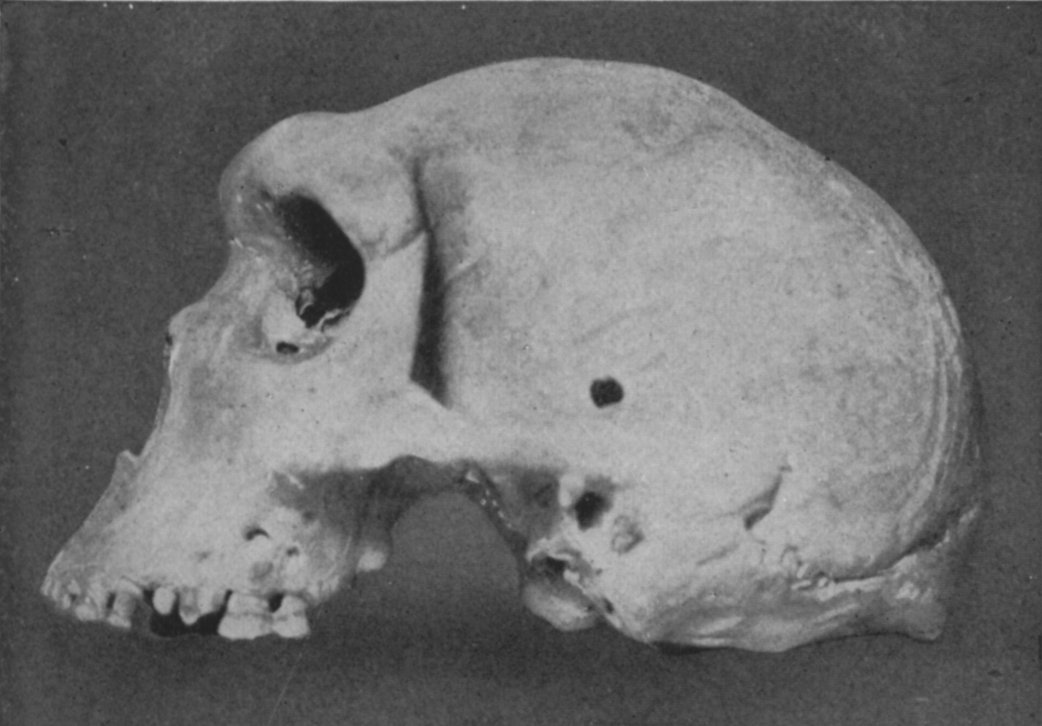
Skull from Broken Hill (Kabwe), Zambia. This kind of human was still around when the Neanderthals were going extinct in Europe. (Wikicommons)


East Africa, 60,000 to 80,000 years ago. The relative stasis of early humans was being shaken by a series of population expansions. The last one went global, spreading out of Africa, into Eurasia and, eventually, throughout the whole world (Watson et al., 1997). Those humans became us.

This expansion took place at the expense of more archaic humans: Neanderthals in Europe, the Middle East, and Central Asia; Denisovans in East Asia; and mysterious hobbit-like creatures in parts of Southeast Asia.

And in Africa itself? We know less about those archaic humans, partly because the archeological record is so patchy and partly because ancient DNA does not survive as long in the tropics. Over time, the double helix breaks down, and this decomposition occurs faster at higher ambient temperatures. We'll probably never be able to reconstruct the genome of archaic Africans.

Yet they did exist. Surprisingly, they held out longer in parts of Africa than their counterparts did much farther away. A Nigerian site has yielded a skull that is only about 16,300 years old and yet looks intermediate in shape between modern humans on the one hand and Neanderthals and Homo erectus on the other. It resembles the skull of a very early modern human, like the ones who once lived at Skhul and Qafzeh in Israel some 80,000 to 100,000 years ago (Harvati et al., 2011; Stojanowski, 2014).

Archaic humans also held out in southern Africa. The Broken Hill or Kabwe skull, from Zambia has been dated to 110,000 years ago and looks very much like a Homo erectus (Bada et al., 1974; Stringer, 2011). This pre-sapiens human seems to have lasted into much later times. Hammer et al. (2011) found that about 2% of the current African gene pool comes from a population that split from ancestral modern humans some 700,000 years ago. They dated the absorption of this archaic DNA to about 35,000 years ago and placed it in Central Africa, since the level of intermixture is highest in pygmy groups from that region.
 

Cognitive modernity: less awesome on its home turf

Why did archaic humans survive longer in Africa than elsewhere? Some of them were more advanced than the Neanderthals or Denisovans, and perhaps better able to fend off invasive groups. This was the case with archaic West Africans, who seem to have been transitional between pre-sapiens and sapiens. They may have met modern humans on a more level playing field while enjoying the home team advantage.

On the other hand, archaic southern Africans look clearly pre-sapiens. What was levelling their playing field? Perhaps modern humans had advantages that were more useful outside Africa. Klein (1995) has argued that this advantage was cognitive, specifically a superior ability not only to create ideas but also to share them with other individuals via language—in a word, culture. This cognitive edge may have been more useful outside the tropics, where the yearly cycle forced humans to plan ahead collectively and keep warm collectively by building shelters and making garments. The result was a much wider range of human technology: deep storage pits for meat refrigeration; hand-powered rotary tools; kilns for ceramic manufacture; woven textiles; eyed sewing needles; traps and snares; and so on (Frost, 2014).

Modern humans were thus pre-adapted in Africa for later success elsewhere. We see this in their rapid penetration of cold environments unlike anything in their place of origin. By 43,500 years ago, they were already present in Central Europe at a time when it was barren steppe with some boreal forest in sheltered valleys (Nigst et al., 2014).

Pre-adaptation is a recurring oddity of evolution. A new ability may initially be a bit helpful and only later truly awesome. Does this mean that evolution anticipates future success? Well, no. It's just that the difference between failure and success—or between so-so success and the howling kind—often hinges on a few things that may or may not exist in your current environment. By moving to other environments, you increase your chances of finding one that will put your talents to better use. Success is fragile, but so is failure.
 

References 

Bada, J.L., R.A. Schroeder, R. Protsch, & R. Berger. (1974). Concordance of Collagen-Based Radiocarbon and Aspartic-Acid Racemization Ages, Proceedings of the National Academy of Sciences (USA), 71, 914-917.
http://www.pnas.org/content/71/3/914.short 

Frost, P. (2014). The first industrial revolution, Evo and Proud, January 18
http://evoandproud.blogspot.ca/2014/01/the-first-industrial-revolution.html

Hammer, M.F., A.E. Woerner, F.L. Mendez, J.C. Watkins, and J.D. Wall. (2011). Genetic evidence for archaic admixture in Africa, Proceedings of the National Academy of Sciences (USA), 108, 15123-15128.

Harvati, K., C. Stringer, R. Grün, M. Aubert, P. Allsworth-Jones, C.A. Folorunso. (2011). The Later Stone Age Calvaria from Iwo Eleru, Nigeria: Morphology and Chronology. PLoS ONE 6(9): e24024. doi:10.1371/journal.pone.0024024
http://www.plosone.org/article/info%3Adoi%2F10.1371%2Fjournal.pone.0024024 

Klein, R.G. (1995). Anatomy, behavior, and modern human origins, Journal of World Prehistory, 9, 167-198.
http://link.springer.com/article/10.1007/BF02221838 

Nigst, P.R., P. Haesaerts, F. Damblon, C. Frank-Fellner, C. Mallol, B. Viola, M. Gotzinger, L. Niven, G. Trnka, and J-J. Hublin. (2014). Early modern human settlement of Europe north of the Alps occurred 43,500 years ago in a cold steppe-type environment, Proceedings of the National Academy of Sciences (USA), published online before print
http://www.pnas.org/content/early/2014/09/16/1412201111.short 

Stojanowski, C.M. (2014). Iwo Eleru's place among Late Pleistocene and Early Holocene populations of North and East Africa, Journal of Human Evolution, epub ahead of print
http://www.sciencedirect.com/science/article/pii/S0047248414000876 

Stringer, C. (2011). The chronological and evolutionary position of the Broken Hill cranium. American Journal of Physical Anthropology, 144(supp. 52), 287

Watson, E., P. Forster, M. Richards, and H-J. Bandelt. (1997). Mitochondrial footprints of human expansions in Africa, American Journal of Human Genetics, 61, 691-704. 0024024
http://www.plosone.org/article/info%3Adoi%2F10.1371%2Fjournal.pone.0024024 

Saturday, February 4, 2012

Encounters between modern humans and archaics in Africa


Broken Hill (Kabwe) skull. In Africa, very archaic hominins persisted into recent times.

Were archaic hominins still roaming over parts of Africa when farming villages began to form in the Middle East? I raised this question in my last post. But others are now raising it too:

The lesson is that Africa, a vast continent encompassing virtually all of our recent evolutionary ancestry, contains yet unknown degrees of diversity. At the same time that modern humans were emerging, they would have lived in landscapes alongside more archaic populations, possibly into very recent times. This implies also that at least some of the traces of archaic genetic markers still found in people today may have arisen as a result of intermixing of archaic and modern populations within Africa, rather than interbreeding of ‘pristine’ modern people with archaic populations only after leaving Africa. (Wells, 2012)


A new convert to this view is the paleontologist Chris Stringer, who only ten years ago was arguing that archaic hominins had long disappeared from Africa when modern humans began to spread into Europe and Asia. Today, the evidence cannot be easily ignored. There are too many skulls from western and southern Africa that look archaic and yet are surprisingly recent, like the Broken Hill cranium:

A relatively late date for the Broken Hill cranium suggests a long time span for the “rhodesiensis/heidelbergensis’’ group and warrants caution about inferring the presence of early modern humans from the presence of early Middle Stone Age artifacts (Stringer, 2011).


Other paleontologists, like Lily Malekfar, are similarly taking a second look at African cranial and skeletal remains that had previously been thought to be modern human:

Current research indicates that modern Homo sapiens originated in East Africa and then migrated across Africa as well as out of Africa, where they encountered archaic hominins. The Klasies River Main site (KRM) in South Africa is one location where there is evidence that modern and archaic Homo sapiens may have interacted. As Smith and other researchers have suggested, the KRM mandibular sample, in particular, exhibits significant size and morphological variability, which counters claims that the KRM specimens are fully modern.

[…] The results demonstrate that the KRM sample is markedly more variable than any of the comparative samples, which rejects the null hypothesis and is one possible indicator of an admixed sample at KRM.
(Malekfar, 2012)


So just what is the story about modern humans and archaic hominins in Africa? Since DNA rapidly degrades in tropical climates, we will probably never retrieve DNA from those archaic skulls. But there is archaic DNA in living Africans, as Hammer et al (2011) discovered, so we may be able to piece together parts of the archaic African genome. Modern DNA can also tell us about ancient population movements within Africa, including the “big bang” that gave rise to modern humans some 60,000 years ago:

African mtDNA has three main lineages — L1, L2 and L3 — which have an estimated coalescence date of 126,000–165,000 yr BP. The L1 lineage is the most ancient and is present in the San population from South Africa and the Biaka Pygmies from the Central African Republic, which are two of the most genetically divergent populations in Africa18. L2 and L3 diverged from L1 ~60,000–103,000 yr BP. The L2 lineage is present in Mbuti Pygmies from the Democratic Republic of the Congo and in west African Bantu-speaking populations. The L3 lineage is widely dispersed throughout east Africa but is rare elsewhere in sub-Saharan Africa. Phylogenetic analysis indicates that the L3 haplogroup is the precursor of non-African mtDNA haplotypes and that a subset of this lineage (L3a) travelled out of Africa in the ancestors of modern Eurasians ~60,000–80,000 yr BP. The L3a lineage also occurs at a high frequency in Ethiopian mtDNA40, which supports the proposal that modern humans migrated out of Africa through Ethiopia. (Tishkoff & Williams, 2002)


Watson et al. (1997) elaborate further on this “big bang”:

It seems reasonable to speculate that a behavioral innovation appeared some 60,000-80,000 years ago in a subpopulation of anatomically modern humans, containing the ancestors of L3 (and possibly also L2), who had previously been living with a Middle Paleolithic/Middle Stone Age technology—and that this small subpopulation subsequently expanded as a result.


There seems to have been a series of expansions, beginning around 80,000 years ago. The last expansion, dated to c. 60,000 BP and associated with subcluster L3a, was the one that spread modern humans out of Africa and to the rest of the world (Watson et al., 1997).

In summary, the evolutionary sequence can be described as follows:

1. Half a million years ago, all of Africa was inhabited by an archaic population similar to the Neanderthals in Europe and the Denisovans in Asia

2. Over time, these African hominins differentiated into two populations: (a) an evolutionarily conservative one in western and southern Africa; and (b) a more evolving one in eastern Africa.

3. Around 120,000 years ago, the eastern hominins expanded north into the Levant (Skhul-Qafzeh). They were now almost like modern humans. Their material culture was like that of the Neanderthals but their anatomy was almost modern, albeit with some archaic features.

4. Beginning around 80,000 years ago, a sub-population of the eastern hominins underwent a series of expansions. Then, around 60,000 years ago, a final "big bang" eclipsed the preceding ones and gave rise to true modern humans.

5. Within Africa, these modern humans initially expanded into territory inhabited by “almost moderns,” i.e., people more or less modern in appearance while still largely archaic in behavior and material culture, like the Skhul-Qafzeh hominins of the Levant. Archaic admixture thus entered the gene pool of modern sub-Saharan Africans and today represents about 13% of the total.

6. As modern humans pushed farther into western and southern Africa, they encountered much more archaic hominins, almost like Homo erectus. There was less admixture from those archaics, only 2% of the total.

References

Hammer, M.F., A.E. Woerner, F.L. Mendez, J.C. Watkins, and J.D. Wall. (2011). Genetic evidence for archaic admixture in Africa, Proceedings of the National Academy of Science (USA), 108, 15123-15128.

Labuda, D., E. Zietkiewicz, & V. Yotova. (2000). Archaic lineages in the history of modern humans, Genetics, 156, 799–808.

Malekfar, L. (2012).
An analysis of the Klasies River hominins using a hybrid model, American Journal of Physical Anthropology, Program of the 81st Annual Meeting of the American Association of Physical Anthropologists, p. 201.
http://physanth.org/annual-meeting/2012

Stringer, C. (2011). The chronological and evolutionary position of the Broken Hill cranium. American Journal of Physical Anthropology, 144(supp. 52), 287

Tishkoff, S.A., & S.M. Williams. (2002). Genetic analysis of African populations: human evolution and complex disease, Nature Reviews – Genetics, 3, 611-621.

Watson, E., P. Forster, M. Richards, and H-J. Bandelt. (1997). Mitochondrial footprints of human expansions in Africa, American Journal of Human Genetics, 61, 691-704. 0024024
http://www.plosone.org/article/info%3Adoi%2F10.1371%2Fjournal.pone.0024024

Wells, S. (2012).
What made us human? Simon Wells reviews Chris Stringer’s ‘The origin of our species’, Red Mist, January 4
http://redmistreviews.com/?p=848

Saturday, January 28, 2012

The Sub-Saharan African Dental Complex


Map of Nigeria, showing the location of the Iwo Eleru rock shelter and the Iwo Eleru skulls. (Harvati et al., 2011)

Sub-Saharan Africans have an unusual complex of dental features:

[…] compared to other world populations, Africans south of the Sahara Desert are distinct dentally — especially in their expression of nine high- and two low-frequency morphological features. This suite of traits was termed the “Sub-Saharan African Dental Complex” (SSADC); it includes the world’s highest occurrences of Bushman canine, two-rooted UP1, UM1 Carabelli’s trait, three-rooted UM2, LM2 Y-groove, LM1 cusp 7, LP1 Tom’s root, two-rooted LM2, and UM3 presence, and among the lowest occurrences of UI1 double shoveling and UM1 enamel extension. (Irish, 2011)

The two low-frequency traits appear to be “derived.” They seem to have developed in sub-Saharan Africa after modern humans began to spread to other continents. The other traits, however, are ancestral:


[…] the same nine high-frequency traits are also ubiquitous in the dentitions of extinct hominids and many extinct and extant non-human primates


[…] The presence and, indeed, prevalence (see next section), of high-frequency Sub-Saharan dental traits in fossil and recent hominoids—some of which are probably direct ancestors of modern humans, suggests they have been around for a long time. (Irish, 1998, pp. 87-88)


In addition to these traits, Irish (1998) mentions a low-frequency trait that seems likewise ancestral and specific to sub-Saharan Africans:

A final ancestral feature found with some regularity in Sub-Saharan Africans, relative to other modern groups, is polydontia. Numerous cases of extra incisors, third premolars, and fourth molars have been noted […] In one study (Watters, 1962) the incidence reached 2.5-3% in several hundred west Africans; many of the extra teeth were fully formed and erupted. “Typical” mammals exhibit three incisors and four premolars (Jordan et al., 1992). Polydontia is also found in living non-human primates […] (Irish, 1998, p. 88)

Why are these ancestral traits much more common in sub-Saharan Africans than in other humans? There are several possible reasons. One is that non-Africans began as a small founder group and thus lost much of the dental variability that still characterizes Africans. Another reason might be that natural selection favored new forms of dentition outside Africa, perhaps as a response to new food sources or new ways of preparing food.

But there’s a third possible reason: archaic admixture. Just as modern humans mixed to some extent with Neanderthals in Europe and Denisovans in Asia, perhaps there was also mixture with archaic hominins in Africa, and perhaps this admixture introduced archaic dental features into present-day Africans.

But how could present-day Africans have archaic admixture? If modern humans originated in Africa, wouldn’t they have encountered archaic humans only in Europe and Asia?

Well, at first, modern humans did not occupy all of Africa. They were initially a small population somewhere in East Africa. Then, around 80,000 years ago, this population began to expand northward and eventually into Eurasia (Watson et al., 1997). Meanwhile, the same expansion was taking modern humans westward and southward into other parts of Africa.

Just whom exactly did these modern humans encounter during their expansion within Africa? Initially, they probably met hominins who looked the same but still lacked some of the mental rewiring that gave modern humans a competitive edge. These “almost-moderns” account for about 13% of the current sub-Saharan gene pool and may have been related to the Skhul-Qafzeh hominins who occupied the Middle East 120,000 to 80,000 years ago (Watson et al., 1997).

As modern humans spread further west and south within Africa, they encountered much more archaic hominins, and perhaps even lingering Homo erectus groups. About 2% of the modern African genome comes from an archaic population that split from ancestral modern humans some 700,000 years ago. This admixture is dated to about 35,000 years ago and may have occurred in Central Africa, since the level of admixture is highest in pygmy groups from that region (Hammer et al., 2011).

A more tangible sign of admixture is visible in a skull retrieved from the Iwo Eleru rock shelter, in southwestern Nigeria, and dated to approximately 16,300 BP:

Our analysis indicates that Iwo Eleru possesses neurocranial morphology intermediate in shape between archaic hominins (Neanderthals and Homo erectus) and modern humans. This morphology is outside the range of modern human variability in the PCA and CVA analyses, and is most similar to that shown by LPA individuals from Africa and the early anatomically modern specimens from Skhul and Qafzeh.

[… ] the transition to anatomical modernity in Africa was more complicated than previously thought, with late survival of “archaic” features and possibly deep population substructure in Africa during this time.
(Harvati et al., 2011)

Then there is the Broken Hill skull, found near Kabwe, Zambia and dated to 110,000 BP (Bada et al., 1974). It looks for all the world like a Homo erectus. Textbooks generally try to raise it to Homo sapiens status or argue for an earlier dating. Recently, a late dating has been confirmed by Stringer (2011).

Interestingly, when Irish (2011) compared dentitions from west, central, east, and south Africa, ranging in age from the late Pleistocene to the mid-1950s, the early Holocene Kenyans and Tanzanians were the sample that had the fewest ancestral traits of the Sub-Saharan African Dental Complex (SSADC). In other words, the SSADC seems to have been least present in the “homeland” of modern humans (East Africa) and more present farther west and south.

Given the high level of archaic admixture in sub-Saharan Africans, we may have to revise downwards the estimate of 1 to 4% Neanderthal admixture in Eurasians. Yes, Eurasians are closer than sub-Saharan Africans to the Neanderthal genome. But is this discrepancy solely due to Neanderthal admixture in Eurasians? Could it also be due to Sub-Saharan Africans becoming further removed from the Neanderthal genome through admixture with other archaic groups?

The past may be a stranger country than previously thought. When farming villages began to form in the Middle East, there may still have been archaic hominins roaming over parts of western and southern Africa.

References

Bada, J.L., R.A. Schroeder, R. Protsch, & R. Berger. (1974). Concordance of Collagen-Based Radiocarbon and Aspartic-Acid Racemization Ages, Proceedings of the National Academy of Sciences (USA), 71, 914-917.

Hammer, M.F., A.E. Woerner, F.L. Mendez, J.C. Watkins, and J.D. Wall. (2011). Genetic evidence for archaic admixture in Africa, Proceedings of the National Academy of Science (USA), 108, 15123-15128,
www.pnas.org/cgi/doi/10.1073/pnas.1109300108

Irish, J.D. (2011). Afridonty: the “Sub-Saharan African Dental Complex” revisited, American Journal of Physical Anthropology, 144(supp. 52), 174

Irish, J.D. (1998). Ancestral dental traits in recent Sub-Saharan Africans and the origins of modern humans, Journal of Human Evolution, 34, 81-98.

Harvati, K., C. Stringer, R. Grün, M. Aubert, P. Allsworth-Jones, C.A. Folorunso. (2011). The Later Stone Age Calvaria from Iwo Eleru, Nigeria: Morphology and Chronology. PLoS ONE 6(9): e24024. doi:10.1371/journal.pone.0024024
http://www.plosone.org/article/info%3Adoi%2F10.1371%2Fjournal.pone.0024024

Stringer, C. (2011). The chronological and evolutionary position of the Broken Hill cranium. American Journal of Physical Anthropology, 144(supp. 52), 287

Watson, E., P. Forster, M. Richards, and H-J. Bandelt. (1997). Mitochondrial footprints of human expansions in Africa, American Journal of Human Genetics, 61, 691-704.