Showing posts with label Roman Empire. Show all posts

Sunday, July 28, 2019

Why that stereotype and not the other?


Nubian Pyramids (Wikicommons - Petr Adam Dohnalek). In classical antiquity, contacts with black Africans were largely with Nubians, a people who already enjoyed a high level of material culture. 


A decade ago, Jason Malloy noted a curious fact: the ancient world did not see sub-Saharan Africans as less intelligent, despite the existence of other stereotypes, like macrophallia (Frost 2009, see comments; Thompson 1989). A stereotype of low intelligence is recorded in only two Greco-Roman texts, to the best of my knowledge. One is a reference by Ibn Khaldun (1332-1406 AD) to the Greek physician Galen (129-210 AD). The statement attributed to Galen does not appear in any of his works, at least not in those that have survived, and may be a false attribution.

We have seen that Negroes are in general characterized by levity, excitability, and great emotionalism. They are found to dance wherever they hear a melody. They are everywhere described as stupid. ... Al-Masfiüdi undertook to investigate the reason [for this]. However, he did no better than to report on the authority of ... al-Kindi and Jalinus [Galen] that the reason is a weakness of their brains which results in a weakness of their intellects. This is an inconclusive and unproven statement. ... The real reason is that ... joy and gladness are due to the expansion and diffusion of the animal spirit. Sadness is due to the opposite. (Hunwick 2005)

The other is the Christian parable of the Ethiopian woodcutter. The desert monk Arsenius (350-445 AD) recounted how an Ethiopian went out to gather wood. When the burden became too heavy, he put it down and continued to gather, but now his load was even heavier. So he put it down and gathered even more (Wallis Budge 1907). This parable is from late antiquity and may reflect the growing influx of black slaves into the Middle East during that period.

It seems, then, that low intelligence was not attributed to sub-Saharan Africans during classical antiquity, at least not often enough to become a stereotype. This stereotype would emerge later, during late antiquity and even more so during the Islamic period (Lewis 1990, pp. 46-47, 92-97).

I suspect there were two reasons:

- mean intelligence was probably lower in the Mediterranean world during classical antiquity, perhaps in the low 90s. This would be consistent with the apparently smaller size of its "smart fraction," in contrast not only to Western societies in later times but also to ancient Greece in earlier times (see July 13 post). In Roman society, intellectuals seem to have largely been isolated individuals. They did not come together to hold regular conferences or publish journals. While there were elementary schools, the ludus litterarius, there were no institutions of higher learning, only private tutors. The difference in mean intelligence with sub-Saharan Africa would have thus seemed smaller.

- contacts with dark-skinned Africans were initially most frequent with Nubians, who under Egyptian influence already enjoyed a high level of material culture and were thus already being selected for cognitive ability. Contacts with peoples farther south developed later, with development of the African slave trade. This trade seems to have slowly but steadily increased in volume during late antiquity and, subsequently, the Islamic period (Frost 2008).


Civilization and intelligence

So, beyond a certain point, does civilization actually select against intelligence? The short answer: yes, in some cases. 

Now for the long answer. First, increased intelligence comes at a cost:

The brain requires about 22 times as much energy to run as the equivalent in muscle tissue. The energy required to run every bodily process comes from the food we eat. Human brains are three times larger than our closest living relative, the chimpanzee, and use up to three times the energy, but the two species have the same metabolic rate. (Welsh 2011)

Because of that high energy cost, any excess intelligence is under strong negative selection and will decline noticeably—even over a few generations. Positive selection becomes confined to a minority of the population as a civilization develops and moves toward specialization of labor, i.e., the most difficult intellectual work is done by a minority while the majority performs menial tasks. 

Nonetheless, we have examples of advanced civilizations, notably in East Asia from ancient times and, later on, in Western Europe, where mean intelligence was and still is quite high. Those civilizations likewise had specialization of labor. So what made them different?

It seems to have been a process of internal demographic replacement that Gregory Clark described with respect to England and Ron Unz with respect to China. The mean intelligence of an entire population will steadily rise if two conditions are met:

1. Fertility is higher in higher social classes.

2. Class boundaries are sufficiently porous that the resulting demographic surplus of these classes can move downward and replace the lower classes.

Historically and cross-culturally, these two conditions were far from universal. In many societies, surplus members of the upper class preferred to remain unmarried and wait for a suitable high-status niche to open up. It was shameful to "lose caste" and enter a niche lower on the social ladder. Nor was fertility universally higher in higher social classes. In some cases, the rich and powerful had fewer children because they could count on other means of support for their old age. In other cases, they tended to congregate in towns and cities, where infant mortality was higher. Finally, greater sexual access to women often failed to translate into reproductive success because of infertility due to STDs or because of a culture of debauchery and indifference to married life.


Conclusion

With ancient DNA and polygenic cognitive scores, we can now understand history in a new light. Mean intelligence has risen and fallen during the time of recorded history, and not simply because of migrant influxes. The people may have been the same, and yet they really weren't:

Since it looks like there has been significant evolutionary change over historical time, we're going to have to rewrite every history book every written," said Gregory Cochran, a population geneticist at the University of Utah. "The distribution of genes influencing relevant psychological traits must have been different in Rome than it is today," he added. "The past is not just another country but an entirely different kind of people” (Wade 2006).


References

Clark, G. (2007). A Farewell to Alms. A Brief Economic History of the World, 1st ed.; Princeton University Press: Princeton,

Frost, P. (2008). The beginnings of black slavery. Evo and Proud, January 25
http://evoandproud.blogspot.com/2008/01/beginnings-of-black-slavery.html

Frost, P. (2009). Skin color and Egyptian/Nubian encounters. Evo and Proud, April 23
http://evoandproud.blogspot.com/2009/04/skin-color-and-egyptiannubian.html

Hunwick, J.O. (2005). A region of the mind: Medieval Arab views of African geography and ethnography and their legacy. Sudanic Africa 16: 103-136
https://org.uib.no/smi/sa/16/16Hunwick.pdf

Lewis, B. (1990). Race and Slavery in the Middle East. Oxford University Press.

Thompson, L.A.  (1989). Romans and Blacks. Norman: University of Oklahoma Press.

Unz, R. (2013). How Social Darwinism made modern China. The American Conservative, March/April, 16-27.
https://www.theamericanconservative.com/articles/how-social-darwinism-made-modern-china-248/

Wade, N. (2006). The twists and turns of history, and of DNA. The New York Times, March 12, Week in Review 14

Wallis Budge, E.A. (1907). The Paradise of the Holy Fathers. London: Chatto and Windus.
https://books.google.ca/books?id=LX_sCgAAQBAJ&printsec=frontcover&hl=fr&source=gbs_ge_summary_r&cad=0#v=onepage&q&f=false

Welsh, J. (2011). Still up for debate. LiveScience, November 9
https://www.livescience.com/16953-brain-body-size-expense.html 

Sunday, September 27, 2015

Déjà vu ?


Goths traversant une rivière, Évariste-Vital Luminais (1822-1896). The Goths came en masse and unopposed, as immigrants. They discovered that Roman civilians would not defend themselves and had not done so for a long time.


When discussing the influx of Syrian refugees into Europe, we often ignore one thing: most of them are neither Syrians nor refugees. The majority are Iraqis, Iranians, Afghans, Pakistanis, or even Bangladeshis. They live crummy lives but are in no immediate danger, their motive being simply the prospect of a better life in the West.

A Pakistani identity card in the bushes, a Bangladeshi one in a cornfield. A torn Iraqi driver's license bearing the photo of a man with a Saddam-style mustache, another one with a scarfed woman displaying a shy smile.

Documents scattered only metres from Serbia's border with Hungary provide evidence that many of the migrants flooding Europe to escape war or poverty are scrapping their true nationalities and likely assuming new ones, just as they enter the European Union. Serbian border police say that 90 percent of those arriving from Macedonia, some 3,000 a day, claim they are Syrian, although they have no documents to prove it. [...]

"You can see that something is fishy when most of those who cross into Serbia enter January first as the date of their birth," said border police officer Miroslav Jovic. "Guess that's the first date that comes to their mind." (The New Zealand Herald, 2015)

A breach has opened up in the defenses of Europe, and large numbers of people are pouring through. Meanwhile, another breach has been made in Libya.

Steve Sailer has compared this influx to the entry of the Goths into the Roman Empire (Sailer, 2015). They too came en masse and unopposed, as refugees. Is the comparison justified? There are both similarities and dissimilarities, but the latter, I will argue, are such that the current crisis may actually be the worse one.

Let's begin with the similarities:

Demographic imbalance

Contemporary observers (Augustus, Tacitus, Pliny the Younger, Plutarch, Stobaeus) believed that birth rates had fallen considerably, largely because too many people were postponing marriage and resorting to abortion or infanticide within marriage (Harris, 1982; Rawson, 1986). This opinion is supported by archaeological evidence that Roman towns and cities lost population between the 2nd and 5th centuries, with no signs of population growth elsewhere. Using this evidence, Latouche (1947) argued that birth rates were falling throughout the Empire by the 3rd century. Nonetheless, other historians tend to be dismissive, saying that the contemporary observers in question had pro-family biases.

There is agreement on one point: infantile mortality was high, particularly in urban areas. Even a modest fertility decline would have led to a shrinking population (Frost, 2010b). Just to keep the population stable, each Roman mother would have had to bear at least five children (Parkin, 1992).

Conditions were better for growth just outside the Empire, where people enjoyed increased opportunities for trade without the cultural influences that tend to delay family formation and reduce fertility (Wells, 1999, p. 225). The result would have been an increasing pressure of population on the Empire's borders.

Controlled immigration: beginnings of the mass influx

The fall of Rome evokes horrific images of death and plunder. At first, however, the barbarians came peacefully, being recruited as soldiers and rewarded with land grants at the end of their military service (Goffart, 1980). It was with this outcome in mind that the Goths, fleeing the advance of the Huns in the 4th century, showed up along the Danube and begged to be allowed in. But this time the influx would be much greater, perhaps in the hundreds of thousands. They were nonetheless allowed in, and the Emperor's entourage saw this influx as business as usual.

Optimism among the elites

By that time, Rome's capacity to assimilate was at its height. Ethnic and regional identities were dissolving throughout the Empire and being replaced by a common identity of Roman civilization or humanitas. This broader identity seemed to be spreading even beyond the Empire:

The most profound effect of the interactions was to spread Roman goods, practices, and values beyond the provinces out to regions far removed from the territories conquered by Rome. When auxiliary soldiers returned home to regions such as Denmark or Poland, they brought with them not only their weapons and perhaps Roman bronze vessels and ornate pottery, but also personal familiarity with large-scale political organization, cities, writing, and all of the myriad other features that distinguished Roman civilization from the cultures of the peoples of northern Europe. (Wells, 1999, p. 225)

Christianity was likewise making inroads. For all these reasons, the northern barbarians didn't form a rival civilization like the Persian Empire to the east. They were merely disparate tribes being drawn economically and culturally into Rome's orbit and apparently destined to become future Romans. This should be kept in mind when we read about the optimism of the Emperor's entourage, who considered the Gothic influx to be a godsend of future soldiers and loyal subjects (Pohl, 1997, p. 4). Goffart (1980, p. 35) is not far off the mark when he states, "what we call the fall of the Western Roman Empire was an imaginative experiment that got a little out of hand."

Why things went wrong

To some degree, optimism was justified. Large numbers of barbarians had become useful citizens, particularly soldiers. But past success is no guarantee against future failure. First, a demographic pressure cooker was developing beyond the Empire's borders, and many more barbarians would soon follow the example of the Goths. Second, even as longtime Roman soldiers, they often felt greater loyalty to their own people than to abstract principles of humanitas. Third, many had trouble accepting the Roman idea that only the State may use violence.

Barbarians considered violence to be legitimate. In their eyes, every adult male had the right to use violent means when and if appropriate, even to the point of committing murder. In barbarian society, a victim of violence could go to a court of law, but the court's decision had to be enforced by the victim and his kinsmen. In short, no one had an inherent right to life and property. That right had to be continually earned through one's ability to defend oneself and rally support from friends and family (Frost, 2010a). 

Things were very different within the Empire, as summed up by the term Pax Romana. Only the State had the right to use violence, and people who usurped that right were branded as bandits and treated as such. It was this pacification of social relations that made possible the creation of a large complex society where people could live, trade, and come and go in relative peace.

The barbarian influx would destroy the Pax Romana. If we take the case of the Goths, so many were allowed to enter that the Empire lacked the means to feed them. The resulting famine pushed them to plunder towns and villages for food. At that point, they saw with their own eyes the defenselessness of the average Roman, who in any altercation would not defend himself and would typically flee.

The Romans did have a system of collective defense. By the 4th century, there was an extensive network of walls, forts, and watchtowers along the border, as well as defense in depth—legions stationed farther behind to contain any incursions. But this system failed to allow for a situation where large numbers of barbarians would be invited to cross the militarized border zone with no opposition whatsoever. At that point, they entered the so-called 'civil zone,' where defenses were much weaker.

The resulting crisis tended to feed on itself. When large numbers of barbarians were invited in, even more decided to invite themselves. The border ceased to exist. There was no longer any barrier between the barbaric outer world and the pacified Roman world, which was home to millions of people who didn't know how to defend themselves and who had not done so for generations.

And so the inevitable happened. The barbarians didn't wish to destroy Roman society—they just wanted to help themselves to its wealth—-but their very presence made the survival of Roman society impossible. No, they didn't completely destroy the heritage of Rome. They came to plunder, not to destroy; moreover, they were already semi-Roman and semi-Christian, and in time the kingdoms they founded would preserve some of that heritage. But the Empire did collapse, as a French historian has wryly pointed out:

For the decisive point is that Rome had shown its weakness by admitting peoples onto its territory whom it had been unable to subordinate and whose presence it had regularized without having vanquished them in the field. Contrary to what is commonly said today, the invasions really did happen. The Barbarians were in no way "invited" to settle in the empire. They entered in large numbers by immigration and also, at least in equal numbers, by violent invasion, by piercing the defense lines, plundering the cities, and massacring people as much in Italy and Greece as in Gaul, Spain, and Africa. (Voisin, 2014)

And now the differences

While the fall of Rome resembles the current crisis, there are differences. First, the demographic imbalance between Romans and barbarians was hardly comparable to the one that now exists between Europeans, on the one hand, and Muslims and Africans, on the other. When the Roman Empire collapsed, barbarians replaced the native population in only a few areas: England, Flanders, southern Germany, parts of Switzerland, and Austria (furthermore, the case of England is disputed by some historians). Elsewhere, they were no more than 5 to 10% of the local population. The population replacement now under way—which is merely in its initial stages—promises to be much greater.

Second, the peoples of Africa and the Muslim world may covet Europe's higher standard of living, but they don't see themselves as future Europeans. They see themselves as Africans and Muslims, and that's not going to change. The difference is crucial. Whereas Europe was still European when the Dark Ages ended, it may be something else when this is all over.

The outcome will depend on what you do or fail to do. When people look on and say nothing, they hand over the keys of history to those who have no such inhibitions.

References

Frost, P. (2010a). The Roman State and genetic pacification, Evolutionary Psychology, 8(3), 376-389.

Frost, P. (2010b). Are empires bad for your health? Evo and Proud, January 14 http://evoandproud.blogspot.ru/2010/01/are-empires-bad-for-your-health.html

Goffart, W. (1980). Barbarians and Romans A.D. 418-584. The Techniques of Accommodation, Princeton University Press.
https://books.google.ru/books?id=_oooA4QiDY8C&printsec=frontcover&hl=ru#v=onepage&q&f=false

Harris, W.V. (1982). The theoretical possibility of extensive infanticide in the Graeco-Roman world, The Classical Quarterly, 32, 114-116.
http://www.jstor.org/stable/638743?seq=1#page_scan_tab_contents

Latouche, R. (1947). Aspect démographique de la crise des grandes invasions, Population, 2, 681-690.
http://www.persee.fr/web/revues/home/prescript/article/pop_0032-4663_1947_num_2_4_1870

Parkin, T.G. (1992). Demography and Roman Society, Ancient Society and History, Baltimore: Johns Hopkins University Press.

Pohl, W. (1997). Kingdoms of the Empire. The Integration of Barbarians in Late Antiquity, Brill.
https://books.google.ru/books?id=f1eWQ8w9m7AC&printsec=frontcover&hl=ru#v=onepage&q&f=false

Rawson, B. (1986). The Roman Family, in B. Rawson (ed.) The Family in Ancient Rom, New Perspectives, Cornell University Press.
https://books.google.ru/books?id=85Gdul_43DEC&printsec=frontcover&hl=ru#v=onepage&q&f=false

Sailer, S. (2015). Civilization capitulates to barbarism at the Danube in "The Decline and Fall of the Roman Empire," The Unz Review, September 7
http://www.unz.com/isteve/civilization-capitulates-to-barbarism-at-the-danube-in-the-decline-and-fall-of-the-roman-empire/

The New Zealand Herald. (2015). The big migrant passport scam, September 7 http://m.nzherald.co.nz/world/news/article.cfm?c_id=2&objectid=11509101 

Voisin, J.L. (2014). Ce que nous enseigne la chute de l'empire romain, Le Figaro, October 17
http://www.lefigaro.fr/vox/histoire/2014/10/17/31005-20141017ARTFIG00353-ce-que-nous-enseigne-la-chute-de-l-empire-romain.php 

Wells, P.S. (1999). The Barbarians Speak. How the Conquered Peoples Shaped Roman Europe, Princeton University Press.
https://books.google.ru/books?id=vru5XzGXkuAC&printsec=frontcover&hl=ru#v=onepage&q&f=false

Saturday, June 8, 2013

Making Europeans kinder, gentler


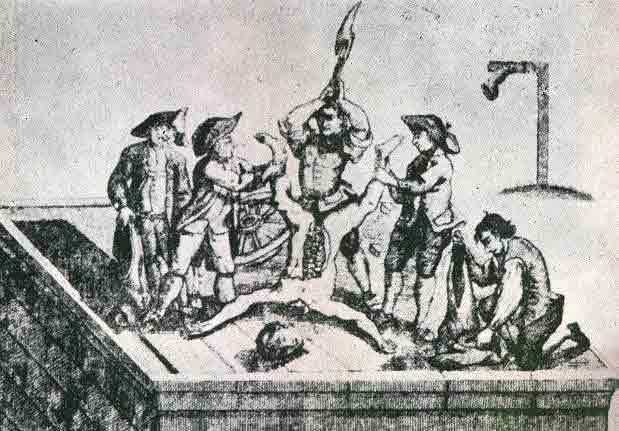
Hanged, drawn, and quartered. (source)

Although the Middle Ages were, in the imagination of our contemporaries, “the time of the gallows,” the reality was appreciably different (Carbasse, 2011, pp. 38-39)

Like many well-meaning people, I once considered the death penalty a relic of a more barbaric age. Outside the old jailhouse, here in Quebec City, I can see the open space where people used to be hanged … in public. In some cases, the authorities would go one better. The body would be placed in a cage and suspended near a thoroughfare for all to see … while it decomposed. This was our past, and presumably the system of justice was even more gruesome longer ago.

Actually, it wasn’t. Longer ago, the death penalty was not the preferred punishment for murder.

The Dark Ages – 5th to 12th centuries

When the Roman Empire collapsed in the 5th century, so did its system of retributive justice. Actually, justice had already become less retributive through the growing influence of Christianity. This is apparent in a letter from a Roman magistrate who felt troubled by the death penalty and sought advice from Ambrose, bishop of Milan (374-397). In a long reply, the bishop defended this punishment, but then went on to praise those who refrain from it. In fact, most of his reply was an appeal for mercy on the grounds that the wrongdoer may end up repenting (Swift, 1970, p. 542, see also Frost, 2010).

This trend continued after the Empire’s collapse. In 511, the bishops of France greatly extended the right of sanctuary. If a man committed murder, he could now ask for and receive sanctuary in any holy place. This policy was defended by Pope Gregory the Great: “Let the Church extend its protection even to those who have spilled blood, for it must not contribute, even indirectly, to the shedding of their own blood” (Carbasse, 2011, p. 34).

The new barbarian rulers also disliked the death penalty, but for different reasons. There was a strong feeling that every adult male had a right to use violence and to kill, if need be. This right was of course reciprocal. If you killed a man, his death could be avenged by his brothers and other male kinsmen. The prospect of a vendetta thus created a ‘balance of terror’ that kept violence within limits. So, initially, the barbarians allowed capital punishment only for treason, desertion, and cowardice in combat (Carbasse, 2011, p. 35).

As the barbarian kingdoms developed on the ruins of the Roman Empire, steps were taken to limit male violence, particularly when it took the form of vendettas. This was the aim of the Salic Law, proclaimed in 507-511:

[The Salic Law] is a pact (pactus) “concluded between the Franks and their chiefs,” for the specific purpose of ensuring peace among the people by “cutting short the development of brawls.” This term evidently means private acts of vengeance, the traditional vendettas that went on from generation to generation. In place of the vengeance henceforth forbidden, the law obliged the guilty party to pay the victim (or, in the case of murder, his family) compensation. This was an indemnity whose amount was very precisely set by the law, which described with much detail all of the possible damages, this being to avoid any discussion between the parties and make [murder] settlements as rapid, easy, and peaceful as possible. […] This amount was called the wergild, the “price of a man.” The victim’s family could not refuse the wergild, and once it was paid, the family had to be satisfied. They no longer had the right to avenge themselves (Carbasse, 2011, pp. 33-34).

The punishment for murder was thus monetized. If you killed a boy under 10, you paid 24,000 denars. Killing a free pregnant woman would cost a bit more: 28,000 denars. The payment was only 12,000 denars for killing a Roman who ate in the king’s palace (source). Capital punishment existed only for the murder of the king, for whom there was no wergild, or in the case of a slave killing a free man.

Over the next few centuries, attempts were made to broaden the scope of the death penalty but to little avail, partly because law enforcement was still rudimentary and because of resistance from the Church:

[…] the couple “peace and charity” remained the supreme objective. This ideal had practical applications, since the legal forms of this time offered model agreements called “peace” or “concords” (today we would say ‘plea bargaining’) for even major crimes like murder. Clearly, the public justice system was used only in exceptional cases, the usual way of settling disputes being private in nature (Carbasse, 2011, p. 36).

The war on murder – 12th to 17th centuries

Thus, for a long period, murder was normally a personal matter to be settled by the victim’s family, through vengeance or a cash settlement.

This situation began to change in the 12th century. One reason was that the State had become stronger. But there also had been an ideological change. The State no longer saw itself as an honest broker for violent disputes that did not challenge its existence. Jurists were now arguing that the king must punish the wicked to ensure that the good may live in peace. The Church itself was coming around to this view through what may be called a medieval synthesis of Christian morality:

[…] a reaction arose beginning in the 11th century against the previous system of monetary compensation. Henceforth, increasingly, it was felt that money could not be a sufficient compensation for such an infraction. The idea that the murder of a man is a crime too serious, an offence too manifest to the order of Creation, to be simply “compensated” by a sum of money was present from the early 11th century onward in the thinking of some bishops (Carbassse, 2011, p. 38)

And so began the war on murder. From the 12th to 17th centuries, capital punishment became steadily more prevalent. We see this in an increasing willingness to use it not only for murder but also for other crimes (rape, abortion, infanticide, lèse majesté, theft, counterfeiting, etc.). We also see this in the use of ‘exemplary’ punishment: drawing and quartering, breaking on the wheel, and burning. Beginning in the 13th and 14th centuries, we see cases of a murderer being buried alive in a casket placed underneath the victim’s casket (Carbasse, 2011, p. 53).

Then, after the 17th century, the war on murder began to go into reverse. It had been largely won, and public sympathy now shifted to the condemned man. In England, the homicide rate fell by over a hundred-fold between 1300 and 1900 (Eisner, 2001). Europeans were becoming kinder and gentler, and this pacification of social relations would make possible much of what we call modernity: the expansion of the market economy; a growing freedom to live among total strangers; the rise of the individual as an autonomous, self-maximizing being, and so on.

But this pacification also had a down side. We now take it for granted. If people act violently, to the point of committing murder, we assume there must be a very good reason. Otherwise, why would they have done it?

References

Carbasse, J-M. (2011). La peine de mort, Que sais-je ? Paris

Eisner, M. (2001). Modernization, self-control and lethal violence. The long-term dynamics of European homicide rates in theoretical perspective, Br J Criminol.,41, 618-638. http://bjc.oxfordjournals.org/content/41/4/618.abstract

Frost, P. (2010). The Roman State and genetic pacification, Evolutionary Psychology, 8(3), 376-389.
http://www.epjournal.net/filestore/EP08376389.pdf


Swift, L.J. (1970). St. Ambrose on violence and war, Transactions and Proceedings of the American Philological Association, 101, 533-543.

Friday, July 30, 2010

The Roman State and Genetic Pacification

The online journal Evolutionary Psychology has published my article “The Roman State and genetic pacification.” The following is the abstract:

Over the last 10,000 years, the human genome has changed at an accelerating rate. The change seems to reflect adaptations to new social environments, including the rise of the State and its monopoly on violence. State societies punish young men who act violently on their own initiative. In contrast, non-State societies usually reward such behavior with success, including reproductive success. Thus, given the moderate to high heritability of male aggressiveness, the State tends to remove violent predispositions from the gene pool while favoring tendencies toward peacefulness and submission.

This perspective is applied here to the Roman state, specifically its long-term effort to pacify the general population. By imperial times, this effort had succeeded so well that the Romans saw themselves as being inherently less violent than the “barbarians” beyond their borders. By creating a pacified and submissive population, the empire also became conducive to the spread of Christianity—a religion of peace and submission. In sum, the Roman state imposed a behavioral change that would over time alter the mix of genotypes, thus facilitating a subsequent ideological change.

Please feel free to offer your comments.

Reference
Frost, P. (2010). The Roman State and genetic pacification, Evolutionary Psychology, 8(3), 376-389,
 https://journals.sagepub.com/doi/full/10.1177/147470491000800306

Thursday, July 22, 2010

A strange story

Eboracum with the Colonia in the foreground and the fortress across the river.

In my last two posts, I presented evidence that Roman York (Eboracum) was home to a large African community in the late 300s. This was due to the stationing of Nubian archers and other African legionnaires in this and other garrison towns of northern England.

Did many remain after the end of Roman rule c. 400? By then, the legions had been largely pulled out and redeployed elsewhere in the dying empire. So the African legionnaires were certainly fewer in number. But these pullouts did not affect the veterans, who were already settled on local estates with their families. Among these ‘Afro-British’ settlers, valued skills like archery would have been passed down from father to son, thus making their community a key player during increasingly troubled times...

What happened after the end of Roman rule? Did this community survive into sub-Roman times? This is the period that began with the last pullout of Roman troops c. 400 and ended with the collapse of Romano-British society in the late 500s.

The historical sources are not entirely mute on this question. These sources, however, have been corrupted by the passage of time. There is also the human temptation to embellish the facts and tell a good story. This is especially so for the sub-Roman period, when many written records were destroyed and when writing itself became almost a lost art. Historical accounts survived only in oral form before being later written down, often much later.

The source that most interests us is the Historia Regum Britanniae (c. 1136), purportedly a translation of an old Welsh chronicle. It is largely consistent with earlier works on British history, like the Historia Britonum (9th-century), the Historia ecclesiastica gentis Anglorum (8th century), and the De Excidio et Conquestu Britanniae (6th century). On the other hand, many of its passages seem too outlandish to be true.

One passage, for instance, reports that over a hundred thousand Africans took part in the struggles between the Romano-British and the Anglo-Saxons:

The Saxons, having had experience of his [the British ruler’s] shiftiness, went unto Gormund, King of the Africans, in Ireland, wherein, adventuring thither with a, vast fleet, he had conquered the folk of the country. Thereupon, by the treachery of the Saxons, he sailed across with a hundred and sixty-six thousand Africans into Britain, which in one province the Saxons by perjuring their oath of fealty, and in another the Britons by continually carrying on civil wars amongst themselves, were utterly laying waste.

Entering into covenant, therefore, with the Saxons, Gormund made war upon Careticus, and after many battles betwixt them, drove him fleeing from city unto city until he forced him into Cirencester and did there beleaguer him.

[…] When Gormund at last had taken and burnt the said city, he did battle with Careticus and drove him fleeing beyond the Severn into Wales. Then he desolated the fields, set fire to all the neighbouring cities, nor did he stint his fury until he had burnt up well-nigh the whole face of the country from sea to sea; in such sort that all the colonies were battered to the ground by rams, and all they that dwelt therein along with the priests of the churches delivered up to the flashing of their swords or the crackling of the flames.

[… after] the tyrant of evil omen had laid waste, as hath been said, well-nigh the whole island with his countless thousands of Africans, the more part thereof which was called Loegria did he make over unto the Saxons through whose treachery he had come into the land. The remnant of the Britons did therefore withdraw them into the western parts of the kingdom, Cornwall, to wit, and Wales […]

Historia Regum Britanniae 11:8-10

If we exclude the African subplot, this story is consistent with other historical accounts, i.e., the Romano-British state fell because of internal dissensions and because the Anglo-Saxons had renewed their war of conquest after a half-century of vassalage.

But did these warring factions recruit soldiers from an African state in Ireland? No such state is described in any other account. On the other hand, the chronicler may have confused Hibernia (Ireland) with Eboracum (York)—the old garrison town where many African legionnaires had once been stationed. The two place names are especially similar if we remember that Eboracum would have been shortened to Ebora in late Latin.

Initially, these Africans may have hired themselves out to opposing Romano-British factions. Then, with the renewal of the Anglo-Saxon invasion, it is possible that many of them defected to that side, having seen which way the wind was turning. Perhaps this mass defection was decisive. Or perhaps the Welsh chronicler needed a scapegoat.

Anyhow, there is no doubt about the final outcome: the Romano-British state collapsed under conditions probably as dramatic as those described above. And it is certainly plausible that some soldiers switched sides. These were chaotic times when people had to live by their wits. In this, the Afro-British were probably no worse than others.

Did their community last into Anglo-Saxon times? This is doubtful. Even without the carnage of war, their numbers would have steadily declined, partly because of the below-replacement fertility that prevailed throughout the Roman Empire and partly because of the 6th-century plagues that carried off one in three people. There was also assimilation: beyond a certain point, successive intermarriage would have led to many individuals passing into the broader Romano-British society.

And, of course, there was the carnage of war. As soldiers, the Afro-British would have suffered many casualties. As civilians, they would have been caught up in the widespread destruction of the late 500s.

If this community did survive into Anglo-Saxon times, there would surely have been some mention by the
Venerable Bede [672-735], a prolific Christian writer who lived in Northumbria and often visited York. Yet he made no reference to them.

Or maybe he did. In his commentary on the book of Genesis, he comes down hard on Nimrod, who is often identified by Christian and Jewish commentators as a black African (because his father was Cush):

Genesis 10:8-9a Now Cush begot Nimrod. He began to be mighty on the earth, and he was a stout hunter before the Lord.
While the descendants of Shem and of Japheth remained in the innocence of a life of honesty, there arose from the cursed offspring of Ham one who corrupted the condition of the human way of life by a new kind of living. So long as he was puffed up by his remarkable power, he at first lived by hunting; then, having gathered an army, he strove to exert an unaccustomed tyranny upon the peoples. […]

10:9b From this came a proverb: Like Nimrod a stout hunter before the Lord.
It was turned into a proverb because unaccustomed deeds were done in his times. And the additional phrase, before the Lord, is for the sake of magnifying the outrage, namely that it was totally rash and arrogant that a man should dare to live in such a way on earth ‘before the Lord’.

But then why didn’t Bede mention these Afro-British in his Ecclesiastical History of the English People (Historia ecclesiastica gentis Anglorum)? Perhaps there was a reason for not mentioning them. He had sent an earlier draft to Ceolwulf, king of Northumbria, and asked for the king’s approval. If there had been an alliance between the Anglo-Saxons and Eboracum, Ceolwulf’s family would have been directly involved...

We will never know the full story. (It’s not for nothing that this period is called the Dark Ages). It’s likely that when Roman rule ended c. 400, power fell into the hands of a number of regional entities, including one centered on Eboracum. These entities gradually consolidated to fight the Anglo-Saxon invasion, eventually becoming a single kingdom under a charismatic leader, the semi-mythical “King Arthur.” This leader reduced the Anglo-Saxons to vassalage c. 500, thus bringing about a half-century of peace. Then, after his death c. 550, the Romano-British kingdom split up into warring factions. The Anglo-Saxons seized the opportunity and allied themselves with one or more of the losing factions, including the Afro-British warlords based at Eboracum.

It was an alliance that the Anglo-Saxons lived to regret, apparently because of “unaccustomed deeds.” Perhaps the African soldiers plundered not only Romano-British civilians but also those Anglo-Saxons who had remained in vassalage. Who knows? All we really know, based on archeological evidence, is that Eboracum became uninhabited at some point in the late 500s. And so ends a strange story.

References

Geoffrey of Monmouth. (1904) Histories of the Kings of Britain (Historia Regum Britanniae), transl. by Sebastian Evans
http://www.sacred-texts.com/neu/eng/gem/gem12.htm

Venerable Bede. (2008). On Genesis, transl. by C.B. Kendall, Liverpool University Press.

Friday, July 16, 2010

An African community in Roman Britain?

Figurines of Nubian archers (from Egypt)

The Roman conquest of Britain brought not only cultural change but also profound ethnic change, i.e., an influx of soldiers, officials, and traders from elsewhere. Until recently, historians placed this influx mainly in the first century of Roman rule. As the native British became Romanized, they would have increasingly filled local positions in the army and the administration. This view now appears to be erroneous: the process of ethnic replacement continued unabated and may have even intensified. In particular, the last century of Roman rule saw many soldiers arrive from North Africa and sub-Saharan Africa.

Leach et al. (2010) argue that the north of England, with its many garrison towns, became heavily multi-ethnic through the stationing of foreign soldiers and the subsequent settlement of veterans on local estates:


Inscriptions from York attest to the presence of Gauls, Italians and a possible Egyptian at York, although much of the epigraphic evidence is significantly earlier than the burial discussed here (Ottaway 2004). Artefactual evidence also suggests that ‘the Roman north was a cosmopolitan place with a great mixing of people from all over the empire’ (Cool 2002: 42). For example, Swan (1992) argued for the presence of North Africans in York on the basis of braziers and other vessels typical of North African food-ways but made in local fabrics.

Previous studies of the physical remains of the people of Eboracum (Buxton 1935; Warwick 1968) suggested that the males exhibited heterogeneous craniomorphometric traits suggesting migration from a variety of geographic locales. However, both argued that the female population of Roman York was indigenous. In their view, the diversity noted in the female crania represented genetic admixture between local women and migrant males
(Warwick 1968: 155).

Leach et al. (2009) provide evidence for intense foreign settlement. At one burial ground near Roman York, craniometric analysis revealed that 66% of the individuals clustered most closely with Europeans, 23% with sub-Saharan Africans, and 11% with Egyptians. At another, the proportions were 53% European, 32% sub-Saharan, and 15% Egyptian (Leach et al., 2009).

In a subsequent article, Leach et al. (2010) focus on one burial: a young woman 18 to 23 years old who had been buried between 350 and 400 AD. The authors dubbed her the ‘Lady of York’ because of her stone coffin and its rich array of grave goods, apparently a sign of high status. Nonetheless, her skull showed little or no affinity to any European population, the closest match being a sample of African-American women. Various facial indices showed a mix of sub-Saharan African and European traits, suggesting a person of mixed parentage or perhaps a North African. An African origin is also suggested by the presence of elephant ivory among the grave goods. The authors conclude that this burial “contradicts assumptions that may derive from more recent historical evidence, namely that immigrants are low status and male, and that African individuals are likely to have been slaves.”

Undoubtedly, many Africans rose to high positions in the Roman army. This was especially so for the Nubians, who were prized for their skills in archery. This being said, the Nubians came from the Egyptian culture area and, as such, attached great importance to human burial. In comparison to Europeans of the same socioeconomic status, they would have been more inclined to provide grave goods and to use tombs made from impervious materials.

High status is also inconsistent with a Latin inscription placed in the coffin: SOR AVE VIVAS IN DEO [Sister, hail, live in God]. This is Vulgar Latin, the kind used by the lower classes. An educated citizen would have inscribed the more classical soror instead of sor, especially in the formal context of a burial.

An African community in Roman Britain?

Leach et al. (2010) conclude that the Romans laid “the foundation of a multicultural and diverse community.”

The word ‘foundation’ suggests permanence and is perhaps inappropriate. If the Lady of York had lived a full life, she would have seen the end of Roman Britain—less than a half century later. She would have certainly witnessed the pullout of the legions and, perhaps, the arrival of the Dark Ages … with the breakdown of law and order after 430.

What happened to her community? Did it play a role in the struggles between the Romano-British and the Anglo-Saxons? Did it survive into the early Anglo-Saxon period?

I will try to answer these questions in my next post. For now, let me ponder another question: why had Roman Britain been so intensely militarized? More legions were stationed there than in Lower Germany, which was closer to the Empire’s core and faced a much larger barbarian population. If Britain had been ruled indirectly, through client states, the Romans would have been free to concentrate more soldiers along the crucial Rhine-Danube border.

These questions have answers … more or less. The Empire had annexed Britain during the early days of seemingly endless expansion, when military leaders worried much less about spreading themselves too thin. Britain was also a Celtic homeland. Its people were closely related to those of Gaul and had openly sympathized with them during the rebellion led by Vercingetorix. Even as a collection of client states, Britain would have remained a threat to Roman rule in Gaul. Finally, more legions were needed in Britain because the barbarians to the north (Scots and Picts) were less interested in being friends of Rome than those along the frontier of continental Europe.

Well, perhaps. In any case, history would have turned out the same either way. The main barbarian threat—the one that led to the sack of Rome in 410—came not from the barbarians outside the Empire but from those who had been allowed to settle within. This was an eventuality that Roman military strategists had never foreseen and for which they were unprepared. When the end came, the border fortifications proved to be of no help.

References

Leach, S., H. Eckardt, C. Chenery, G. Müldner, & M. Lewis. (2010). A Lady of York : migration, ethnicity and identity in Roman Britain, Antiquity, 84, 131-145.

Leach, S., M. Lewis, C. Chenery, G. Müldner, & H. Eckardt. (2009). Migration and diversity in Roman Britain: A multidisciplinary approach to the identification of immigrants in Roman York, England, American Journal of Physical Anthropology, 140, 546-561

P.S. The link and reference information for my 2008 article have changed. They are now:

Frost, P. (2008). Sexual selection and human geographic variation, Special Issue: Proceedings of the 2nd Annual Meeting of the NorthEastern Evolutionary Psychology Society. Journal of Social, Evolutionary, and Cultural Psychology, 2(4), pp. 169-191.
http://www.jsecjournal.com/articles/volume2/issue4/NEEPSfrost.pdf

Friday, July 9, 2010

Just who were the Romano-British?

The Anglo-Saxons ‘conquered’ the Civil Zone (non-shaded part of England), where the departing Roman army left a social and demographic vacuum. From W.E. Lunt's History of England

What happened to the Romano-British? Were they wiped out by the Anglo-Saxons? Or were they absorbed by their conquerors?

Razib Khan discusses the latest answer to this question. O'Dushlaine et al. (2010) used three genetic datasets:

1. A sample from Dublin, Ireland to represent the now extinct Romano-British.

2. A sample from Sweden to represent the Anglo-Saxons.

3. A sample from south and southeastern England to represent present-day English people.

Results: the English subjects were genetically closer to the Irish subjects than to the Swedish subjects. Conclusion: present-day English people are largely descended from the Romano-British. There was no ethnic cleansing.

Uh, not so fast. As Razib and his commenters point out, the Anglo-Saxons came not from Sweden but from what is now the Netherlands, northwest Germany, and southern Denmark. Frisians would probably be a closer match. Also, Dubliners inhabit an area of substantial Viking and English settlement. They too would be a lousy proxy for the Celtic inhabitants of Roman Britain.

But there’s another problem. A more basic one. How Celtic were the Romano-British? We know they had ceased to be Celtic linguistically.

After A.D. 43, Latin advanced rapidly. No Celtic inscription occurs, I believe, on any monument of the Roman period in Britain, neither cut on stone nor scratched on tile or potsherd, and this fact is the more noteworthy because, as I shall point out below, Celtic inscriptions are not at all unknown in Gaul. […]

The town site that we can best examine for our present purpose is Calleva or Silchester, ten miles south of Reading, which has been completely excavated with care and thoroughness. Here a few fairly complete inscriptions on stone have been discovered, and many fragments of others, which prove that the public language of the town was Latin. […]

In the twenty years' excavation of the site, no Celtic inscription has emerged. Instead, we have proof that the lower classes wrote Latin for all sorts of purposes. Had they known Celtic well, it is hardly credible that they should not have sometimes written in that language, as the Gauls did across the Channel. A Gaulish potter of Roman date could scrawl his name and record, Sacrillos avot, 'Sacrillus potter', on the outside of a mould. No such scrawl has ever been found in Britain. The Gauls, again, could invent a special letter Eth to denote a special Celtic sound and keep it in Roman times. No such letter was used in Roman Britain, though it occurs on earlier British coins. This total absence of written Celtic cannot be a mere accident. (Haverfield, 1912, pp. 10-12)

To a large degree, the Romano-British also ceased to be Celtic ethnically. This has been suspected on the basis of unusual burial objects and epigraphic inscriptions that record the presence of individuals from throughout the Roman Empire. Many came with the Roman army, as shown by fieldwork in Roman York—a town with a large garrison. At one burial ground, craniometric analysis revealed that 66% of the individuals clustered most closely with Europeans, 23% with sub-Saharan Africans, and 11% with Egyptians. At another, the proportions were 53% European, 32% sub-Saharan, and 15% Egyptian (Leach et al., 2009).

Britain was the most heavily militarized region of the Roman Empire. As such, it bore the full brunt of Romanization via the stationing of imperial troops and their demographic impact (associated influx of Roman officials, traders, etc., settlement of veterans, fathering of children with native women). This was especially so in the ‘Civil Zone’ of the south and the east, where the legions were garrisoned and where veterans usually settled after their years of service.

In the second century A.D., Britain had a garrison of ca. 50,000 men, comprised of three legions (with fortresses at Caerleon, Chester, and York) and a huge force of auxiliary troops. This army of occupation, variously estimated at between 10 and 12 percent of the entire imperial army, is a key distinguishing characteristic of Roman Britain, being by far the heaviest density of troops for a comparable area of territory. (Mattingly, 2000)

Native Celtic society was extinguished in the Civil Zone. It was submerged by a foreign military presence—like the impact of U.S. bases on certain Pacific islands. Thus, the Anglo-Saxons did not replace a native Celtic population. To some extent, they actually restored the status quo ante.

This conclusion leads to others. Wales and Cornwall are Celtic today because their inhabitants remained so during the Roman occupation. These regions fell within the Military Zone and became Romanized to a much lesser degree. In contrast, the Civil Zone developed into an atomized society of diverse origins where the main organizing principle was the Roman army. When the army withdrew in the early 5th century, Romano-British society imploded—a decline made all the worse by below-replacement fertility and 6th-century plagues that killed three out of ten people.


There is no need to postulate a process of ethnic cleansing. Once the plug had been pulled, the death of Roman Britain became inevitable.

References

Haverfield, F. (1912) The Romanization of Roman Britain, Second Edition, Oxford at the Clarendon Press.
http://www.munseys.com/diskfour/rombr.pdf

Khan, R. (2010). The English & Irish together again. Discover – Gene Expression, June 24
http://blogs.discovermagazine.com/gnxp/2010/06/the-english-are-like-the-irish-genetically/#more-4529

Leach, S., M. Lewis, C. Chenery, G. Müldner, & H. Eckardt. (2009). Migration and diversity in Roman Britain: A multidisciplinary approach to the identification of immigrants in Roman York, England, American Journal of Physical Anthropology, 140, 546-561.

Mattingly, D.J. (2000). Roman Britain - Military Aspects, Administration and Government, Towns, Countryside, Religion, Culture, and Economy, vallum, civitates, civitas
http://www.jrank.org/history/pages/5954/Roman-Britain.html

O'Dushlaine, C.T., D. Morris, V. Moskvina, G. Kirov, International Schizophrenia Consortium, M. Gill, A. Corvin, J.F. Wilson, and G.L. Cavalleri. (2010). Population structure and genome-wide patterns of variation in Ireland and Britain, European Journal of Human Genetics, advance online publication.

Thursday, January 14, 2010

Are empires bad for your health?

Do empires provide a higher standard of living? In theory, this might seem so. Empires allow goods, capital, and labor to circulate within a much larger land area, thus creating economies of scale and matching supply and demand more efficiently. Empires can also build public works—roads, canals, aqueducts, etc.—that are beyond the reach of smaller territorial entities.

This is still the view in much scholarly writing on the Roman Empire. Yet it is inconsistent with what physical anthropologists are discovering through analysis of skeletal remains. The latest of these studies concerns child burials from 3rd to 5th century Roman Dorchester, in southern England. The children show high levels of malnutrition and trauma: 38.5% had cribra orbitalia—a sign of iron or vitamin B12 deficiency; 12.5% had rickets—a sign of vitamin D deficiency; 4.8% had scurvy—a sign of vitamin C deficiency; and 5.4% had broken ribs (Lewis, 2010).

These rates are much higher than those for medieval England and point to a very poor diet. The incidence of rickets is interesting, since we see a similar high prevalence in industrial England (18th – early 20th centuries). The latter rickets epidemic is usually attributed to industrial smog that blocked UVB radiation and thus impaired vitamin-D synthesis in the skin. A likelier culprit is a diet made up almost wholly of bread, whose high content of phytic acid increases vitamin-D requirements by binding to calcium and phosphorus in the body, thus making these elements unusable (Lindeberg, 1997). This is also probably the cause of Roman-era rickets.

Lewis (2010) cites similar findings from other Roman sites:

Many questions remain about what impact the introduction of urban centers and the gradual economic decline at the end of the Roman Empire had on the local population. Some Roman scholars argue that “Romanization” brought about improvements to the health of the people (Mattingly, 2006, p. 323), with the writing of Roman architects such as Vitruvius conjuring up images of planned Roman cities, with marbled surfaces and flowing water, providing extensive facilities for the comfort and health of the inhabitants (Morley, 2005). Diametrically opposed is the argument that urbanization widened the divide between the rich and the poor, with many suffering hardships of poverty, social unrest, and subservience to the conquering population. The city of Rome itself is seen as overcrowded and filthy, with dogs and muggers prowling the streets, whereas the archaeological evidence calls into question the organization of the water supply and levels of sanitation, with latrines discovered near kitchen areas (Laurence, 1997; Morley, 2005). Garnsey (1999) has hypothesized that undernutrition was endemic in the urban communities of the Greco-Roman world …

Although the Roman Empire brought about an increase in economic wealth, much of this increase seems to have been either siphoned off by the elite or consumed by the large standing army. There is very little evidence that the average citizens were better off under imperial rule, and much suggests that they were worse off.

Why? One reason may be ‘diseconomies of scale.’ Empires tend to liquidate smaller communal entities that more efficiently deliver collective goods, such as community policing, high-trust social networks (for exchange of services and sharing of scarce goods), and support for family formation and child care. This is particularly evident in the Roman Empire’s high infantile mortality rate and low birth rate, with the result that natural increase became negative in late imperial times.

These smaller communal entities were liquidated by the tendency of individuals to migrate from one part of the Empire to another, either on their own or through resettlement of legionnaire veterans. This process of liquidation was also assisted by the State itself, which saw private collectivities as sources of conspiracy or rebellion. In fact, only a limited number of non-State associations were allowed, such as guilds, burial clubs, and officially recognized religions. The persecution of Christians was part of this tendency to see smaller collectivities as threats to the Empire.

Many of us, living in countries where for several centuries we have had fair liberty of association, may not realize just how recent such freedom is but realize that a civilization in which states fear their own citizens is one that recognizes its own inhumanity. Thus it cannot surprise us that in Antiquity most noncommercial associations were forbidden: the authorities realized that any social club might be a center for opposition to the régime. (source)

Empires also make life worse for the average person by fostering dependence on long-distance economic relationships that may collapse if one link in the supply chain disappears. When barbarian invasion disrupted grain shipments between North Africa and Italy in the 5th century, urban populations were suddenly without food. In general, empires create relationships between people who have no commitment to each other beyond short-term economic interest. When a crisis happens, these same people will give priority to their kinfolk … thus leaving in the cold any atomized individuals with no kinship networks to fall back on. When the Roman Empire collapsed, the latter were the ones who suffered the most.

References

Lewis, M.E. (2010). Life and death in a civitas capital: metabolic disease and trauma in the children from late Roman Dorchester, Dorset, American Journal of Physical Anthropology, early view.

Lindeberg, S. (1997), Cereal grains, Paleolithic Diet Symposium List, http://www.paleodiet.com/phytic.txt

Thursday, November 5, 2009

Was Roman Britain multiracial?

Historians often assume that the Romans changed Britain politically but not demographically. The indigenous elites adopted Roman culture while the mass of the population remained Celtic. When the Anglo-Saxons arrived in the fifth century, much of this population fled to Wales and Cornwall, where they would retain their language and traditions. Meanwhile, those who remained behind were obliterated through a process of ethnic cleansing and coerced assimilation.

This historical account may be false. First, the Roman occupation seems to have brought profound demographic change. This has been suspected for some time on the basis of unusual burial objects and epigraphic inscriptions that record the presence of individuals from throughout the Roman Empire. Now, after analyzing remains from two burial grounds near Roman York, a research team has concluded that the buried individuals had diverse geographic origins (Leach et al., 2009). In particular, the craniometric data revealed many of sub-Saharan or Egyptian origin. At the ‘Trentholme Drive’ burial ground, 66% clustered most closely with Europeans, 23% with sub-Saharan Africans, and 11% with Egyptians. At the ‘Railway’ burial ground, the proportions were 53% European, 32% sub-Saharan, and 15% Egyptian.

York was a legionary fortress, so these individuals may have been legionnaires. There are, in fact, epigraphic references to African soldiers and even a written account about one in a history of the Emperor Septimius Severus (146-211 AD) (Scriptores Historiae Augustae, p. 425).

On another occasion, when he was returning to his nearest quarters from an inspection of the wall at Luguvallium (Carlisle) in Britain, at a time when he had not only proved victorious but had concluded a perpetual peace, just as he was wondering what omen would present itself, an Ethiopian soldier, who was famous among buffoons and always a notable jester, met him with a garland of cypress-boughs. And when Severus in a rage ordered that the man be removed from his sight, the Ethiopian by way of jest cried, it is said, “You have been all things, now, O conqueror, be a god.”

Why were these Africans so far from home? In the case of the Egyptians, Rome thought it unwise to station soldiers among people of the same ethnic background. The temptation would be strong to side with the locals if a rebellion occurred. In the case of the sub-Saharan Africans, they were recruited into the army for the same reason that Germanic barbarians were recruited: Rome could not meet its manpower requirements solely from within its empire. There was also a perception that the Romans had become soft and that barbarians made better soldiers.

Finally, Rome, like many multi-national empires, had a policy of moving people around in order to promote a common identity and to eliminate ethnic distinctiveness. The Assyrians had perfected this policy, e.g., the deportation of the Jews to Babylon and their replacement by other peoples. The Roman authorities used their army to this end. They wished to create an atomized society where regionalism or ethnicity could not mobilize resistance to imperial rule.

It is likely that these legionnaires had a major demographic impact wherever they were stationed, especially if we include the many officials, petty functionaries, traders, and others who came in their wake. Much of Roman Britain thus seems to have been Romanized in culture and multiethnic in origin.

This, in turn, calls for a few other reinterpretations. Wales and Cornwall are not Celtic-speaking today because they took in Romano-British refugees fleeing Anglo-Saxon invaders. They were simply those parts of Britain that had remained Celtic in language, culture, and population. The rest—present-day England—had long become heavily Romanized and cosmopolitan.

Nor do we have to postulate a process of ethnic cleansing and coerced assimilation to explain the extinction of Roman Britain in the 5th and 6th centuries. As Seccombe (1992) points out, the Roman Empire suffered from negative population growth. Not enough people married and had children to offset relatively high mortality among infants and young adults. In breaking down local collective identities, whether ethnic or regional, the Empire had created an atomized and increasingly anonymous society without the carrots and sticks that tightly knit societies use to push individuals down the path of family formation.

Once Rome had pulled its troops out of Britain in the early 5th century, there was no longer an inflow of people to offset the demographic deficit. The local population fell into decline, and the decline accelerated in the 6th century when plagues killed three out of every ten people. The Romano-British needed no help from the Anglo-Saxons to die out. They did it largely on their own.

References

Leach, S., M. Lewis, C. Chenery, G. Müldner, & H. Eckardt. (2009). Migration and diversity in Roman Britain: A multidisciplinary approach to the identification of immigrants in Roman York, England, American Journal of Physical Anthropology, 140, 546-561.

Scriptores Historiae Augustae – Septimius Severus 22:4-6, transl. D. Magie (1922-1932) Vol 1, London: Heinemann.

Seccombe, W. (1992). A Millennium of Family Change. London: Verso.