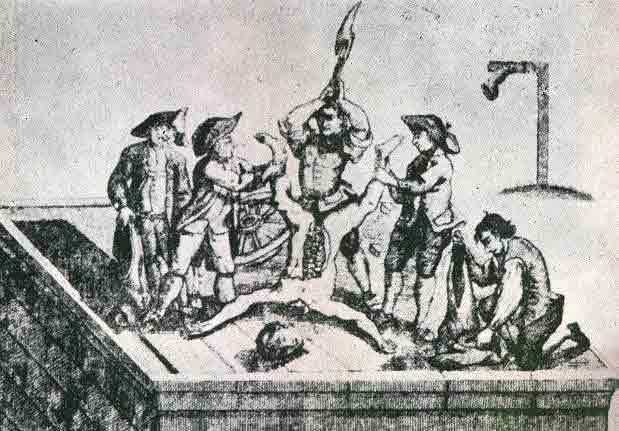
Hanged, drawn, and quartered. (source)
Although the Middle Ages were, in
the imagination of our contemporaries, “the time of the gallows,” the reality
was appreciably different (Carbasse, 2011, pp. 38-39)
Like many well-meaning people, I once considered the
death penalty a relic of a more barbaric age. Outside the old jailhouse, here
in Quebec City, I can see the open space where people used to be hanged … in
public. In some cases, the authorities would go one better. The body would be
placed in a cage and suspended near a thoroughfare for all to see … while it decomposed.
This was our past, and presumably the system of justice was even more gruesome longer
ago.
Actually, it wasn’t. Longer ago, the death penalty was
not the preferred punishment for murder.
The Dark Ages –
5th to 12th centuries
When the Roman Empire collapsed in the 5th century,
so did its system of retributive justice. Actually, justice had already become
less retributive through the growing influence of Christianity. This is
apparent in a letter from a Roman magistrate who felt troubled by the death
penalty and sought advice from Ambrose, bishop of Milan (374-397). In a long
reply, the bishop defended this punishment, but then went on to praise those who
refrain from it. In fact, most of his reply was an appeal for mercy on the
grounds that the wrongdoer may end up repenting (Swift, 1970, p. 542, see also Frost, 2010).
This trend continued after the Empire’s collapse. In
511, the bishops of France greatly extended the right of sanctuary. If a man
committed murder, he could now ask for and receive sanctuary in any holy place.
This policy was defended by Pope Gregory the Great: “Let the Church extend its
protection even to those who have spilled blood, for it must not contribute,
even indirectly, to the shedding of their own blood” (Carbasse, 2011, p. 34).
The new barbarian rulers also disliked the death
penalty, but for different reasons. There was a strong feeling that every adult
male had a right to use violence and to kill, if need be. This right was of
course reciprocal. If you killed a man, his death could be avenged by his
brothers and other male kinsmen. The prospect of a vendetta thus created a
‘balance of terror’ that kept violence within limits. So, initially, the
barbarians allowed capital punishment only for treason, desertion, and
cowardice in combat (Carbasse, 2011, p. 35).
As the barbarian kingdoms developed on the ruins of
the Roman Empire, steps were taken to limit male violence, particularly when it
took the form of vendettas. This was the aim of the Salic Law, proclaimed in 507-511:
[The Salic Law] is a pact (pactus) “concluded between the Franks
and their chiefs,” for the specific purpose of ensuring peace among the people
by “cutting short the development of brawls.” This term evidently means private
acts of vengeance, the traditional vendettas that went on from generation to
generation. In place of the vengeance henceforth forbidden, the law obliged the
guilty party to pay the victim (or, in the case of murder, his family) compensation.
This was an indemnity whose amount was very precisely set by the law, which
described with much detail all of the possible damages, this being to avoid any
discussion between the parties and make [murder] settlements as rapid, easy,
and peaceful as possible. […] This amount was called the wergild, the “price of a man.” The victim’s family could not refuse
the wergild, and once it was paid,
the family had to be satisfied. They no longer had the right to avenge
themselves (Carbasse, 2011, pp. 33-34).
The punishment for murder was thus monetized. If you
killed a boy under 10, you paid 24,000 denars. Killing a free pregnant woman
would cost a bit more: 28,000 denars. The payment was only 12,000 denars for killing
a Roman who ate in the king’s palace (source). Capital punishment existed only
for the murder of the king, for whom there was no wergild, or in the case of a slave killing a free man.
Over the next few centuries, attempts were made to broaden
the scope of the death penalty but to little avail, partly because law
enforcement was still rudimentary and because of resistance from the Church:
[…] the couple “peace and
charity” remained the supreme objective. This ideal had practical applications,
since the legal forms of this time offered model agreements called “peace” or
“concords” (today we would say ‘plea bargaining’) for even major crimes like
murder. Clearly, the public justice system was used only in exceptional cases,
the usual way of settling disputes being private in nature (Carbasse, 2011, p.
36).
The war on
murder – 12th to 17th centuries
Thus, for a long period, murder was normally a
personal matter to be settled by the victim’s family, through vengeance or a
cash settlement.
This situation began to change in the 12th century.
One reason was that the State had become stronger. But there also had been an
ideological change. The State no longer saw itself as an honest broker for violent
disputes that did not challenge its existence. Jurists were now arguing that
the king must punish the wicked to ensure that the good may live in peace. The
Church itself was coming around to this view through what may be called a
medieval synthesis of Christian morality:
[…] a reaction arose beginning in
the 11th century against the previous system of monetary compensation.
Henceforth, increasingly, it was felt that money could not be a sufficient
compensation for such an infraction. The idea that the murder of a man is a
crime too serious, an offence too manifest to the order of Creation, to be
simply “compensated” by a sum of money was present from the early 11th century onward
in the thinking of some bishops (Carbassse, 2011, p. 38)
And so began the war on murder. From the 12th to
17th centuries, capital punishment became steadily more prevalent. We see this
in an increasing willingness to use it not only for murder but also for other
crimes (rape, abortion, infanticide, lèse majesté, theft, counterfeiting,
etc.). We also see this in the use of ‘exemplary’ punishment: drawing and
quartering, breaking on the wheel, and burning. Beginning in the 13th and 14th
centuries, we see cases of a murderer being buried alive in a casket placed underneath
the victim’s casket (Carbasse, 2011, p. 53).
Then, after the 17th century, the war on murder began
to go into reverse. It had been largely won, and public sympathy now shifted to
the condemned man. In England, the homicide rate fell by over a hundred-fold
between 1300 and 1900 (Eisner, 2001). Europeans were becoming kinder and
gentler, and this pacification of social relations would make possible much of what we
call modernity: the expansion of the market economy; a growing freedom to live
among total strangers; the rise of the individual as an autonomous,
self-maximizing being, and so on.
But this pacification also had a down side. We now
take it for granted. If people act violently, to the point of committing
murder, we assume there must be a very good reason. Otherwise, why would they
have done it?
References
Carbasse, J-M. (2011). La peine de mort, Que sais-je ? Paris
Eisner, M. (2001). Modernization, self-control and
lethal violence. The long-term dynamics of European homicide rates in
theoretical perspective, Br J Criminol.,41, 618-638. http://bjc.oxfordjournals.org/content/41/4/618.abstract
Frost, P. (2010). The Roman State and genetic
pacification, Evolutionary Psychology,
8(3), 376-389.
http://www.epjournal.net/filestore/EP08376389.pdf
Swift, L.J. (1970). St. Ambrose on violence and war,
Transactions and Proceedings of the
American Philological Association, 101,
533-543.


