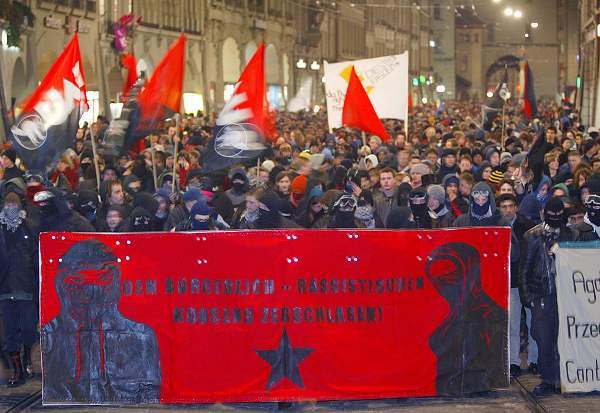
Antifas,
Switzerland (Wikicommons). Today, antifas are becoming an extrajudicial police,
just as human rights commissions are becoming a parallel justice system.
Until
three years ago, Canada’s human rights commissions had the power to prosecute
and convict individuals for "hate speech." This power was taken away after
two high-profile cases: one against the magazine Maclean's for printing an excerpt from Mark Steyn's book America Alone; and the other against the
journalist Ezra Levant for publishing Denmark’s satirical cartoons of the
prophet Mohammed. Both cases were eventually dismissed, largely because the
accused were well known and popular. As Mark Steyn observed:
[...]
they didn't like the heat they were getting under this case. Life was chugging
along just fine, chastising non-entities nobody had ever heard about, piling up
a lot of cockamamie jurisprudence that inverts the principles of common law,
and nobody paid any attention to it. Once they got the glare of publicity from
the Maclean's case, the kangaroos
decided to jump for the exit. I've grown tired of the number of Canadian
members of Parliament who've said to me over the last best part of a year now,
"Oh, well of course I fully support you, I'm fully behind you, but I'd
just be grateful if you didn't mention my name in public.” (Brean, 2008)
Despite
the dismissals, both cases had a chilling effect on Canadian journalism. Maclean's made this point in a news
release:
Though
gratified by the decision, Maclean's
continues to assert that no human rights commission, whether at the federal or
provincial level, has the mandate or the expertise to monitor, inquire into, or
assess the editorial decisions of the nation's media. And we continue to have
grave concerns about a system of complaint and adjudication that allows a media
outlet to be pursued in multiple jurisdictions on the same complaint, brought
by the same complainants, subjecting it to costs of hundreds of thousands of
dollars, to say nothing of the inconvenience. (Maclean's, 2008)
This
situation had come about gradually in Canada. At first, human rights
commissions fought discrimination only in employment and housing, and there was
strong resistance to prosecution of people simply for their ideas. This
situation changed from the 1970s onward. Human rights took the place in society
that formerly belonged to religion, and human rights advocates acquired the
immunity from criticism that formerly belonged to the clergy. Discrimination was
no longer wrong in certain cases and under certain circumstances. It became
evil, and people who condoned it in any form and for any reason were likewise
evil.
This
view of reality progressively transformed human rights commissions. On the one
hand, they were given an ever longer list of groups to protect. On the other, their
scope of action grew larger, expanding to include not only the job and housing
markets but also the marketplace of ideas. Their power increased until they
became a parallel justice system, the key difference being that they denied the
accused certain rights that had long existed in traditional courts of law,
particularly the presumption of innocence and the right to know one’s accuser. All
of this was made possible by section 13 of the Human Rights Act (1977):
Section
13 ostensibly banned hate speech on the Internet and left it up to the
quasi-judicial human rights commission to determine what qualified as
"hate speech." But, unlike a court, there was no presumption of
innocence of those accused of hate speech by the commission. Instead, those
accused had to prove their innocence. (Akin, 2013)
In
2012, the House of Commons repealed section 13. The ensuing three years brought
a return to normal and a dissipation of the chill that had descended on Canadian
journalists and writers.
Today,
our Indian summer is coming to an end. In Alberta, the human rights commission
is pushing to see how far it can go, and Ezra Levant is again being prosecuted:
This
October I will be prosecuted for one charge of being "publicly
discourteous or disrespectful to a Commissioner or Tribunal Chair of the
Alberta Human Rights Commission" and two charges that my "public
comments regarding the Alberta Human Rights Commission were inappropriate and
unbecoming and that such conduct is deserving of sanction."
Because
last year I wrote a newspaper editorial calling Alberta's human rights
commission "crazy". (Levant, 2015)
Last
month in Quebec, the government passed a bill that greatly expands the powers
of its human rights commission to prosecute "hate."
Bill
59, introduced by Quebec Premier Philippe Couillard's Liberal government, would
make it illegal to promote hate speech in Quebec, without defining what hate
speech is. Despite this, it would expand the definition of hate speech to
include "political convictions" for any speech deemed by Quebec's
human rights bureaucracy to promote "fear of the other", an absurdly
vague term which could easily lead to prosecutorial abuses.
Bill
59 would empower Quebec's human rights commission to investigate anonymous
complaints, or to launch investigations on its own, without any complaint,
culminating in charges before Quebec's Human Rights Tribunal. The tribunal
would be able to impose fines of up to $10,000 for first offenders, $20,000 for
repeat offenders. Those found to have violated the legislation would be named
and shamed on a publicly accessible list of offenders, maintained by the
government. (Editorial, 2015)
The
new law also casts a wider net by defining two forms of complicity in hate
speech, direct and indirect:
Engaging
in or disseminating the types of speech described in section 1 is prohibited.
Acting
in such a manner as to cause such types of speech to be engaged in or
disseminated is also prohibited. (Gouvernement du Québec, 2015)
"Hate
speech" is supposedly defined in section 1 of Bill 59, but this section
merely repeats the same term:
The
Act applies to hate speech and speech inciting violence that are engaged in or
disseminated publicly and that target a group of people sharing a
characteristic identified as prohibited grounds for discrimination under
section 10 of the Charter of human rights and freedoms (chapter C-12).(Gouvernement du Québec, 2015)
In
short, "hate speech" will be defined by the Quebec Human Rights
Commission, the only limitation being that the speech must target a protected
group.
How
did this piece of legislation come to be? It had been sold to the public as a
means to fight Islamist terrorism and, as such, gained the support of many people,
including right-wing politicians who thought its “ant-hate” language was just window
dressing to make it more palatable. In its final form, however, there are no
references at all to Islamism or terrorism. As columnist Joanne Marcotte points
out:
Nowhere
in the bill is this goal mentioned. It doesn't seem that this is the intention
of the Liberal Party, which is perhaps more concerned about a supposedly
Islamophobic current of opinion than about the pressure that radical religious
fundamentalists are exerting on our values of individual freedom.
Indeed,
no mention of the following words appear in the bill: fundamentalism,
fundamentalist, radicalism, radicalization, terrorism, religious (as in
"religious fundamentalism").
So
it isn't surprising that only two groups to date have supported the bill: The
Canadian Muslim Forum and the Muslim Council of Montreal. (Marcotte, 2015)
As
Joanne Marcotte notes ironically, this bill was pushed through by a
center-right government that claims to believe in individual freedom. Even more
ironically, the strongest support for the new law comes from the far left. A
demonstration in Montreal against Bill 59 was broken up by a hundred antifas.
The police were there but not one antifa was arrested (Kamel, 2015).
This
is a growing trend in Western countries: a strange alliance between
center-right regimes and far-left antifas. For all intents and purposes, the
latter are becoming an extrajudicial police, just as human rights commissions
are becoming a parallel justice system.
Conclusion
After
a brief lull, a new offensive has begun against "hate speech" in
Canada. Quebec is leading the way with legislation that is not only punitive
but also broadly-worded. Hate speech is whatever the human rights commission
considers to be hate speech.
Outside
Quebec, existing laws are likewise being interpreted more punitively and more broadly,
as seen in the prosecution of Ezra Levant for "disrespectful" speech.
This trend may lead to new legislation in other provinces and perhaps at the
federal level, especially if the Liberal Party takes power on October 19.
Although
the Liberal Party of Canada is legally distinct from the Liberal Party of
Quebec, the two work together and cater to the same clientele. The major
difference is that the former defines itself as center-left and the latter as
center-right. In practice, the difference is trivial, "left" and
"right" referring more and more to the same ideology. Today, the left
pushes for cultural globalism (multiculturalism, antiracism), while the right pushes
for economic globalism (outsourcing to low-wage countries, insourcing of
low-wage labor).
Quebec's
Bill 59 may thus become a template for federal legislation. The Liberal leader,
Justin Trudeau, has in fact promised to amend the Human Rights Act while not
spelling out his plans, other than to say he will recognize transgendered
individuals as a protected group.
So
will I be packing my bags and going south of the border? No, I love my country too
much and, frankly, I don’t envy Americans. The U.S. doesn’t have anti-hate laws
because it doesn’t need them. Most Americans have fully internalized the antiracist
ethos and can be counted on to be willing partners in their own dispossession.
The
situation is different in Canada, especially in Quebec: the new ethos is more
recent, has a weaker hold on people, and cannot be counted on “to do its job.”
This is why we have legislation like Bill 59. It’s a sign of weakness, not of
strength.
References
Akin,
D. (2013). Hate speech provision in Human Rights Act struck down, The Toronto Sun, June 26.
http://www.torontosun.com/2013/06/26/hate-speech-provision-in-human-rights-act-struck-down
Brean,
J. (2008). Maclean's wins third round of hate fight, National Post, October 11
Editorial
(2015). Quebec's Bill 59 attacks free speech, The Toronto Sun, September 4
http://www.torontosun.com/2015/09/04/quebecs-bill-59-attacks-free-speech
Kamel,
Z. (2015). Blows exchanged between anti-Bill 59 and anti-fascist demos. No
arrests made despite physical altercations, The
Link, September 28
http://thelinknewspaper.ca/article/blows-exchanged-between-anti-bill-59-and-anti-fascist-demos
Levant,
E. (2015). I'm being prosecuted for calling human rights commissions
"crazy," Stand with Ezra
http://www.standwithezra.ca/?utm_campaign=mrg_before_july&utm_medium=email&utm_source=standwithezra
Maclean's. (2008). Maclean's
responds to recent decision from the Canadian Human Rights Commission, June 26,
News Release
http://archive.newswire.ca/fr/story/210185/maclean-s-responds-to-recent-decision-from-the-canadian-human-rights-commission
Marcotte, J. (2015). Projet de
loi 59: liberticide, dangereux, inutile, Le
Huffington Post, September 21
http://quebec.huffingtonpost.ca/joanne-marcotte/projet-loi-59-liberticide-dangereux-propos-haineux-liberte-expression_b_8159532.html


