Showing posts with label French Canadians. Show all posts

Saturday, October 17, 2015

The end of Indian summer


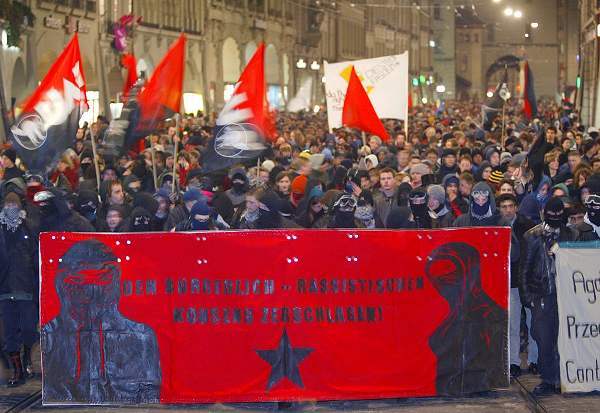
Antifas, Switzerland (Wikicommons). Today, antifas are becoming an extrajudicial police, just as human rights commissions are becoming a parallel justice system.


Until three years ago, Canada’s human rights commissions had the power to prosecute and convict individuals for "hate speech." This power was taken away after two high-profile cases: one against the magazine Maclean's for printing an excerpt from Mark Steyn's book America Alone; and the other against the journalist Ezra Levant for publishing Denmark’s satirical cartoons of the prophet Mohammed. Both cases were eventually dismissed, largely because the accused were well known and popular. As Mark Steyn observed:

[...] they didn't like the heat they were getting under this case. Life was chugging along just fine, chastising non-entities nobody had ever heard about, piling up a lot of cockamamie jurisprudence that inverts the principles of common law, and nobody paid any attention to it. Once they got the glare of publicity from the Maclean's case, the kangaroos decided to jump for the exit. I've grown tired of the number of Canadian members of Parliament who've said to me over the last best part of a year now, "Oh, well of course I fully support you, I'm fully behind you, but I'd just be grateful if you didn't mention my name in public.” (Brean, 2008)

Despite the dismissals, both cases had a chilling effect on Canadian journalism. Maclean's made this point in a news release:

Though gratified by the decision, Maclean's continues to assert that no human rights commission, whether at the federal or provincial level, has the mandate or the expertise to monitor, inquire into, or assess the editorial decisions of the nation's media. And we continue to have grave concerns about a system of complaint and adjudication that allows a media outlet to be pursued in multiple jurisdictions on the same complaint, brought by the same complainants, subjecting it to costs of hundreds of thousands of dollars, to say nothing of the inconvenience. (Maclean's, 2008)

This situation had come about gradually in Canada. At first, human rights commissions fought discrimination only in employment and housing, and there was strong resistance to prosecution of people simply for their ideas. This situation changed from the 1970s onward. Human rights took the place in society that formerly belonged to religion, and human rights advocates acquired the immunity from criticism that formerly belonged to the clergy. Discrimination was no longer wrong in certain cases and under certain circumstances. It became evil, and people who condoned it in any form and for any reason were likewise evil.

This view of reality progressively transformed human rights commissions. On the one hand, they were given an ever longer list of groups to protect. On the other, their scope of action grew larger, expanding to include not only the job and housing markets but also the marketplace of ideas. Their power increased until they became a parallel justice system, the key difference being that they denied the accused certain rights that had long existed in traditional courts of law, particularly the presumption of innocence and the right to know one’s accuser. All of this was made possible by section 13 of the Human Rights Act (1977):

Section 13 ostensibly banned hate speech on the Internet and left it up to the quasi-judicial human rights commission to determine what qualified as "hate speech." But, unlike a court, there was no presumption of innocence of those accused of hate speech by the commission. Instead, those accused had to prove their innocence. (Akin, 2013)

In 2012, the House of Commons repealed section 13. The ensuing three years brought a return to normal and a dissipation of the chill that had descended on Canadian journalists and writers.

Today, our Indian summer is coming to an end. In Alberta, the human rights commission is pushing to see how far it can go, and Ezra Levant is again being prosecuted:

This October I will be prosecuted for one charge of being "publicly discourteous or disrespectful to a Commissioner or Tribunal Chair of the Alberta Human Rights Commission" and two charges that my "public comments regarding the Alberta Human Rights Commission were inappropriate and unbecoming and that such conduct is deserving of sanction."

Because last year I wrote a newspaper editorial calling Alberta's human rights commission "crazy". (Levant, 2015)

Last month in Quebec, the government passed a bill that greatly expands the powers of its human rights commission to prosecute "hate."

Bill 59, introduced by Quebec Premier Philippe Couillard's Liberal government, would make it illegal to promote hate speech in Quebec, without defining what hate speech is. Despite this, it would expand the definition of hate speech to include "political convictions" for any speech deemed by Quebec's human rights bureaucracy to promote "fear of the other", an absurdly vague term which could easily lead to prosecutorial abuses.

Bill 59 would empower Quebec's human rights commission to investigate anonymous complaints, or to launch investigations on its own, without any complaint, culminating in charges before Quebec's Human Rights Tribunal. The tribunal would be able to impose fines of up to $10,000 for first offenders, $20,000 for repeat offenders. Those found to have violated the legislation would be named and shamed on a publicly accessible list of offenders, maintained by the government. (Editorial, 2015)

The new law also casts a wider net by defining two forms of complicity in hate speech, direct and indirect:

Engaging in or disseminating the types of speech described in section 1 is prohibited.

Acting in such a manner as to cause such types of speech to be engaged in or disseminated is also prohibited. (Gouvernement du Québec, 2015)

"Hate speech" is supposedly defined in section 1 of Bill 59, but this section merely repeats the same term:

The Act applies to hate speech and speech inciting violence that are engaged in or disseminated publicly and that target a group of people sharing a characteristic identified as prohibited grounds for discrimination under section 10 of the Charter of human rights and freedoms (chapter C-12).(Gouvernement du Québec, 2015)
 
In short, "hate speech" will be defined by the Quebec Human Rights Commission, the only limitation being that the speech must target a protected group.

How did this piece of legislation come to be? It had been sold to the public as a means to fight Islamist terrorism and, as such, gained the support of many people, including right-wing politicians who thought its “ant-hate” language was just window dressing to make it more palatable. In its final form, however, there are no references at all to Islamism or terrorism. As columnist Joanne Marcotte points out:

Nowhere in the bill is this goal mentioned. It doesn't seem that this is the intention of the Liberal Party, which is perhaps more concerned about a supposedly Islamophobic current of opinion than about the pressure that radical religious fundamentalists are exerting on our values of individual freedom.

Indeed, no mention of the following words appear in the bill: fundamentalism, fundamentalist, radicalism, radicalization, terrorism, religious (as in "religious fundamentalism").

So it isn't surprising that only two groups to date have supported the bill: The Canadian Muslim Forum and the Muslim Council of Montreal. (Marcotte, 2015)

As Joanne Marcotte notes ironically, this bill was pushed through by a center-right government that claims to believe in individual freedom. Even more ironically, the strongest support for the new law comes from the far left. A demonstration in Montreal against Bill 59 was broken up by a hundred antifas. The police were there but not one antifa was arrested (Kamel, 2015).

This is a growing trend in Western countries: a strange alliance between center-right regimes and far-left antifas. For all intents and purposes, the latter are becoming an extrajudicial police, just as human rights commissions are becoming a parallel justice system. 

Conclusion

After a brief lull, a new offensive has begun against "hate speech" in Canada. Quebec is leading the way with legislation that is not only punitive but also broadly-worded. Hate speech is whatever the human rights commission considers to be hate speech.

Outside Quebec, existing laws are likewise being interpreted more punitively and more broadly, as seen in the prosecution of Ezra Levant for "disrespectful" speech. This trend may lead to new legislation in other provinces and perhaps at the federal level, especially if the Liberal Party takes power on October 19.

Although the Liberal Party of Canada is legally distinct from the Liberal Party of Quebec, the two work together and cater to the same clientele. The major difference is that the former defines itself as center-left and the latter as center-right. In practice, the difference is trivial, "left" and "right" referring more and more to the same ideology. Today, the left pushes for cultural globalism (multiculturalism, antiracism), while the right pushes for economic globalism (outsourcing to low-wage countries, insourcing of low-wage labor).

Quebec's Bill 59 may thus become a template for federal legislation. The Liberal leader, Justin Trudeau, has in fact promised to amend the Human Rights Act while not spelling out his plans, other than to say he will recognize transgendered individuals as a protected group.

So will I be packing my bags and going south of the border? No, I love my country too much and, frankly, I don’t envy Americans. The U.S. doesn’t have anti-hate laws because it doesn’t need them. Most Americans have fully internalized the antiracist ethos and can be counted on to be willing partners in their own dispossession.

The situation is different in Canada, especially in Quebec: the new ethos is more recent, has a weaker hold on people, and cannot be counted on “to do its job.” This is why we have legislation like Bill 59. It’s a sign of weakness, not of strength.

References 

Akin, D. (2013). Hate speech provision in Human Rights Act struck down, The Toronto Sun, June 26.
http://www.torontosun.com/2013/06/26/hate-speech-provision-in-human-rights-act-struck-down

Brean, J. (2008). Maclean's wins third round of hate fight, National Post, October 11 

Editorial (2015). Quebec's Bill 59 attacks free speech, The Toronto Sun, September 4
http://www.torontosun.com/2015/09/04/quebecs-bill-59-attacks-free-speech 

Gouvernement du Québec (2015). Bill no. 59: An Act to enact the Act to prevent and combat hate speech and speech inciting violence and to amend various legislative provisions to better protect individuals, Assemblée Nationale du Québec.
http://www.assnat.qc.ca/en/travaux-parlementaires/projets-loi/projet-loi-59-41-1.html

Kamel, Z. (2015). Blows exchanged between anti-Bill 59 and anti-fascist demos. No arrests made despite physical altercations, The Link, September 28
http://thelinknewspaper.ca/article/blows-exchanged-between-anti-bill-59-and-anti-fascist-demos 

Levant, E. (2015). I'm being prosecuted for calling human rights commissions "crazy," Stand with Ezra
http://www.standwithezra.ca/?utm_campaign=mrg_before_july&utm_medium=email&utm_source=standwithezra 

Maclean's. (2008). Maclean's responds to recent decision from the Canadian Human Rights Commission, June 26, News Release
http://archive.newswire.ca/fr/story/210185/maclean-s-responds-to-recent-decision-from-the-canadian-human-rights-commission 

Marcotte, J. (2015). Projet de loi 59: liberticide, dangereux, inutile, Le Huffington Post, September 21
http://quebec.huffingtonpost.ca/joanne-marcotte/projet-loi-59-liberticide-dangereux-propos-haineux-liberte-expression_b_8159532.html

Saturday, October 5, 2013

French Canadians: The unexplained genetic diversity


Interior of a magasin général (source: photographiquement Frank). Wherever there was less competition from British or American merchants, it was easier for French Canadians to go into business. These same regions also have unusually high rates of neurological disorders, including Tay-Sachs. Coincidence?


French Canadians have a unique demographic history. From a founding population of some 10,000 settlers who came in the 17th and 18th centuries, they today number over ten million in Canada alone. This rapid growth shows what humans can do when war is absent, land plentiful, and government reasonably good.

Over those past three centuries, French Canadians have diverged from their cousins in France, not only culturally and politically but genetically as well. This is the finding of a recent study:

[…] in less than 20 generations of genetic isolation from the French population, the genetic pool of French-Canadians shows reduced levels of diversity, higher homozygosity, and an excess of rare variants with low variant sharing with Europeans. Furthermore, the French-Canadian population contains a larger proportion of putatively damaging functional variants, which could partially explain the increased incidence of genetic disease in the province. (Casals et al., 2013)

The authors try to explain this genetic divergence in terms of two causes: (1) a genetic bottleneck that allowed in only a small sample of France’s gene pool; and (2) relaxation of natural selection due to better living conditions, with a consequent accumulation of new genetic variants, i.e., people survived and reproduced who otherwise wouldn’t have back in Europe.

Clearly, there was a bottleneck. This is obvious from historical records and also from the degree of genetic homogeneity:

Compared to French individuals, French-Canadians have lower levels of heterozygosity (on average 19.2% and 11.5% of the variants per individual are heterozygous in French and French-Canadians, respectively) and have lower average nucleotide pairwise diversity. (Casals et al., 2013)

Despite this relative homogeneity, rare genetic variants are more frequent in French Canadians than in French people from France: 

The French-Canadian population also exhibits an excess of low frequency variants in comparison to the French population, and the proportion of variants with MAF [minor allele frequency] less than 5% is significantly higher in the French-Canadian population (p less than 0.01). The excess is not a consequence of different sample sizes; if we resample the same number of individuals from each population and include only sites where all individuals pass identical quality filters, we observe a similar excess of rare variants in the French-Canadian population compared to the French population. (Casals et al., 2013)

Why would French Canadians be less diverse for common alleles but more diverse for rare ones? The authors suggest relaxation of selection. As new mutations appeared in this new population, there was less selection than in France to weed out the bad ones.

Even so, the frequency of minor alleles seems to be higher than can be explained by relaxation of selection alone: “the shift observed in the empirical data, which shows an increase of 9.8% of variants with MAF less than 5% in the French-Canadian population compared to the French population when using the same sample sizes […], is larger than that generated by simulations” (Casals et al., 2013). The authors suggest that current theoretical models might underestimate the effects of relaxed selection, particularly under conditions of rapid population growth. Or perhaps this unexplained genetic diversity has some other cause. 

That other cause might be selection pressures that developed in some French Canadian subgroups and not in others. The authors themselves seem to raise this possibility when they go on to state that “the French-Canadian population is genetically stratified into subpopulations with differentiated demographic histories” (Casals et al., 2013).

Demographically and historically, there was a difference between frontier regions, where land was more available, and settled regions, where it was less so. Moreau et al. (2011) have shown that settlers on the wave front of colonization enjoyed a reproductive advantage over other French Canadians and thus contributed more to the current gene pool. Such settlers also seem to have been selected for higher fertility, according to a study of one French Canadian community. Between 1800 and 1940, the community of Île aux Coudres saw its mean age of first reproduction (AFR) fall by four years, not through a lowering of the mean age of marriage (which remained stable) but through a shortening of the mean interval between marriage and first birth. The study’s authors rule out better nutrition as a possible explanation, since infantile and juvenile survival rates should have likewise improved, yet they failed to do so during this period (Milot et al., 2011). 

There was also a demographic and historical difference between regions where French Canadians co-existed with American or British settlers and regions where they formed almost the entire population. In the first type of region, English-speakers dominated occupations that required business skills, i.e., numeracy, literacy, merchandising, bookkeeping, etc. In the second type of region, which covered most of eastern Quebec, these mercantile niches were much more open to any suitable French Canadian.

It is also in the second type of region that we see unusually high rates of neurological disorders. Of the top ten disorders in eastern Quebec, six are primarily neurological and two secondarily so. By comparison, only three of the top ten genetic disorders in the United Kingdom are primarily or secondarily neurological (Frost, 2012). These eastern French Canadian disorders also include two forms of Tay-Sachs: one on the south shore of the St. Lawrence and another on the north shore. In the town of Rimouski, the heterozygote frequency of Tay-Sachs is 7.6%, versus 4.2% among Ashkenazi Jews and 0.3% among French Canadians in Montreal (De Braekeleer et al., 1992). Relaxation of selection alone cannot account for this high incidence, nor can it explain the emergence of two different forms of Tay-Sachs within the same geographic area.

Instead of relaxation of selection, these eastern Quebec disorders may attest to intense selection for individuals who could exploit mercantile niches that were less available to French Canadians elsewhere. These niches were much more numerous than might seem from the relatively few people who identified themselves as ‘merchants’ to census takers. There was in fact a much larger number of ‘farmers’ who nonetheless had mercantile sidelines of one sort or another (note #1 and Frost, 2012). In eastern Quebec, the payoff for going into business, and the requisite mental skills, was so lucrative that it may have favored alleles, like Tay-Sachs, that seem to improve mental processing in the heterozygous state while being deleterious in the homozygous state (Cochran et al., 2006).

This last point bears repeating. What is harmful in the homozygote may still be adaptive in the far more numerous heterozygotes. A high prevalence of genetic disorders might just mean that a very strong selection pressure was acting for a very short time … and that there was nothing better to work with. Natural selection does its best with whatever genetic variants are available. Eventually, through random mutation, there will appear more suitable variants that provide the same benefits with fewer adverse effects, and these genetic solutions will replace the ‘rough-and-ready’ ones that had initially been favored. 

Conclusion

French Canadians are genetically unique for several reasons. First, they descend from a small founder group. Second, they had high rates of population growth over a period of some three centuries. Third, they adapted to a very different environment and a very different set of selection pressures. In France, their ancestors lived almost under steady state conditions: land scarcity, small family size, late marriage for men and women alike, rigid class distinctions, and limited geographic mobility. In Quebec, those limitations were weaker if not absent altogether. Because land was much more plentiful, the opportunities were accordingly greater for marrying younger and having larger families. This freer and less limiting environment foiled attempts to transplant feudalism to Quebec even during the French Regime, with the result that the term paysan never caught on. People called themselves habitants. Finally, in comparison to other French Canadians within the same region, business-minded individuals had more chances for economic betterment in those areas, like eastern Quebec, where competition from American or British merchants was relatively weak.

Note

1. Gustave Papillon, the founder of one of Quebec’s leading cement plants, started off as a poultry producer and probably identified himself as such to census takers. Yet he also had two sidelines: installing elevators and escalators; and reselling pharmaceutical products to local drugstores. His decision to start up a cement plant grew out of this pre-existing entrepreneurial mindset (Gadbois and Papillon, 2013).

References 

Casals, F., A. Hodgkinson, J. Hussin, Y. Idaghdour, V. Bruat, T. de Maillard, J-C. Grenier, E. Gbeha, F.F. Hamdan, S. Girard, J-F. Spinella, M. Larivière, V. Saillour, J. Healy, I. Fernandez, D. Sinnett, J.L. Michaud, G.A. Rouleau, E. Haddad, F. Le Deist, and P. Awadalla. (2013). Whole-exome sequencing reveals a rapid change in the frequency of rare functional variants in a founding population of humans. PLoS Genet 9(9): e1003815. doi:10.1371/journal.pgen.1003815
http://www.plosgenetics.org/article/info%3Adoi%2F10.1371%2Fjournal.pgen.1003815 

Cochran, G., J. Hardy, and H. Harpending. (2006). Natural history of Ashkenazi intelligence, Journal of Biosocial Science, 38, 659-693.
http://web.mit.edu/fustflum/documents/papers/kim-beder.pdf 

De Braekeleer, M., P. Hechtman, E. Andermann, and F. Kaplan. (1992). The French Canadian Tay-Sachs disease deletion mutation: Identification of probable founders, Human Genetics, 89, 83-87.
http://link.springer.com/article/10.1007/BF00207048#page-1

Frost, P. (2012). Tay-Sachs and French Canadians: A case of gene-culture co-evolution? Advances in Anthropology, 2 (3), 132-138. http://www.scirp.org/journal/PaperInformation.aspx?paperID=21701

Gadbois, M-E. and L. Papillon. (2013). Gustave Papillon. Building Ciment Québec, Ciment Québec.

Milot, E., F.M. Mayer, D.H. Nussey, M. Boisvert, F. Pelletier, and D. Réale. (2011). Evidence for evolution in response to natural selection in a contemporary human population, Proceedings of the National Academy of Sciences (USA), 108, 17040–17045.
http://www.ncbi.nlm.nih.gov/pmc/articles/PMC3193187/pdf/pnas.201104210.pdf

Moreau, C., C. Bherer, H. Vezina, M. Jomphe, D. Labuda, and L. Excoffier. (2011). Deep human genealogies reveal a selective advantage to be on an expanding wave front, Science, 334, 1148–1150.
http://www.sciencemag.org/content/334/6059/1148.short

Saturday, September 8, 2012

Growing your own merchant class

Sign for an inn, late 17th century, New France. Many merchants began as innkeepers who provided not only accommodation but also other services. (source)

I have just published an article in the journal Advances in Anthropology:  Tay-Sachs and French Canadians: A Case ofGene-Culture Co-Evolution? Comments are welcome.

Abstract
Tay-Sachs, an inherited neurological disorder, is unusually common among French Canadians from eastern Quebec. Two alleles are responsible, one being specific to the north shore of the St. Lawrence and the other to the south shore. This pattern of convergent evolution suggests the presence of a selection pressure limited to eastern Quebec. Both alleles probably arose after the British conquest of Quebec in 1759 or at least were uncommon previously. To explain the high incidence of Tay-Sachs among Ashkenazi Jews, some authors have invoked heterozygote advantage, i.e., heterozygous individuals enjoy a higher rate of neuronal growth, and thus greater learning capacity, without the neurological deterioration of homozygous individuals. Such an advantage would have helped Ashkenazim perform the mental effort required for work in trade and crafts. A similar situation may have developed in eastern Quebec, where the relative scarcity of British and American merchants made it easier for French Canadians to enter occupations that required literacy, numeracy, and future time orientation.

Reference


Frost, P. (2012). Tay-Sachs and French Canadians: A Case of Gene-Culture Co-Evolution? Advances in Anthropology, 2 (3), 132-138.
http://www.scirp.org/journal/PaperInformation.aspx?paperID=21701

Saturday, November 12, 2011

The Western European marriage pattern


The ‘Hajnal line’ marks the eastern limit of a longstanding pattern of late and non-universal marriage. The line in red is Hajnal's. The dark blue lines show areas of high nuptiality West of the Hajnal line. Source

In the 17th and 18th centuries, settlers emigrated from land-poor France to land-rich Canada. The result was a lower age of marriage. Young men and women no longer had to wait for their parents to hand over the family farm. Land was plentiful, and early family formation much easier.

This new social reality led to a new biological reality. From one generation to the next there was a steady contraction of the time between age of marriage and age of first birth. Married women—many as young as 15— were getting pregnant faster. The mean age of full reproductive maturity seems to have slowly fallen at a steady rate, apparently through the reproductive success of women who could better exploit the opportunities for early family formation (Milot et al., 2011).

But what about the homeland of these French settlers? Had that land-poor environment selected for a later onset of full reproductive maturity? That would seem to be a logical inference. Late and non-universal marriage was in fact the pattern throughout Europe west of a line stretching from Trieste to St. Petersburg:

By 1650, when village reconstitution studies become sufficiently numerous to render the generality of the pattern indubitable, the average age of women at first marriage was twenty-four or over, 7 to 20 per cent of women never married, and the incidence of childbirth out of wedlock was below 3 per cent. This marital pattern restricted fertility massively. A very considerable minority of women remained single and bore no children; those who married bore none for the first ten years of their fecund life-phase, on average. If they had their last child at the age of forty, their entire reproductive careers would span roughly fifteen years, a long time by modern standards but remarkably brief in a pre-transition context. Resulting fertility was less than half the rate that would have been achieved if all women between fifteen and fifty were married. (Seccombe, 1992, p. 184)

The ‘Western European marriage pattern’ was initially thought to have developed after the Black Death of the mid-14th century. But this belief has been challenged by a study of marriage between 1252 and 1478 in an English community:

The average age at first marriage in the Lincolnshire Fenland before the Black Death would be 24 years for the woman and 32 years for the man. The wife would die one year before her husband and the marriage would last for about 13 years. The couple could have six children, if their fertility was higher than average, of whom, judging by pedigrees, perhaps three would survive to become adults. After the Black Death the mean age would be 27 for the woman and 32 for the man. The husband would die three years before his wife and the marriage would last about 12 years. Again the couple could have six children, of whom perhaps three would survive to become adult. (Hallam, 1985, p. 66)

This pattern of late marriage may have been accentuated by the Black Death, but it was already present beforehand. Hallam (1985, p. 56) cites additional evidence for late marriage farther back in 9th-century France. On the estates of the Abbey of St Germain-des-Prés near Paris, about 16.3% of all adults were unmarried. In Villeneuve-Saint-Georges, the figure was 11.5%. Seccombe (1992, p. 94) cites a 9th-century survey of the Church of St Victor of Marseille, where both men and women appear to have married in their mid to late twenties.

Going even farther back, Seccombe (1992, p. 94) cites the Roman author Tacitus’ reference to Germanic women being “not hurried into marriage [and] as old and as full-grown as the men [who were] slow to mate.”

So when did the Western European marriage pattern begin? I suspect its origins lie in the late Neolithic of Western Europe, when farming communities had reached a saturation point. With farmland in short supply, young men and women had to wait their turn before they could marry and have children of their own. And some would never marry.

What happened to these never-married? They may have turned toward community service of one kind or another. If they couldn’t have children of their own, they would’ve invested their energies in helping others of their community—who were often their kinfolk. In this respect, the Catholic Church may have simply adopted and further developed a cultural pattern that was already present in Western Europe.

By the early Christian era, this pattern was clearly in evidence: monks and nuns dedicated their lives to creating centers of learning and, eventually, colleges and universities. They also founded hospices for the sick and injured. Much of what we now call the ‘welfare state’ has its origins in the work of these celibate men and women.

Together with the prohibition of cousin marriage, this pattern of lengthy and sometimes lifelong celibacy paved the way for a future of larger and more open societies where the State, and not one’s clan, would provide collective services. Of course, it wasn’t planned that way. Nothing is planned in cultural or biological evolution. Western Europe simply accumulated a mix of cultural traits that would later make possible the rise of ‘modern society.’

Did this marriage pattern shape the biology of Western Europeans through natural selection? Was there gene-culture co-evolution? This is likely with respect to the pace of sexual maturation. Keep in mind that the time between menarche and first birth was ten to twelve years on average. Nature abhors a vacuum, and there would have been a tendency to slow the pace of sexual maturation for both biological and psychological traits. Just as land-rich North America selected for successful pregnancy at younger ages, the reverse had probably happened in land-poor Europe.

References

Hallam, H.E. (1985). Age at first marriage and age at death in the Lincolnshire Fenland, 1252-1478, Population Studies, 39, 55-69.

Milot, E., F.M. Mayer, D.H. Nussey, M. Boisvert, F. Pelletier, and D. Réale. (2011). Evidence for evolution in response to natural selection in a contemporary human population, Proceedings of the National Academy of Sciences (USA), early view

Seccombe, W. (1992). A Millennium of Family Change. Feudalism to Capitalism in Northwestern Europe, London: Verso.

Saturday, October 29, 2011

Bringing reproductive maturity into line with the age of marriage


Île aux Coudres, a French Canadian community on an island in the St. Lawrence

Human biodiversity is slowly making headway in academia. It has three defining principles:

1. Evolution did not end, or even slow down, with the advent of Homo sapiens. It has actually accelerated.

2. It especially accelerated about 10,000 years ago, when the rate of genetic change rose over a hundred-fold among early modern humans. This acceleration didn’t happen because they were spreading into new physical environments with different climates, topographies, vegetation, and wildlife. By then, humans had already spread throughout the world from the equator to the arctic. They were now spreading into new cultural environments with different technologies, social structures, belief systems, and means of subsistence.

3. The human species has therefore experienced more genetic change over the past 10,000 years than over the previous million years. This change has particularly involved genes for mental, behavioral, and life-history traits (Frost, 2011; Hawks et al., 2007).

One life-history trait is the age of first reproduction (AFR). Because AFR is highly heritable, there may have been co-evolution between biology and culture. In other words, natural selection has tended to bring full reproductive maturity into line with the age when young couples have enough resources to marry and start a family.

When Europeans first began to settle North America, they came from a land-poor environment where young people had to postpone marriage and family formation. Typically, they had to wait until their parents handed over the farm in whole or in part. This tendency toward late marriage was widespread throughout Western Europe, so much so that it has been dubbed the ‘Western European Marriage Pattern’:

[…] the late and non-universal marriage pattern was definitely prevalent across Northwestern Europe in the seventeenth century. By 1650, when village reconstitution studies become sufficiently numerous to render the generality of the pattern indubitable, the average age of women at first marriage was twenty-four or over, 7 to 20 per cent of women never married, and the incidence of childbirth out of wedlock was below 3 per cent. This marital pattern restricted fertility massively. A very considerable minority of women remained single and bore no children; those who married bore none for the first ten years of their fecund life-phase, on average. If they had their last child at the age of forty, their entire reproductive careers would span roughly fifteen years, a long time by modern standards but remarkably brief in a pre-transition context. Resulting fertility was less than half the rate that would have been achieved if all women between fifteen and fifty were married. (Seccombe, 1992, p. 184)

All of this changed when Europeans began to settle in the “New World.” Suddenly, land was no longer a constraint on marriage, and early marriage became the norm. With the downward shift in the age of marriage, was there a corresponding downward shift, via natural selection, in the age of full reproductive maturity?

Yes, according to a recent study of Île aux Coudres, a French Canadian community on an island in the St. Lawrence. Over a period of 140 years, from 1800 to 1940, this community saw its mean AFR fall by four years. This decline was driven not by a lowering of the mean age of marriage (which now remained stable) but by a shortening of the mean interval between marriage and first birth.

The decline in AFR seems to have been real, and not an artefact of incomplete marriage and birth records. In fact, the church registers provide exceptionally detailed birth and marriage data. Nor was it an artefact of an influx of people with lower AFRs. Almost everyone on Île aux Coudres is descended from thirty families who settled the island between 1720 and 1773.

Could the reason have been changes to diet and nutrition? Unlikely.

The advancement of age at maturity, as well as increases in fertility, may reflect plastic responses to improvements in nutritional conditions, such as those observed during the 19th and 20th centuries in Western societies. Better-fed women grow faster, mature earlier and in a better physiological state, and are more fecund. Importantly, alongside such plastic responses in reproductive traits, we would expect an increase in infant and juvenile survival rates with time. Despite some fluctuations, infant and juvenile survival rates on île aux Coudres were not higher at the end of the study period than at the beginning. (Milot et al., 2011)

When I first heard of this study, I thought that some kind of cultural lag might have been responsible. Old habits die hard. Perhaps many of the early settlers, with memories of the old country, were still afraid of not having enough land to support a family, even after they had decided to marry. This reticence would have then gradually disappeared as memories of the old country disappeared.

Such a change in mentality, however, would have happened much more among the earlier generations than among the later ones. Yet this is not what we see in the data. AFR changed at the same rate from one generation to the next throughout the 140-year period. Couples married after 1870 showed the same rate of change as couples married before 1870. Indeed, this steady rate of change seems to rule out most socio-cultural explanations, particularly those that involve some kind of re-adjustment to new conditions. In any case, the study period (1800 to 1940) postdates the years of immigration and settlement (1720 to 1773).

We’re certainly going to see more studies like this one, either from Île aux Coudres or from other regions of French Canada. In general, French Canadian communities are ideal for the study of human microevolution. Records of births, marriages, and deaths are remarkably complete over a span of three centuries, and the inhabitants tended to stay put in the same locality generation after generation. For several regions of Quebec, we already have complete genealogical databases that could be enriched with genetic data for the most recent generations.

Reference

Frost, P. (2011). Human nature or human natures? Futures, 43, 740-748.
http://dx.doi.org/10.1016/j.futures.2011.05.017

Hawks, J., E.T. Wang, G.M. Cochran, H.C. Harpending, & R.K. Moyzis. (2007). Recent acceleration of human adaptive evolution, Proceedings of the National Academy of Sciences (USA), 104, 20753-20758.

Milot, E., F.M. Mayer, D.H. Nussey, M. Boisvert, F. Pelletier, and D. Réale. (2011). Evidence for evolution in response to natural selection in a contemporary human population, Proceedings of the National Academy of Sciences (USA), early view

Seccombe, W. (1992). A Millennium of Family Change. Feudalism to Capitalism in Northwestern Europe, London: Verso.

Saturday, June 18, 2011

More on French Canadians and Tay Sach's

French Canadian habitants playing at cards (Cornelius Krieghoff). With fewer British merchants than elsewhere, eastern Quebec was a land of opportunity for business-minded French Canadians. Did this selection affect the local gene pool?

When discussion turns to Tay Sach’s, people automatically think of the Jewish community. Yet this inherited illness reaches high levels in other human populations, particularly French Canadians.

Tay Sach’s has three unusual characteristics among French Canadians:

1. It is highly localized geographically, being concentrated in eastern Quebec. In Rimouski, the heterozygote frequency is 7.6%, versus 4.2% among Ashkenazi Jews and 0.3% among French Canadians in Montreal (De Braekeleer et al, 1992).

2. It is caused by two separate mutations: one that arose on the north shore of the St. Lawrence (Charlevoix and Saguenay-Lac Saint-Jean) and another that arose on the south shore (Bas Saint-Laurent) (Zlotogora, 1994).

3. It is relatively recent in origin, being absent in France. Neither mutation can be more than three centuries old and both probably postdate the British conquest of Quebec (1759).

These three characteristics argue for some kind of selective advantage, and not a random founder effect. Among Ashkenazi Jews, the selective advantage seems to be improved mental processing. Indeed, Tay Sach’s is one of four different genetic illnesses that are unusually common among Ashkenazim and that affect the same metabolic pathway in brain tissues (lysosomal storage). Homozygotes suffer neurological degeneration, mental retardation, and other neural problems. Heterozygotes, however, may be better at mentally demanding occupations (Cochran et al., 2006; Frost 2007; Murray, 2007; Zlotogora, 1994).

Interestingly, Tay Sach’s co-occurs in eastern Quebec with another hereditary illness that lies in the same metabolic pathway, i.e., lysosomal storage.

The mucolipidoses are composed of four distinct clinical conditions (designated type I–IV) that result from the accumulation of lipid and carbohydrate molecules due to specific lysosomal enzyme defects. (...) In the absence of this step, lysosomal enzymes are incorrectly routed into the extracellular space. This disorder is rare, with an estimated incidence of 1 in 640 000 births, although it may be higher in Saguenay-Lac-St Jean, a French Canadian isolate. (Ekstrand & Sankar, 2009, p. 603)


Are lysosomal storage illnesses common in eastern Quebec for the same reason that they are common among Ashkenazi Jews? At first thought, the idea may seem absurd. Weren’t French Canadians historically a nation of farmers? And didn’t British merchants fill all of the mentally demanding occupations?

In reality, things were not so simple. There was always a French-Canadian middle class, particularly wherever British merchants were few and far between. They were especially rare in those parts of eastern Quebec that today have high rates of Tay Sach’s (Charlevoix, Saguenay-Lac Saint-Jean, Bas Saint-Laurent). This rarity came to the notice of Alexis de Tocqueville while passing through Bas Saint-Laurent in 1831:

In this portion of Canada, one does not hear English at all. The population is only French, and yet when one encounters an inn, or a merchant, the sign is in English. (De Tocqueville, 2003, p. 185).


This lack of English competition opened up an enviable niche for French Canadians—or rather for those with the right aptitudes, especially in numeracy, literacy, and bilingualism. Elsewhere, these niches were filled by British immigrants, particularly in Montreal, Quebec City, the Eastern Townships, the Ottawa valley, and the southern and eastern shorelines of the Gaspé Peninsula.

This point is made in a study of the life of John Guay (1828-1880), a leading French Canadian merchant in the Saguenay region. To enter this occupational niche required a special mental toolkit:

Success in trade was never easy because of the competition, the fragility of the markets, and the instability of business conditions. The ablest managed to live or survive. Others, the greatest number, closed shop after a few years. Only those possessing exceptional qualities would make a fortune. (Lapointe, 1996, p. 3)


But the payoff was huge. John Guay had ten children who survived to adulthood—twice the mean reproductive success of his French Canadian contemporaries. Lapointe (1996, p. 126) attributes Guay’s success in business to the mental outlook he displayed from an early age:

The evolution of market capitalism has given rise to rules that a businessman cannot evade. One cannot simply improvise as a merchant. It takes talent and of course capital. Spontaneous generation was very uncommon in 19th-century Quebec, indeed nonexistent in John Guay’s case. The family environment in which he grew up predisposed him to develop an interest and also aptitudes for the businesses of trade, forestry, and farming. His successful career henceforth proved that a French-Canadian merchant could ably penetrate the world of business; a world where, let us remember, English Canadians controlled most of the commercial and industrial activities.


The Beauce exception

One region in eastern Quebec, however, has always been solidly French Canadian and yet has low incidences of Tay Sach’s and mucoliposes. This is Beauce County, a region south of Quebec City that covers the Chaudière valley up to the American border. Furthermore, Beaucerons are stereotyped as being self-reliant, business-minded go-getters—the “Yankees” of Quebec.

Beauce County nonetheless differs demographically from the rest of eastern Quebec in one respect. Settlement began earlier there than elsewhere, well before the Conquest. There was thus a larger pool of people and hence more individuals who could fill the niches that opened up after the Conquest, as Quebec moved from a semi-feudal mercantilist society to a more market-driven economy. Selection thus had more leeway to favor individuals who had the necessary aptitudes while not suffering the costs that lysosomal storage illnesses impose on homozygotes.

Fast evolution?

All of this might seem hard to believe. How could such selection operate over a time span of less than two centuries? Yet that is what the data tell us. Neither of these Tay Sach’s mutations is present in France. They must have gone from zero to their current high prevalence in less than ten generations.

References

Cochran, G., J. Hardy, & H. Harpending. (2006). Natural history of Ashkenazi intelligence. Journal of Biosocial Science, 38, 659-693.

De Braekeleer, M., P. Hechtman, E. Andermann, & F. Kaplan. (1992). The French Canadian Tay-Sachs disease deletion mutation: identification of probable founders, Human Genetics, 89, 83-87.
De Tocqueville, A. (2003). Regards sur le Bas-Canada, Typo.

Ekstrand J. and R. Sankar (2009). Storage Disorders, in Lisak, R.P., D.D. Truong, W.M. Carroll, & R. Bhidayasiri (eds). International Neurology. A Clinical Approach, (pp. 600-608), Wiley-Blackwell: Oxford

Frost, P. (2007). Natural selection in proto-industrial Europe, Evo and Proud, November 16.
http://evoandproud.blogspot.com/2007/11/natural-selection-in-proto-industrial.html

Lapointe, N. (1996). Le capitalisme marchand au Saguenay-Lac-Saint-Jean : John Guay (1828-1880), négociant et propriétaire foncier, Master’s thesis in regional studies for the Université du Québec à Chicoutimi, 153 p.

Murray, C. (2007). Jewish Genius. Commentary, April

Zlotogora, J. (1994). High frequencies of human genetic diseases: founder effect with genetic drift or selection? American Journal of Medical Genetics, 49, 10-13.

Friday, January 28, 2011

French Canadians: an evolving gene pool

In French Canadians, Tay Sach’s is caused by 2 different mutations that arose within a relatively small geographic area and short time frame (neither mutation is reported in France). This area (Bas St-Laurent and Charlevoix) is also the one where English Canadian merchants and managers were historically the least present. Is there a link between the two?

The field of human genetics has focused more on some gene pools than on others, with French Canadians being one of its favorites. There are two reasons:

1. While numbering some six million today in Quebec alone, they descend almost entirely from 8,500 or so founders—mostly French settlers with some Amerindian and British admixture. Such a homogeneous gene pool can more easily show how mutations spread and how natural selection works.

2. The genetic lineages are relatively easy to reconstruct for the past three to four centuries, partly because French Canadians have tended to stay put in the same locality, at least until recently, and partly because Catholic parishes have kept detailed records of births, marriages, and deaths.

The French Canadian gene pool is showing us that human evolution did not stop in remote prehistoric times. Yes, natural selection is ongoing. It has produced significant genetic change even over the last three to four centuries.

Decline in Amerindian admixture

One example of recent selection is the decline in Amerindian admixture. According to a genealogical study of parish registers, Amerindians made up 1.2% of all founders but now account for only 0.1 - 0.3% of current ancestry (Bherer et al., 2010).

Both estimates certainly understate Amerindian admixture. Such admixture was under-reported by parish registers because it tended to occur in frontier areas and through common-law marriages. Amerindian admixture also entered the French Canadian gene pool via Acadians, whom Bherer et al (2010) list as a separate ethnic group.

Nonetheless, this under-reporting should have affected the above two estimates more or less equally. If we look at the lineages for which we do have information, it seems that Amerindian admixture has tended to reduce their reproductive success.

Why? One reason is that it largely occurred among French settlers who were already more marginal than average, either socially (lower on the social scale) or spatially (farther away from the main zone of settlement). Such people had fewer opportunities for success and thus tended to have fewer children who would survive to adulthood.

Ferron and Cliché (1982, p. 35) describe this social differentiation for Beauce County, in southeastern Quebec:

Beginning in the 19th century, the inhabitants were split into two social groups. In one, the inhabitants were stable, hardworking, preoccupied with their heritage of land and family, and governed by an increasingly strict ethic. In the other group were the marginal folk, the métissés [mixed with Amerindians], the less rich, and those who mucked about. They would settle on the periphery of the parish, in “the concessions” …

Because the two groups differed in their circumstances, behavior, and sub-cultural characteristics, it is hardly surprising that they followed different trajectories of reproductive success.

Tay Sach’s: founder effect or selection?

Tay Sach’s disease is unusually common among French Canadians, particularly in eastern Quebec. In Rimouski, the heterozygote frequency is 7.6%, compared to 4.2% for Ashkenazi Jews and 0.3% for French Canadians in Montreal (De Braekeleer et al, 1992). The medical literature almost always explains it as a founder effect that was amplified by the rapid population growth of French Canadians from the mid-18th to mid-20th centuries.

This explanation is challenged by Zlotogora (1994), who points out that French Canadian Tay Sach’s is produced by two different mutations: one that originated on the south shore of the lower St. Lawrence and another that originated on the north shore (Charlevoix County). Neither mutation has been reported from France. Thus, on two separate occasions and in a very small population, something has maintained a genetic mutation that has failed to maintain itself in a much larger population.

Nor does a founder effect easily explain how 2 out of 8,500 founders (0.02%) could have produced the incidences we now see in eastern Quebec or even French Canada in general.

In Ashkenazi Jews, the high incidence of Tay Sach’s has been attributed to natural selection, specifically some advantage associated with mental processing. Indeed, Tay Sach’s is one of four different genetic illnesses that are unusually common among Ashkenazim and that affect the same metabolic pathway in brain tissues (lysosomal storage) (Zlotogora, 1994). In the homozygous state, the alleles in question produce neurological degeneration, mental retardation, and other neural problems. In the heterozygous state, however, they may have helped Ashkenazi Jews cope with mentally demanding occupations, such as in finance or in cottage industry crafts (Cochran et al., 2006; Frost 2007; Murray, 2007)

But why would this natural selection operate among French Canadians? Weren’t they the ones who toiled on the land and in the factories while English Canadians monopolized the skilled brainwork of trade, accounting, and management? First of all, this is a caricature of reality. There has always been a French Canadian middle class, although it was historically smaller in size than the English Canadian one.

More to the point, middle-class English Canadians were not uniformly spread across the province. Demographically and economically, they used to dominate the Ottawa valley, the Montreal area, the Eastern Townships, Quebec City, and the eastern and southern portions of the Gaspé Peninsula. Economically, they also dominated the hinterland of Trois-Rivières and the Lac Saint-Jean region (timber industry). This leaves two regions where, historically, they were virtually non-existent—the same regions that report unusually high incidences of Tay Sach’s.

An economic niche existed and had to be filled. In the absence of ethnic outsiders, middle-class French Canadians would have had more opportunities to go into business, marry earlier, and have larger families. Is this what happened in the lower St. Lawrence and Charlevoix County?

An obvious test would be to review Tay Sach genealogies in these two regions to see whether heterozygotes were over-represented in mentally demanding occupations, i.e., small business, law, medicine, accounting, etc.

References

Bherer, C., D. Labuda, M.-H. Roy-Gagnon, L. Houde, M. Tremblay, and H. Vézina (2010). Admixed ancestry and stratification of Quebec regional populations, American Journal of Physical Anthropology, in press.

Cochran, G., J. Hardy, & H. Harpending. (2006). Natural history of Ashkenazi intelligence. Journal of Biosocial Science, 38, 659-693.

De Braekeleer, M., P. Hechtman, E. Andermann, and F. Kaplan. (1992). The French Canadian Tay-Sachs disease deletion mutation: identification of probable founders, Human Genetics, 89, 83-87.

Ferron, M. & R. Cliché. (1982). Les Beaucerons. Ces insoumis, Montreal: Hurtubise HMH.

Frost, P. (2007). Natural selection in proto-industrial Europe, Evo and Proud, November 16.
http://evoandproud.blogspot.com/2007/11/natural-selection-in-proto-industrial.html

Murray, C. (2007). Jewish Genius. Commentary, April

Roy-Gagnon, M-H., C. Moreau, C. Bherer, P. St-Onge, D. Sinnett, C. Laprise, H. Vézina, D. Labuda. (2011). Genomic and genealogical investigation of the French Canadian founder population structure, Human Genetics, in press.

Zlotogora, J. (1994). High frequencies of human genetic diseases: founder effect with genetic drift or selection? American Journal of Medical Genetics, 49, 10-13.