Showing posts with label IQ. Show all posts

Monday, January 8, 2024

My wish list for research in 2024: Recent cognitive evolution in West Africa


Drainage basin of the Niger River (Wikicommons - Wizardist)


Social complexity was more advanced, and cognitive demands higher, in West African societies that benefited from trade via the Niger River. This was especially true for the Igbo of the Niger Delta, who dominated trade between the coast and the interior.


We have identified thousands of genes whose alleles are associated with cognitive ability, i.e., the capacity to process information, to recognize patterns, and to solve problems (Lee et al., 2018). By finding out which alleles are present on an individual’s genome, we can make an estimate of that person’s cognitive ability, and that estimate will show a high correlation with performance on tests in mathematics, reading, and science (r = 0.8). The same method can provide an estimate of a population’s mean cognitive ability, and that estimate will show a high correlation with the population’s mean IQ (r = 0.9) (Piffer, 2019).


Using this method, the anthropologist Davide Piffer has estimated the mean cognitive ability of several West African populations. Mean cognitive ability seems to increase as you go from west to east, being lowest among the Mende of Sierra Leone and progressively higher among Gambians, the Esan of Nigeria, and the Yoruba of Nigeria. The Yoruba have almost the same mean as do African Americans, who are nonetheless 20% European by ancestry (Piffer, 2021, see Figure 7).


This geographic pattern seems to reflect differences in societal development. From the fourth century onward, West African societies became more complex in the north and the east, i.e., within the drainage basin of the Niger. As trade along that river increased in volume and value, villages grew into towns, and social relations became more varied and complex. This social complexity was both a cause and effect of trade. As powerful individuals acquired the materials they needed to erect buildings, create works of art, and hold ceremonies to legitimize their rule, they became even more powerful and, thus, better able to purchase such materials. Social complexity was thus driven by a positive feedback loop: elite buying power led to an increase in trade, which in turn led to an increase in elite buying power (Frost, 2022; McIntosh and McIntosh, 1988, p. 123).


As social relations became more varied and complex in settlements along the Niger, those populations had to cope with a heavier cognitive workload. The demands of farming were giving way to those of craft production, urban architecture, and long-distance trade. Numeracy and literacy were becoming important, as were skills for manipulation and assemblage of various materials. Did that new social environment select for an increase in cognitive ability?

Evidence of high cognitive ability is especially strong among the Igbo people (formerly the Ibo), who live at the Niger’s mouth and who have historically dominated trade between the coast and the interior (Frost, 2022). Their children excel at school not only in Nigeria but also in overseas communities, such as those of the United Kingdom. They do exceptionally well on the GCSE (Chisala, 2015).


In addition to high cognitive ability, the Igbo are said to have a certain mindset: “the Ibo have a greater achievement motivation and are more willing to explore new avenues of power than either the Yoruba or the Hausa.” They have “a general belief in the possibility, indeed necessity, of manipulating one’s world; of determining one’s own destiny; of ‘getting up’ in the world” (Slater, 1983).  The earliest European observers, from the eighteenth century, described them as “competitive, individualistic, status-conscious, antiauthoritarian, pragmatic, and practical—a people with a strongly developed commercial sense” (Mullin, 1994, p. 286).


Trade thus seems to select for higher cognitive ability, either directly through new cognitive demands (i.e., pricing, bargaining, accounting) or indirectly through a resulting increase in social complexity. This has been the case not only among the Igbo but also among the Ashkenazi Jews, the Parsis, and other trading peoples (Cochran et al., 2006; Frost, 2012; Frost, 2021). As these peoples became specialized in trade, over the past millennium or so, they appear to have experienced a sharp rise in mean cognitive ability. These examples of recent evolutionary change support the view that mental and behavioral evolution did not stop back in the Pleistocene, anymore than the evolution of outward physical traits like skin color or body shape. Cognitive ability continued to evolve into the time of recorded history, albeit to different extents in different human groups (Cochran and Harpending, 2009; Hawks et al., 2007; Rinaldi, 2017).


Shell vessel with leopard from Igbo-Ukwu, Nigeria, ninth century (Wikicommons). This bronze artefact, like others from the same site, has an unusually high silver content with only traces of zinc, an alloy not used in Europe or the Middle East at that time. Ancestral Igbo thus seem to have developed metallurgy on their own (McIntosh and McIntosh, 1988, pp. 120-121).


Proposed study


The aim is to test the hypothesis that mean cognitive ability increased to a greater extent in those populations that were closer to the Niger, particularly the Igbo at the Niger’s mouth, where trade led to greater social complexity and higher cognitive demands during precolonial times.


For this study, mean cognitive ability can be estimated from genomic data, specifically from alleles associated with educational attainment (Edu PGS). The alleles identified to date are only a fraction of all those that play a role in cognitive ability, but we have identified enough of them to produce reliable estimates of mean cognitive ability within a population. With the help of data from history and prehistory, we could then outline the trajectories that mean cognitive ability has followed in different West African populations.


Finally, these hypothetical trajectories could be verified by retrieving and examining aDNA from archaeological sites throughout West Africa. It would be particularly interesting to determine when mean cognitive ability began to increase among ancestral Igbo, and how fast it increased. That research aim may be unrealistic, however, given the degradation of DNA in hot climates.


References


Chisala, C. (2015). The IQ gap is no longer a black and white issue. The Unz Review, June 25. http://www.unz.com/article/the-iq-gap-is-no-longer-a-black-and-white-issue/


Cochran, G., J. Hardy, and H. Harpending. (2006). Natural history of Ashkenazi intelligence. Journal of Biosocial Science 38(5): 659-693. https://doi.org/10.1017/S0021932005027069


Cochran, G. and H. Harpending. (2009). The 10,000 Year Explosion: How Civilization Accelerated Human Evolution. Basic Books: New York.


Frost, P. (2012). Tay-Sachs and French Canadians: A case of gene-culture co-evolution? Advances in Anthropology 2(3): 132-138. http://dx.doi.org/10.4236/aa.2012.23016     


Frost, P. (2021). Commentary on Fuerst et al: Do Human Populations Differ in Their Mental Characteristics? Mankind Quarterly 62(2). http://doi.org/10.46469/mq.2021.62.2.9


Frost, P. (2022). West Africa and recent cognitive evolution. Peter Frost’s Newsletter, November 14. https://peterfrost.substack.com/p/west-africa-and-recent-cognitive   


Hawks, J., E.T. Wang, G.M. Cochran, H.C. Harpending, and R.K. Moyzis. (2007). Recent acceleration of human adaptive evolution. Proceedings of the National Academy of Sciences (USA) 104: 20753-20758. https://doi.org/10.1073/pnas.0707650104


Lee, J. J., R. Wedow, A. Okbay, E. Kong, O. Maghzian, M. Zacher, et al. (2018). Gene discovery and polygenic prediction from a genome-wide association study of educational attainment in 1.1 million individuals. Nature Genetics 50(8): 1112-1121. https://doi.org/10.1038/s41588-018-0147-3    


McIntosh, S.K., and R.J. McIntosh. (1988). From stone to metal: New perspectives on the later prehistory of West Africa. Journal of World Prehistory 2(1): 89-133. https://doi.org/10.1007/BF00975123    


Mullin, M. (1994). Africa in America: Slave Acculturation and Resistance in the American South and the British Caribbean, 1736-1831. University of Illinois Press.


Piffer, D. (2019). Evidence for Recent Polygenic Selection on Educational Attainment and Intelligence Inferred from Gwas Hits: A Replication of Previous Findings Using Recent Data. Psych 1: 55-75. https://doi.org/10.3390/psych1010005


Piffer, D. (2021). Divergent selection on height and cognitive ability: evidence from Fst and polygenic scores. OpenPsych. April 3 https://doi.org/10.26775/OP.2021.04.03   


Rinaldi, A. (2017). We're on a road to nowhere. Culture and adaptation to the environment are driving human evolution, but the destination of this journey is unpredictable. EMBO reports 18: 2094-2100. https://doi.org/10.15252/embr.201745399   


Slater, R. (1983). Bureaucracy, Education and the Ibo: A Review. Journal of Educational Administration and History 15(1): 46-49. https://doi.org/10.1080/0022062830150106    


Tuesday, November 1, 2022

Looking beyond the data


General intelligence (g factor) as a function of alleles associated with educational attainment (Education polygenic score). (Fuerst et al. 2021, p. 165)


Among non-Hispanic European Americans, cognitive ability shows a positive correlation with Amerindian admixture. The reason is to be found in the history of European settlement.


We know that cognitive ability differs among human populations, but are those differences innate? Or are they purely cultural? The question is difficult to answer because a purely cultural difference can, over time, become innate. If you are better able to meet the demands of your culture, you will probably live longer, have more offspring, and pass on many of your characteristics. Thus, over succeeding generations, those heritable characteristics will become more and more widespread in the gene pool, and they will increasingly determine certain abilities that were initially created by culture.


This is a recurring problem when we try to distinguish between cultural and genetic determination. The two often run parallel to each other, and we can seemingly rule out the existence of genetic determination by showing that cultural determination runs in the same direction.


But there is another recurring problem in our efforts to distinguish between culture and genetics. We lack the proper tools. For a long time, we could only infer genetic influences by using twin studies or adoption studies. 


Things have changed with the advent of a new tool: genomic data. Specifically, we can now:


·         Measure ethnic ancestry in mixed populations, as opposed to using self-report or inferring from skin color.

·         Measure the genetic component of cognitive ability, by using genetic variants associated with educational attainment. Although these variants explain only 11-13% of the variance in educational attainment among individuals, they explain a much higher percentage of the variance among populations (Piffer 2019). This is because genetic variants within the same population are exposed to the same pressure of selection and will thus vary in the same direction. They act, so to speak, as “weathervanes” that tell us the strength and direction of selection in that population.

·         Measure skin color, by looking at the relevant genes. We can thus control for the effects of “colorism” in mixed populations, i.e., discrimination in favor of lighter-skinned individuals.


In my last post, I described how Bryan Pesta used these tools to understand differences in mean cognitive ability between African Americans and European Americans (Lasker et al. 2019). To that end, his research team looked at cognitive ability among African Americans in relation to European admixture and in relation to genetic variants associated with educational attainment.


They made several findings: 1) among African Americans, cognitive ability correlates with European admixture; 2) the correlation is modestly reduced, but not eliminated, when controlled for parental education; 3) controlling for skin color has no effect; and 4) the correlation seems to be largely explained by genetic variants associated with educational attainment.


The same data source was then used by Fuerst et al. (2021) to investigate cognitive ability not only in European Americans and African Americans but also in Hispanic Americans. The research team thus looked at cognitive ability in relation to Amerindian admixture, and not just in relation to European and African admixture.


Most of their findings are similar to those of the first study:


·         Among Hispanic Americans, cognitive ability shows a positive correlation with European admixture and a negative correlation with African admixture and Amerindian admixture.

·         Among Hispanic Americans, the correlations are reduced but not eliminated by controlling for parental education. Controlling for skin color has no effect.

·         The above correlations are partially explained by variants associated with educational attainment, but not by skin color.

·         Among non-Hispanic European Americans, cognitive ability shows a positive correlation with Amerindian admixture.


The last correlation may seem curious. Keep in mind that the data came from residents of Pittsburgh and that the native peoples of the Eastern U.S. intermixed mostly with early settlers of British, Dutch, or French origin. There is much less Amerindian admixture among the descendants of later immigrants from southern and eastern Europe. The correlation may thus be due not to Amerindian admixture per se but rather to variation in cognitive ability among Europeans.


Until the eleventh century, mean IQ was relatively low throughout Europe, perhaps hovering in the low 90s. It then rose during late medieval and post-medieval times through the expansion of the middle class. There was in fact a broad mental and behavioral change: "Thrift, prudence, negotiation, and hard work were becoming values for communities that previously had been spendthrift, impulsive, violent, and leisure loving" (Clark 2007, p. 166; see also Clark 2007, 2009a, 2009b). More people could better understand probability, cause and effect, and another person’s perspective, whether real or hypothetical (Rinderman 2018, pp. 49, 86-87; Oesterdiekhoff 2012). As the "smart fraction" grew in size, a point was reached when intellectuals were no longer voices crying in the wilderness. They were now numerous enough to form learned societies and collaborate in projects of various sorts (Frost 2019b, pp. 175-176).


Western Europe was where the middle class began to expand, and that was where the expansion would have its greatest impact, not only demographically but also behaviorally and cognitively. Gregory Clark (2009a) has shown that the English, even in the lower classes, are largely descended from people who were middle-class several generations earlier. The same is likely true elsewhere in Western Europe. We should therefore see a cognitive gradient between the Western European core and its periphery, as can indeed be seen between northern and southern Italy. When Piffer and Lynn (2022) looked at genomic data from that country, they found a north-south gradient in alleles associated with educational attainment. That difference corresponds to historical differences in economic development. By the 18th century, the South had already fallen behind the North; its middle class had remained small and economic relations were still structured by paternalism and familialism (De Rosa 1979).


All of that leads to an interesting corollary: the IQ gap used to be smaller between Europeans and sub-Saharan Africans. On the one hand, European mean IQ had probably remained in the low 90s until late medieval times. On the other hand, mean IQ may have been in the upper 80s among those Black African groups that Europeans had first encountered, particularly the Nubians. By the time of Classical Antiquity they had reached a high level of material culture, social complexity and State formation.


A smaller IQ gap would be in line with an observation by Jason Malloy. He noted that blacks were often described in the ancient world as having large penises but not as being less intelligent. Indeed, I have found only two Greco-Roman texts in which the writer disparaged Black Africans as being unintelligent. One of them is of doubtful authenticity, and both come from Late Antiquity (Frost 2019b). By then, blacks in the Roman world were increasingly slaves who came from farther within the African interior. Thereafter, a stereotype of low intelligence is regularly attested in Middle Eastern and European sources.


References


Clark, G. (2007). A Farewell to Alms. A Brief Economic History of the World. Princeton University Press: Princeton and Oxford.


Clark, G. (2009a). The indicted and the wealthy: surnames, reproductive success, genetic selection and social class in pre-industrial England.  http://www.econ.ucdavis.edu/faculty/gclark/Farewell%20to%20Alms/Clark%20-Surnames.pdf     


Clark, G. (2009b). The domestication of man: The social implications of Darwin. ArtefaCTos 2: 64-80. https://www.researchgate.net/publication/277275046_The_Domestication_of_Man_The_Social_Implications_of_Darwin


De Rosa, L. (1979). Property Rights, Institutional Change, and Economic Growth in Southern Italy in the XVIIIth and XIXth Centuries. Journal of European Economic History 8(3): 531-551.


Frost, P. (2019a). The Original Industrial Revolution. Did Cold Winters Select for Cognitive Ability? Psych 1(1): 166-181. https://doi.org/10.3390/psych1010012   


Frost, P. (2019b). Why that stereotype and not the other? Evo and Proud, July 28. https://evoandproud.blogspot.com/2019/07/why-that-stereotype-and-not-other.html


Frost, P. (2021). Commentary on Fuerst et al: Do Human Populations Differ in Their Mental Characteristics? Mankind Quarterly 62(2). http://doi.org/10.46469/mq.2021.62.2.9   


Fuerst, J., E.O.W. Kirkegaard and D. Piffer. (2021). More research needed: There is a robust causal vs. confounding problem for intelligence-associated polygenic scores in context to admixed American populations. Mankind Quarterly 62(1): 151-185. https://www.researchgate.net/profile/John-Fuerst/publication/354767141_More_Research_Needed_There_is_a_Robust_Causal_vs_Confounding_Problem_for_Intelligence-associated_Polygenic_Scores_in_Context_to_Admixed_American_Populations/links/614bc1dfa595d06017e4c017/More-Research-Needed-There-is-a-Robust-Causal-vs-Confounding-Problem-for-Intelligence-associated-Polygenic-Scores-in-Context-to-Admixed-American-Populations.pdf


Lasker, J., B.J. Pesta, J.G.R. Fuerst, and E.O.W. Kirkegaard. (2019). Global Ancestry and Cognitive Ability. Psych 1(1):431-459. https://doi.org/10.3390/psych1010034  


Oesterdiekhoff, G.W. (2012). Was pre-modern man a child? The quintessence of the psychometric and developmental approaches. Intelligence 40, 470–478. https://doi.org/10.1016/j.intell.2012.05.005


Piffer, D. (2019). Evidence for Recent Polygenic Selection on Educational Attainment and Intelligence Inferred from Gwas Hits: A Replication of Previous Findings Using Recent Data. Psych 1(1):55-75. https://doi.org/10.3390/psych1010005


Piffer, D., and R. Lynn. (2022). In Italy, North-South Differences in Student Performance Are Mirrored by Differences in Polygenic Scores for Educational Attainment. Mankind Quarterly 62(4), Article 2. https://doi.org/10.46469/mq.2022.62.4.2   


Rindermann, H. (2018). Cognitive Capitalism. Human Capital and the Wellbeing of Nations, 1st ed.; Cambridge University Press.

Monday, September 26, 2022

Is intelligence all that matters for a successful society?


If we consider intelligence to be the only worthy mental attribute, we’ll end up with an elite that is not only intelligent but also narcissistic … and indifferent to the rest of us.


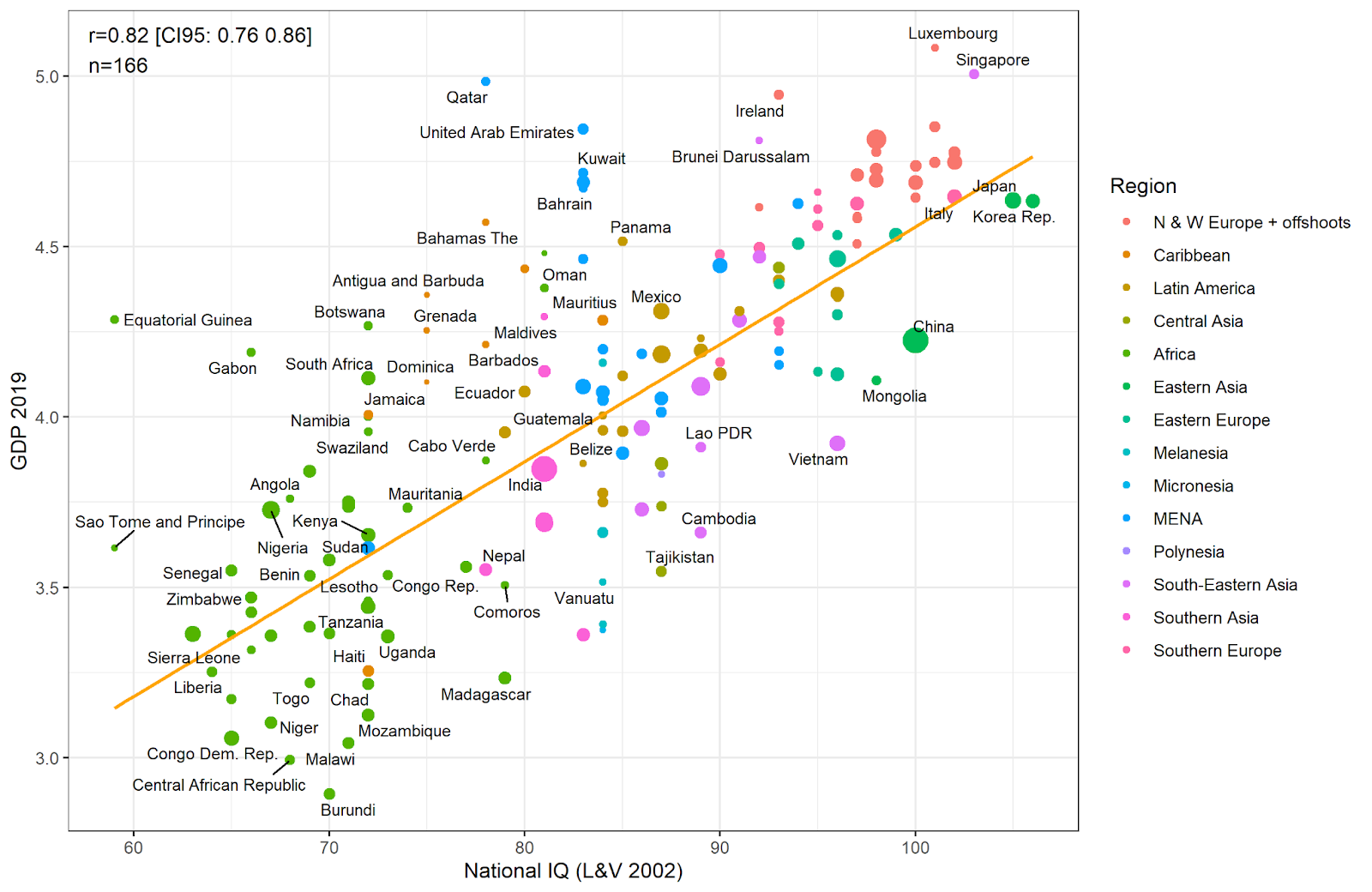
George Francis and Emil Kirkegaard have come out with a study that shows a strong correlation between IQ and wealth creation. The higher the mean IQ, the more a nation can create wealth:


We find national IQ to be the “best predictor” of economic growth, with a higher average coefficient and average posterior inclusion probability than all other tested variables (over 67) in every test run. Our best estimates find a one point increase in IQ is associated with a 7.8% increase in GDP per capita (Francis and Kirkegaard 2022)


The study is essentially an update of an earlier one by Richard Lynn and Tatu Vanhanen (2002). It’s better done, and I agree more or less with the conclusion. Wealth is not created in a vacuum. It’s created by flesh-and-blood humans who possess certain mental and behavioral attributes, one of which is high cognitive ability.


I do, however, have two criticisms.


Criticism #1: On a societal level, cognitive ability is confounded with other mental and behavioral attributes


Yes, high cognitive ability is important. But sustainable creation of wealth also requires other mental and behavioral attributes, notably:


·         propensity to identify social rules, obey them, and enforce them on others

·         feelings of guilt when one breaks the rules, even when there are no witnesses

·         empathy for others and a desire to understand how one’s behavior affects them

·         inhibition against using violence to settle disputes

·         high degree of future time orientation (also known as low time preference)


High IQ + high trust + low violence + low time preference = sustainable creation of wealth (Clark 2007; Clark 2009a; Clark 2009b; Frost 2020). Some will argue that intelligence goes hand in hand with high trust and low time preference (Carl 2014; Kirkegaard and Karlin 2020). That is true on a societal level: the same selection pressures that favor high intelligence usually favor the entire mental and behavioral package. On an individual level, however, intelligent sociopaths do exist, and they can prosper while others suffer. If they become too numerous or too influential, they will eventually destroy their host society. But that can take time.


In all fairness, Francis and Kirkegaard did investigate social trust and time preference. Unfortunately, those attributes are confounded with IQ: successful societies tend to have people who are not only intelligent but also trustworthy and future-oriented. That’s survivorship bias: if a society lacks the full mental and behavioral package, it usually goes extinct, and extinct societies get overlooked by cross-national studies. To be precise, societal extinction happens when the intelligent are unrestrained in their contempt for the less intelligent in their midst; they thus prey on them by any means possible, and the resulting strife leads to societal collapse.


IQ, social trust, and time preference are normally confounded with each other, at least in most existing societies. Therefore, if you control for IQ, the other two variables will go away, and you’ll think: “Aha! The key variable must be IQ!”


And you’ll feel all the more certain because IQ is not just equal to social trust or time preference in predicting wealth creation. It’s actually better! That greater predictive power, however, has a simple explanation: measurement of IQ is based on less subjective data. In this study, social trust is measured by self-report, and time preference is measured by an amalgam of survey responses and credit risk.


Criticism #2: The correlation is driven largely by unreliable African data


This study has another weak point: the correlation between wealth creation and IQ is driven largely by economic and cognitive data from Africa. If you remove Africa from the chart, the correlation becomes a lot weaker.


How reliable is the African data? Not very. First, a lot of African economic activity is “off the books.” That is particularly true for subsistence farming in the countryside, but it’s also true for many businesses in the towns and cities. GDP thus tends to be underestimated.


Second, even HBD writers disagree among themselves on mean African IQ, as pointed out by Heiner Rindermann:


The [cognitive] ability levels for Africans in Africa are the subject of strong disagreement. Rushton studied positively selected samples (South African university engineering students; Rushton, Skuy, & Fridjhon, 2003), but the mean differences between Africans and Europeans (14 IQ points) were similar to the ones found in Western countries. Lynn and Vanhanen (2006) estimated that sub-Saharan African countries had a mean IQ of 70. Wicherts, Dolan, and Maas (2010) using a different selection procedure came to a mean IQ of 82.


Rindermann’s “best guess” is 75. He concludes: “Given the quality of the data, it is not possible to come to a really precise result” (Rindermann 2013, p. 3). If we look at the chart from Lynn and Vanhanen (2002), we see that most sub-Saharan African countries are assigned mean IQs lower than 75. In fact, 75 seems to be the upper limit. That’s the IQ dataset of the new study.


Francis and Kirkegaard (2022, pp. 22-23) are aware that the IQ/GDP correlation is a lot weaker without the African IQ data, and they defend the validity of that dataset at some length. I’m still unimpressed, for two reasons:


·         If mean African IQ is 70, one must conclude that Africans are much less intelligent than African Americans, whose mean IQ is usually estimated at 85. Such a large difference cannot be explained by European admixture, heterosis, or nutrition.


·         The Yoruba of Nigeria have about the same polygenic score as that of African Americans (Piffer 2021, Fig. 7). Their mean IQ should therefore be 85. Yet, according to Lynn and Vanhanen, Nigerians have a mean IQ of 67. Since Nigeria is 18% Igbo, and since the Igbo show high academic achievement, mean Yoruba IQ should therefore be much less than the presumed Nigerian average of 67 (Chisala 2015; Frost 2022). The numbers don’t seem to add up.


Please don’t get me wrong. I agree that mean IQ is lower in Africa than in Eurasia, but the Lynn and Vanhanen estimates seem too low. In any case, they are not widely accepted even by researchers who accept that cognitive ability varies among human populations.


Similarly, I agree that more wealth is created per capita in Eurasia than in Africa. The difference, however, is overstated because so much of African GDP goes unreported. Furthermore, I don’t believe that lower IQ largely explains Africa’s economic underperformance. There is also the excessive use of violence to achieve one’s goals, both by the State and by private individuals. There is also the low level of trust that people have in each other—for the most part, Africans trust only their immediate family and friends. Finally, because family ties are so important, nepotism is widespread, and successful entrepreneurs end up being plundered by greedy relatives. The market economy cannot realize its full potential because the logic of the market has to compete with the logic of kinship.


Edit: George Francis has informed me that the correlation between IQ and GNP per capita remains unchanged if African cognitive and economic data are excluded. Without the African data, GDP per capita would increase 7.7% with each one point increase in IQ, rather than 7.8%.


Conclusion


Cognitive ability is only one of several mental and behavioral attributes that are key to building successful economies and societies. If we focus on it to the exclusion of others, we will be talked into supporting policies that have unintended consequences. A good example is the idea of reorienting immigration policy toward recruitment of high-IQ individuals.


That idea has the support of many conservatives throughout the West, but the consequences are very un-conservative. In short, we would be selecting immigrants who excel at creating wealth for themselves, by hook or by crook. The eventual result: an elite of rich narcissists who feel little sympathy for common people and who see them as objects to be used, when useful, and thrown away, when not.


Please don’t get bamboozled by reassurances that IQ correlates with trustworthiness and low time preference. That’s true only at the societal level. Those three attributes align with each other because they have to: otherwise, society would become dysfunctional and collapse. That’s survivorship bias: we get data from societies that have survived, and not from those that haven’t. If we cherry-pick high IQ immigrants from all over the world, we will create a new kind of society that has not stood the test of time.


Actually, that kind of society has arisen in the past:


And you should know that all the Cathayans [Chinese] detested the Grand Khan's rule because he set over them governors who were Tartars, or still more frequently Saracens, and these they could not endure, for they were treated by them just like slaves. You see the Great Khan had not succeeded to the dominion of Cathay [China] by hereditary right, but held it by conquest; and thus having no confidence in the natives, he put all authority into the hands of Tartars, Saracens, or Christians who were attached to his household and devoted to his service, and were foreigners in Cathay [China].

            The Travels of Marco Polo, Book 2, Chapter 23


Why do you think revolutions happen? It was precisely to avoid such a prospect that elite schools sought to develop not only intellect but also character, including the idea that the powerful have a duty to rule wisely and fairly. That view of higher education has given way to “meritocracy” throughout the West, with results that could have been predicted.


References


Carl, N. (2014). Does intelligence explain the association between generalized trust and economic development? Intelligence 47: 83-92. https://doi.org/10.1016/j.intell.2014.08.008


Chisala, C. (2015). The IQ gap is no longer a black and white issue. The Unz Review, June 25. http://www.unz.com/article/the-iq-gap-is-no-longer-a-black-and-white-issue/     


Clark, G. (2007). A Farewell to Alms. A Brief Economic History of the World. Princeton University Press: Princeton and Oxford.


Clark, G. (2009a). The indicted and the wealthy: surnames, reproductive success, genetic selection and social class in pre-industrial England.

http://www.econ.ucdavis.edu/faculty/gclark/Farewell%20to%20Alms/Clark%20-Surnames.pdf    


Clark, G. (2009b). The domestication of man: The social implications of Darwin. ArtefaCTos 2: 64-80. 

https://www.researchgate.net/publication/277275046_The_Domestication_of_Man_The_Social_Implications_of_Darwin  


Francis, G., and E.O.W. Kirkegaard. (2022). National Intelligence and Economic Growth: A Bayesian Update. The Mankind Quarterly 63(1). http://dx.doi.org/10.46469/mq.2022.63.1.2  


Frost, P. (2020). The large society problem in Northwest Europe and East Asia. Advances in Anthropology 10(3): 214-134. https://doi.org/10.4236/aa.2020.103012     


Frost, P. (2022). Recent cognitive evolution in West Africa: the Niger’s role. Evo and Proud, April 30. https://evoandproud.blogspot.com/2022/04/recent-cognitive-evolution-in-west.html  


Kirkegaard, E.O.W., and A. Karlin. (2020). National intelligence is more important for explaining country well-being than time preference and other measured non-cognitive traits. Mankind Quarterly 61: 339-370. http://doi.org/10.46469/mq.2020.61.2.11  


Lynn, R. and T. Vanhanen. (2002). IQ and the Wealth of Nations. Westport, Conn: Praeger


Piffer, D. (2021). Divergent selection on height and cognitive ability: evidence from Fst and polygenic scores. OpenPsych https://openpsych.net/files/submissions/14_Divergent_selection_on_height_and_cognitive_ability_evidence_from_Fst_and_13c3ICJ.pdf     


Rindermann, H. (2013). African cognitive ability: Research, results, divergences and recommendations. Personality and Individual Differences 55: 229-233. https://doi.org/10.1016/j.paid.2012.06.022     

Wednesday, September 14, 2022

The Great Decline


Mean polygenic score of Icelanders by year of birth (Kong et al. 2017, Fig. 2)


Three polygenic studies have shown that cognitive ability declined among European Americans, British people, and Icelanders during the 20th century. The decline briefly stopped during the postwar baby boom and again with the liberalization of abortion laws.


How can we measure the genetic component of cognitive ability? For a long time, the only way was to administer an IQ test, but the result would inevitably be influenced by the test-taker’s environment—not only culture and life history but also familiarity with taking tests and answering questions in rapid-fire succession. Yes, twin studies and adoption studies suggest that genetic factors largely explain variation in IQ between individuals. But the same is not necessarily true for variation in IQ between populations. That could be 100% environmental.


Recent years have seen the advent of a direct measure of innate cognitive ability: the educational attainment polygenic score. It’s a summation of the predicted effects of genetic variants that together explain 11-13% of the variance in educational attainment among individuals (Lee et al. 2018). It’s especially suited for predicting the mean IQ of a population—the correlation is 98% with the actual mean IQ (Piffer 2019).  Polygenic data predict a mean IQ of about 85 for sub-Saharan Africans, 100 for Europeans, and 105 for East Asians. There is also variation within each of those geographic groups. Among Europeans, predicted IQ varies from 97 for southern Europeans to 102 for Finns and 110 for Ashkenazi Jews. Among sub-Saharan Africans, it seems to be higher among groups who were more advanced during precolonial times, particularly those, like the Igbo, who lived along the Niger and took part in trade between the coast and the interior (Frost 2022).


The above predictions should be viewed with some caution. Because the genetic variants have been identified only in people of European descent, the polygenic score is less valid for non-Europeans, particularly those of sub-Saharan African descent. It thus predicts the IQ of African Americans with five times less accuracy than that of European Americans (Lasker et al. 2019).


Generational change


In addition to predicting differences in mean IQ across space, we can do the same across time. That begs the question: were past generations as intelligent as the latest one? We can answer that question by examining past generations who are still alive. That approach, however, raises the issue of survivorship bias: people who live to an old age are generally smarter than those who do not (Gottfredson and Deary 2004).


Beauchamp (2016) deals with this issue point by point when he discusses polygenic data from the Health and Retirement Study (HRS), a longitudinal study of 20,000 Americans shortly before and during retirement:


·         The HRS participants are people who have lived to the age of 50; however, about 10% of American women and 15% of American men born in 1940 were already dead by the age of 50.

·         Thus, in Beauchamp’s sample, 85% of the original participants were still alive in 2008, 69% were asked to be genotyped, and 59% consented to be genotyped.

·         Nonetheless, no important differences emerged when he compared the genotyped participants with the total sample. 


European Americans


Beauchamp found evidence that alleles associated with high educational attainment had declined in frequency among European Americans between the 1931 and 1953 birth cohorts. “[M]y results strongly suggest that genetic variants associated with EA have slowly been selected against among both female and male Americans of European ancestry born between 1931 and 1953.”


That decline is attributed to differences in fertility: “individuals with high EA typically have children at a more advanced age, which may further reduce their fitness.”


Icelanders


The above findings have been replicated by Kong et al. (2017) in their study of Icelanders born since 1910. Although survivorship bias is still a problem, it does not easily explain the decline in cognitive ability between the last two cohorts, i.e., Icelanders born in the 1970s and those born in the 1980s. In that decline, any survivorship bias would be due to deaths of people less than 44 years old, and in most cases less than 36 years old. “The samples studied here were collected between 1998 and 2014, with a majority (68%) ascertained before 2006” (Kong et al, 2017, p. E729).


Iceland’s cognitive decline had two “pauses”: one in the 1950s and another in the 1970s. The first pause coincides with the postwar economic boom and a corresponding improvement in the ability of middle class couples to start families early in life. The second pause may reflect the passage in 1975 of Iceland’s abortion law, which, while not allowing abortion on demand, did allow it for cases of rape, mental disability of the mother, and “difficult family situation” (Wikipedia 2022)


Kong et al. (2017) concluded that the cognitive decline was due only in part to more intelligent Icelanders staying in school longer and postponing reproduction. In fact, a high educational level, unlike a high polygenic score, was actually associated with somewhat higher fertility among males. A high polygenic score seems to reduce fertility independently of whether one pursues or does not pursue higher education, perhaps because higher intelligence goes hand in hand with greater ability to plan ahead and thus foresee, with trepidation, the costs of raising a family. 


British of European descent


In a study of British of European origin, using the UK Biobank, Hugh-Jones and Abdellaoui. (2022) found that mean cognitive ability had declined between two successive generations, particularly in lower-income groups. The median birth year was 1950 for the second generation and unknown for the first. The authors also looked at genetic variants that influence non-cognitive traits. In general, the bulk of the population seems to be getting dumber, fatter, and nuttier.


The authors nonetheless warn against excessive pessimism:


Many people would probably prefer to have high educational attainment, a low risk of ADHD and major depressive disorder, and a low risk of coronary artery disease, but natural selection is pushing against genes associated with these traits. Potentially, this could increase the health burden on modern populations, but that depends on effect sizes.


The authors go on to argue that the effect sizes are “small,” although one wonders: smaller than what? They then make the obvious point that generational change can accumulate from one generation to the next: “Although effects on our measured polygenic scores are small even after weighting, individually small disadvantages can cumulate to create larger effects” (Hugh-Jones and Abdellaoui 2022). Beauchamp (2016) makes a similar comment that seems reassuring on first thought, and then not so reassuring on second thought: “natural selection has thus been occurring in that population—albeit at a rate that pales in comparison with the rapid changes that have occurred in recent generations.”


Finally, Hugh-Jones and Abdellaoui (2022) point out that their data may suffer from ascertainment bias. For instance, the first generation of their dataset is composed of the parents of the second generation. The dataset thus excludes the childless individuals of the first generation. Were they more intelligent or less intelligent on average than the succeeding generation? Furthermore, participation in the UK Biobank is voluntary. Could that factor also be a source of bias? If so, in what direction?


Conclusion


As time goes by, intergenerational genetic datasets will become more complete, and the problem of survivorship bias will diminish. Ideally, we should conduct a “genetic census” of each generation, perhaps by collecting a DNA sample from everyone at the time of death. We will thus be able to see how we are evolving.


We now have intergenerational polygenic studies from three different Western countries: the U.S., the U.K., and Iceland. In all three cases, the genetic component of cognitive ability declined during the 20th century, with the exception of two pauses: one during the postwar baby boom and the other with the liberalization of access to abortion.


If we wish to halt the cognitive decline, we should push for the following measures:


·         A return to the protected high-wage economy that prevailed during the postwar era;

·         Free access to abortion, at least for cases of rape, mental disability of either parent, and difficult economic circumstances;

·         Pro-natalist measures to counteract the fear of not having the means to support a family. This fear is particularly strong among people who like to plan and are oriented toward the future.


References


Beauchamp, J.P. (2016). Genetic evidence for natural selection in humans in the contemporary United States. Proceedings of the National Academy of Sciences 113(28): 7774-7779. https://doi.org/10.1073/pnas.1600398113    


Frost, P. (2022). Recent cognitive evolution in West Africa: the Niger’s role. Evo and Proud, April 30. https://evoandproud.blogspot.com/2022/04/recent-cognitive-evolution-in-west.html  


Gottfredson, L. S., and I.J. Deary. (2004). Intelligence Predicts Health and Longevity, but Why? Current Directions in Psychological Science 13(1): 1–4. https://doi.org/10.1111/j.0963-7214.2004.01301001.x


Hugh-Jones, D., and A. Abdellaoui. (2022). Human Capital Mediates Natural Selection in Contemporary Humans. Behavior Genetics. https://doi.org/10.1007/s10519-022-10107-w  


Kong, A., M.L. Frigge, G. Thorleifsson, H. Stefansson, A.I. Young, F. Zink, G.A. Jonsdottir, A. Okbay, P. Sulem, G. Masson, D.F. Gudbjartsson, A. Helgason, G. Bjornsdottir, U. Thorsteinsdottir, and K. Stefansson. (2017). Selection against variants in the genome associated with educational attainment. Proceedings of the National Academy of Sciences 114(5): E727-E732. https://doi.org/10.1073/pnas.1612113114   


Lasker, J., B.J. Pesta, J.G.R. Fuerst, and E.O.W. Kirkegaard. (2019). Global ancestry and cognitive ability. Psych 1(1). https://doi.org/10.3390/psych1010034    


Lee, J. J., Wedow, R., Okbay, A., Kong, E., Maghzian, O., Zacher, et al. (2018). Gene discovery and polygenic prediction from a genome-wide association study of educational attainment in 1.1 million individuals. Nature Genetics 50(8): 1112-1121. https://doi.org/10.1038/s41588-018-0147-3  


Piffer, D. (2019). Evidence for Recent Polygenic Selection on Educational Attainment and Intelligence Inferred from Gwas Hits: A Replication of Previous Findings Using Recent Data. Psych 1(1): 55-75. https://www.mdpi.com/2624-8611/1/1/5   


Wikipedia (2022). Abortion in Iceland. https://en.wikipedia.org/wiki/Abortion_in_Iceland