Showing posts with label cognitive ability. Show all posts

Monday, January 8, 2024

My wish list for research in 2024: Recent cognitive evolution in West Africa


Drainage basin of the Niger River (Wikicommons - Wizardist)


Social complexity was more advanced, and cognitive demands higher, in West African societies that benefited from trade via the Niger River. This was especially true for the Igbo of the Niger Delta, who dominated trade between the coast and the interior.


We have identified thousands of genes whose alleles are associated with cognitive ability, i.e., the capacity to process information, to recognize patterns, and to solve problems (Lee et al., 2018). By finding out which alleles are present on an individual’s genome, we can make an estimate of that person’s cognitive ability, and that estimate will show a high correlation with performance on tests in mathematics, reading, and science (r = 0.8). The same method can provide an estimate of a population’s mean cognitive ability, and that estimate will show a high correlation with the population’s mean IQ (r = 0.9) (Piffer, 2019).


Using this method, the anthropologist Davide Piffer has estimated the mean cognitive ability of several West African populations. Mean cognitive ability seems to increase as you go from west to east, being lowest among the Mende of Sierra Leone and progressively higher among Gambians, the Esan of Nigeria, and the Yoruba of Nigeria. The Yoruba have almost the same mean as do African Americans, who are nonetheless 20% European by ancestry (Piffer, 2021, see Figure 7).


This geographic pattern seems to reflect differences in societal development. From the fourth century onward, West African societies became more complex in the north and the east, i.e., within the drainage basin of the Niger. As trade along that river increased in volume and value, villages grew into towns, and social relations became more varied and complex. This social complexity was both a cause and effect of trade. As powerful individuals acquired the materials they needed to erect buildings, create works of art, and hold ceremonies to legitimize their rule, they became even more powerful and, thus, better able to purchase such materials. Social complexity was thus driven by a positive feedback loop: elite buying power led to an increase in trade, which in turn led to an increase in elite buying power (Frost, 2022; McIntosh and McIntosh, 1988, p. 123).


As social relations became more varied and complex in settlements along the Niger, those populations had to cope with a heavier cognitive workload. The demands of farming were giving way to those of craft production, urban architecture, and long-distance trade. Numeracy and literacy were becoming important, as were skills for manipulation and assemblage of various materials. Did that new social environment select for an increase in cognitive ability?

Evidence of high cognitive ability is especially strong among the Igbo people (formerly the Ibo), who live at the Niger’s mouth and who have historically dominated trade between the coast and the interior (Frost, 2022). Their children excel at school not only in Nigeria but also in overseas communities, such as those of the United Kingdom. They do exceptionally well on the GCSE (Chisala, 2015).


In addition to high cognitive ability, the Igbo are said to have a certain mindset: “the Ibo have a greater achievement motivation and are more willing to explore new avenues of power than either the Yoruba or the Hausa.” They have “a general belief in the possibility, indeed necessity, of manipulating one’s world; of determining one’s own destiny; of ‘getting up’ in the world” (Slater, 1983).  The earliest European observers, from the eighteenth century, described them as “competitive, individualistic, status-conscious, antiauthoritarian, pragmatic, and practical—a people with a strongly developed commercial sense” (Mullin, 1994, p. 286).


Trade thus seems to select for higher cognitive ability, either directly through new cognitive demands (i.e., pricing, bargaining, accounting) or indirectly through a resulting increase in social complexity. This has been the case not only among the Igbo but also among the Ashkenazi Jews, the Parsis, and other trading peoples (Cochran et al., 2006; Frost, 2012; Frost, 2021). As these peoples became specialized in trade, over the past millennium or so, they appear to have experienced a sharp rise in mean cognitive ability. These examples of recent evolutionary change support the view that mental and behavioral evolution did not stop back in the Pleistocene, anymore than the evolution of outward physical traits like skin color or body shape. Cognitive ability continued to evolve into the time of recorded history, albeit to different extents in different human groups (Cochran and Harpending, 2009; Hawks et al., 2007; Rinaldi, 2017).


Shell vessel with leopard from Igbo-Ukwu, Nigeria, ninth century (Wikicommons). This bronze artefact, like others from the same site, has an unusually high silver content with only traces of zinc, an alloy not used in Europe or the Middle East at that time. Ancestral Igbo thus seem to have developed metallurgy on their own (McIntosh and McIntosh, 1988, pp. 120-121).


Proposed study


The aim is to test the hypothesis that mean cognitive ability increased to a greater extent in those populations that were closer to the Niger, particularly the Igbo at the Niger’s mouth, where trade led to greater social complexity and higher cognitive demands during precolonial times.


For this study, mean cognitive ability can be estimated from genomic data, specifically from alleles associated with educational attainment (Edu PGS). The alleles identified to date are only a fraction of all those that play a role in cognitive ability, but we have identified enough of them to produce reliable estimates of mean cognitive ability within a population. With the help of data from history and prehistory, we could then outline the trajectories that mean cognitive ability has followed in different West African populations.


Finally, these hypothetical trajectories could be verified by retrieving and examining aDNA from archaeological sites throughout West Africa. It would be particularly interesting to determine when mean cognitive ability began to increase among ancestral Igbo, and how fast it increased. That research aim may be unrealistic, however, given the degradation of DNA in hot climates.


References


Chisala, C. (2015). The IQ gap is no longer a black and white issue. The Unz Review, June 25. http://www.unz.com/article/the-iq-gap-is-no-longer-a-black-and-white-issue/


Cochran, G., J. Hardy, and H. Harpending. (2006). Natural history of Ashkenazi intelligence. Journal of Biosocial Science 38(5): 659-693. https://doi.org/10.1017/S0021932005027069


Cochran, G. and H. Harpending. (2009). The 10,000 Year Explosion: How Civilization Accelerated Human Evolution. Basic Books: New York.


Frost, P. (2012). Tay-Sachs and French Canadians: A case of gene-culture co-evolution? Advances in Anthropology 2(3): 132-138. http://dx.doi.org/10.4236/aa.2012.23016     


Frost, P. (2021). Commentary on Fuerst et al: Do Human Populations Differ in Their Mental Characteristics? Mankind Quarterly 62(2). http://doi.org/10.46469/mq.2021.62.2.9


Frost, P. (2022). West Africa and recent cognitive evolution. Peter Frost’s Newsletter, November 14. https://peterfrost.substack.com/p/west-africa-and-recent-cognitive   


Hawks, J., E.T. Wang, G.M. Cochran, H.C. Harpending, and R.K. Moyzis. (2007). Recent acceleration of human adaptive evolution. Proceedings of the National Academy of Sciences (USA) 104: 20753-20758. https://doi.org/10.1073/pnas.0707650104


Lee, J. J., R. Wedow, A. Okbay, E. Kong, O. Maghzian, M. Zacher, et al. (2018). Gene discovery and polygenic prediction from a genome-wide association study of educational attainment in 1.1 million individuals. Nature Genetics 50(8): 1112-1121. https://doi.org/10.1038/s41588-018-0147-3    


McIntosh, S.K., and R.J. McIntosh. (1988). From stone to metal: New perspectives on the later prehistory of West Africa. Journal of World Prehistory 2(1): 89-133. https://doi.org/10.1007/BF00975123    


Mullin, M. (1994). Africa in America: Slave Acculturation and Resistance in the American South and the British Caribbean, 1736-1831. University of Illinois Press.


Piffer, D. (2019). Evidence for Recent Polygenic Selection on Educational Attainment and Intelligence Inferred from Gwas Hits: A Replication of Previous Findings Using Recent Data. Psych 1: 55-75. https://doi.org/10.3390/psych1010005


Piffer, D. (2021). Divergent selection on height and cognitive ability: evidence from Fst and polygenic scores. OpenPsych. April 3 https://doi.org/10.26775/OP.2021.04.03   


Rinaldi, A. (2017). We're on a road to nowhere. Culture and adaptation to the environment are driving human evolution, but the destination of this journey is unpredictable. EMBO reports 18: 2094-2100. https://doi.org/10.15252/embr.201745399   


Slater, R. (1983). Bureaucracy, Education and the Ibo: A Review. Journal of Educational Administration and History 15(1): 46-49. https://doi.org/10.1080/0022062830150106    


Tuesday, October 25, 2022

Eppur si muove


General intelligence (g) varies with ethnicity, as do genetic variants associated with educational attainment (Lasker et al. 2019, p. 445)


Bryan Pesta was fired from a tenured university position for a study he coauthored in a peer-reviewed journal. No one actually disputed his findings. It was simply taken for granted that they could not be true.


Three years ago I contributed a paper to a special issue of Psych. One of the other contributors, Bryan J. Pesta, coauthored a paper on “Global Ancestry and Cognitive Ability.” It was one of several recent studies that had used genetic data to understand how populations differ on average in their capacity for intelligence.


Pesta and his coauthors looked at data from an existing neurodevelopment study of 9,421 participants from Philadelphia. A little over half of them were European American, and a third were African American. They had all been genotyped and had all taken a battery of cognitive tests.


The study produced several findings:


·         Almost 15 IQ points separated the African American participants from the European American participants. About three quarters of the difference was due to general intelligence (g).

·         Among the African Americans, general intelligence correlated with the degree of European admixture.

·         The correlation was modestly reduced, but not eliminated, when controlled for parental education. Controlling for skin color had no effect. Although skin color does correlate with European admixture, it evidently has a less direct relationship to general intelligence. This finding therefore eliminates “colorism” (discrimination in favor of lighter-skinned African Americans) as a possible cause.

·         As much as 20-25% of the difference in general intelligence between the African Americans and the European Americans was explained by genetic variants associated with educational attainment. By comparison, the same variants explain only 11-13% of the variance in educational attainment among individuals.

·         Although these genetic variants predicted general intelligence in both groups, the predictive power for the African Americans was only 20% of the predictive power for the European Americans. This finding is consistent with a growing consensus that the genetic architecture of intelligence is different in the two groups. Because the genetic variants have been identified in Europeans or European Americans, they may contribute less to the capacity for intelligence in people of African descent. In addition, other variants may be found only in African populations and thus remain to be identified.


For the above findings, Bryan Pesta would be fired from his tenured position at Cleveland State University. The whole affair is described in The Chronicle of Higher Education. At no point did anyone actually dispute his findings. It was simply taken for granted that they could not be true. And that’s that.


Please don’t argue that Bryan Pesta unconsciously looked for data that would provide the findings he wanted. The data had already been collected by another research team for a completely different purpose. So put aside The Mismeasure of Man and tell Stephen Jay Gould to go back to sleep.


This story isn’t over. People are curious, and curiosity ends up finding a way—despite the barriers we erect. Below is a screen shot of the paper’s access statistics (Hint: The Chronicle’s article came out on October 13).


References


Lasker, J., B.J. Pesta, J.G.R. Fuerst, and E.O.W. Kirkegaard. (2019). Global Ancestry and Cognitive Ability. Psych 1(1):431-459. https://doi.org/10.3390/psych1010034  


Standifer, C. (2022). Racial Pseudoscience on the Faculty. A professor’s research flew under the radar for years. What finally got him fired? The Chronicle of Higher Education. October 13. https://www.chronicle.com/article/racial-pseudoscience-on-the-faculty?cid2=gen_login_refresh&cid=gen_sign_in

Monday, September 26, 2022

Is intelligence all that matters for a successful society?


If we consider intelligence to be the only worthy mental attribute, we’ll end up with an elite that is not only intelligent but also narcissistic … and indifferent to the rest of us.


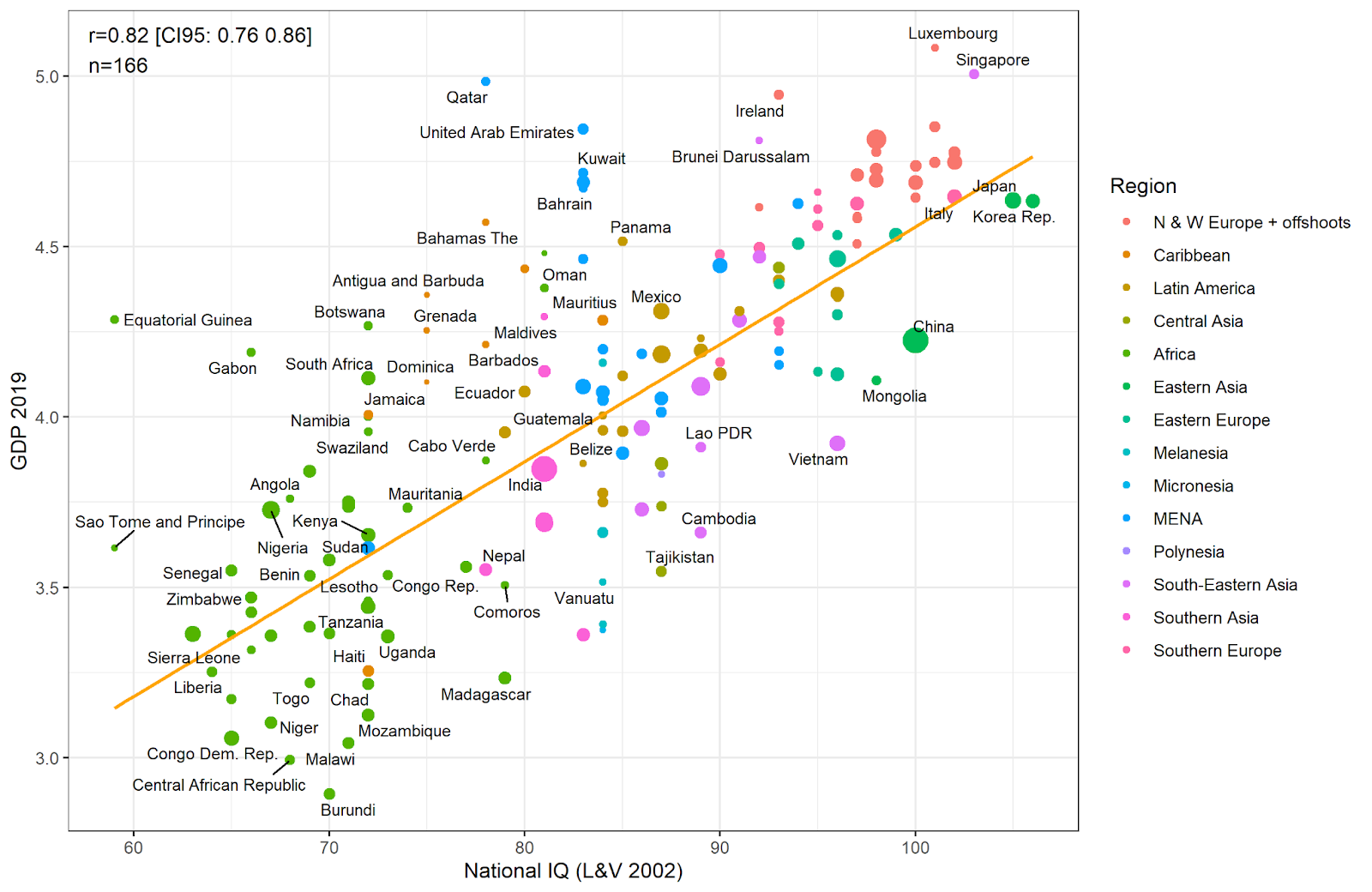
George Francis and Emil Kirkegaard have come out with a study that shows a strong correlation between IQ and wealth creation. The higher the mean IQ, the more a nation can create wealth:


We find national IQ to be the “best predictor” of economic growth, with a higher average coefficient and average posterior inclusion probability than all other tested variables (over 67) in every test run. Our best estimates find a one point increase in IQ is associated with a 7.8% increase in GDP per capita (Francis and Kirkegaard 2022)


The study is essentially an update of an earlier one by Richard Lynn and Tatu Vanhanen (2002). It’s better done, and I agree more or less with the conclusion. Wealth is not created in a vacuum. It’s created by flesh-and-blood humans who possess certain mental and behavioral attributes, one of which is high cognitive ability.


I do, however, have two criticisms.


Criticism #1: On a societal level, cognitive ability is confounded with other mental and behavioral attributes


Yes, high cognitive ability is important. But sustainable creation of wealth also requires other mental and behavioral attributes, notably:


·         propensity to identify social rules, obey them, and enforce them on others

·         feelings of guilt when one breaks the rules, even when there are no witnesses

·         empathy for others and a desire to understand how one’s behavior affects them

·         inhibition against using violence to settle disputes

·         high degree of future time orientation (also known as low time preference)


High IQ + high trust + low violence + low time preference = sustainable creation of wealth (Clark 2007; Clark 2009a; Clark 2009b; Frost 2020). Some will argue that intelligence goes hand in hand with high trust and low time preference (Carl 2014; Kirkegaard and Karlin 2020). That is true on a societal level: the same selection pressures that favor high intelligence usually favor the entire mental and behavioral package. On an individual level, however, intelligent sociopaths do exist, and they can prosper while others suffer. If they become too numerous or too influential, they will eventually destroy their host society. But that can take time.


In all fairness, Francis and Kirkegaard did investigate social trust and time preference. Unfortunately, those attributes are confounded with IQ: successful societies tend to have people who are not only intelligent but also trustworthy and future-oriented. That’s survivorship bias: if a society lacks the full mental and behavioral package, it usually goes extinct, and extinct societies get overlooked by cross-national studies. To be precise, societal extinction happens when the intelligent are unrestrained in their contempt for the less intelligent in their midst; they thus prey on them by any means possible, and the resulting strife leads to societal collapse.


IQ, social trust, and time preference are normally confounded with each other, at least in most existing societies. Therefore, if you control for IQ, the other two variables will go away, and you’ll think: “Aha! The key variable must be IQ!”


And you’ll feel all the more certain because IQ is not just equal to social trust or time preference in predicting wealth creation. It’s actually better! That greater predictive power, however, has a simple explanation: measurement of IQ is based on less subjective data. In this study, social trust is measured by self-report, and time preference is measured by an amalgam of survey responses and credit risk.


Criticism #2: The correlation is driven largely by unreliable African data


This study has another weak point: the correlation between wealth creation and IQ is driven largely by economic and cognitive data from Africa. If you remove Africa from the chart, the correlation becomes a lot weaker.


How reliable is the African data? Not very. First, a lot of African economic activity is “off the books.” That is particularly true for subsistence farming in the countryside, but it’s also true for many businesses in the towns and cities. GDP thus tends to be underestimated.


Second, even HBD writers disagree among themselves on mean African IQ, as pointed out by Heiner Rindermann:


The [cognitive] ability levels for Africans in Africa are the subject of strong disagreement. Rushton studied positively selected samples (South African university engineering students; Rushton, Skuy, & Fridjhon, 2003), but the mean differences between Africans and Europeans (14 IQ points) were similar to the ones found in Western countries. Lynn and Vanhanen (2006) estimated that sub-Saharan African countries had a mean IQ of 70. Wicherts, Dolan, and Maas (2010) using a different selection procedure came to a mean IQ of 82.


Rindermann’s “best guess” is 75. He concludes: “Given the quality of the data, it is not possible to come to a really precise result” (Rindermann 2013, p. 3). If we look at the chart from Lynn and Vanhanen (2002), we see that most sub-Saharan African countries are assigned mean IQs lower than 75. In fact, 75 seems to be the upper limit. That’s the IQ dataset of the new study.


Francis and Kirkegaard (2022, pp. 22-23) are aware that the IQ/GDP correlation is a lot weaker without the African IQ data, and they defend the validity of that dataset at some length. I’m still unimpressed, for two reasons:


·         If mean African IQ is 70, one must conclude that Africans are much less intelligent than African Americans, whose mean IQ is usually estimated at 85. Such a large difference cannot be explained by European admixture, heterosis, or nutrition.


·         The Yoruba of Nigeria have about the same polygenic score as that of African Americans (Piffer 2021, Fig. 7). Their mean IQ should therefore be 85. Yet, according to Lynn and Vanhanen, Nigerians have a mean IQ of 67. Since Nigeria is 18% Igbo, and since the Igbo show high academic achievement, mean Yoruba IQ should therefore be much less than the presumed Nigerian average of 67 (Chisala 2015; Frost 2022). The numbers don’t seem to add up.


Please don’t get me wrong. I agree that mean IQ is lower in Africa than in Eurasia, but the Lynn and Vanhanen estimates seem too low. In any case, they are not widely accepted even by researchers who accept that cognitive ability varies among human populations.


Similarly, I agree that more wealth is created per capita in Eurasia than in Africa. The difference, however, is overstated because so much of African GDP goes unreported. Furthermore, I don’t believe that lower IQ largely explains Africa’s economic underperformance. There is also the excessive use of violence to achieve one’s goals, both by the State and by private individuals. There is also the low level of trust that people have in each other—for the most part, Africans trust only their immediate family and friends. Finally, because family ties are so important, nepotism is widespread, and successful entrepreneurs end up being plundered by greedy relatives. The market economy cannot realize its full potential because the logic of the market has to compete with the logic of kinship.


Edit: George Francis has informed me that the correlation between IQ and GNP per capita remains unchanged if African cognitive and economic data are excluded. Without the African data, GDP per capita would increase 7.7% with each one point increase in IQ, rather than 7.8%.


Conclusion


Cognitive ability is only one of several mental and behavioral attributes that are key to building successful economies and societies. If we focus on it to the exclusion of others, we will be talked into supporting policies that have unintended consequences. A good example is the idea of reorienting immigration policy toward recruitment of high-IQ individuals.


That idea has the support of many conservatives throughout the West, but the consequences are very un-conservative. In short, we would be selecting immigrants who excel at creating wealth for themselves, by hook or by crook. The eventual result: an elite of rich narcissists who feel little sympathy for common people and who see them as objects to be used, when useful, and thrown away, when not.


Please don’t get bamboozled by reassurances that IQ correlates with trustworthiness and low time preference. That’s true only at the societal level. Those three attributes align with each other because they have to: otherwise, society would become dysfunctional and collapse. That’s survivorship bias: we get data from societies that have survived, and not from those that haven’t. If we cherry-pick high IQ immigrants from all over the world, we will create a new kind of society that has not stood the test of time.


Actually, that kind of society has arisen in the past:


And you should know that all the Cathayans [Chinese] detested the Grand Khan's rule because he set over them governors who were Tartars, or still more frequently Saracens, and these they could not endure, for they were treated by them just like slaves. You see the Great Khan had not succeeded to the dominion of Cathay [China] by hereditary right, but held it by conquest; and thus having no confidence in the natives, he put all authority into the hands of Tartars, Saracens, or Christians who were attached to his household and devoted to his service, and were foreigners in Cathay [China].

            The Travels of Marco Polo, Book 2, Chapter 23


Why do you think revolutions happen? It was precisely to avoid such a prospect that elite schools sought to develop not only intellect but also character, including the idea that the powerful have a duty to rule wisely and fairly. That view of higher education has given way to “meritocracy” throughout the West, with results that could have been predicted.


References


Carl, N. (2014). Does intelligence explain the association between generalized trust and economic development? Intelligence 47: 83-92. https://doi.org/10.1016/j.intell.2014.08.008


Chisala, C. (2015). The IQ gap is no longer a black and white issue. The Unz Review, June 25. http://www.unz.com/article/the-iq-gap-is-no-longer-a-black-and-white-issue/     


Clark, G. (2007). A Farewell to Alms. A Brief Economic History of the World. Princeton University Press: Princeton and Oxford.


Clark, G. (2009a). The indicted and the wealthy: surnames, reproductive success, genetic selection and social class in pre-industrial England.

http://www.econ.ucdavis.edu/faculty/gclark/Farewell%20to%20Alms/Clark%20-Surnames.pdf    


Clark, G. (2009b). The domestication of man: The social implications of Darwin. ArtefaCTos 2: 64-80. 

https://www.researchgate.net/publication/277275046_The_Domestication_of_Man_The_Social_Implications_of_Darwin  


Francis, G., and E.O.W. Kirkegaard. (2022). National Intelligence and Economic Growth: A Bayesian Update. The Mankind Quarterly 63(1). http://dx.doi.org/10.46469/mq.2022.63.1.2  


Frost, P. (2020). The large society problem in Northwest Europe and East Asia. Advances in Anthropology 10(3): 214-134. https://doi.org/10.4236/aa.2020.103012     


Frost, P. (2022). Recent cognitive evolution in West Africa: the Niger’s role. Evo and Proud, April 30. https://evoandproud.blogspot.com/2022/04/recent-cognitive-evolution-in-west.html  


Kirkegaard, E.O.W., and A. Karlin. (2020). National intelligence is more important for explaining country well-being than time preference and other measured non-cognitive traits. Mankind Quarterly 61: 339-370. http://doi.org/10.46469/mq.2020.61.2.11  


Lynn, R. and T. Vanhanen. (2002). IQ and the Wealth of Nations. Westport, Conn: Praeger


Piffer, D. (2021). Divergent selection on height and cognitive ability: evidence from Fst and polygenic scores. OpenPsych https://openpsych.net/files/submissions/14_Divergent_selection_on_height_and_cognitive_ability_evidence_from_Fst_and_13c3ICJ.pdf     


Rindermann, H. (2013). African cognitive ability: Research, results, divergences and recommendations. Personality and Individual Differences 55: 229-233. https://doi.org/10.1016/j.paid.2012.06.022     

Monday, September 5, 2022

How real is the Flynn effect? Part II


Can you pass a Grade 8 exam that was given to American children in 1912? Why the Flynn effect never really happened.


My last post elicited a tweet from Elon Bachman:


Argument by incredulity (w.r.t. retardation) bedevils discussions of intelligence data. What's striking about most retards is the *congenital* speech & motor impairment, not the level of g. Height also increased 1 SD last century. There used to be a lot of malnourished peasants. @ElonBachman


In a population with an average IQ of 100, an IQ below 70 is usually due to abnormal circumstances, either freak accidents during pregnancy or rare mutations that haven’t been eliminated by natural selection. In either case, the adverse effects are wide-ranging and affect many aspects of mind and behavior. If your IQ is below 70, you’re lacking in much more than cognitive ability. You probably suffer from various speech and motor impairments. In short, you look and act “funny.”


A century ago, if we use current norming of IQ tests, average IQ was below 70 in the Western world. Yet it was not associated with looking and acting “funny.” How come?  For Elon Bachman, this is because an IQ of 70 was normal back then. It was not an outcome of freak accidents or rare mutations. The mental deficit was therefore confined to cognitive ability alone.


I understand that argument. Nonetheless, the increase in IQ between then and now is still 35 points—more than two standard deviations. Such a difference in cognitive ability should be visible in popular culture, particularly the books and newspapers that people read. It should also be visible in the academic requirements of elementary school, which was compulsory by that time in most North American jurisdictions.


The following are some questions from a Grade 8 exam that was given in 1912 to children in Bullitt County, Kentucky:


Find cost at 12½ cents per sq. yd. of kalsomining the walls of a room 20 ft. long, 16 ft. wide and 9 ft. high, deducting 1 door 8 ft. by 4 ft. 6 in. and 2 windows 5 ft. by 3 ft. 6 in. each.


A man sold a watch for $180 and lost 16 2/3%. What was the cost of the watch?


How many parts of speech are there? Define each.


What is a personal pronoun? Decline I.


Define longitude and latitude.


Tell what you know of the Gulf Stream.


Through what waters would a vessel pass in going from England through the Suez Canal to Manila?


Compare arteries and veins as to function. Where is the blood carried to be purified?


Define Cerebrum; Cerebellum.


Define the following forms of government: Democracy, Limited Monarchy, Absolute Monarchy, Republic. Give examples of each.


Name five county officers and the principal duties of each.


What is a copyright? Patent right?


Describe the Battle of Quebec.


Name the last battle of the Civil War; War of 1812; French and Indian War and the commanders in each battle.


Those are only a few of the questions. The full exam is here.


I understand why some want to believe that Western societies were much less intelligent a century ago. If we cannot use IQ to compare different populations over time, perhaps we cannot use it to compare different populations over space, i.e., in different parts of the world. And then what?


I’ve heard that sort of argument before. “If we accept genetic determinism for this, we may have to accept it for that. And then what?” If that’s your frame of mind, I have nothing more to say.


The increase in IQ and the increase in height during the 20th century


But what about the increase in height? That was real. If insufficient nutrition held back height during the 20th century, it should have also held back cognitive ability. The assumption here is that IQ and height are equally constrained by nutrition during development. Has that assumption been tested?


It has. The Dutch suffered a terrible famine during the winter of 1944-1945, as did much of continental Europe. Yet that famine had no discernable impact on the mental development of unborn children from that time:


A detailed retrospective study was made of 125,000 19-yr-old male Dutch military inductees of whom 20,000 were exposed to the Netherland's winter famine, 1944-1945, through maternal starvation. […] Findings show that (a) starvation during pregnancy had no detectable effects on adult mental performance of surviving male offspring. (b) Mental performance of surviving adult males from the entire population had no association with changing levels of mean birth weight in a hospital sample from the population. And (c) there was a strong association of social class with mental performance. (Stein et al. 1972)


It isn’t as if the Flynn effect didn’t occur in the Netherlands, As James Flynn points out:


As for nutrition, to my knowledge no one has actually shown that American or British or Western European children have a better diet today than they did in 1950, indeed, the critics of junk food argue that diets are worse. Yet, post-1950 IQ gains have been very large. Military samples tested in 1952, 1962, 1972, and 1982 show that Dutch males made a 20-point gain on a Raven’s-type test (Flynn, 1987, p. 172). Even the latest period shows a huge gain, that is, the Dutch 18-year olds tested in 1982 outscored the Dutch 18-year olds tested in 1972 by fully 8 IQ points. Did the quality of the Dutch diet really escalate that much in 10 years? The gains posted by the 1962 males over the 1952 males are interesting. (Flynn 2008)


Those 1962 males were born or still in the womb during the 1944-45 famine. Yet they “do not show up even as a blip in the pattern of Dutch IQ gains” (Flynn 2008). One could argue that the famine was too brief to affect cognitive ability. Perhaps malnutrition needs a longer time span to affect mental development. And again, what about the increase in height? What was driving that increase?


We don’t know for sure. We do know that height increased independently of the increase in IQ.


Norway was cited above as a nation in which the nutrition hypothesis is viable thanks to greater gains in the lower half of the IQ distribution. Actually, it counts against the posited connection between height gains and IQ gains. Height gains have been larger in the upper half of the height distribution than in the lower half (Sundet et al., 2004). This combination, greater height gains in the upper half of the distribution, greater IQ gains in the lower, poses a serious problem. Are there two kinds of enhanced nutrition, one of which raises height more than it does IQ, the other of which raises IQ more than it does height? (Flynn 2008)


There is no common cause behind the increase in IQ and the increase in height. The latter seems to be due to people eating a more varied diet after the Second World War. In particular, fewer and fewer people were subsisting largely on bread. That food item is problematic not only because it lacks many nutrients but also because it has a high content of phytic acid, which binds to calcium and other essential minerals in the food we eat (Harrison and Mellanby 1939; McCance and Widdowson 1942a; McCance and Widdowson 1942b; Sandstead 1992). With the postwar boom, and with efforts to educate people about the benefits of a balanced diet, bread made up a smaller and smaller proportion of total food intake. Bones could now fully develop.


Excessive consumption of bread, and the resulting lack of essential minerals, constrained skeletal development during the early 20th century. But it did not constrain cognitive ability.


References


Flynn, J.R. (2008). Requiem for nutrition as the cause of IQ gains: Raven's gains in Britain 1938-2008. Economics and Human Biology 7(1):18-27. https://doi.org/10.1016/j.ehb.2009.01.009


Harrison, D.C., and E. Mellanby. (1939). Phytic acid and the rickets-producing action of cereals. Biochemical Journal 33: 1660-1680. https://doi.org/10.1042%2Fbj0331660


McCance, R.A., and E.M. Widdowson. (1942a). Mineral metabolism of healthy adults on white and brown bread dietaries. The Journal of Physiology 101: 44-85. https://doi.org/10.1113%2Fjphysiol.1942.sp003967


McCance, R.A., and E.M. Widdowson. (1942b). Mineral metabolism on dephytinized bread. The Journal of Physiology 101: 304-313. https://doi.org/10.1113%2Fjphysiol.1942.sp003984


Sandstead, H.H. (1992). Fiber, phytates, and mineral nutrition. Nutrition Reviews 50: 30-31. https://doi.org/10.1111/j.1753-4887.1992.tb02464.x


Sieczkowksi, C. (2013). 1912 Eighth-Grade Exam Stumps 21st-Century Test Takers. Could You Pass This Eighth-Grade Exam from 1912? Huffpost, August 12. https://www.huffpost.com/entry/1912-eighth-grade-exam_n_3744163


Stein, Z., M. Susser, G. Saenger, and F. Marolla. (1972). Nutrition and mental performance. Science 178(4062): 708–713. https://doi.org/10.1126/science.178.4062.708


Sundet, J.M., D.G. Barlaug, and T.M. Torjussen. (2004). The end of the Flynn effect? A study of secular trends in mean intelligence test scores of Norwegian conscripts during half a century. Intelligence 32: 349– 362. https://doi.org/10.1016/j.intell.2004.06.004


Monday, August 15, 2022

Comparing an incomparable?


Stigmata Siciliana (1964), David McLure (Wikicommons)


What is the mean IQ of sub-Saharan Africans? There’s no clear answer. Current estimates come from an early stage of the Flynn effect and are also distorted by qualitative differences in cognition. Furthermore, mean IQ differs among African groups.


At present, there is little consensus on the mean IQ of sub-Saharan Africans. Estimates have ranged from a low of 66 to a high of 82 (Lynn 2010; Wicherts et al. 2010). Rindermann (2013) put forward a "best guess" of 75, which is inexplicably much lower than the estimated African American mean of 85. Yes, African Americans are about 20% European by ancestry, but that degree of admixture would not cause a 10-point difference. Malnutrition? That might depress IQ scores in some African countries but not most.


Noah Carl (2022) has reopened the debate by inferring mean IQ from harmonized test scores and GDP per capita. Sub-Saharan Africa looks somewhat better on the first measure and somewhat worse on the second. Both measures correlate roughly with mean IQ, but the correlation isn’t strong enough to tell us whether the mean is 62, 75, or 82. Moreover, the first measure suffers from the same problem that plagues IQ tests: Africa is just starting to experience the secular increase in mean IQ that the West experienced during the 20th century, i.e., the Flynn effect. By how much should we increase the estimate of mean African IQ to adjust for Africa being at an earlier stage of the Flynn effect?


As for the second measure, GDP per capita, the ability to create wealth is determined not only by cognitive ability but also by other mental traits: future time orientation (also known as time preference), willingness to follow rules and enforce them, feelings of guilt over breaking rules, reluctance to use violence to settle disputes, tendency toward individualism rather than nepotism and familialism, and so on.


In a reply to Carl’s article, Emil Kirkegaard (1922) infers mean IQ from the Social Progress Index. But that measure is no less problematic than GDP per capita. Social progress is driven by a basket of mental qualities, of which cognitive ability is only one. Emil himself makes that point:


One cannot just impute IQs reliably from non-IQ data in order to get some kind of unbiased estimates of a region's IQ because the regions themselves may under- or overperform on international rankings for whatever reason, [including] legacy of or current communism, nonWEIRDness, low individualism, or any other difference you can imagine.


Emil concludes: “There’s no avoiding having to collect more African IQ data.”


More data would be nice, but no amount of data will provide us with a mean African IQ that can be usefully compared with the mean IQs of other populations. There are several reasons:


·        Again, estimates of African IQ come from an early stage of the Flynn effect. They are not comparable with estimates of IQ that come from a later stage in other populations.

·        The genetic architecture of cognition is not the same. Sub-Saharan Africans seem to have alleles for cognitive ability that do not exist in other populations. To date, such alleles have been identified only in people of European descent.

·       Recent cognitive evolution, particularly in societies near the Niger, has created differences in mean cognitive ability among African groups. It is no more meaningful to talk about a single mean African IQ than it is to talk about a single mean European IQ.


Differences in the stage of the Flynn effect


IQ data from Western societies are not comparable with IQ data from African societies. The latter are just beginning to experience the rise in mean IQ that took place earlier in the West, specifically the increase of 13.8 points between 1932 and 1978 (Flynn 1984). The Flynn effect seems to be not so much an increase in cognitive ability as an increase in familiarity with the “test paradigm” at school and, more broadly, in society. Flynn (2013) situates the cause in the modernist paradigm: “We freed ourselves from fixation on the concrete and entered a world in which the mass of people began to use logic on abstractions and universalize their moral principles.”


Keep in mind that competitive exams began to appear in the West only in the late 19th century, first for entry into the civil service and then more generally for the educational system (Wikpedia 2022). Previously, people entered the civil service through patronage appointments, and education took the form of apprenticeship and imitation of role models. In those days, people were less inclined to formulate questions and look for the answers. The answers were already known, and you had to learn them. In fact, there was a stigma attached to asking too many questions, especially in rapid-fire succession.


Differences in the genetic architecture of cognition


As a means to estimate cognitive ability, the IQ test is becoming superseded by the educational polygenic score. This measure is based on SNPs that have been shown to be associated with educational attainment. Your polygenic score is higher to the extent that the alleles at those SNPs are associated with higher educational attainment. It is thus a measure of innate cognitive ability. At present, we have identified 1,271 SNPs that are associated with educational attainment and which, together, explain 11-13% of the variance in educational attainment among individuals (Lee et al. 2018). The educational polygenic score has shown good reliability in predicting the IQ of individuals and even better reliability in predicting the mean IQ of populations.


Again, we have identified alleles associated with educational attainment only in people of European descent. For this reason, the educational polygenic score is five times worse at predicting the cognitive ability of African Americans (Lasker et al. 2019). The loss of predictive power seems greatest in the domain of language ability, according to two studies:


·        Guo et al. (2019, p. 27) found that the educational polygenic score is ten to eighteen times worse at predicting the verbal ability of African Americans, in comparison to White, Asian, and Hispanic White Americans. They attributed this difference to the smaller size of the African American sample, to gene-environment interactions, and to “significantly less than full coverage of African genetic variants related to cognitive ability.”

·        With a sample of school-age African Americans, Rabinowitz et al. (2019) found that the educational polygenic score fails to predict performance on a standardized reading test but does predict pursuit of postsecondary education, getting a criminal record (only among boys), and performance on a standardized math test (only for one of the three cohorts).


When modern humans began to spread out of Africa some 60,000 years ago, those left behind began to pursue their own trajectory of cognitive evolution. The evolutionary change seems to have been greatest in the domain of language, i.e., the ability to express oneself in speech and writing. Polygenic scores cannot predict innate reading ability because too many of the relevant alleles are exclusive to the African gene pool and remain unidentified. Other relevant alleles may simply be more important or less important in other gene pools.


Although the educational polygenic score is based on alleles identified in Europeans, it can still be used for rough predictions of cognitive ability among people of African descent. Lasker et al. (2019, pp. 444-445) were able to increase its predictive power for African Americans by almost a factor of three, i.e., an increase from 20% to 54% of its predictive power for European Americans. They achieved this improvement by using alleles from a much smaller subset of SNPs that are less sensitive to decay of linkage disequilibrium.


Differences among African groups in the trajectory of cognitive evolution


Within the larger African trajectory of cognitive evolution, various African populations have pursued their own sub-trajectories. This has been especially true for populations in West Africa over the past millennium and a half. Their educational polygenic scores vary as you go from west to east, being lowest among the Mende (Sierra Leone) and progressively higher among Gambians, the Esan (Nigeria), and the Yoruba (Nigeria). The Yoruba have almost the same educational polygenic score as that of African Americans, who nonetheless are about 20% admixed with Europeans (Piffer 2021, see Figure 7).


Before European contact, West African societies were more complex in the north and the east, i.e., in the Sahel and the Nigerian forest. Those areas saw the creation of towns, the formation of states, and an increasing use of metallurgy and luxury goods from the fourth century onward. The increase in social complexity seems to have been driven by the development of trade along the Niger, which served as the main trading route between the coast and the interior (Frost 2022).


In West Africa, cognitive evolution seems to have gone the farthest among the Igbo of the Niger delta. We have no educational polygenic data on them, but their record of academic achievement in Nigeria, the UK, and elsewhere indicates an unusually high level of cognitive ability (Chisala 2015).


Conclusion


We should get more data, while recognizing the limits of what the data may tell us. IQ tests will always be problematic, and future research should focus on educational polygenic scores. In particular, we need to identify relevant alleles in non-European populations. Some of those alleles may be population-specific, and others may be universal but more important in some populations than in others. Finally, Africa is not a monolith. Different African populations have pursued different trajectories of cognitive evolution.


References


Carl, N. (2022). How useful are national IQs? Noah’s Newsletter, July 13. https://noahcarl.substack.com/p/how-useful-are-national-iqs  


Chisala, C. (2015). The IQ gap is no longer a black and white issue. The Unz Review, June 25.

http://www.unz.com/article/the-iq-gap-is-no-longer-a-black-and-white-issue/   


Flynn, J.R. (1984). The mean IQ of Americans: Massive gains 1932–1978. Psychological Bulletin 95(1):29–51. https://psycnet.apa.org/doi/10.1037/0033-2909.95.1.29  


Flynn, J.R. (2013). The “Flynn Effect” and Flynn’s paradox. Intelligence 41: 851-857. http://dx.doi.org/10.1016%2Fj.intell.2013.06.014   


Frost, P. (2021). Polygenic scores and Black Americans. Evo and Proud, April 27. https://evoandproud.blogspot.com/2021/04/polygenic-scores-and-black-americans.html   


Frost, P. (2022). Recent cognitive evolution in West Africa: the Niger’s role. Evo and Proud, April 30. https://evoandproud.blogspot.com/2022/04/recent-cognitive-evolution-in-west.html  


Guo, G., Lin, M.J., and K.M. Harris. (2019). Socioeconomic and Genomic Roots of Verbal Ability. bioRxiv, 544411. https://www.biorxiv.org/content/10.1101/544411v1  


Kirkegaard, E.O.W. (2022). African IQs without African IQs: it’s complicated. Just Emil Kirkegaard Things. August 7. https://kirkegaard.substack.com/p/african-iqs-without-african-iqs-its?utm_source=substack&utm_medium=email  


Lasker, J., B.J. Pesta, J.G.R. Fuerst, and E.O.W. Kirkegaard. (2019). Global ancestry and cognitive ability. Psych 1(1). https://doi.org/10.3390/psych1010034  


Lee, J. J., Wedow, R., Okbay, A., Kong, E., Maghzian, O., Zacher, et al. (2018). Gene discovery and polygenic prediction from a genome-wide association study of educational attainment in 1.1 million individuals. Nature Genetics 50(8): 1112-1121. https://doi.org/10.1038/s41588-018-0147-3


Lynn, R. (2010). The average IQ of sub-Saharan Africans assessed by the Progressive Matrices: A reply to Wicherts, Dolan, Carlson & van der Maas. Learning and Individual Differences 20(3): 152-154. https://doi.org/10.1016/j.lindif.2010.03.009   


Piffer, D. (2021). Divergent selection on height and cognitive ability: evidence from Fst and polygenic scores. OpenPsych. https://openpsych.net/files/submissions/14_Divergent_selection_on_height_and_cognitive_ability_evidence_from_Fst_and_13c3ICJ.pdf     


Rabinowitz, J.A., S.I.C. Kuo, W. Felder, R.J. Musci, A. Bettencourt, K. Benke, ... and A. Kouzis. (2019). Associations between an educational attainment polygenic score with educational attainment in an African American sample. Genes, Brain and Behavior, e12558. https://doi.org/10.1111/gbb.12558   


Rindermann, H. (2013). African cognitive ability: Research, results, divergences and recommendations. Personality and Individual Differences 55: 229-233. https://doi.org/10.1016/j.paid.2012.06.022   


Wicherts, J.M., C.V. Dolan, and H.L.J. van der Maas. (2010). A systematic literature review of the average IQ of sub-Saharan Africans. Intelligence 38: 1-20. https://doi.org/10.1016/j.intell.2009.05.002   


Wikipedia. (2022). Imperial examination – Influence - West. https://en.wikipedia.org/wiki/Imperial_examination#West