Showing posts with label high-trust culture. Show all posts

Monday, September 26, 2022

Is intelligence all that matters for a successful society?


If we consider intelligence to be the only worthy mental attribute, we’ll end up with an elite that is not only intelligent but also narcissistic … and indifferent to the rest of us.


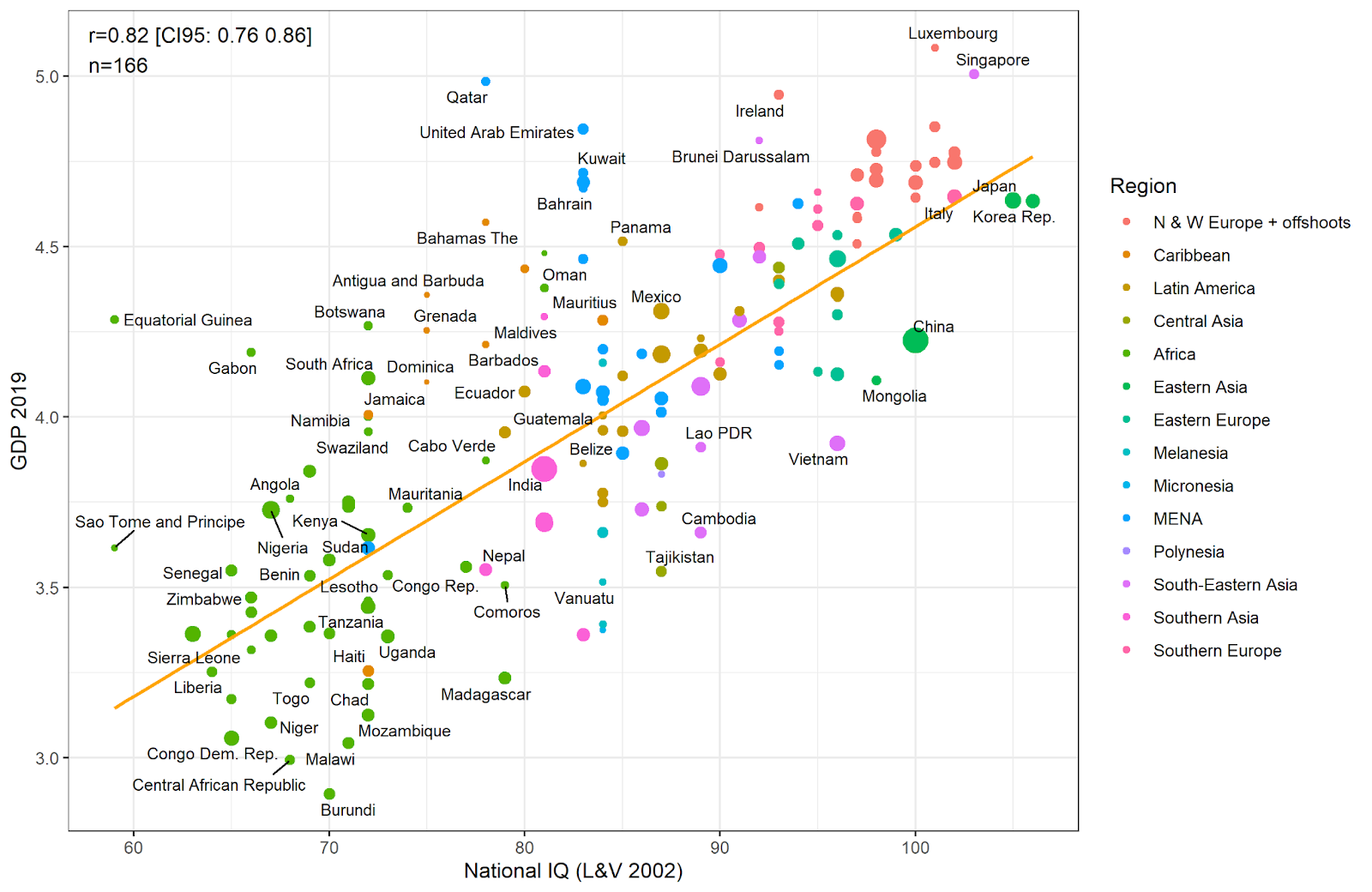
George Francis and Emil Kirkegaard have come out with a study that shows a strong correlation between IQ and wealth creation. The higher the mean IQ, the more a nation can create wealth:


We find national IQ to be the “best predictor” of economic growth, with a higher average coefficient and average posterior inclusion probability than all other tested variables (over 67) in every test run. Our best estimates find a one point increase in IQ is associated with a 7.8% increase in GDP per capita (Francis and Kirkegaard 2022)


The study is essentially an update of an earlier one by Richard Lynn and Tatu Vanhanen (2002). It’s better done, and I agree more or less with the conclusion. Wealth is not created in a vacuum. It’s created by flesh-and-blood humans who possess certain mental and behavioral attributes, one of which is high cognitive ability.


I do, however, have two criticisms.


Criticism #1: On a societal level, cognitive ability is confounded with other mental and behavioral attributes


Yes, high cognitive ability is important. But sustainable creation of wealth also requires other mental and behavioral attributes, notably:


·         propensity to identify social rules, obey them, and enforce them on others

·         feelings of guilt when one breaks the rules, even when there are no witnesses

·         empathy for others and a desire to understand how one’s behavior affects them

·         inhibition against using violence to settle disputes

·         high degree of future time orientation (also known as low time preference)


High IQ + high trust + low violence + low time preference = sustainable creation of wealth (Clark 2007; Clark 2009a; Clark 2009b; Frost 2020). Some will argue that intelligence goes hand in hand with high trust and low time preference (Carl 2014; Kirkegaard and Karlin 2020). That is true on a societal level: the same selection pressures that favor high intelligence usually favor the entire mental and behavioral package. On an individual level, however, intelligent sociopaths do exist, and they can prosper while others suffer. If they become too numerous or too influential, they will eventually destroy their host society. But that can take time.


In all fairness, Francis and Kirkegaard did investigate social trust and time preference. Unfortunately, those attributes are confounded with IQ: successful societies tend to have people who are not only intelligent but also trustworthy and future-oriented. That’s survivorship bias: if a society lacks the full mental and behavioral package, it usually goes extinct, and extinct societies get overlooked by cross-national studies. To be precise, societal extinction happens when the intelligent are unrestrained in their contempt for the less intelligent in their midst; they thus prey on them by any means possible, and the resulting strife leads to societal collapse.


IQ, social trust, and time preference are normally confounded with each other, at least in most existing societies. Therefore, if you control for IQ, the other two variables will go away, and you’ll think: “Aha! The key variable must be IQ!”


And you’ll feel all the more certain because IQ is not just equal to social trust or time preference in predicting wealth creation. It’s actually better! That greater predictive power, however, has a simple explanation: measurement of IQ is based on less subjective data. In this study, social trust is measured by self-report, and time preference is measured by an amalgam of survey responses and credit risk.


Criticism #2: The correlation is driven largely by unreliable African data


This study has another weak point: the correlation between wealth creation and IQ is driven largely by economic and cognitive data from Africa. If you remove Africa from the chart, the correlation becomes a lot weaker.


How reliable is the African data? Not very. First, a lot of African economic activity is “off the books.” That is particularly true for subsistence farming in the countryside, but it’s also true for many businesses in the towns and cities. GDP thus tends to be underestimated.


Second, even HBD writers disagree among themselves on mean African IQ, as pointed out by Heiner Rindermann:


The [cognitive] ability levels for Africans in Africa are the subject of strong disagreement. Rushton studied positively selected samples (South African university engineering students; Rushton, Skuy, & Fridjhon, 2003), but the mean differences between Africans and Europeans (14 IQ points) were similar to the ones found in Western countries. Lynn and Vanhanen (2006) estimated that sub-Saharan African countries had a mean IQ of 70. Wicherts, Dolan, and Maas (2010) using a different selection procedure came to a mean IQ of 82.


Rindermann’s “best guess” is 75. He concludes: “Given the quality of the data, it is not possible to come to a really precise result” (Rindermann 2013, p. 3). If we look at the chart from Lynn and Vanhanen (2002), we see that most sub-Saharan African countries are assigned mean IQs lower than 75. In fact, 75 seems to be the upper limit. That’s the IQ dataset of the new study.


Francis and Kirkegaard (2022, pp. 22-23) are aware that the IQ/GDP correlation is a lot weaker without the African IQ data, and they defend the validity of that dataset at some length. I’m still unimpressed, for two reasons:


·         If mean African IQ is 70, one must conclude that Africans are much less intelligent than African Americans, whose mean IQ is usually estimated at 85. Such a large difference cannot be explained by European admixture, heterosis, or nutrition.


·         The Yoruba of Nigeria have about the same polygenic score as that of African Americans (Piffer 2021, Fig. 7). Their mean IQ should therefore be 85. Yet, according to Lynn and Vanhanen, Nigerians have a mean IQ of 67. Since Nigeria is 18% Igbo, and since the Igbo show high academic achievement, mean Yoruba IQ should therefore be much less than the presumed Nigerian average of 67 (Chisala 2015; Frost 2022). The numbers don’t seem to add up.


Please don’t get me wrong. I agree that mean IQ is lower in Africa than in Eurasia, but the Lynn and Vanhanen estimates seem too low. In any case, they are not widely accepted even by researchers who accept that cognitive ability varies among human populations.


Similarly, I agree that more wealth is created per capita in Eurasia than in Africa. The difference, however, is overstated because so much of African GDP goes unreported. Furthermore, I don’t believe that lower IQ largely explains Africa’s economic underperformance. There is also the excessive use of violence to achieve one’s goals, both by the State and by private individuals. There is also the low level of trust that people have in each other—for the most part, Africans trust only their immediate family and friends. Finally, because family ties are so important, nepotism is widespread, and successful entrepreneurs end up being plundered by greedy relatives. The market economy cannot realize its full potential because the logic of the market has to compete with the logic of kinship.


Edit: George Francis has informed me that the correlation between IQ and GNP per capita remains unchanged if African cognitive and economic data are excluded. Without the African data, GDP per capita would increase 7.7% with each one point increase in IQ, rather than 7.8%.


Conclusion


Cognitive ability is only one of several mental and behavioral attributes that are key to building successful economies and societies. If we focus on it to the exclusion of others, we will be talked into supporting policies that have unintended consequences. A good example is the idea of reorienting immigration policy toward recruitment of high-IQ individuals.


That idea has the support of many conservatives throughout the West, but the consequences are very un-conservative. In short, we would be selecting immigrants who excel at creating wealth for themselves, by hook or by crook. The eventual result: an elite of rich narcissists who feel little sympathy for common people and who see them as objects to be used, when useful, and thrown away, when not.


Please don’t get bamboozled by reassurances that IQ correlates with trustworthiness and low time preference. That’s true only at the societal level. Those three attributes align with each other because they have to: otherwise, society would become dysfunctional and collapse. That’s survivorship bias: we get data from societies that have survived, and not from those that haven’t. If we cherry-pick high IQ immigrants from all over the world, we will create a new kind of society that has not stood the test of time.


Actually, that kind of society has arisen in the past:


And you should know that all the Cathayans [Chinese] detested the Grand Khan's rule because he set over them governors who were Tartars, or still more frequently Saracens, and these they could not endure, for they were treated by them just like slaves. You see the Great Khan had not succeeded to the dominion of Cathay [China] by hereditary right, but held it by conquest; and thus having no confidence in the natives, he put all authority into the hands of Tartars, Saracens, or Christians who were attached to his household and devoted to his service, and were foreigners in Cathay [China].

            The Travels of Marco Polo, Book 2, Chapter 23


Why do you think revolutions happen? It was precisely to avoid such a prospect that elite schools sought to develop not only intellect but also character, including the idea that the powerful have a duty to rule wisely and fairly. That view of higher education has given way to “meritocracy” throughout the West, with results that could have been predicted.


References


Carl, N. (2014). Does intelligence explain the association between generalized trust and economic development? Intelligence 47: 83-92. https://doi.org/10.1016/j.intell.2014.08.008


Chisala, C. (2015). The IQ gap is no longer a black and white issue. The Unz Review, June 25. http://www.unz.com/article/the-iq-gap-is-no-longer-a-black-and-white-issue/     


Clark, G. (2007). A Farewell to Alms. A Brief Economic History of the World. Princeton University Press: Princeton and Oxford.


Clark, G. (2009a). The indicted and the wealthy: surnames, reproductive success, genetic selection and social class in pre-industrial England.

http://www.econ.ucdavis.edu/faculty/gclark/Farewell%20to%20Alms/Clark%20-Surnames.pdf    


Clark, G. (2009b). The domestication of man: The social implications of Darwin. ArtefaCTos 2: 64-80. 

https://www.researchgate.net/publication/277275046_The_Domestication_of_Man_The_Social_Implications_of_Darwin  


Francis, G., and E.O.W. Kirkegaard. (2022). National Intelligence and Economic Growth: A Bayesian Update. The Mankind Quarterly 63(1). http://dx.doi.org/10.46469/mq.2022.63.1.2  


Frost, P. (2020). The large society problem in Northwest Europe and East Asia. Advances in Anthropology 10(3): 214-134. https://doi.org/10.4236/aa.2020.103012     


Frost, P. (2022). Recent cognitive evolution in West Africa: the Niger’s role. Evo and Proud, April 30. https://evoandproud.blogspot.com/2022/04/recent-cognitive-evolution-in-west.html  


Kirkegaard, E.O.W., and A. Karlin. (2020). National intelligence is more important for explaining country well-being than time preference and other measured non-cognitive traits. Mankind Quarterly 61: 339-370. http://doi.org/10.46469/mq.2020.61.2.11  


Lynn, R. and T. Vanhanen. (2002). IQ and the Wealth of Nations. Westport, Conn: Praeger


Piffer, D. (2021). Divergent selection on height and cognitive ability: evidence from Fst and polygenic scores. OpenPsych https://openpsych.net/files/submissions/14_Divergent_selection_on_height_and_cognitive_ability_evidence_from_Fst_and_13c3ICJ.pdf     


Rindermann, H. (2013). African cognitive ability: Research, results, divergences and recommendations. Personality and Individual Differences 55: 229-233. https://doi.org/10.1016/j.paid.2012.06.022     

Monday, March 15, 2021

Nigerians, Scrabble, and the GCSE


Exam hall at Hull Collegiate School (Wikicommons – Robin S. Taylor). The GCSE exam is a poor measure of raw cognitive ability. If some students get tutored and others do not, there will be more environmental variance in IQ, and the exam results will say less about the genetic potential for cognitive ability.


Chanda Chisala has written more about cognitive ability in sub-Saharan Africa. His argument is straightforward:


[…] if it is true that on average black Africans in Africa score extremely low on scholastic/intelligence tests because they grow up with much less educational and other modern cultural resources (as Flynn would agree), then they should perform "extremely well" (by comparison) in those "g-loaded" cognitive contests that do not require too much of such quality cultural exposure (as Jensen would agree). (Chisala 2021)


Chanda argues that raw cognitive ability is better measured in Africa by a Scrabble championship than by an IQ test, since most Africans lack "access to well-trained teachers, big libraries, computers or even TVs" (Chisala 2021). Africans are good at Scrabble:


Nigeria happens to be the world's top performing nation in English Scrabble, while francophone African countries are also the most dominant in French Scrabble, despite the fact that the top players in Western countries are super-high-IQ nerds with visibly exceptional mathematical talents (Chisala 2021)


Correlation isn't causation. Is a high IQ needed to do well at Scrabble? Not according to this study:


Forty tournament-rated SCRABBLE players (20 elite, 20 average) and 40 unrated novice players completed a battery of domain-representative laboratory tasks and standardized verbal ability tests. The analyses revealed that elite- and average-level rated players only significantly differed from each other on tasks representative of SCRABBLE performance. Furthermore, domain-relevant practice mediated the effects of SCRABBLE tournament ratings on representative task performance, suggesting that SCRABBLE players can acquire some of the knowledge necessary for success at the highest levels of competition by engaging in activities deliberately designed to maximize adaptation to SCRABBLE-specific task constraints. (Tuffiash, Roring, and Ericsson 2007)


Success at Scrabble seems to be due largely to practice and is thus a poor measure of raw cognitive ability.


A curious detail: Nigeria's top performers come overwhelmingly from one part of the country: the Niger Delta, which is home to the Igbo and related tribes. Since the peoples of the Niger Delta used to dominate trade between the coast and the interior, and since trade selects for cognitive ability, mean IQ should be higher in those populations that have long practiced it, like the Igbo (Frost 2015).


Young Nigerians in the UK - Academic achievement on the GCSE


Although many African immigrants do poorly in British schools, some actually do well. A study of six secondary schools in inner London found that results on the General Certificate of Secondary Education (GCSE) were higher for African students who spoke Igbo, Yoruba, Luganda, and Ga than for White British students who spoke only English (Demie 2013, p. 9). Chanda sees the GCSE as a proxy for IQ and argues that IQ differences between African immigrants and White British must be highly malleable:


Africans speaking Luganda and Krio did better than the Chinese students in 2011. The igbo were even more impressive given their much bigger numbers (and their consistently high performance over the years, gaining a 100 percent pass rate in 2009!). The superior Igbo achievement on GCSEs is not new and has been noted in studies that came before the recent media discovery of African performance. A 2007 report on "case study" model schools in Lambeth also included a rare disclosure of specified Igbo performance (recorded as Ibo in the table below) and it confirms that Igbos have been performing exceptionally well for a long time (5 + A*-C GCSEs); in fact, it is difficult to find a time when they ever performed below British whites. (Chanda 2015)


Igbo students stood out as high achievers on the GCSE, as did Yoruba students to a lesser extent. In both groups, however, the mean results were highly variable from one year to the next:


2009: Igbo - 100%, Yoruba - 39%

2010: Igbo - 80%, Yoruba - 68%

2011: Igbo - 76%, Yoruba - 75% 

(Demie 2013, p. 9)


Chanda attributes this variability to statistical noise caused by small sample size. If so, there should be an inverse correlation between sample size and variability. GCSE scores should be more variable for smaller groups than for larger ones. Yet the reverse seems to be true for the years 2009 to 2011:


Yoruba: 90 students / gain of 36 percentage points

Somali: 53 students / gain of 13 percentage points

Twi-Fante: 37 students / loss of 3 percentage points

Igbo: 16 students / loss of 24 percentage points

Krio: 12 students / gain of 4 percentage points

Tigrinya: 12 students / loss of 8 percentage points

Lingala: 12 students / loss of 5 percentage points

Ga: 8 students / gain of 9 percentage points

Swahili: 8 students / gain of 10 percentage points 

(Demie 2013, pp. 7, 9)


The two largest gains were made by the two largest groups: the Yoruba and the Somali. If the differences between 2009 and 2011 are statistical noise, why are the largest ones associated with the largest groups? Shouldn't we see the reverse? Shouldn't the smallest groups show the most variability?


Something seems to be causing those impressive GCSE gains. Since the students are not the same from one year to the next, and since the gains differ considerably from one ethnic community to another, the "something" must be the community itself. Over time, the Yoruba community became better at assisting its students, and this kind of assistance was available only in larger communities like the Yoruba.


The most obvious forms of assistance are tutoring and coaching. Such assistance is mentioned by parents in interviews for the above study:


Parent A: Father of daughter in Year 9. Generally supportive of the school which was not his first choice but is supplementing his daughter's education with a home tutor. He also calls on his extended family, his oldest son who is a graduate is also expected to help. (Demie 2013, p. 14)


Although tutoring and coaching are perfectly legitimate, they invalidate the GCSE as a means to measure IQ, particularly its genetic component. If some students get tutored and others do not, there will be more environmental variance in IQ, and the exam results will say less about the genetic potential for cognitive ability. Therefore, GCSE results tell us what we already know: if you get tutored and coached before an exam, you'll do better.


Are tutoring and coaching the only forms of community assistance? There is another one: impersonation. In other words, the parents hire a smart student from their community to take the exam in their child's place. This strategy is feasible only if the community has enough individuals who are (1) intelligent and (2) similar in age and appearance to the student in question. Such individuals are lacking in a small community, as are the middlemen who can refer an anxious parent to a suitable source of assistance.


How common is this strategy? Adebayo (2013) studied cheating behavior among Nigerian university students and British university students. He found that impersonation services were used or provided by 20% of the former and 1% of the latter. In general, cheating took non-collaborative forms among British students and collaborative forms among Nigerian students:


These include behaviours like writing somebody's coursework, colluding with others to communicate answers to one another, over marking one another's course work etc. This is quite different from plagiarism and non-collaborative cheating characteristic of the British sample reported by Newstead et al (1996). Reasons for these differences may be attributable to differences in population, differences in cultural ethnic, differences in emphasis placed on examination as part of educational assessment (Adebayo 2013, p. 146)


Adebayo (2013, p. 148) found high rates of collaborative cheating among Nigerian students:


Permitting own coursework to be copied - 72.6%

Copying another student's coursework with consent - 47.3%

Collaborative generous marking of coursework - 64.6%

Submitting joint work as an individual's - 49.3%

Doing another student's coursework for them - 77.3%

Collusion with another student to communicate answers - 83%


We live in a world that has low-trust and high-trust societies. In a high-trust society, like the UK, cheating is considered shameful and disreputable, regardless of whom you cheat. In a low-trust society, like Nigeria, cheating is wrong only when you do it to friends and relatives.


What happens when individuals from a low-trust society migrate to a high-trust one? If they come in sufficient numbers, their opportunities for collaborative cheating are greatly increased. Imagine you're supervising an exam in an English school, and you suspect an African student is filling in for another. He shows you his school card and another piece of ID. Both are correct. So what do you do now? Do you really want to make a fuss and risk being accused of racial profiling? No you don't.


Future research


The GCSE study by Demie (2013) leaves much to be desired. It does not provides the number of students who had to retake that exam (which must be a large number); nor does it provide a breakdown of the number of students taking it per year.


In any case, the GCSE is a poor substitute for an IQ test. Even if we exclude cheating, the results are distorted by legitimate activities like tutoring and coaching. The latter are more available to some students than to others. Consequently, GCSE results tell us nothing about differences in raw cognitive ability, either between individuals or between communities.


Chanda promises to write an article that will rule out cheating as an explanation for Nigerian success on the GCSE. Again, the issue isn't just cheating. It's any assistance that goes to some students and not to others. If you want to measure raw cognitive ability, you need a level playing field. In particular, you need a test that does not offer high achievers the lure of personal gain, which may push test-takers to do well by hook or by crook. In the UK, an African with good GCSE results has access to a wide range of good-paying jobs, in large part because of "diversity quotas" of one sort or another.


This motive comes out in interviews with the parents of African students:


● 'Without an education you cannot earn a decent salary, without qualifications you cannot get a good job. The best thing is to push your children as hard as you can.'

● 'Being a Black woman if you don't have education in this country, what job will you have to do, clean people's toilets?'  (Demie 2013, p. 13)


This subject should definitely be a research priority. We need IQ data on Nigerians, and not inadequate substitutes like GCSE scores. We also need data on alleles associated with educational attainment (i.e., polygenic scores). Furthermore, we need data on each of Nigeria's ethnic groups, particularly the Igbo. It's hard to fake intelligence in the real world, and the Igbo have a long history of doing better at business and other endeavors. Unfortunately, intelligent people are also better at cheating, so there is some confounding between real intelligence and the fake kind.


References


Adebayo, S.O. (2011). Common Cheating Behaviour among Nigerian University Students: A Case Study of University of Ado-Ekiti, Nigeria. World Journal of Education 1(1): 144-149.

https://files.eric.ed.gov/fulltext/EJ1159043.pdf


Chisala, C. (2015). The IQ Gap Is No Longer a Black and White Issue. The Unz Review, June 25

https://www.unz.com/article/the-iq-gap-is-no-longer-a-black-and-white-issue/


Chisala, C. (2020). Nigerians, Jews and Scrabble: An Update on the IQ Debate. The Unz Review, February 27

https://www.unz.com/article/nigerians-jews-and-scrabble-an-update-on-the-iq-debate/#comment-4520966


Demie, F. (2013). Raising Achievement of Black African Pupils. Good Practice in Schools. London: Lambeth Research and Statistics Unit, Lambeth Council.

https://www.lambeth.gov.uk/rsu/sites/www.lambeth.gov.uk.rsu/files/Raising_the_Achievement_of_Black_African_Pupils-Good_Practice_in_Schools_2013.pdf


Frost, P. (2015). The Jews of West Africa. The Unz Review, July 4

https://www.unz.com/pfrost/the-jews-of-west-africa/


Tuffiash, M., R.W. Roring, and K.A. Ericsson. (2007). Expert performance in SCRABBLE: Implications for the study of the structure and acquisition of complex skills. Journal of Experimental Psychology: Applied, 13(3), 124-134. https://doi.org/10.1037/1076-898X.13.3.124

Monday, January 6, 2020

The 2020s are here


Elderly Shanghai woman practicing tai-chi (Wikipedia – Tom Thai)


Two years ago I wrote about "The Crisis of the 2020s." I argued that this decade would see a worsening confrontation between two world views:

On the one hand, the globalist consensus will continue to radicalize in the core countries of the Western world. On the other hand, a very different consensus will dominate most of central and eastern Europe, with inroads being made into France and Germany. These opposing consensuses will diverge more and more, if only because mutual antagonism will make dialogue impossible. (Frost 2017a)

This confrontation is taking place at a time when the "consensus" no longer seems to be delivering the goods. Economic growth is sluggish not only throughout the West but also in the supposed beneficiaries of globalization—China, in particular. For some, this slowdown means that the current system has failed. For others, it means that the failings of globalization can be resolved only through more globalization.

The Crisis of the 2020s is thus primarily ideological. People are split into opposing camps, and it is far from clear which one will win. While the globalist consensus is losing ground in eastern, central, and southern Europe, it still dominates the western core of the UK, France, and Germany ... as well as North America. The West has lost its manufacturing base but is still culturally dominant. That dominance, not so much in ideas as in the packaging of ideas, is critical to promoting a model of society where people are interchangeable units in a global marketplace.

The ideological crisis will nonetheless be made worse by real-world problems:


China: a shrinking work force

China’s exports will become more expensive as its work force shrinks and grows old. This shrinkage will be worse than expected because the Chinese authorities have been overestimating the country’s fertility rate for almost two decades. The current rate is not 1.6 children per women. In fact, it had already fallen to 1.4 by 2003 and is now probably one child per woman. And this is happening even though the one-child policy is no longer in effect. The fertility rate is even lower among Han Chinese and lower still in the industrialized northeast—where it is down to 0.75 (Frost 2019a; Wang 2018). 

There are already fewer Chinese workers with each passing year, and this decrease will accelerate as the smaller cohorts of the noughts and teens enter the job market. Inevitably, the price of labor will rise. This will be good for China, which needs to reorient away from exports and toward its domestic economy. Western countries, however, will have to be weaned off their dependence on cheap Chinese goods.

Can the same goods be produced elsewhere? Unlikely. None of the alternatives sources of cheap labor have the same worker quality or, just as importantly, worker quantity. In hindsight, China was a lucky find for globalization—a country where the average worker was not only inexpensive but also intelligent and disciplined.

Western consumers are already cash-strapped, with most of them living from pay check to pay check. Where will they get the money to pay for a steep increase in the price of consumer goods?


The global food crisis

The Arab Spring was triggered by a surge in food prices. That surge was no fluke. We are reaching the end of a long increase in food production, a “green revolution” made possible by large-scale monoculture, intensive plowing, and heavy use of chemical fertilizers. That increase has come at a price, particularly degradation of soil fertility. Further increases will be modest and will require a more sustainable model of agriculture, as well as more investment in automation and robotization. Unfortunately, such changes, especially the latter, are impeded by the current heavy reliance on cheap migrant labor.

Agribusiness, particularly in the U.S., has become a conservative force that will stubbornly resist change. Like the culture industry, it will push for more of the same.


The decline of high-trust societies

The evolution of social complexity is far from easy. One of the main challenges has been the creation of large societies in which economic transactions take place mostly between unrelated individuals. Such societies are impossible in most of the world because of the high level of mistrust between unrelated individuals. Each transaction has to be checked and double-checked for lying, cheating, and outright theft. Many transactions never take place because they just aren't cost-effective.

This obstacle has been overcome in northwest Europe and East Asia. In both areas, the solution is behavioral and psychological. Northwest Europeans are more individualistic, less loyal to kin, and more trusting of strangers. Because they attach less importance to kinship, they have been able to build large, functioning societies on the basis of “impersonal prosociality,” i.e., willingness to obey universal social rules, affective empathy toward nonkin, and feelings of guilt for unwitnessed rule breaking (Frost 2017b; Frost 2019b; Schulz et al. 2019). East Asians are less individualistic but just as willing to obey universal rules, which are enforced more by shame than by guilt. Empathy is also at a high level, but less differentiated between affective and cognitive empathy:

The main difference is in the relationship between self and society. Whereas a greater sense of self has helped Northwest Europeans to transcend the limitations of kinship and, thus, build larger societies, East Asians have relied on a lesser sense of self to create a web of interdependence that extends beyond close kin. (Frost 2015)

Northwest Europeans and East Asians are now in steep demographic decline. Inevitably, less wealth will be created. I say "inevitably" because those two groups produce most of the world’s wealth. When they go, most of the wealth will go too. This is not a problem we can resolve by passing laws or changing the school curriculum. To some extent, we could force people to adopt the behaviors of a high-trust society, but that would take time and will. And we don't have much of either.


A name with a nice ring to it

When I wrote that post two years ago I settled on the name "Crisis of the 2020s." It had a nice ring to it. While doing research for this post, I googled the same name ... and got over 56,000 hits. The oldest hit seems to be a 2011 article: "Global Aging and the Crisis of the 2020s." I hadn't read it previously, but it points to the same underlying problem:

The working-age population has already begun to contract in several large developed countries, including Germany and Japan. By 2030, it will be stagnant or contracting in nearly all developed countries, the only major exception being the United States. In a growing number of nations, total population will begin a gathering decline as well. Unless immigration or birthrates surge, Japan and some European nations are on track to lose nearly one-half of their total current populations by the end of the century. (Howe and Jackson 2011)

That article differs from mine in its implied advocacy of immigration as a solution. To be sure, it does mention "the lawlessness of immigrant youths in large cities [of Western Europe]," but it remains upbeat about the United States "because of its higher fertility rate and because of substantial net immigration, which America assimilates better than most other developed countries" (Howe and Jackson 2011). That optimism was already exaggerated in 2011. Today, mass immigration is just as much a process of cultural and demographic replacement in the U.S. as it is in Western Europe.

Let's be frank. The high productivity of North America, Western Europe, and East Asia has profound behavioral and psychological causes. It is not due to political ideals, universal education, or a particular legal system. It is due to a higher level of social trust, as well as a higher level of cognitive ability and a lower level of personal violence. When immigrants enter that kind of environment, their productivity dramatically rises. They are now working in a society where laws are observed, where information is reliable, and where disputes are not normally settled through violence. We all benefit from that kind of society—simply by virtue of living in it.

That’s the "unearned privilege" that antiracists and right-wing economists love to denounce. Their argument is deceptively simple: “By what right do we deny this privilege to others?  It’s a mere accident of birth! Just think, they’re less productive because we’re keeping them out. So let them in! We’ll all be better off!”

Well, no. Do I have to explain why? 


References

Frost, P. (2015). Two Paths. The Unz Review, January 24
https://www.unz.com/pfrost/two-paths/

Frost, P. (2017a). The Crisis of the 2020s. Evo and Proud, December 19.
http://evoandproud.blogspot.com/2017/12/the-crisis-of-2020s.html

Frost, P. (2017b). The Hajnal line and gene-culture coevolution in northwest Europe. Advances in Anthropology 7: 154-174.
https://file.scirp.org/pdf/AA_2017082915090955.pdf 

Frost, P. (2019a). Autumn in China. Evo and Proud, March 26
http://evoandproud.blogspot.com/2019/03/autumn-in-china.html 

Frost, P. (2019b). Was Western Christianity a cause or an effect? Comment on: J.F. Schulz, D. Bahrami-Rad, J.P. Beauchamp, and J. Henrich. The Church, intensive kinship, and global psychological variation. Science 366 (6466)
https://science.sciencemag.org/content/366/6466/eaau5141/tab-e-letters  

Howe, N., and R. Jackson. (2011). Global aging and the Crisis of the 2020s. Current History, January, pp. 20-25
https://pdfs.semanticscholar.org/9879/fe3ea41e85f5fdfb6bc1ffcc2ae5c44a1a2a.pdf 

Schulz, J.F., D. Bahrami-Rad, J.P. Beauchamp, and J. Henrich. (2019). The Church, intensive kinship, and global psychological variation. Science 366(707): 1-12. 
https://web.ics.purdue.edu/~drkelly/SchulzHenrichetalTheChurchIntensiveKinshipGlobaPsychologicalVariation2019.pdf

Wang, M. (2018). For Whom the Bell Tolls: A Retrospective and Predictive Study of Fertility Rates in China (November 8, 2018). Available at SSRN: https://papers.ssrn.com/sol3/papers.cfm?abstract_id=3234861  

Monday, June 11, 2018

Doing better in the promised land


View of Tel Aviv. Israel shows good intellectual achievement, but not the top intellectual achievement of Jews in the U.S. How come?


Why do Ashkenazi Jews do worse in Israel than in the United States? This question is raised by Heiner Rindermann in his new book Cognitive Capitalism. Israel is an advanced country and shows promise in certain areas, like nuclear power and certain high-tech goods. Yet it underperforms when compared with Jewish communities in the West. "There is clear evidence for good intellectual achievement; however, not for top intellectual achievement as from Western Ashkenazi Jews" (Rindermann 2018, p. 149).

Israel is 42% Ashkenazi, a proportion that works out to more than three and a half million. By comparison, American Jews number between 5.5 and 8 million, and their intellectual creativity—in whatever field you choose—has been many times greater. So what gives?

One reason is that the above figure of 42% includes the recent wave of Russian immigrants to Israel, and they are on average only half-Jewish (Wikipedia 2018). It is also possible that offspring of Ashkenazi-Sephardic or Ashkenazi-Mizrahi marriages tend to self-identify as Ashkenazi. 

A second reason is ideological. The Zionist movement sought to create a "new Jew," who would be less intellectual and more interested in other pursuits. Furthermore, Israel is home to over a million Haridim (strictly Orthodox Jews), who confine their intellectual pursuits to Torah study.

A third reason is that Israel is not a high-trust culture, at least not to the same extent as Western countries:

Statistics from Transparency International on corruption corroborate these political observations: while Scandinavian nations are leading in non-corruption, closely followed by (present and past) British and European countries, Israel comes at rank 37, after Botswana, [United Arab] Emirates and Chile. (Rindermann 2018, p. 150).

This is consistent with mainstream thinking. When Jews immigrated to the United States, they found a land of opportunity where they could use their abilities to the fullest. This narrative, however, is usually framed in terms of freedom from discrimination: America offered a haven from antisemitism. Just as importantly, however, it also offered a high-trust culture. Americans could generally be counted on to do what they said they would do and charge only what they said they would charge. When two Soviet journalists, Ilya Ilf and Evgeny Petrov, visited the U.S. in 1935, they were struck by the integrity of the average American:

The American sits in his office with his coat off and works. He works quietly, unobtrusively, without making any fuss. He is never late anywhere. He never hurries anywhere. He has only one telephone. No one waits for him in his reception room, because an appointment is usually made with absolute accuracy, and not a single extra minute is wasted during the interview.

[...] Should an American say in the course of a conversation, even incidentally, "I'll do that," it is not necessary to remind him of anything at all in the future. Everything will be done. The ability to keep his word, to keep it firmly, accurately, to burst, but keep his word—this is the most important thing which our Soviet business people must learn from American business people. (Ilf and Petrov 1937)


Migration and productivity

The same could be said for other immigrant groups. People do better when they move from a low-trust culture to a high-trust one. They can fully realize their potential. We see this with PISA math scores. Asian American students do better than students in Asia, White American students do better than students in Europe, Hispanic American students do better than students in Latin America, and African American students do better than students in sub-Saharan Africa (Sailer 2013).

This benefit of migration is affirmed by mainstream economists, although they usually attribute migrant success to abstractions like "good government" and "good institutions"—as if these entities are not composed of flesh-and-blood people who think and act like other people of the same culture:

There are many reasons why this is so. Among them are that the lower earners usually live in societies with predatory governments that arbitrarily confiscate wealth, are rent asunder by civil war and other armed conflicts, and lack the social, political, and economic institutions that are the foundations for economic growth, as well as numerous other factors. By contrast, residents of developed countries face fewer political and social barriers to economic growth, thus incentivizing the long-term accumulation of the machines, knowledge, and human capital that propel the economy. (Nowrasteh 2016)

As a result, migrants are more productive in First World societies like the United States than they were in their home societies:

[...] the median worker from the developing world can expect a fourfold increase in wages by coming to the United States. Across the board, wage growth can range from a twofold increase for Dominicans to a 15-fold increase for Yemenis. Thus, just by moving to the United States, these workers will experience increases in income that few in the developed world can imagine. These gains do not come at the cost of Americans' losses, but from the increased productivity of the immigrant workers themselves. (Nowrasteh 2016)

Their productivity will increase because they are now interacting with a high-trust culture. They receive their supplies on time, and these supplies don't have to be checked and double-checked. The product of their labor is then distributed or further processed by people who do what they say they will do. More work gets done, and less time gets wasted.

This is the main argument for labor mobility. Workers from a Third World country can do better if moved to a First World country. This is not because they have become better workers. It's because they are now immersed in a culture that functions better.

So why not let people migrate from the Third World to the First World? Their productivity will rise, employers will get cheaper labor, and the global economy as a whole will benefit. It's a win-win, isn't it?

Well, no. If you fill a high-trust culture with people from low-trust societies, you'll eventually get .... another low-trust culture. You'll kill the goose that laid the golden egg.


Parting thoughts

When I raise these points with other people, I soon run into disagreement, even when among people with open minds.

Disagreement often comes from a belief that immigrants will "assimilate." The habits of a low-trust culture will be shed and replaced with those of a high-trust one. To some extent, this does happen when immigrants are relatively few in number. As they become more numerous, however, the pressure to assimilate slackens and may even go into reverse. The pressure to assimilate is also weakened by new technologies, particularly the Internet, which are making it easier for migrants to live in their native culture anywhere on the planet.

There is also disagreement over what creates a high-trust culture. At one time this question used to interest social scientists, but now that interest has refocused on "whiteness studies." It seems that societies like Iceland function admirably because of their "white privilege."

Sarcasm aside, trust does matter. It has been key to the rise of Western societies to global dominance. But how is it created? I've argued that Western societies have extended the high-trust environment of the family to a much larger social context, specifically through a more individualistic mindset that is governed by universal moral rules, rather than by a dual morality that favors close kin over everyone else.

This high-trust mindset has four main components:

Independent social orientation - independence of the self from others, including stronger motivation toward self-expression, self-esteem, and self-efficacy and emphasis on personal happiness rather than social happiness. 

Universal rule adherence - capacity to obey universal and absolute moral rules, i.e., moral universalism and moral absolutism, as opposed to situational morality based on kinship. These rules are enforced by monitoring not only others but also oneself. Rule-breakers may be branded as morally worthless and expelled from the entire moral community, as opposed to being ostracized by close kin.

Guilt proneness - capacity to self-monitor thoughts and behavior for rule adherence in order to self-judge and, if necessary, to self-punish.

Affective empathy - capacity to experience the emotional states of other people in order to prevent harm and to provide help if needed. This help is conditional on the other person being judged morally worthy, i.e., a rule follower. In most human populations, affective empathy is largely confined to relations between a mother and her offspring. In northwest Europeans, it has become generalized to all community members (Frost 2017).

In addition, there is a fifth and historically more recent component: pacification of social relations. This is an outcome of the first component. Once violent individuals had become branded as immoral, they were removed from society with fanatical zealousness (Frost and Harpending 2015). Finally, there is increased cognitive ability, which I mention last partly because it receives too much attention in this sort of discussion and partly because it too may be relatively recent. Rindermann (2018, pp. 86-87) has argued that mean IQ rose in Western Europe during late medieval and post-medieval times as a result of the greater reproductive success of the nascent middle class.

All of the above components have medium to high heritability. If we wish to impose this mindset, we will be constrained by the underlying genotype. Guilt and empathy cannot be elicited from people who are not guilt-prone and empathic. Nor can such people be made to feel calm if they have exceeded their anger threshold. There remain only "carrot and stick" methods to make them act in ways they normally would not. As for cognitive ability, the room for improvement is slim. Any gains made during adolescence will largely "wash out" during adulthood.

That may not be the message you want to hear. And perhaps it is too pessimistic. Again, it depends on the numbers. It would also help if Christians were still interested in enforcing proper behavior. Nowadays, most aren't.

Finally, I should point out that there may be more than one way to build a high-trust culture. East Asian societies, for instance, rely more on rule adherence and less on affective empathy and guilt proneness (Frost 2015).


References

Frost, P. (2017). The Hajnal line and gene-culture coevolution in northwest Europe, Advances in Anthropology 7: 154-174.
http://file.scirp.org/pdf/AA_2017082915090955.pdf

Frost, P. (2015). Two Paths. The Unz Review, January 24
http://www.unz.com/pfrost/two-paths/

Frost, P. and H. Harpending. (2015). Western Europe, state formation, and genetic pacification, Evolutionary Psychology 13: 230-243.
http://evp.sagepub.com/content/13/1/147470491501300114.abstract

Ilf, I. and E. Petrov. (1937). Little Golden America
https://scholar.google.ca/scholar?hl=fr&as_sdt=0%2C5&q=little+golden+america&btnG= 

Nowrasteh, A. (2016). The Case for More Immigration. Democracy. A Journal of Ideas. Fall. No. 42
https://democracyjournal.org/magazine/42/the-case-for-more-immigration/

Rindermann, H. (2018). Cognitive Capitalism. Human Capital and the Wellbeing of Nations. Cambridge University Press.

Sailer, S. (2013). PISA racial results for Americans on Math. December 3, Steve Sailer. iSteve.
https://isteve.blogspot.com/2013/12/pisa-racial-results-for-americans-on.html

Wikipedia (2018). 1990s Post-Soviet aliyah
https://en.wikipedia.org/wiki/1990s_Post-Soviet_aliyah