Showing posts with label agriculture. Show all posts

Monday, January 6, 2020

The 2020s are here


Elderly Shanghai woman practicing tai-chi (Wikipedia – Tom Thai)


Two years ago I wrote about "The Crisis of the 2020s." I argued that this decade would see a worsening confrontation between two world views:

On the one hand, the globalist consensus will continue to radicalize in the core countries of the Western world. On the other hand, a very different consensus will dominate most of central and eastern Europe, with inroads being made into France and Germany. These opposing consensuses will diverge more and more, if only because mutual antagonism will make dialogue impossible. (Frost 2017a)

This confrontation is taking place at a time when the "consensus" no longer seems to be delivering the goods. Economic growth is sluggish not only throughout the West but also in the supposed beneficiaries of globalization—China, in particular. For some, this slowdown means that the current system has failed. For others, it means that the failings of globalization can be resolved only through more globalization.

The Crisis of the 2020s is thus primarily ideological. People are split into opposing camps, and it is far from clear which one will win. While the globalist consensus is losing ground in eastern, central, and southern Europe, it still dominates the western core of the UK, France, and Germany ... as well as North America. The West has lost its manufacturing base but is still culturally dominant. That dominance, not so much in ideas as in the packaging of ideas, is critical to promoting a model of society where people are interchangeable units in a global marketplace.

The ideological crisis will nonetheless be made worse by real-world problems:


China: a shrinking work force

China’s exports will become more expensive as its work force shrinks and grows old. This shrinkage will be worse than expected because the Chinese authorities have been overestimating the country’s fertility rate for almost two decades. The current rate is not 1.6 children per women. In fact, it had already fallen to 1.4 by 2003 and is now probably one child per woman. And this is happening even though the one-child policy is no longer in effect. The fertility rate is even lower among Han Chinese and lower still in the industrialized northeast—where it is down to 0.75 (Frost 2019a; Wang 2018). 

There are already fewer Chinese workers with each passing year, and this decrease will accelerate as the smaller cohorts of the noughts and teens enter the job market. Inevitably, the price of labor will rise. This will be good for China, which needs to reorient away from exports and toward its domestic economy. Western countries, however, will have to be weaned off their dependence on cheap Chinese goods.

Can the same goods be produced elsewhere? Unlikely. None of the alternatives sources of cheap labor have the same worker quality or, just as importantly, worker quantity. In hindsight, China was a lucky find for globalization—a country where the average worker was not only inexpensive but also intelligent and disciplined.

Western consumers are already cash-strapped, with most of them living from pay check to pay check. Where will they get the money to pay for a steep increase in the price of consumer goods?


The global food crisis

The Arab Spring was triggered by a surge in food prices. That surge was no fluke. We are reaching the end of a long increase in food production, a “green revolution” made possible by large-scale monoculture, intensive plowing, and heavy use of chemical fertilizers. That increase has come at a price, particularly degradation of soil fertility. Further increases will be modest and will require a more sustainable model of agriculture, as well as more investment in automation and robotization. Unfortunately, such changes, especially the latter, are impeded by the current heavy reliance on cheap migrant labor.

Agribusiness, particularly in the U.S., has become a conservative force that will stubbornly resist change. Like the culture industry, it will push for more of the same.


The decline of high-trust societies

The evolution of social complexity is far from easy. One of the main challenges has been the creation of large societies in which economic transactions take place mostly between unrelated individuals. Such societies are impossible in most of the world because of the high level of mistrust between unrelated individuals. Each transaction has to be checked and double-checked for lying, cheating, and outright theft. Many transactions never take place because they just aren't cost-effective.

This obstacle has been overcome in northwest Europe and East Asia. In both areas, the solution is behavioral and psychological. Northwest Europeans are more individualistic, less loyal to kin, and more trusting of strangers. Because they attach less importance to kinship, they have been able to build large, functioning societies on the basis of “impersonal prosociality,” i.e., willingness to obey universal social rules, affective empathy toward nonkin, and feelings of guilt for unwitnessed rule breaking (Frost 2017b; Frost 2019b; Schulz et al. 2019). East Asians are less individualistic but just as willing to obey universal rules, which are enforced more by shame than by guilt. Empathy is also at a high level, but less differentiated between affective and cognitive empathy:

The main difference is in the relationship between self and society. Whereas a greater sense of self has helped Northwest Europeans to transcend the limitations of kinship and, thus, build larger societies, East Asians have relied on a lesser sense of self to create a web of interdependence that extends beyond close kin. (Frost 2015)

Northwest Europeans and East Asians are now in steep demographic decline. Inevitably, less wealth will be created. I say "inevitably" because those two groups produce most of the world’s wealth. When they go, most of the wealth will go too. This is not a problem we can resolve by passing laws or changing the school curriculum. To some extent, we could force people to adopt the behaviors of a high-trust society, but that would take time and will. And we don't have much of either.


A name with a nice ring to it

When I wrote that post two years ago I settled on the name "Crisis of the 2020s." It had a nice ring to it. While doing research for this post, I googled the same name ... and got over 56,000 hits. The oldest hit seems to be a 2011 article: "Global Aging and the Crisis of the 2020s." I hadn't read it previously, but it points to the same underlying problem:

The working-age population has already begun to contract in several large developed countries, including Germany and Japan. By 2030, it will be stagnant or contracting in nearly all developed countries, the only major exception being the United States. In a growing number of nations, total population will begin a gathering decline as well. Unless immigration or birthrates surge, Japan and some European nations are on track to lose nearly one-half of their total current populations by the end of the century. (Howe and Jackson 2011)

That article differs from mine in its implied advocacy of immigration as a solution. To be sure, it does mention "the lawlessness of immigrant youths in large cities [of Western Europe]," but it remains upbeat about the United States "because of its higher fertility rate and because of substantial net immigration, which America assimilates better than most other developed countries" (Howe and Jackson 2011). That optimism was already exaggerated in 2011. Today, mass immigration is just as much a process of cultural and demographic replacement in the U.S. as it is in Western Europe.

Let's be frank. The high productivity of North America, Western Europe, and East Asia has profound behavioral and psychological causes. It is not due to political ideals, universal education, or a particular legal system. It is due to a higher level of social trust, as well as a higher level of cognitive ability and a lower level of personal violence. When immigrants enter that kind of environment, their productivity dramatically rises. They are now working in a society where laws are observed, where information is reliable, and where disputes are not normally settled through violence. We all benefit from that kind of society—simply by virtue of living in it.

That’s the "unearned privilege" that antiracists and right-wing economists love to denounce. Their argument is deceptively simple: “By what right do we deny this privilege to others?  It’s a mere accident of birth! Just think, they’re less productive because we’re keeping them out. So let them in! We’ll all be better off!”

Well, no. Do I have to explain why? 


References

Frost, P. (2015). Two Paths. The Unz Review, January 24
https://www.unz.com/pfrost/two-paths/

Frost, P. (2017a). The Crisis of the 2020s. Evo and Proud, December 19.
http://evoandproud.blogspot.com/2017/12/the-crisis-of-2020s.html

Frost, P. (2017b). The Hajnal line and gene-culture coevolution in northwest Europe. Advances in Anthropology 7: 154-174.
https://file.scirp.org/pdf/AA_2017082915090955.pdf 

Frost, P. (2019a). Autumn in China. Evo and Proud, March 26
http://evoandproud.blogspot.com/2019/03/autumn-in-china.html 

Frost, P. (2019b). Was Western Christianity a cause or an effect? Comment on: J.F. Schulz, D. Bahrami-Rad, J.P. Beauchamp, and J. Henrich. The Church, intensive kinship, and global psychological variation. Science 366 (6466)
https://science.sciencemag.org/content/366/6466/eaau5141/tab-e-letters  

Howe, N., and R. Jackson. (2011). Global aging and the Crisis of the 2020s. Current History, January, pp. 20-25
https://pdfs.semanticscholar.org/9879/fe3ea41e85f5fdfb6bc1ffcc2ae5c44a1a2a.pdf 

Schulz, J.F., D. Bahrami-Rad, J.P. Beauchamp, and J. Henrich. (2019). The Church, intensive kinship, and global psychological variation. Science 366(707): 1-12. 
https://web.ics.purdue.edu/~drkelly/SchulzHenrichetalTheChurchIntensiveKinshipGlobaPsychologicalVariation2019.pdf

Wang, M. (2018). For Whom the Bell Tolls: A Retrospective and Predictive Study of Fertility Rates in China (November 8, 2018). Available at SSRN: https://papers.ssrn.com/sol3/papers.cfm?abstract_id=3234861  
Saturday, August 9, 2014

The agricultural revolution that wasn't


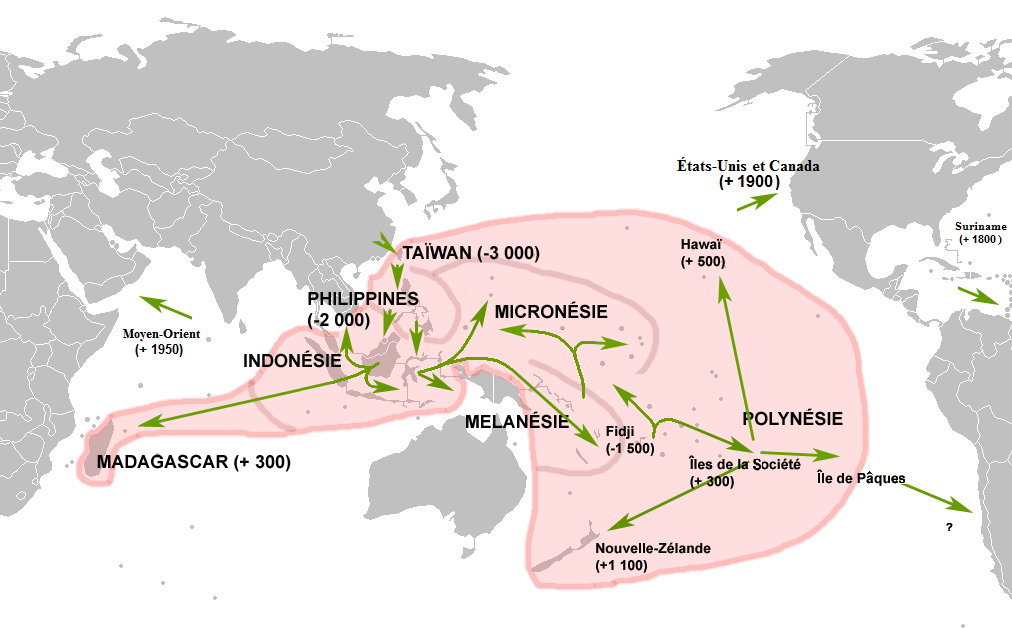
Originally from south China, Austronesians spread successively outward to Taiwan, Southeast Asia, and Oceania. Was farming the secret of their success? Or was it their mental makeup? (source: French Wikipedia - Maulucioni)


About 10,000 years ago, the pace of human genetic evolution rose a hundred-fold (Hawks et al., 2007). Our ancestors were no longer adapting to slowly changing physical environments. They were adapting to rapidly evolving cultural environments.

What, exactly, caused this speed-up? The usual answer is the shift from hunting and gathering to farming, which in turn caused other changes. People were becoming sedentary and living in ever larger communities: villages, towns, and finally cities. Farming also produced a food surplus to be stored for future use, thereby providing powerful men with the means to bankroll a growing number of servants, soldiers, and other hangers-on. Thus began the formation of early states. And thus ended the primitive equality of hunter-gatherers.

But is that the whole story? Was farming the trigger for this chain of events? Or did something earlier get things going? More and more anthropologists are taking a closer look at what happened just before the advent of farming, a period called the "Broad Spectrum Revolution": 

All Paleolithic hominids lived by hunting and collecting wild foods, an aspect of existence that began to disappear only with the emergence of the farming and herding societies of the Neolithic ≤10,000 years ago (10 KYA). What are the roots of this remarkable economic transformation? The answer lies in equally revolutionary changes that took place within certain stone age cultures several millennia before. In 1968, Lewis R. Binford noted what appeared to be substantial diversification of human diets in middle- and high-latitude Europe at the end of the Paleolithic, roughly 12-8 KYA. Rapid diversification in hunting, food processing, and food storage equipment generally accompanied dietary shifts, symptoms of intensified use of habitats, and fuller exploitation of the potential foodstuffs they contained. (Stiner, 2001).

Farming thus came on the heels of a broader cultural, behavioral, and even psychological revolution. It is this broader change, rather than farming alone, that probably caused many supposedly farming-related events, such as the rapid spread of certain agricultural peoples into territories that formerly belonged to hunter-gatherers. Examples include the Bantu expansion, which began about 4,000 years ago along the Nigerian/Cameroun border and spread east and south, eventually throughout almost all of central, eastern and southern Africa. There was also the more controversial Neolithic expansion, which started about 10,000 years ago in present-day Turkey and pushed north and west into Europe. Finally, there was the Austronesian expansion, which began over 6,000 years ago when Malay-speaking farmers crossed from south China to Taiwan. Then, some 4,000 years ago, they began to push rapidly into Southeast Asia and Oceania, finally reaching places as far apart as Easter Island and Madagascar.

Farming is said to have fueled all three demographic expansions. It created more food, which in turn created more people, who then bulldozed the less numerous hunter-gatherers out of existence. Yet this theoretical model does not fit the Austronesian expansion very well, as anthropologist Roger Blench points out:

The [existing] model proposes that it was the Austronesian adoption of an agricultural package, including rice, pigs and chickens, which allowed them to colonise Island SE Asia at the expense of resident hunter-gatherers. However, archaeology has signally failed to confirm this model. Early sites show very similar dates across a wide geographical area, suggesting that the first phase of post-Taiwan Austronesian expansion took place extremely rapidly. Pigs, dogs and chickens have been shown to arrive in ISEA via other routes and rice is conspicuously absent in most places. This paper argues that this model has effectively inverted the actual situation, and that the Austronesian expansion was the consequence of a failed agricultural revolution and a reversion to opportunistic foraging. (Blench, 2014)

There was no "package" of domesticated plants and animals that enabled Austronesians to overwhelm the earlier inhabitants of Southeast Asia:

No remains of cereals of the relevant antiquity have been found in the Northern Philippines. Even today, the characteristic millets of the Asian mainland are barely represented in ISEA agriculture. Of the dogs, pigs and chickens originally thought to be part of the Austronesian 'package' only pigs cross the Taiwan Strait, and these now seem to be a local domestication not ancestral to the domestic pigs which are generally part of the Austronesian world. The apparent reconstructions for names of these domestic species formed part of the argument for their salience, but as Blench (2012) points out, these were based on chains of loanwords giving an appearance of spurious antiquity. (Blench, 2014)

Not only did the Austronesians bring a limited farming package to Southeast Asia, the existing peoples there already practiced a mix of farming and foraging:

Ellen (1988) describes this type of mixed vegeculture and arboriculture, a sedentary lifestyle based around sago extraction, for Seram in Eastern Indonesia. Stark (1996) touches on this hypothesis in a discussion of the archaeology of Eastern Indonesia, and Kyle Latinis (2000) discusses the broader role of arboriculture in early subsistence in ISEA. Hunt & Rushworth (2005) report evidence for disturbance in the tropical lowland forest at Niah, Sarawak, Malaysian Borneo at 6000 BP which they attribute to cultivation. Huw Barton (2012) has evidence from starch on stone pounders in the Kelabit highlands for palm granules earlier than 6500 BP. (Blench, 2014)

The incoming Austronesians really brought little, agriculturally speaking. In some cases, they actually reverted to foraging. In other cases, they adopted various crops and farm animals from the locals.

The picture is diverse, suggesting continued foraging, vegeculture, and sago starch extraction. Hence the concept that the maritime Austronesians reverted to a type of subsistence based on fishing, trading, possibly raiding and exchange of prestige goods. With their advanced sailing technology, they were well-placed to carry high-value goods from one exchange site to another. Their encounter with the Melanesian populations in Eastern Indonesia is certainly responsible for their adoption of vegeculture and domestic animals, but they were willing to drop and re-adopt these according to the circumstances of individual cultures they encountered. (Blench, 2014)

The Austronesians are often treated in the existing literature as a type-society for demographic expansion, with agriculture the underlying engine of growth. This is in increasing disaccord with the archaeology of the region, and this paper will suggest that the explanation is almost its inverse, that they succeeded precisely because they strategically reverted to foraging. (Blench, 2014)

What advantage, then, did the Austronesians have over the natives they displaced? There must have been something to offset the "home team" advantage of the natives, who knew the local environment better than anyone else. 

The Austronesian advantage seems to have been threefold: (1) a more flexible and innovative approach; (2) a less present-oriented time orientation that extended further into the past and the future; and (3) a less individualistic approach to life that made collective goods and goals more possible.
 

Flexibility and innovation

Blench (2014) states: “Austronesians quickly reinvented themselves, incorporating regional innovations into their cultural repertoire. Apart from their own distinctive pottery, they must have quickly seized on other early trade possibilities, obsidian, stone axes, woven goods and baskets. By the time they begin to reach uninhabited islands they have constructed Austronesian culture out of fragmentary elements adopted from a wide range of sources.”
 

Time orientation

The Austronesians saw themselves as the embodiment of lineages that stretched backwards into the past and forwards into the future. Preservation of genealogies seems to have been a typical cultural trait of Austronesian peoples, and this ancestor worship fostered a widespread desire among them to become revered ancestors. Quoting an earlier author, Blench (2014) points to "a culturally sanctioned desire to found new settlements in order to become a revered or even deified founder ancestor in the genealogies of future generations." The rapidity of the Austronesian expansion was thus, in part, ideologically driven.
 

Collectivism

Blench (2014) refers to "the striking differences between Austronesians in contact with Melanesians, whose typical social structures were individualist, acephalous and marked by great diversity in approaches to religion and belief." Austronesian society was more hierarchical with caste-like elements, particularly priestly castes who acted as repositories of esoteric knowledge. Belief-systems were more homogeneous. Austronesian peoples have long shown evidence of strong religiosity, even those who have not converted to Hinduism, Islam, or Catholicism.
 

Conclusion

One of my professors, Bernard Arcand, would talk to us about the hunter-gatherers of Upper Amazonia and their indifference to farming. They saw it as something akin to slavery and couldn't understand why anyone would want to stay put in one place and toil in the fields all day. Attempts to teach them the benefits of farming typically failed. Benefits? What benefits?

There has to be a change in mental makeup before farming becomes possible. People must become willing to exchange short-term pain for long-term gain. They must accept monotony and sedentary living. They must live in larger communities with people who are not necessarily close kin. And they must get used to bland, nutrient-poor food.

Anthropology has long tried to explain human societies in terms of their modes of subsistence: hunting and gathering, farming, industrial capitalism. This material basis of society is thus the source of our mental makeup. In reality, the two have coevolved with each other. Moreover, when humans adapt to a certain mode of subsistence, they may become "pre-adapted" to later ones. We associate the dawn of civilization with a shift toward future time orientation and a resulting complexification of technology, yet this shift seems to have first begun among hunter-gatherers of the sub-Arctic, where the yearly cycle required development of technologies for storage, meat refrigeration, and heat conservation, as well as other means to collect unpredictable and widely dispersed resources. This 'first industrial revolution' pre-adapted early modern humans for later cultural developments in places farther south. 

It is perhaps no coincidence that most of the human gene pool ultimately came from people who, more than 10,000 years ago, roamed the northern wastes of Eurasia. Such people were ancestral to many southward-pushing demographic expansions, including the one that would give rise to the Austronesians (Frost, 2014).


References

Blench, R. (2014). The Austronesians: An agricultural revolution that failed, To be presented at the Second International Conference on Taiwan Indigenous Peoples, 15-17 September 2014 Shung Ye Museum, Taipei, Taiwan
http://rb.rowbory.co.uk/Archaeology/Oceania/Blench%20Austronesian%20Taipei%202014%20agric%20failed.pdf

Cochran, G. and H. Harpending. (2009). The 10,000 Year Explosion: How Civilizations Accelerated Human Evolution, Basic Books, New York. 

Frost, P. (2014). The first industrial revolution, Evo and Proud, January 18
http://evoandproud.blogspot.ca/2014/01/the-first-industrial-revolution.html  

Hawks, J., E.T. Wang, G.M. Cochran, H.C. Harpending, & R.K. Moyzis. (2007). Recent acceleration of human adaptive evolution. Proceedings of the National Academy of Sciences (USA), 104, 20753-20758.
http://www.ncbi.nlm.nih.gov/pmc/articles/PMC2410101/  

Stiner, M.C. (2001). Thirty years on the "Broad Spectrum Revolution" and paleolithic demography, Proceedings of the National Academy of Sciences, 98 (13), 6993-6996.
http://hatayup.web.arizona.edu/pubs/stiner2001.pdf

Friday, January 21, 2011

Religiosity and the origins of civilization

Scenes of daily life from Sumer. The causes of civilization are not to be found in early art, writing, or architecture. These are merely the consequences of a preceding mental revolution.

Humans have gone through three stages of development: hunting/gathering, simple agricultural societies, and complex agricultural societies. The last stage brought us most of what we call “civilization”— state formation, class differentiation, urbanization, writing systems, literate culture, and so on.

What caused this transition from simple to complex agricultural societies? Was it simply the passage of time? Doubtful. Some societies have made this transition sooner than others. Others have never made it.

According to Atkinson and Whitehouse (2011), this debate has shifted away from technological causes and toward social and symbolic ones:

The main drivers of the great transition from small-scale hunter-gatherer societies in the pre-pottery Neolithic to the vast and complex civilizations of East Asia, MesoAmerica and the Fertile Crescent are still much debated […] Doubts have been growing with respect to the explanatory power of technological innovation, and attention has been focused increasingly on changes in social and symbolic worlds.

For the two authors, the change in the mode of subsistence (from hunting/gathering to agriculture) paved the way for a change in the mode of religiosity. It was this second transition that actually made the complexification of society possible. Humans became accustomed to a more systematized and accumulative form of thinking, and it was this new mental space that eventually became translated into a new physical space of buildings, roads, towns, and so forth.

Atkinson and Whitehouse argue that human societies seem to cluster into two modes of religiosity:

1. An “imagistic” mode associated with hunter-gatherers. Religiosity is focused on non-routine events that evoke an intense state of mental arousal (initiation, ordeals, bodily mutilation, etc).

2. A “doctrinal” mode associated with agricultural societies. Religiosity is more routine and is focused on frequently repeated teachings and rituals that generally evoke a less intense state of mental arousal.

Among hunter-gatherers, religiosity is meant to be traumatic. The aim is to create a vivid experience with long-lasting effects, such as an emotional bond that will keep men loyal to each other for hunting or war.

In agricultural societies, religiosity supports tasks that occur more often and more regularly:

Whereas the exploitation of wild resources requires only sporadic group co-operation (e.g., in hunting larger game), the domestication of animals and plants fosters increasingly routinized forms of collaborative labour (e.g., clearing, planting, harvesting and building). In traditional societies, such activities are typically punctuated by rituals.

There is thus selection for a new kind of mental space:

Put simply, the proposed doctrinal mode is seen as favouring high-frequency, low-arousal rituals, allowing large bodies of religious teachings to be stored in semantic memory, reproduced stably and spread efficiently as oral tradition.

[…] The doctrinal mode is based around frequently repeated teachings and rituals. High-frequency ritual performances allow complex networks of ideas to be transmitted and stored in semantic memory and give rise to generic identity markers ascribed to large-scale ‘imagined communities.’

It was this new mental space that made complex societies possible. Thus, the causes of civilization are not to be found in early art, writing, or architecture. These are merely the consequences of a preceding mental revolution. Atkinson and Whitehouse argue that the doctrinal mode of religiosity created a positive feedback loop of increasing cultural complexity:

If the emergence of agriculture drives an overall increase in the frequency of communal rituals, it also indirectly opens up opportunities for other features of the doctrinal mode to appear.

Other features might include organized priesthoods, ways to codify, transmit, and organize religious traditions (such as writing), and methods to enforce group cooperation and resource control.

Atkinson and Whitehouse do not ask why this mental revolution occurred in some agricultural societies and not in others. Tropical horticulturalists, for example, seem to have permanently stalled at the stage of simple societies. One reason may be that year-round agriculture enables women to provide for themselves and their offspring with limited male assistance. When agriculture is largely a female task, it is less likely to generate communal forms of religiosity that structure everyone’s mental space.

In addition, female reproductive autonomy reduces the costs of polygyny and thus increases male-male rivalry for mates. Such rivalry makes it harder to bring the men of a community together into stable communal structures. Yet such structures must be in place before rituals can become fully communalized on a regular basis, this being the first step toward complexification of mental space and, hence, society itself.

Reference

Atkinson, Q.D. & H. Whitehouse. (2011). The cultural morphospace of ritual form : Examining modes of religiosity cross-culturally, Evolution & Human Behavior, 32, 50-62.

Saturday, October 16, 2010

The evolution of Cavalli-Sforza. Part VII

Bird in a gilded cage

Cavalli-Sforza’s last big project was the publication of The History and Geography of Human Genes, which came out in 1994. Since then, he has kept himself busy tying up loose ends.

Advancing age is only one reason why he has lowered his sights. In fact, he had originally planned to work on two major projects until the end of his life. One was on gene-culture co-evolution. It would have involved studying the Inuit to see how their hunting lifestyle had selected for a keen sense of spatial orientation, specifically the ability to disembed an object from a larger visual landscape, to store it as a spatio-temporal model in the mind, and then to convert it back into a real-world object (e.g., a soapstone carving). Adopted and non-adopted Inuit would have been studied to find out how much of this ability was innate and how much learned. The project would have then served as a springboard for comparative studies of mental traits in other hunter-gatherer groups and, later, in agricultural populations.

That project suddenly aborted, for nebulous reasons. Its place was then taken by the Human Genome Diversity Project. This would have been a continuation of work that Cavalli-Sforza had been pursuing off and on since the mid-1960s, the main aim being to reconstruct how ancestral humans had split up as they spread out of Africa to the other continents. That project too came to a sudden end—in the face of violent accusations of racism. Funding dried up and researchers shied away. Today, research is still ongoing unofficially, the unspoken premise being that an unofficial project is less likely to catch flak than an official one. And the less Cavalli-Sforza has to do with it, the better.

So what should he do in his twilight years? One possibility would be a second edition of The History and Geography of Human Genes. This massive tome is based on data collected up to 1986, so it is now a quarter of a century out of date (Cavalli-Sforza & Cavalli-Sforza 2008, p. 281). An update is sorely needed and Razib Khan (2010) has shown how some of the gene charts could be redone. Such reediting would not be difficult. Most of the work could be delegated to other people, with Cavalli-Sforza keeping overall editorial control. His opus would thus gain a new lease on life and earn itself a place in university classrooms for another quarter-century. This is something he can and should do.

Yet something tells me he won’t. He seems content, or perhaps obliged, to rest on his laurels … and be buried with them. Until then, he will certainly not suffer from lack of recognition. His eventual departure from life will be met with eulogies of praise, such as befits a great man of science, and probably a state funeral in his home country.

And then his works will fade into obscurity. THGHG will be the first to go. Ironically, his earliest works will retain attention the longest. In twenty years, he will be remembered as we now ‘remember’ great anthropologists like William Sumner and Lewis Morgan.

But who knows? These are the shadows of what might be, not what must be. Cavalli-Sforza may still surprise us. Let me give him the last word of this unauthorized biography:

Why does one fear the unknown, the future, that which is new? Some stability is necessary for everyone’s life and well-being. It is normal to fear sudden changes that could upset this equilibrium.

[…] In all the cases where we feel powerless before the unknown, we should simply keep our eyes wide open and face the situation, if possible, with a certain fatalism, as befits the old saying, “whoever will live will see.”

(Cavalli-Sforza & Cavalli-Sforza 2008, pp. 326-327)

References

Cavalli-Sforza, L.L. and F. Cavalli-Sforza (2008). La génétique des populations : histoire d'une découverte, Paris: Odile Jacob. (translation of Perché la scienza : L’aventura di un ricercatore).

Cavalli-Sforza, L.L., P. Menozzi, and A. Piazzi. (1994). The History and Geography of Human Genes, Princeton: Princeton University Press.

Khan, R. (2010). A generation of human genetics & genomics. Discover Magazine. October 8.
http://blogs.discovermagazine.com/gnxp/2010/10/a-generation-of-human-genetics-genomics/#more-6985

Friday, August 6, 2010

How long have Europeans been European?

How long have Europeans been in Europe? Clearly, their ancestors were not Neanderthals, except for an admixture of 1 to 4%. What about the modern humans who came about 35,000 years ago as hunter-gatherers? Or did they too die out? Were they replaced by Middle-Eastern farmers some 9,000 to 3,000 years ago?

This is an ongoing debate and a single study will not decide things one way or the other. In recent years, the evidence has been shifting towards the replacement model. In northern Europe, there seems to have been a genetic divide between late hunter-gatherers and early farmers (although the divide is just as great between the latter and present-day Europeans). In particular, European hunter-gatherers possessed genetic lineages (haplogroup U) that are rare among present-day Europeans.

Now, the pendulum is swinging back. After studying 92 Danish human remains that range in time from the Mesolithic to the Middle Ages, Melchior et al. (2010) have found evidence of genetic continuity from late hunter-gatherers to early farmers.

The extent to which early European farmers were immigrants or descendants of resident hunter-gatherers (replacement vs. cultural diffusion) has been widely debated, and new genetic elements have recently been added. A high frequency of Hg U lineages, especially U5, has been inferred for pre-Neolithic Europeans based on modern mtDNA data, with Hg U5 being fairly specific to Europe.

[…] The present findings indicate that predominantly haplogroup U lineages persist among Neolithic/Bronze Age population samples in Southern Scandinavia and it may point to regional variation in the penetrance rate of these lineages across cultural shifts in different areas of North Europe. Given our small sample sizes from these crucial time periods further studies are certainly required. However, the frequency of Hg U4 and U5 declines significantly among our more recent Iron Age and Viking Age Danish population samples to the level observed among the extant Danish population. Our study therefore would point to the Early Iron Age and not the Neolithic Funnel Beaker Culture as suggested by Malmström et al. (2009), as the time period when the mtDNA haplogroup frequency pattern, which is characteristic to the presently living population of Southern Scandinavia, emerged and remained by and large unaltered by the subsequent effects of genetic drift.

As the authors note, the sample sizes were small. But it is odd that all of the Neolithic and Early Bronze Age samples were either U4 or U5a. These lineages now account for only 1–5% and 5–7% of present-day Europeans.

Reference

Melchior, L., N. Lynnerup, H.R. Siegismund, T. Kivisild, J. Dissing. (2010). Genetic diversity among ancient Nordic populations, PLoS ONE 5(7): e11898.
doi:10.1371/journal.pone.0011898

Thursday, June 4, 2009

A pseudo-epidemic?

In the late 19th century, a major concern was the poor health of industrial populations, particularly in England but also in other Western countries. The cause? For the medical profession, it seemed to be lack of sunlight. In densely packed tenements under the pall of factory smoke, not enough sunlight was getting through to kill bacteria in the air and on exposed surfaces. This argument seemed clinched by the high prevalence of rickets in children. Rickets develops when not enough calcium is absorbed from the gut. Since this absorption is aided by vitamin D, which the skin synthesizes in response to UV-B light, the conclusion was that people were not getting enough sunlight.

This consensus spread from the medical community to public health authorities, as evidenced at the 1913 congress of Québec health services: "Sunlight must illuminate all classrooms for several hours in the day; the sun is a factor of gaiety, and it is the best natural disinfectant" (Labarre, 1913). Another speaker denounced the dimly lit homes of Canadian farmers:

Natural light, in these homes, hardly has more than pure air its rightful place. It is in many cases intercepted by blinds, shutters, thick curtains … In a word, our people have not learned or do not sufficiently understand these laws of hygiene, fundamental laws of capital importance, which consist in wise and frequent ventilation and in salutary lighting of houses by letting the sun's beneficial rays flood in abundantly. (Savard, 1913)

A movement thus took shape to bring sunlight into every area of life. The means were many and varied: public beaches, fresh-air camps, summer resorts, outdoor youth movements, relocation of the working class to the suburbs, early closure of businesses to let workers walk home in the sun, and more and bigger windows on buildings.

The ‘sunshine movement’ became culturally dominant during the 1920s, fueled in part by the Spanish flu epidemic of 1918. The mid-decade was the tipping point. A 1925 novel The Great Gatsby features a woman with "sun-strained eyes," a "slender golden arm," a "brown hand," a "golden shoulder," and a "face the same brown tint as the fingerless glove on her knee" (Fitzgerald, 1992, pp. 15, 47, 57, 84, 185). In 1926, a Connecticut radio station announced that "a coat of tan seems to be the latest style in natural coloring at this season of the year. [It has] been increasing in favor during the last few years" (Nickerson, 1926). In 1929, a fashion magazine, The Delineator, affirmed that all women would appear incompletely beautiful if not made entirely brown or at least golden by the sun (Cole, 1929). The same year, the readers of Vogue were told, "The 1929 girl must be tanned" and "A golden tan is the index of chic" (Vogue, 1929).

This was a big change, as recalled later in a 1938 poem by Patience Strong (Strong, 1938, p. 37). It begins with a crowded beach “full of lovely girls in scant attire – stretched out full length upon the sand beneath the Sun’s fierce fire.” Then amidst the throng, she sees a lone girl:

Her pretty little parasol she carried with an air;
she wore long gloves – a shady hat – and how the
folks did stare! Protected from the sun, her skin
looked smooth and soft as silk; her cheeks were pink
as roses, and her throat as pale as milk.

And suddenly like magic she had disappeared from
view. She had vanished like a vision that dissolves
into the blue. “Come back! Come back!” I cried to
her. But she had passed away;
and then I knew that I had seen the Ghost of Yesterday.

Much of our modern culture can be traced to the sunshine movement. Without it, we would have no public beaches or winter trips to the Caribbean. Early afternoon would be a time for staying indoors. We would have a more densely built urban environment with less sprawl and taller buildings closer to streets. Demographics, too, would look different. The suburbs not having the same allure, the old-stock population would have remained in the inner city, with the suburbs being home to newer groups (as is the pattern in France). Perhaps even sexual morality might have taken another path. After all, it was the sunshine movement that increasingly exposed the human body to public view, notably on beaches and in the street. Public space thus became sexualized to a degree hitherto unthinkable.

Ironically, this cultural revolution may have all begun through a misunderstanding. Doubts have already been expressed about whether lack of sunlight explains the poor health of industrial towns and cities in late 19th century Britain. Malnutrition and poor sanitation were likelier causes. Now there is reason to doubt whether this factor explains the rickets epidemic of the same period.

Today, rickets is most common not where sunlight is weak but where sunlight is quite strong—the Middle East and South Asia. The cause is dietary, specifically low consumption of calcium and high consumption of foods rich in phytic acid, such as unleavened bread or chapatti (Berlyne et al., 1973; Harinarayan, Ramalakshmi, Prasad, Sudhakar, Srinivasarao, Sarma, & Kumar, 2007). Phytic acid strongly binds to calcium and makes it unusable, with the result that less calcium is available to the body. It is this calcium depletion—and not lack of vitamin D—that causes rickets in the Middle East and South Asia.

In the Western world, phytic acid is present in industrially processed cereals, particularly the high-fiber ones that have become popular in recent years (Sandberg, 1991). Before the industrial age, it was much less present in Western diets:

In the archaeological record, rickets is rare or absent in preagricultural human skeletons, while the prevalence increases during medieval urbanization and then explodes during industrialism. In the year 1900, an estimated 80-90 per cent of Northern European children were affected. This can hardly be explained only in terms of decreasing exposure to sunlight and decreased length of breast-feeding. An additional possible cause is a secular trend of increasing intake of phytate since cereal intake increased during the Middle Ages and since old methods of reducing the phytate content such as malting, soaking, scalding, fermentation, germination and sourdough baking may have been lost during the agrarian revolution and industrialism by the emergence of large-scale cereal processing. The mentioned methods reduce the amount of phytic acid by use of phytases, enzymes which are also present in cereals. These enzymes are easily destroyed during industrial cereal processing. (Paleolithic Diet Symposium)

We thus have the apparent paradox of rickets in the face of normal vitamin D levels. This was shown in a case study from the 1970s of rickets in a Bedouin woman:

Vitamin D was present in normal amounts in the plasma of our patient so this excludes the premise that she was deprived of vitamin D. Bedouin women are sunburned over the anterior half of their head and forearms. They go about their tasks at home unveiled. Vitamin D levels would be expected to be normal from the area of skin available for irradiation and the intensity of sunlight in this area. (Berlyne et al., 1973)

She might still have been vitamin-D deficient. Recommended vitamin D levels have since been raised and now range between 75 nmol/L and 150 nmol/L. These new levels, however, are based on data from a North American population that is consuming ever higher levels of phytic acid, particularly with the popularity of high-fiber diets. It’s also doubtful whether such levels can be attained even with considerable sun exposure. Binkley et al. (2007) studied the vitamin D status of 93 healthy young adults from Hawaii. They had an average of 22.4 hours per week of unprotected sun exposure, 40% reported never having used sunscreen, and all were visibly tanned. Yet their mean vitamin D level was 79 nmol/L and 51% had levels below 75 nmol/L.

This study may surprise those who’ve heard that 15 minutes of sunshine every other day will provide more than enough vitamin D. Well, that figure is just a back-of-the-hand calculation. It makes a lot of assumptions about things we don’t fully know. The truth is that we still know little about the different feedback loops that maintain vitamin D in the human body, especially at the levels that now seem necessary.

This study also calls into question the media-fueled perception that North Americans are facing severe vitamin D deficiency because of sun avoidance and excessive sunscreen use. Such a perception is at odds with the rising incidence of skin cancer, particularly among 20-30 year olds. The trend actually seems to be pointing in the other direction: people are exposing themselves more to the sun, not less.

All this is not to say that vitamin D cannot help people who lack calcium because they consume too much phytic acid. Of course it can. Modern diets have created a new adaptive equilibrium that requires higher levels of vitamin D. We could, however, get the same health outcome by changing industrial processing of cereals, specifically by eliminating the heat treatments that inactivate phytases and by allowing these enzymes to reduce the phytic acid content.

References

Berlyne, G.M., Ari, J.B., Nord, E., & Shainkin, R. (1973). Bedouin osteomalacia due to calcium deprivation caused by high phytic acid content of unleavened bread. The American Journal of Clinical Nutrition, 26, 910-911.

Binkley N, Novotny R, Krueger D, et al. (2007). Low vitamin D status despite abundant sun exposure. Journal of Clinical Endocrinology & Metabolism, 92, 2130 –2135.

Cole, C.C. (1929). La Revue Moderne, July 1929, p. 16.

Fitzgerald, F.S. (1992). The Great Gatsby, New York: Collier Books.

Harinarayan, C.V., Ramalakshmi, T., Prasad, U.V., Sudhakar, D., Srinivasarao, P.V.L.N., Sarma, K.V.S., & Kumar, E.G.T. (2007). High prevalence of low dietary calcium, high phytate consumption, and vitamin D deficiency in healthy south Indians, American Journal of Clinical Nutrition, 85, 1062-1067.

Labarre, M.J.P. (1913). De l’hygiène scolaire et de son influence sur le physique et le moral des écoliers, Bulletin Sanitaire, Conseil d’hygiène de la province de Québec, 13, 86-98.

Nickerson, E.C. (1926). Nature's Cosmetics, Bulletin sanitaire, 26(5),134-140.

Sandberg, A.S. (1991). The effect of food processing on phytate hydrolysis and availability of iron and zinc. Advances in Experimental Medical Biology, 289, 499-508.

Savard, A. (1913). Ce que doit être l’Organisation Municipale pour la lutte contre la Tuberculose, Bulletin Sanitaire, Conseil d’hygiène de la province de Québec, 13, 129-150.

Strong, P. (1938). The Sunny Side, London: Muller.

Vogue (1929). June 22, pp. 99, 100.

Thursday, May 7, 2009

More on paternal investment and agriculture

Many anthropologists have noted a correlation between the incidence of polygyny and the predominance of women in agriculture. The more women are responsible for producing food, the likelier men will have second or third wives. This correlation is especially evident in sub-Saharan Africa, where food is produced mostly by mothers hoeing garden plots and where fathers are highly polygynous (see Goody 1973 for a review of the literature).

This correlation has exceptions, even in sub-Saharan Africa. Goody (1973) points to the West African savannah where humans have adapted to this semi-arid zone by developing a very different system of food production. Here, women plant grain and help with the harvest but men do the rest of the farm work. Nonetheless, polygyny rates are as high as in other regions where women produce most of the food.

How do these men manage to feed all of their wives and children? Well, they don’t, at least not entirely. In this region, as in West Africa in general, women obtain food for themselves and their families through trade, i.e., by tending stalls in village markets and by gathering wood for sale. There is also food provisioning from unmarried sons. Since young men have to wait some fifteen years to get married (because so many women are taken by older polygynous males), the unmarried sons in a family are called upon to help their father provide for his wives and offspring.

This system is not without disadvantages. Ideally, a woman should specialize in activities that are compatible with infant care and transport, i.e., that can be done within a relatively small land area. This is why women tend to specialize in food gathering and hoe gardening. Collecting and selling wood requires much longer walking distances. The risks are higher not only for any infants being carried but also for the mother.

Nor does this system work very well for young men. Some of them die during the fifteen or so years they spend waiting for a bride. Their genetic contribution to the next generation is limited to kin selection (by helping out their polygynous fathers), illicit sex, and abduction of women during warfare.

If humans could design their societies, things might be done differently. The polygyny rate could be reduced to give all men early access to marriage and to equalize the burden of parental investment for men and women. This would make everything a lot fairer

Of course, societies are not designed. They come about ad hoc. And fairness has nothing to do with it either. When humans stumble into a new environment, they try to adapt while also trying to satisfy their existing inclinations and predispositions, these being psychological adaptations to the previous environment. In time, new adaptations will arise through natural selection, but again this takes time—all the more so if a way is found to sustain the existing ones.

References

Goody, J. (1973). “Polygyny, economy and the role of women,” in J. Goody (ed.). The Character of Kinship, Cambridge: Cambridge University Press, pp. 175-190.

Thursday, April 30, 2009

Paternal investment and agriculture

In sub-Saharan societies, female-dominated agriculture is associated with low paternal investment and high polygyny rates. Why? The short answer is that year-round tropical agriculture enables women to meet their food needs and those of their children without a male provider. Paternal investment thus tends to fall to zero and men are free to maximize their reproductive fitness by mating with as many women as possible.

Long answer: this difference between tropical and non-tropical humans was already present before agriculture. Even during the hunter-gatherer stage, men provided more food for their mates and offspring with increasing distance from the equator, apparently because the longer winters made food gathering impossible for women during much of the year. Thus, when agriculture became the new mode of food production, men were much more predisposed to exploit its possibilities outside the tropics.

For instance, most livestock were domesticated in Europe and Asia, the guinea fowl being the only food-producing animal to have been domesticated in sub-Saharan Africa. Livestock domestication thus seems to have been limited not only by technical constraints (availability of wild animals with the right characteristics) but also by psychological constraints (relative predispositions of men and women to take part in food production).

Wherever men had previously provisioned their families with food from hunting, they were more inclined to do the same by domesticating game animals—often the same ones they used to hunt.

I discuss some of these points in my latest article: "Sexual Selection and Human Geographic Variation."

Reference

Frost, P. (2008). Sexual selection and human geographic variation, Special Issue: Proceedings of the 2nd Annual Meeting of the NorthEastern Evolutionary Psychology Society. Journal of Social, Evolutionary, and Cultural Psychology, 2(4), pp. 169-191.

http://www.jsecjournal.com/articles/volume2/issue4/NEEPSfrost.pdf