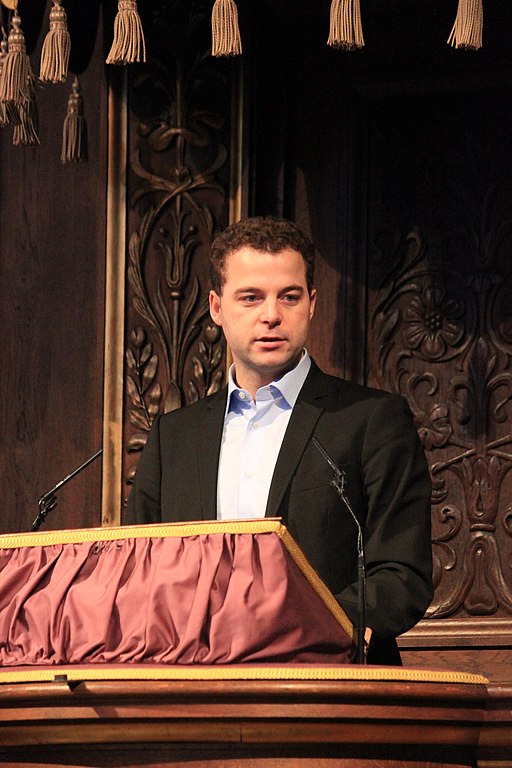
Morten Østergaard, Danish Minister for Research,
Innovation, and Higher Education (source: VicVal). Morten, if you’re reading
this post, please reply to my e-mail.
I first learned about Danish psychologist Helmuth
Nyborg while working on my doctoral thesis. In those pre-Internet days, I
plodded my way through the academic literature largely by consulting the Science Citation Index and then pulling
bound journals off library shelves. This was how I encountered Dr. Nyborg, or
rather his studies on hormones and behavior.
As early as the late 1980s, he began to take an
interest in “human biodiversity,” i.e., the belief that heritable mental and
behavioral traits differ among human populations just as they do among individuals.
At the time, I had an attitude of friendly skepticism, being still influenced
by the belief that cultural evolution had replaced genetic evolution way back
in the Pleistocene. Only later did I learn that cultural evolution had actually
accelerated the pace of genetic evolution (Hawks et al., 2007).
In recent years, Dr. Nyborg has turned his attention
to the demographic changes that are sweeping through Western Europe and his own
country. In this, he has acted not just as an academic who wishes to understand
reality, but also as a Danish citizen who is concerned about his country’s
future. What will Denmark look like half a century from now? Will it still be
recognizably Danish? Will it still be functioning as a modern society with a
high quality of life?
On the basis of population projections, he concluded
that ethnic Danes will become a minority in their own country, the tipping
point being sometime in the late 21st century. In addition, the Danish
population will no longer be able to provide the standard of living that Danes
have long been used to. Denmark will cease to be a First World country.
His study made the following points:
- Contrary to official statistics, immigrant birth
rates are not falling. In fact, they have been rising since 1980 and were over
twice the ethnic Danish birth rate in 2009. Meanwhile, the ethnic Danish birth
rate has been falling since 1995 and reached a new low of 9.31 in 2009.
- After rising for half a century, average national
IQ began to fall in 1997. This decline has also been observed in Norway, even
though average IQ has continued to rise elsewhere (in line with the Flynn
effect).
- By 2050, less than one fifth of the population
will have IQs in the 90 to 104 range, whereas over half will have IQs in the 70
to 85 range. Primary schools will mainly have low IQ children of sub-Saharan,
Middle Eastern, North African, Latin American, and Caribbean backgrounds.
- By 2072, ethnic Danes will have fallen to 60% of
the population and 33% of all births. They will become a minority around 2085.
This study was met with much criticism.
Unfortunately, not content with making their views known in academic forums,
three people complained to the Danish
Committee for Scientific Dishonesty. The committee ruled that two of their
complaints were justified: “the defendant had committed scientific dishonesty
by appearing as the sole author of an article and by including a reference
which did not support the data it indicated to support.” The committee also
ruled that Dr. Nyborg must withdraw his study from the scientific literature.
The two complaints seem to me weird. Yes, another
person had contributed to the study, but he had specifically requested that his
contribution remain anonymous. The second complaint is a bit more valid. Dr.
Nyborg had not explained how he had converted his fertility rate data into birth
rate data. Nonetheless, he corrected that shortcoming by having an addendum published
in a subsequent issue of the journal.
I was initially stumped by the ruling that Dr.
Nyborg must withdraw his study from the scientific literature. How can one
withdraw an already published study? Then the penny dropped. Most journals are
now published online, and cash-strapped university libraries have been phasing
out their paper subscriptions. So it’s quite easy to “disappear” a published
study.
I e-mailed the following letter to the Danish
minister responsible for this committee:
Morten Østergaard, Minister for Research,
Innovation, and Higher Education
Subject: Decision that Helmuth Nyborg must withdraw
a published paper from the international scientific literature
Dear Mr. Østergaard:
I have known Dr. Nyborg for many years. He
is much appreciated in the international academic community and has
published on many subjects, some of which are controversial. Recently, the Danish Committee for Scientific Dishonesty
has ruled that Dr. Nyborg must withdraw a published article from the
international scientific literature. In my opinion, this kind of ruling is
unprecedented and should not go unchallenged.
Scientific papers are published with a view to
provoking debate. If other scholars consider a paper to
be "dishonest," they are free to write a letter to the journal
of that paper and, normally, such letters will be published in a subsequent
issue. They are also free to denounce the paper at conferences or in their own
published papers. That is how the system works, and to date it has worked very
well.
But no one has the right to delete a paper once it
has been published. The paper no longer belongs solely to its author. It also
belongs to the international academic community. It is part of the
marketplace of ideas. Yes, in the past, certain governments would try to remove
books, articles, and papers from circulation. Police officers would go into
bookstores, libraries, and publishing houses and literally remove the offending
publications from the shelves. Must I state the obvious? Such governments
were totalitarian. They were either communist or fascist.
Yes, thanks to electronic publishing of academic
journals, it is much easier to delete a published paper. But that does not
change the rightness or wrongness of the act. Your ministry is acting in a way
that is morally wrong. Not technically wrong. Morally wrong. This decision is
an offence not just to the Danish academic community, but also to the
international academic community.
Please, think long and hard about the implications
of this decision.
Yours sincerely,
Peter Frost, Ph.D.
Anthropology
Université LavalQuebec City, Canada
I resisted the temptation to write something like:
“I disagree with what he says, but I defend his right to say it.” That goes
without saying. Just as physicians must swear the Hippocratic Oath, academics
are supposed to defend the marketplace of ideas.
I will say more in my next post. In the meantime, I
encourage others, especially other academics, to denounce this decision by
e-mailing Morten Østergaard (min@fivu.dk)
References
Hawks, J., E.T. Wang, G.M. Cochran, H.C. Harpending,
and R.K. Moyzis. (2007). Recent acceleration of human adaptive evolution. Proceedings of the National Academy of
Science, 104(52), 20753–20758.
http://www.pnas.org/content/104/52/20753.full
Nyborg, H. (2011). The decay of Western
civilization: Double relaxed Darwinian Selection. Personality and Individual Differences, 53, 118-125.
http://emilkirkegaard.dk/da/wp-content/uploads/Helmuth-nyborg-2011-the-decay-of-western-civilization-double-relaxed-darwinian-selection1.pdf


