Showing posts with label female homosexuality. Show all posts

Saturday, August 29, 2015

Hiatus


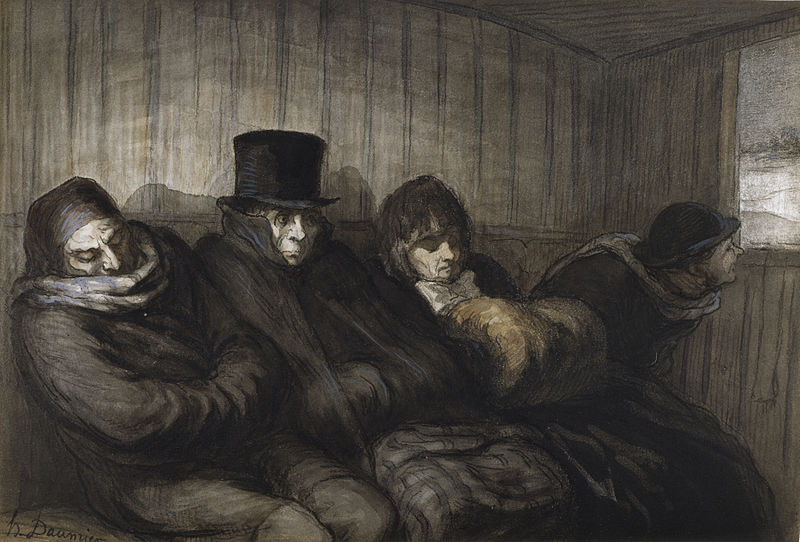
The Second Class Carriage, Honoré Daumier (1808-1879)


I'll be on vacation until October and will probably have little time for my weekly column. I hope to profit from this hiatus to rethink my priorities for the next twelve months.

That rethink will include this column. Is it reaching its target audience? Are changes needed? A recurring suggestion is that I should write more simply and in a less pedantic style. Yes, plain language is best. A lot of academic writing suffers from turgid jargon, not to mention silly attempts to imitate the syntax of French deconstructionists. But it’s not as if I write my columns first and later try to impress folks by inserting “organizing principle,” “evolutionary trajectory,” and other bafflegab. That’s how I think. Jargon also allows me to squeeze complex ideas into a few words. A certain amount is unavoidable, unless you want to read columns that are twice as long.

Russia, Russia, Russia ...

Another suggestion is that I should write more pieces about foreign politics, like "Impressions of Russia." In The Unz Review that column got me 246 comments (My score was higher with only one other column “The Jews of West Africa”). Yet I wrote it off the top of my head.

So why not write about Russia? To be honest I don't feel qualified. I remember my first impressions of that country and how so many turned out to be incomplete or dead wrong. Nonetheless, those same first impressions turn up again and again in pieces by journalists and other writers.

Like the ones who go on about "grim-faced Russians weighed down by centuries of oppression." I've read that refrain so often it's no longer funny. Russians dislike smiling at strangers because it’s considered rude—and also because a stranger with attitude might take it the wrong way. But among friends and family they laugh and smile like anyone else. This is changing, to be sure. On my last visit I noticed many store employees flashing American-style smiles at customers.

Then there's that travel writer who said he knew he was being spied upon because the hotel maid looked like a top model. Uh, that's just the local demographics, and the fact that many young women work in services to pay for their university education. In the West, students are supposed to work as unpaid "interns."

Finally, many journalists have been writing that Russia is hell on earth for gays and lesbians. The real situation is like that of the West in the 1970s: homosexuality is no longer illegal but most people still consider it wrong. So gays and lesbians get disowned by their parents and beaten up by young toughs. On the other hand, they form a large and very visible community with its own bars, magazines, and festivals. I remember going to a night club where about a third of the clientele were openly gay or lesbian. It was no hole-in-the wall either.

So if some journalists think Russia today is evil, they should also think the West in the 1970s was evil. Maybe they do.

Of course, there is a big difference between us in the 1970s and Russians today. We had to wait forty years to see how things would turn out. They don’t have to wait. They can just look at us. That cuts two ways. On the one hand, Russian gays and lesbians look at the West and feel frustrated. They want change to happen faster. On the other hand, traditional Russians look at the West and feel dismayed. They want no part of this change.

Can you blame them? In the 1980s I supported gay rights on the principle of "live and let live." Gays weren't asking to be accepted by people who didn't accept them, least of all religious conservatives. They just wanted to be left alone, as consenting adults, and who could be against what consenting adults do in private?

The next three decades then saw a ratcheting upward of gay rights. For example, since 2012 all Ontario schools have had to allow gay/lesbian clubs on their premises, even Catholic and elementary schools. So much for freedom of religion. So much for "consenting adults."  Gays and lesbians seem to be like any pressure group: they make whatever promises are necessary to get what they want and then forget them when they get what they want.

So Russia is a bit like our past. Only it's a past where people have a better idea of the future.

Punditry, left vs. right, and globalism

That's about all I have to say about Russia. If you want to know more, ask someone from that country.

What about punditry on other topics? Again, I don't feel qualified, and there are columnists far better at that than me.

I also have mixed feelings about punditry. It aims not so much to change how people think as to confirm what they think. So the net effect is to polarize public opinion. Liberals become more self-assured about their ideology and conservatives likewise. Yet, as I see it, both groups are equally wrong, and both have betrayed their original principles. 

As I see it (again), the worst threat comes from the right. It’s the right that best articulates globalism and is best able to persuade everyone that it's for their own good. And globalism will be much more far-reaching—and devastating—than communism ever was. It is literally the abolition of all barriers to the free flow of capital, trade, and labor. In the best scenario, wages and working conditions will be levelled downward throughout the West. In the worst scenario, the whole world will be worse off because the conditions most suitable to wealth creation are in the high-trust societies of the West.

Those societies are not high-trust because of laws, constitutions, or charters of rights. They are that way because of their cultural, behavioral, and psychological characteristics—low levels of personal violence, high levels of affective empathy and guilt proneness, strong orientation toward the future rather than the present, and so on. It was that mental package that made the rise of the West possible.

That mental package is now being dissolved, not so much by "cultural Marxists" as by business interests that want to cut labor costs and increase GDP. They feel no animosity toward the West and its national identities. They just feel those identities have had their day. In their opinion, this is how we'll all move into a better and more prosperous future.

People are entitled to their opinions, but this one—globalism—isn’t competing with the others on a level playing field. It dominates the media, the think tanks, and even the entertainment industry. And it dominates both the left and the right. It’s an opinion that has succeeded not on its own merits but because it has much more money behind it.

This has always been a problem in open, democratic societies. It has gotten worse, however. This is partly because the top 1% have proportionately more money nowadays and partly because they have less sense of national loyalty nowadays. They’ll say it out loud: “Why should I feel more loyal to someone who works here than to someone who works in another country?” This sort of view is promoted by eminently conservative groups, like the Fraser Institute here in Canada.

Punditry becomes part of the problem to the degree it shores up the false dichotomy of “left” versus “right.” Today, the real one is globalism versus the forces it opposes.

Reference 

Ostroff, J. (2015). How Canada got its first Catholic elementary school gay-straight alliance, Huffington Post, May 11
http://www.huffingtonpost.ca/2015/05/11/polly-quinn-gsa-catholic-elementary-school_n_7226896.html 

Saturday, October 11, 2014

Yes, demons do exist


Chlamydia infection rate, by country (WHO 2004, Wikicommons). Sub-Saharan Africa has been a natural laboratory for the evolution of sexually transmitted pathogens, including strains that can manipulate their hosts.


Are we being manipulated by microbes? The idea is not so whacky. We know that a wide range of microscopic parasites have evolved the ability to manipulate their hosts, even to the point of making the host behave in strange ways. A well-known example is Toxoplasma gondii, a protozoan whose life cycle begins inside a cat. After being excreted in the cat's feces, it is picked up by a mouse and enters the new host's brain, where it neutralizes the fear response to the smell of cat urine. The mouse lets itself be eaten by a cat, and the protozoan returns to a cat's gut—the only place where it can reproduce (Flegr, 2013).

T. gondii can also infect us and alter our behavior. Infected individuals have longer reaction times, higher testosterone levels, and a greater risk of developing severe forms of schizophrenia (Flegr, 2013). But there is no reason to believe that T. gondii is the only such parasite we need to worry about. We study it in humans simply because we already know what it does in a non-human species.

Researchers are starting to look at manipulation by another human parasite, a sexually transmitted bacterium called Chlamydia trachomatis. Zhong et al. (2011) have found that it synthesizes proteins that manipulate the signalling pathways of its human host. These proteins seem to facilitate reinfection, although there may be other effects:

Despite the significant progresses made in the past decade, the precise mechanisms on what and how chlamydia-secreted proteins interact with host cells remain largely unknown, and will therefore still represent major research directions of the chlamydial field in the foreseeable future. (Zhong et al., 2011)

What else would a sexually transmitted pathogen do to its host? For one thing, it could cause infertility: 

While several nonsexually transmitted infections can also cause infertility (e.g., schistosomiasis, tuberculosis, leprosy), these infections are typically associated with high overall virulence. In contrast, STIs tend to cause little mortality and morbidity; thus, the effect on fertility seems to be more "targeted" and specific. In addition, several STI pathogens are also associated with an increased risk of miscarriage and infant mortality (Apari et al., 2014)

Chlamydia is a major cause of infertility, and this effect seems to be no accident. Its outer membrane contains a heat shock protein that induces cell death (apoptosis) in placenta cells that are vital for normal fetal development. The same protein exists in other bacteria but is located within the cytoplasm, where it can less easily affect the host's tissues. Furthermore, via this protein, Chlamydia triggers an autoimmune response that can damage the fallopian tubes and induce abortion. This response is not triggered by the common bacterium Escherichia coli. Finally, Chlamydia selectively up-regulates the expression of this protein while down-regulating the expression of most other proteins (Apari et al., 2014).

But how would infertility benefit Chlamydia and other sexually transmitted pathogens? Apari et al. (2011) argue that infertility causes the host and her partner to break up and seek new partners, thus multiplying the opportunities for the pathogen to spread to other hosts. A barren woman may pair up with a succession of partners in a desperate attempt to prove her fertility and, eventually, turn to prostitution as a means to support herself (Caldwell et al., 1989). This is not a minor phenomenon. STI-induced infertility has exceeded 40% in parts of sub-Saharan Africa (Apari et al., 2011).


It gets kinkier and kinkier

Does the manipulation stop there? We know, for instance, that sexual promiscuity correlates with the risk of contracting different STIs, but is this a simple relationship of cause and effect? Could an STI actually promote infidelity by stimulating sexual fantasizing about people other than one's current partner?

Let's look at another pathogen, Candida albicans, commonly known as vaginal yeast, which can cause an itchy rash called vulvovaginal candidiasis (VVC). Reed et al. (2003) found no significant association between VVC and the woman's frequency of vaginal sex, lifetime number of partners, or duration of current relationship. Nor was there any association with presence of C. albicans in her male partner. But there were significant associations with the woman masturbating or practicing cunnilingus in the past month.

VVC is thus more strongly associated with increased sexual fantasizing, as indicated by masturbation rate, than with a higher frequency of vaginal intercourse. This does look like host manipulation, although one might wonder why it doesn't translate into more sex with other men, this being presumably what the pathogen wants. Perhaps the development of masturbation as a lifestyle (through use of vibrators and pornography) is making this outcome harder to achieve.

A sexually transmitted pathogen can also increase its chances of transmission by disrupting mate guarding. This is the tendency of one mate, usually the male, to keep watch over the other mate. If mate guarding can be disabled or, better yet, reversed, the pathogen can spread more easily to other hosts. This kind of host manipulation has been shown in a non-human species (Mormann, 2010).

Do we see reversal of mate guarding in humans? Yes, it's called cuckold envy—the desire to see another man have sex with your wife—and it's become a common fetish. Yet it seems relatively recent. Greco-Roman texts don't mention it, despite abundant references to other forms of alternate sexual behavior, e.g., pedophilia, cunnilingus, fellatio, bestiality, etc. The earliest mentions appear in 17th century England (Kuchar, 2011, pp. 18-19). This was when England was opening up to world trade and, in particular, to the West African slave trade.

Sub-Saharan Africa has been especially conducive to sexually transmitted pathogens evolving a capacity for host manipulation. Polygyny rates are high, in the range of 20 to 40% of all adult males, and the polygynous male is typically an older man who cannot sexually satisfy all of his wives. There is thus an inevitable tendency toward multi-partner sex by both men and women, which sexually transmitted pathogens can exploit ... and manipulate.


What about sexual orientation?

A pathogen can also become more transmissible by giving its host a new sexual orientation. This strategy would disrupt the existing pair bond while opening up modes of transmission that may be more efficient than the penis/vagina one. Some vaginal strains of Candida albicans have adapted to oral sex by becoming better at adhering to saliva-coated surfaces (Schmid et al., 1995). Certain species that cause bacterial vaginosis, notably Gardnerella vaginalis and Prevotella, seem to specialize in female-female transmission (Muzny et al., 2013; Sobel, 2012).

Finally, there is the hypothesis that exclusive male homosexuality has a microbial origin (Cochran et al., 2000). Its main shortcomings are that (a) there is no candidate pathogen and that (b) exclusive male homosexuality has been observed in social environments with limited opportunities for pathogen transmission, such as small bands of hunter-gatherers across pre-Columbian North America (Callender & Kochems, 1983). On the other hand, there seems to have been a relatively recent shift in European societies from facultative to exclusive male homosexuality, so something may have happened in the environment, perhaps the introduction of a new pathogen (Frost, 2009).

Both male and female homosexuality seem to have multiple causes, but it’s likely that various pathogens have exploited this means of spreading to other hosts.


Conclusion

This is a fun subject when it concerns silly mice or zombie ants. But now it concerns us. And that's not so funny. Can microbes really develop such demonic abilities to change our private thoughts and feelings?

It does seem hard to believe. Perhaps this is an argument for intelligent design. After all, only an all-knowing designer could have made creatures that are so small and yet capable of so much ... things like inducing abortion, breaking up marriages, and altering normal sexual desires. Yes, such an argument could be made.

But I don't think anyone will bother.
 

References

Apari, P., J. Dinis de Sousa, and V. Muller. (2014). Why Sexually Transmitted Infections Tend to Cause Infertility: An Evolutionary Hypothesis. PLoS Pathog 10(8): e1004111.
http://www.plospathogens.org/article/info%3Adoi%2F10.1371%2Fjournal.ppat.1004111

Caldwell, J.C., P. Caldwell, and P. Quiggin. (1989). The social context of AIDS in sub-Saharan Africa, Population and Development Review, 15, 185-234.
https://www.soc.umn.edu/~meierann/Teaching/Population/Readings/Feb%209%20Caldwell.pdf

Callender, C. and L.M. Kochems. (1983). The North American Berdache, Current Anthropology, 24, 443-470.
http://www.jstor.org/discover/10.2307/2742448?uid=3739448&uid=2&uid=3737720&uid=4&sid=21104311299061 

Cochran, G.M., P.W. Ewald, and K.D. Cochran. (2000). Infection causation of disease: an evolutionary perspective, Perspectives in Biology and Medicine, 43, 406-448.
http://www.isteve.com/infectious_causation_of_disease.pdf

Flegr, J. (2013). Influence of latent Toxoplasma infection on human personality, physiology and morphology: pros and cons of the Toxoplasma-human model in studying the manipulation hypothesis, The Journal of Experimental Biology, 216, 127-133. http://jeb.biologists.org/content/216/1/127.full 

Frost, P. (2009). Has male homosexuality changed over time, Evo and Proud, March 5
http://evoandproud.blogspot.ca/2009/03/has-male-homosexuality-changed-over.html

Kuchar, G. (2001). Rhetoric, Anxiety, and the Pleasures of Cuckoldry in the Drama of Ben Jonson and Thomas Middleton, Journal of Narrative Theory, 31 (1), Winter, pp. 1-30. 

Mormann, K. (2010). Factors influencing parasite-related suppression of mating behavior in the isopod Caecidotea intermedius, Theses and Disserations, paper 48
http://via.library.depaul.edu/etd/48 

Muzny, C.A., I.R. Sunesara, R. Kumar, L.A. Mena, M.E. Griswold, et al. (2013). Correction: Characterization of the vaginal microbiota among sexual risk behavior groups of women with bacterial vaginosis. PLoS ONE 8(12):
http://www.plosone.org/article/info%3Adoi%2F10.1371%2Fjournal.pone.0080254 

Reed, B.D., P. Zazove, C.L. Pierson, D.W. Gorenflo, and J. Horrocks. (2003). Candida transmission and sexual behaviors as risks for a repeat episode of Candida vulvovaginitis, Journal of Women's Health, 12, 979-989.
http://online.liebertpub.com/doi/abs/10.1089/154099903322643901 

Schmid, J., P.R. Hunter, G.C. White, A.K. Nand, and R.D. Cannon. (1995). Physiological traits associated with success of Candida albicans strains as commensal colonizers and pathogens, Journal of Clinical Microbiology, 33, 2920-2926.
http://jcm.asm.org/content/33/11/2920.short 

Sobel, J.D. (2012). Bacterial vaginosis, Wolters Kluwer, UpToDate
http://www.uptodate.com/contents/bacterial-vaginosis 

Zhong, G., L. Lei, S. Gong, C. Lu, M. Qi, and D. Chen. (2011). Chlamydia-Secreted Proteins in Chlamydial Interactions with Host Cells, Current Chemical Biology, 5, 29-37
http://www.ingentaconnect.com/content/ben/ccb/2011/00000005/00000001/art00004

Saturday, July 14, 2012

Are male and female homosexuality inversely correlated?

U.S. General Social Survey (analysis by Jason Malloy),
- only groups of 40 or more individuals included
- homosexual category includes bisexuals


Jason Malloy has looked into the U.S. General Social Survey for rates of homosexuality by national origin and by gender.  Not surprisingly, he found that different national origins have different rates of homosexuality, given their different levels of sexual permissiveness. Surprisingly, however, there is an apparent inverse correlation between male and female homosexuality. If sexual permissiveness were the causal factor, shouldn’t it increase the numbers of both gays and lesbians? Perhaps not to the same extent, but the effect should at least be in the same positive direction.
This finding is in line with the one discussed in the last post. Although female homosexuality is becoming more common among younger age cohorts, these same cohorts show a stable or even decreasing rate of male homosexuality.

Again, what is going on? When cultural constraints are weak or absent, it may be that the upper limit for expression of homosexuality is higher in females than in males. But that in itself wouldn’t produce an inverse correlation. Perhaps different national groups, for reasons of genetics or family environment (e.g., diet, early childhood upbringing), have different susceptibilities to male and female homosexuality.
For instance, Chinese Americans may be highly susceptible to male homosexuality but only weakly susceptible to female homosexuality. This particular finding might be related to the community’s higher birth ratio of males to females and its corresponding wife shortage. Yet that kind of explanation still rings a bit hollow.

Any ideas?

Saturday, July 7, 2012

Born this way?


Lady Gaga on the Monster Ball Tour, 2010
Note: Post has been updated with new data from Jason Malloy

“Why not? It will leave more women for the rest of us.” I remember hearing that argument for gay rights while in high school, the assumption being that gays greatly outnumbered lesbians. There was some exaggeration in both directions. Gays have never made up 10% of all males and lesbians have never made up only 1% of all females. Even so, the former seemed to outnumber the latter. Back then.

Today, the tables have turned. If we look at General Social Survey data (2010) from the United States (analysis by Jason Malloy), the proportion of gay or bisexual men has held steady at 5 to 6%, although there seems to have been a decline among men born since 1980. Meanwhile, the proportion of lesbian or bisexual women has risen from a low of 4% in the oldest cohort to a high of 9% in the youngest one.

Percentages of men who have had a male sex partner, by birth cohort:

1900-1919  =  6.0
1920-1939  =  5.7
1940-1949  =  5.1
1950-1959  =  6.4
1960-1979  =  6.4

1980-1992  =  5.0

For a better look at what's been going on among males born since 1980 (who are still young adults), the last two cohorts are compared only for the 18-23 age bracket:

1960-1979  =  6.0
1980-1992  =  4.6

Percentages of women who have had a female sex partner, by birth cohort:

1900-1919  =  3.9
1920-1939  =  3.5
1940-1949  =  3.7
1950-1959  =  5.8
1960-1979  =  7.4
1980-1992  =  8.9

This upward trend seems to be continuing among the youngest females (18 to 23 year-olds only):

1960-1979  =  6.5
1980-1992  =  9.2


What is going on? It looks like male homosexuality is much more hardwired than female homosexuality. As our social environment becomes more liberal, fewer gays are coming out of the closet—probably because so few are left there. In contrast, the number of potential lesbians seems much more open-ended. Is there an upper limit?