Friday, July 16, 2010

An African community in Roman Britain?

Figurines of Nubian archers (from Egypt)

The Roman conquest of Britain brought not only cultural change but also profound ethnic change, i.e., an influx of soldiers, officials, and traders from elsewhere. Until recently, historians placed this influx mainly in the first century of Roman rule. As the native British became Romanized, they would have increasingly filled local positions in the army and the administration. This view now appears to be erroneous: the process of ethnic replacement continued unabated and may have even intensified. In particular, the last century of Roman rule saw many soldiers arrive from North Africa and sub-Saharan Africa.

Leach et al. (2010) argue that the north of England, with its many garrison towns, became heavily multi-ethnic through the stationing of foreign soldiers and the subsequent settlement of veterans on local estates:


Inscriptions from York attest to the presence of Gauls, Italians and a possible Egyptian at York, although much of the epigraphic evidence is significantly earlier than the burial discussed here (Ottaway 2004). Artefactual evidence also suggests that ‘the Roman north was a cosmopolitan place with a great mixing of people from all over the empire’ (Cool 2002: 42). For example, Swan (1992) argued for the presence of North Africans in York on the basis of braziers and other vessels typical of North African food-ways but made in local fabrics.

Previous studies of the physical remains of the people of Eboracum (Buxton 1935; Warwick 1968) suggested that the males exhibited heterogeneous craniomorphometric traits suggesting migration from a variety of geographic locales. However, both argued that the female population of Roman York was indigenous. In their view, the diversity noted in the female crania represented genetic admixture between local women and migrant males
(Warwick 1968: 155).

Leach et al. (2009) provide evidence for intense foreign settlement. At one burial ground near Roman York, craniometric analysis revealed that 66% of the individuals clustered most closely with Europeans, 23% with sub-Saharan Africans, and 11% with Egyptians. At another, the proportions were 53% European, 32% sub-Saharan, and 15% Egyptian (Leach et al., 2009).

In a subsequent article, Leach et al. (2010) focus on one burial: a young woman 18 to 23 years old who had been buried between 350 and 400 AD. The authors dubbed her the ‘Lady of York’ because of her stone coffin and its rich array of grave goods, apparently a sign of high status. Nonetheless, her skull showed little or no affinity to any European population, the closest match being a sample of African-American women. Various facial indices showed a mix of sub-Saharan African and European traits, suggesting a person of mixed parentage or perhaps a North African. An African origin is also suggested by the presence of elephant ivory among the grave goods. The authors conclude that this burial “contradicts assumptions that may derive from more recent historical evidence, namely that immigrants are low status and male, and that African individuals are likely to have been slaves.”

Undoubtedly, many Africans rose to high positions in the Roman army. This was especially so for the Nubians, who were prized for their skills in archery. This being said, the Nubians came from the Egyptian culture area and, as such, attached great importance to human burial. In comparison to Europeans of the same socioeconomic status, they would have been more inclined to provide grave goods and to use tombs made from impervious materials.

High status is also inconsistent with a Latin inscription placed in the coffin: SOR AVE VIVAS IN DEO [Sister, hail, live in God]. This is Vulgar Latin, the kind used by the lower classes. An educated citizen would have inscribed the more classical soror instead of sor, especially in the formal context of a burial.

An African community in Roman Britain?

Leach et al. (2010) conclude that the Romans laid “the foundation of a multicultural and diverse community.”

The word ‘foundation’ suggests permanence and is perhaps inappropriate. If the Lady of York had lived a full life, she would have seen the end of Roman Britain—less than a half century later. She would have certainly witnessed the pullout of the legions and, perhaps, the arrival of the Dark Ages … with the breakdown of law and order after 430.

What happened to her community? Did it play a role in the struggles between the Romano-British and the Anglo-Saxons? Did it survive into the early Anglo-Saxon period?

I will try to answer these questions in my next post. For now, let me ponder another question: why had Roman Britain been so intensely militarized? More legions were stationed there than in Lower Germany, which was closer to the Empire’s core and faced a much larger barbarian population. If Britain had been ruled indirectly, through client states, the Romans would have been free to concentrate more soldiers along the crucial Rhine-Danube border.

These questions have answers … more or less. The Empire had annexed Britain during the early days of seemingly endless expansion, when military leaders worried much less about spreading themselves too thin. Britain was also a Celtic homeland. Its people were closely related to those of Gaul and had openly sympathized with them during the rebellion led by Vercingetorix. Even as a collection of client states, Britain would have remained a threat to Roman rule in Gaul. Finally, more legions were needed in Britain because the barbarians to the north (Scots and Picts) were less interested in being friends of Rome than those along the frontier of continental Europe.

Well, perhaps. In any case, history would have turned out the same either way. The main barbarian threat—the one that led to the sack of Rome in 410—came not from the barbarians outside the Empire but from those who had been allowed to settle within. This was an eventuality that Roman military strategists had never foreseen and for which they were unprepared. When the end came, the border fortifications proved to be of no help.

References

Leach, S., H. Eckardt, C. Chenery, G. Müldner, & M. Lewis. (2010). A Lady of York : migration, ethnicity and identity in Roman Britain, Antiquity, 84, 131-145.

Leach, S., M. Lewis, C. Chenery, G. Müldner, & H. Eckardt. (2009). Migration and diversity in Roman Britain: A multidisciplinary approach to the identification of immigrants in Roman York, England, American Journal of Physical Anthropology, 140, 546-561

P.S. The link and reference information for my 2008 article have changed. They are now:

Frost, P. (2008). Sexual selection and human geographic variation, Special Issue: Proceedings of the 2nd Annual Meeting of the NorthEastern Evolutionary Psychology Society. Journal of Social, Evolutionary, and Cultural Psychology, 2(4), pp. 169-191.
http://www.jsecjournal.com/articles/volume2/issue4/NEEPSfrost.pdf

Friday, July 9, 2010

Just who were the Romano-British?

The Anglo-Saxons ‘conquered’ the Civil Zone (non-shaded part of England), where the departing Roman army left a social and demographic vacuum. From W.E. Lunt's History of England

What happened to the Romano-British? Were they wiped out by the Anglo-Saxons? Or were they absorbed by their conquerors?

Razib Khan discusses the latest answer to this question. O'Dushlaine et al. (2010) used three genetic datasets:

1. A sample from Dublin, Ireland to represent the now extinct Romano-British.

2. A sample from Sweden to represent the Anglo-Saxons.

3. A sample from south and southeastern England to represent present-day English people.

Results: the English subjects were genetically closer to the Irish subjects than to the Swedish subjects. Conclusion: present-day English people are largely descended from the Romano-British. There was no ethnic cleansing.

Uh, not so fast. As Razib and his commenters point out, the Anglo-Saxons came not from Sweden but from what is now the Netherlands, northwest Germany, and southern Denmark. Frisians would probably be a closer match. Also, Dubliners inhabit an area of substantial Viking and English settlement. They too would be a lousy proxy for the Celtic inhabitants of Roman Britain.

But there’s another problem. A more basic one. How Celtic were the Romano-British? We know they had ceased to be Celtic linguistically.

After A.D. 43, Latin advanced rapidly. No Celtic inscription occurs, I believe, on any monument of the Roman period in Britain, neither cut on stone nor scratched on tile or potsherd, and this fact is the more noteworthy because, as I shall point out below, Celtic inscriptions are not at all unknown in Gaul. […]

The town site that we can best examine for our present purpose is Calleva or Silchester, ten miles south of Reading, which has been completely excavated with care and thoroughness. Here a few fairly complete inscriptions on stone have been discovered, and many fragments of others, which prove that the public language of the town was Latin. […]

In the twenty years' excavation of the site, no Celtic inscription has emerged. Instead, we have proof that the lower classes wrote Latin for all sorts of purposes. Had they known Celtic well, it is hardly credible that they should not have sometimes written in that language, as the Gauls did across the Channel. A Gaulish potter of Roman date could scrawl his name and record, Sacrillos avot, 'Sacrillus potter', on the outside of a mould. No such scrawl has ever been found in Britain. The Gauls, again, could invent a special letter Eth to denote a special Celtic sound and keep it in Roman times. No such letter was used in Roman Britain, though it occurs on earlier British coins. This total absence of written Celtic cannot be a mere accident. (Haverfield, 1912, pp. 10-12)

To a large degree, the Romano-British also ceased to be Celtic ethnically. This has been suspected on the basis of unusual burial objects and epigraphic inscriptions that record the presence of individuals from throughout the Roman Empire. Many came with the Roman army, as shown by fieldwork in Roman York—a town with a large garrison. At one burial ground, craniometric analysis revealed that 66% of the individuals clustered most closely with Europeans, 23% with sub-Saharan Africans, and 11% with Egyptians. At another, the proportions were 53% European, 32% sub-Saharan, and 15% Egyptian (Leach et al., 2009).

Britain was the most heavily militarized region of the Roman Empire. As such, it bore the full brunt of Romanization via the stationing of imperial troops and their demographic impact (associated influx of Roman officials, traders, etc., settlement of veterans, fathering of children with native women). This was especially so in the ‘Civil Zone’ of the south and the east, where the legions were garrisoned and where veterans usually settled after their years of service.

In the second century A.D., Britain had a garrison of ca. 50,000 men, comprised of three legions (with fortresses at Caerleon, Chester, and York) and a huge force of auxiliary troops. This army of occupation, variously estimated at between 10 and 12 percent of the entire imperial army, is a key distinguishing characteristic of Roman Britain, being by far the heaviest density of troops for a comparable area of territory. (Mattingly, 2000)

Native Celtic society was extinguished in the Civil Zone. It was submerged by a foreign military presence—like the impact of U.S. bases on certain Pacific islands. Thus, the Anglo-Saxons did not replace a native Celtic population. To some extent, they actually restored the status quo ante.

This conclusion leads to others. Wales and Cornwall are Celtic today because their inhabitants remained so during the Roman occupation. These regions fell within the Military Zone and became Romanized to a much lesser degree. In contrast, the Civil Zone developed into an atomized society of diverse origins where the main organizing principle was the Roman army. When the army withdrew in the early 5th century, Romano-British society imploded—a decline made all the worse by below-replacement fertility and 6th-century plagues that killed three out of ten people.


There is no need to postulate a process of ethnic cleansing. Once the plug had been pulled, the death of Roman Britain became inevitable.

References

Haverfield, F. (1912) The Romanization of Roman Britain, Second Edition, Oxford at the Clarendon Press.
http://www.munseys.com/diskfour/rombr.pdf

Khan, R. (2010). The English & Irish together again. Discover – Gene Expression, June 24
http://blogs.discovermagazine.com/gnxp/2010/06/the-english-are-like-the-irish-genetically/#more-4529

Leach, S., M. Lewis, C. Chenery, G. Müldner, & H. Eckardt. (2009). Migration and diversity in Roman Britain: A multidisciplinary approach to the identification of immigrants in Roman York, England, American Journal of Physical Anthropology, 140, 546-561.

Mattingly, D.J. (2000). Roman Britain - Military Aspects, Administration and Government, Towns, Countryside, Religion, Culture, and Economy, vallum, civitates, civitas
http://www.jrank.org/history/pages/5954/Roman-Britain.html

O'Dushlaine, C.T., D. Morris, V. Moskvina, G. Kirov, International Schizophrenia Consortium, M. Gill, A. Corvin, J.F. Wilson, and G.L. Cavalleri. (2010). Population structure and genome-wide patterns of variation in Ireland and Britain, European Journal of Human Genetics, advance online publication.

Friday, July 2, 2010

The vitamin-D hypothesis and ancestral Europeans


Above - Artist's reconstruction of pre-Viking Age boat
Below – Prehistoric rock paintings of boats (Scandinavia)
Some writers argue that European skin became white to offset a decline in dietary vitamin D. Pre-agricultural diets, however, were rich in vitamin D only among coastal Europeans who consumed fatty fish.

The ‘vitamin D hypothesis’ is often invoked to explain differences in skin color among human populations (Loomis 1967; Murray 1934). As modern humans spread out of Africa, they entered northern regions, like Europe, where sunlight is weaker and less conducive to synthesis of vitamin D by the skin. Thus, to maintain the same level of vitamin-D synthesis, there was strong natural selection to depigment the skin and let the sun’s rays penetrate it more easily.

This might explain the whiteness of Europeans, but what about the darker skin of northern Asians and native North Americans? They too live at high latitudes. And they too receive much less sunlight than do tropical peoples.

The standard reply is that they get enough vitamin D from their diet, specifically fatty fish, so natural selection has not lightened their skin to the same degree:

The Eskimo though deeply pigmented and living in a dark habitat, nevertheless is notoriously free from rickets. This is due to his subsisting almost exclusively on a fish oil and meat diet. […] Because of his diet of antirachitic fats, it has been unnecessary for the Eskimo to evolve a white skin in the sunless frigid zone. He has not needed to have his skin bleached by countless centuries of evolution to admit more antirachitic sunlight. He probably has the same pigmented skin with which he arrived in the far north ages ago (Murray 1934).

Actually, this explanation holds true only for a minority of northern natives, i.e., the Inuit, the Aleuts, and some other coastal peoples. Fatty fish is absent from the diet of non-coastal peoples, i.e., most Algonkians, Athapaskans, and indigenous Siberians. Yet the latter are if anything darker-skinned than the Inuit.

Conversely, fatty fish has long been a staple of Scandinavians, who nonetheless are very white-skinned. And the word ‘long’ is no exaggeration: skeletal remains of Danes living 7,000-6,000 years ago have the same carbon isotope profile as those of Greenland Inuit, whose diet is 70-95% of marine origin (Tauber 1981).

But the vitamin-D hypothesis has another shortcoming: Europeans did not turn white until long after their ancestors came to Europe some 35,000 years ago. If we examine the various alleles that lighten European skin color, the time of origin seems to be relatively late. At the SLC45A2 (AIM1) gene, the date is ~ 11,000 BP (Soejima et al. 2005). At SLC24A5, the date falls between ~ 12,000 and 3,000 BP (Norton & Hammer 2007). As a Science journalist commented: “the implication is that our European ancestors were brown-skinned for tens of thousands of years” (Gibbons, 2007).

This has led to an updated version of the vitamin-D hypothesis. It has two postulates:

1. Selection for white skin began long after modern humans entered Europe.

2. The cause was not the weak sunlight of Europe’s high latitudes, but rather less intake of vitamin D from food sources. This happened when a diet of terrestrial game, fish, and wild plants gave way to one based on grains and livestock—in short, the advent of agriculture (Khan & Khan 2010; Sweet 2002).

If we pursue this line of reasoning, Europeans must have turned white almost at the dawn of history. We know that agriculture spread into southeastern Europe from the Middle East around 9,000 years ago. By 7500 BP it had reached a line stretching from the Netherlands through Central Europe and to the Black Sea. Thus, the extreme skin depigmentation of northern Europeans would have occurred over the last seven millennia or so. Actually, the time frame is even narrower, since white-skinned Europeans appear in ancient Egyptian art from the second millennium B.C.

So we’re left with around 3,000 years, at most. Is this pace of phenotypic change consistent with selection due to weak sunlight? Not according to current opinion. Brace et al. (1999) studied how skin color varies among Amerindians, who have inhabited North and South America for 12,000-15,000 years, and among Aborigines, who have inhabited Australia for some 50,000 years. If latitudinal variation in skin color tracks natural selection due to the intensity of sunlight, calculations show that this kind of selection would have taken over 100,000 years to create the skin-color difference between black Africans and northern Chinese and ~ 200,000 years to create the one between black Africans and northern Europeans.

But there’s another problem. How do we know that ancestral Europeans did ingest much less vitamin D when agriculture replaced hunting/fishing/gathering? This question is met only with affirmations, e.g. “Because of the lack of meat and fish in the diet of the new farmers, vitamin D intake would have been drastically reduced” (Khan & Khan 2010). No one seems to have actually quantified vitamin-D intake before and after the advent of agriculture.

To gain a rough idea, we can consult Loomis (1967) for a listing of vitamin-D content by food source:

Food source - Vitamin D content (I.U./gram)

Halibut liver oil – 2,000-4,000
Cod liver oil – 60-300
Milk – 0.1
Butter – 0.0-4.0
Cream – 0.5
Egg yolk – 1.5-5.0
Calf liver – 0.0
Olive oil – 0.0

Sweet (2002) provides a longer list:

Food source – Vitamin D content (I.U.)

Cod liver oil, 1 tbs – 1,360
Salmon, 3.5 oz. – 360
Mackerel, 3.5 oz. – 345
Herring, 3.5 oz. – 315
Sardines, 3.5 oz. – 270
Eel, 3.5 oz. – 200
Shrimp, 3.5 oz. – 150
Beef liver, 3.5 oz. – 30
Egg, 1 whole – 25
Beef, pork, chicken, 3.5 oz. – 20
Cheese, 1 oz. – 4
Unfortified milk – 0
Unfortified cereal - 0

Clearly, fatty fish has a lot of vitamin D. But the same cannot be said for terrestrial animals, like calves. Furthermore, the figures from the first list were initially published in 1938, when most cattle were kept outdoors and exposed to sunlight. These were also American cattle. They lived farther south than the game animals that ancestral Europeans once hunted and whose flesh probably had a lower vitamin-D content.

Thus, before agriculture, Europeans got substantial vitamin D from their diet only in coastal regions, like Scandinavia, where people ate fatty fish. Europeans who lived inland—the majority—did not have this dietary source. One might counter that the issue is not vitamin-D content per se but rather substances, like phytic acids in cereals, that deplete the body’s supply of calcium and phosphorus. The advent of agriculture would have artificially increased the body's need for vitamin D.

Perhaps. Ultimately, this debate will end only when we know the precise time frame when Europeans became white. We already know that this time frame considerably postdates the arrival of modern humans in Europe (c. 35,000 BP). If it significantly predates the arrival of agriculture (after 9,000 BP), the vitamin-D hypothesis will be out of the running, even in its updated form.

This puzzle will then be placed within a larger one. Why do Europeans possess such unusual color traits that involve not only the skin but also the hair and the eyes? How did they evolve so rapidly a white skin and a diverse palette of eye and hair colors? If humans were any other animal, such traits would be readily put down to sexual selection.

References

Brace, C.L., Henneberg, M., and Relethford, J.H. (1999). Skin color as an index of timing in human evolution. American Journal of Physical Anthropology, 108 (supp. 28), 95-96.

Gibbons, A. (2007). American Association Of Physical Anthropologists Meeting: European Skin Turned Pale Only Recently, Gene Suggests. Science 20 April 2007, 316. no. 5823, p. 364 DOI: 10.1126/science.316.5823.364a http://www.sciencemag.org/cgi/content/summary/316/5823/364a

Khan, R. and B.S.R. Khan. (2010). Diet, disease and pigment variation in humans, Medical Hypotheses, early view.

Loomis,W.F. (1967). Skin-pigment regulation of vitamin-D biosynthesis in Man, Science, 157, 501-506.

Murray, F.G. (1934). Pigmentation, sunlight, and nutritional disease. American Anthropologist, 36, 438-445.

Norton, H.L. & Hammer, M.F. (2007). Sequence variation in the pigmentation candidate gene SLC24A5 and evidence for independent evolution of light skin in European and East Asian populations. Program of the 77th Annual Meeting of the American Association of Physical Anthropologists, p. 179.

Soejima, M., Tachida, H., Ishida, T., Sano, A., & Koda, Y. (2005). Evidence for recent positive selection at the human AIM1 locus in a European population. Molecular Biology and Evolution, 23, 179-188.

Sweet, F.W. (2002). The paleo-etiology of human skin tone.
http://backintyme.com/essays/?p=4 (visited on July 10, 2008).

Tauber, H. (1981). 13C evidence for dietary habits of prehistoric man in Denmark. Nature, 292, 332-333.

Friday, June 25, 2010

Blonde jokes aren't funny


The stereotype is not hard to summarize. When a blonde isn’t dumb, she’s lascivious. This is no laughing matter. In fact, a lot of people seem to believe it according to a British survey:

Blondes may have more fun - but it comes at a price. Men don't trust them. A study found that while fair-haired women are considered to be the most adventurous in bed, brunettes are seen as more reliable in a relationship ... and more sexy. In a poll of 1,500 men, more than 60 per cent thought dark-haired girls were the most trustworthy and loyal, compared with just 14 per cent of blondes. The result is men feel brunettes make the best wives.

[…] Commenting on the study for Philips Sensual Massagers, spokesman Karen Moore said: 'Blondes have always had a reputation for being fun, carefree and adventurous and it seems that can also be applied to relationships, as men think they have the best skills when it comes to the bedroom.' (Daily Mail, 2010)

Actually, blondes have not always had this reputation. A very different one emerges from a study of Victorian-era novels:

In each a blonde maiden opposes a brunette, and in each the blonde is preferred. When the ending is happy, the blonde marries the hero; while the brunette is deserted. Most significantly, the blondeness and the darkness are continually emphasized by the authors until their symbolic intention becomes unmistakable. And this symbolic intention is always the same. The maiden with blue eyes and blonde hair is invariably “innocent,” “good,” and “pure”; while the dark lady is “impetuous,” “ardent,” and “passionate.” (Carpenter, 1936, p. 254)

This other study concludes: “In the mid-nineteenth century golden hair became an attribute of the pure and innocent maiden; while dark hair suggested the woman of passion and experience.”

Some hair-color preferences are undoubtedly innate, e.g., rare-color preference (Frost, 2006).
Most, however, seem to be culturally constructed. They are specific to a time and place. They are also specific to the social dynamic that links the observer to the observed. If this dynamic is ignored, one might conclude that light-haired women are indeed sexually freer than dark-haired women, all other things being equal. But all other things were not equal when this stereotype took shape. Light hair and dark hair were proxies for ethnicity.

The current blonde stereotype began in the U.S. of the early 20th century. It was a product of ethnic contact between the native-born population and darker-haired immigrants (Italians, Jews, Greeks, etc.) who were often shocked by the relative sexual freedom of ‘American’ women. This attitude existed in different communities, but it entered the mainstream culture primarily via Jewish immigrants and specifically through their contributions to art and literature. It is a common theme in Jewish-American novels:

The exotic female in Jewish life is the sexy shiksa, frequently a blue-eyed blonde who offers gratifications withheld, at least until marriage, by proper Jewish girls. […] A blend of arrogance and defensiveness prompts many Jews to claim that shiksas are more carnal and promiscuous than women of their own faith because Christians are less intelligent, refined, and clean than themselves. Goyishe Kopf (literally translated as gentile head), the Yiddish colloquialism for stupidity, exemplifies the traditional contempt for Christians. (Jaher, 1983)

This theme entered popular American culture through fiction, motion pictures, and comedy routines, with well-known examples including the novel Portnoy’s Complaint by Philip Roth and the typecasting of Marilyn Munroe in vamp roles (Jaher, 1983).

The ‘dumb blonde’ stereotype gradually spread outside the U.S. As a rural Ontario teenager in the 1970s I heard this term on American sitcoms, but it had no connection to my reality. Nor were the blondes at my school thought to be sexually permissive. In the late 1980s, as a doctoral student in Quebec City, I remember the puzzlement that initially greeted blonde jokes, this humor having no relation to existing beliefs about hair color in French Canada. Today, blondes are routinely stereotyped throughout Canada as being sluttish and stupid, as if they have always been so.

This stereotype likewise came late to Europe. In the mid-1960s, Bastide (1967, p. 326) noted the following about the movie industry: “In Europe, a blond is usually the heroine, and a brunette the dangerous woman. In Brazil, the dark woman is loving and faithful, while the blond is the vamp who leads a man to ruin.”

Several generations now separate Americans from the social dynamic that created the current blonde stereotype. This is less true in northwestern Europe, where recent decades have seen immigration from North Africa, the Middle East, and South Asia. For these immigrant communities, light-colored hair symbolizes European ethnicity and, by extension, relative equality of men and women, low importance of female virginity, permissive attitudes to pre-marital sex, etc. Such stereotyping has been reported from Sweden, as noted in the following news article:


"Ah, girl, blond whore!"'

Josephine' was met with these words on the first school day at a high-school in an immigrant-dominated suburb south of Stockholm. Josephine was quite baffled, since aside from her hair color there was nothing about her appearance that would indicate she was promiscuous. She didn't use makeup and had completely neutral clothing. It was exclusively her hair-color that branded her a 'whore'.'

Josephine' is one of the informants for researcher Maria Bäckman, who did an ethnographic field study in a suburb south of Stockholm, where ethnic Swedes make up about 20% of the population.

[…] In her study she focused on ethnic Swedish girls. They experience being linked to the notion of free, Swedish sexuality, which in the densely immigrant suburbs is not necessarily linked with something positive. The strategy for the suburb girls was therefore to play down their Swedish identity.

"Several dyed their hair. Not necessarily because they wanted to look like immigrants, but because they didn't want to look so Swedish," says Bäckman.
(Brandvold, 2010)

Conclusion

Stereotypes are not merely observations of reality. They also reflect the power relationship between the observer and the observed. Too often, the target is a group that cannot fight back. Albinos, for example, have increasingly appeared in films as hit men and other villains even though their poor eyesight makes such roles impossible in real life. From the 1960s to 2006, they appeared as ‘bad guys’ in sixty-eight films (Wikipedia, 2010). They suited the role perfectly, being easy to stigmatize and yet numerically too weak to retaliate.

Blondes have similarly faced media-driven stereotyping, and this stereotyping has persisted for similar reasons. It incurs few social penalties. It’s like the little boy who gets beaten up just because he’s weaker than the bullies who gang up on him.

References

Bastide, R. (1967). Color, racism, and Christianity, Daedalus, 96, 312-327.

Brandvold, A. (2010). Mobbet fordi hun er hvit, Klassekampen, May 8, 2010.
http://www.klassekampen.no/57468/article/item/null/mobbet-fordi-hun-er-hvit (English translation at: http://islamineurope.blogspot.com/2010/05/norwaysweden-when-locals-become.html

Carpenter, F.I. (1936). Puritans preferred blondes, New England Quarterly, 9, 253-272.

Daily Mail. (2010). So blondes really do have more fun: Men claim brunettes make the best wives, but fair haired women are better in bed, Daily Mail, February 13, 2010
http://www.dailymail.co.uk/femail/article-1250520/Blondes-really-fun-Men-claim-brunettes-make-best-wives-fair-haired-women-better-bed.html

Frost, P. (2006). European hair and eye color - A case of frequency-dependent sexual selection? Evolution and Human Behavior, 27, 85-103.

Jaher, F.C. (1983). The quest for the ultimate shiksa, American Quarterly, 35, 518-542.

Swami, V., M. Rozmus-Wrzesinska, M. Voracek, T. Haubner, D. Danel, B. Pawłowski, D. Stanistreet, F. Chaplin, J. Chaudhri, P. Sheth, A. Shostak, E.X. Zhang, A. Furnham. (2008). The influence of skin tone, body weight, and hair colour on perceptions of women’s attractiveness and health: A cross-cultural investigation. Journal of Evolutionary Psychology, 6, 321-341.

Wikipedia (2010). Albinism in popular culture.
http://en.wikipedia.org/wiki/Albinism_in_popular_culture

Friday, June 18, 2010

More on doll tests


These are the two dolls I used to measure skin-color preferences in preschool children. As you can see, the difference in color is barely visible—both would be considered “white.”

This point bears repeating. It is debatable whether racial attitudes exist among toddlers if their social environment is almost 100% French Canadian. But the question is academic: neither doll looks like an ethnic Other.

A psychology professor kindly offered me a “better” explanation for the correlation between adiposity and darker-doll preference: the fatter children were making a gesture of solidarity with another disadvantaged group. Frankly, I doubt whether most grownups possess this kind of political sophistication. But, again, the question is academic.

References

Frost, P. (1994). Preference for darker faces in photographs at different phases of the menstrual cycle: Preliminary assessment of evidence for a hormonal relationship, Perceptual and Motor Skills, 79, 507-514.

Frost, P. (1989). Human skin color: the sexual differentiation of its social perception, Mankind Quarterly, 30, 3-16.

Thursday, June 10, 2010

An interesting finding ...

Y-axis: Mean attractiveness rating
X-axis: Black faces, Mixed-Race faces, White faces
Top curve – ratings by female students
Bottom curve – ratings by male students (Lewis, 2010)


A random sample of 1205 black, white, and mixed-race faces was collected. These faces were then rated for their perceived attractiveness. There was a small but highly significant effect, with mixed-race faces, on average, being perceived as more attractive (Lewis, 2010).

This study has attracted much notice in the media and on the Internet. When photos of black, white, and mixed-race faces were shown to twenty white psychology students from Cardiff University in Wales, the mixed-race faces were considered to be better-looking than either black or white faces. This finding, the author went on to argue, shows the benefits of hybrid vigor.

Actually, it’s doubtful whether this study proves much about hybrid vigor. There are negative effects from mating with close kin (‘inbreeding depression’), but these effects decrease exponentially with increasing genetic distance. Marrying a !Kung provides just a bit more benefit than not marrying your second cousin.

But something else is questionable about this study. The male students rated the black faces more highly than the white faces. This is an interesting finding—just as interesting as the one that the author chose to underscore. After all, British culture has long stigmatized blacks as the antithesis of beauty. In a history of American race relations, Winthrop Jordan (1968, pp. 8-9) notes:


Whiteness, moreover, carried a special significance for Elizabethan Englishmen: it was, particularly when complemented by red, the color of perfect human beauty, especially female beauty. This ideal was already centuries old in Elizabeth’s time, and their fair Queen was its very embodiment: her cheeks were “roses in a bed of lilies.” [...] It was important, if incalculably so, that English discove­ry of Black Africans came at a time when the accep­ted standard of ideal beauty was a fair complexion of rose and white. Negroes not only failed to fit this ideal but seemed the very picture of perverse negation. (Jordan, 1968, pp. 8-9)

Of course, that was then and this is now. But even today black women are underrepresented as icons of beauty in men’s magazines:


More than 70 percent of professional athletes are African American, but you wouldn’t know it by reading the latest issue of Sport’s Illustrated’s much ballyhooed swimsuit issue.

The 184-page issue, the magazine’s most profitable, boasts 18 models, but only two are African American and you won’t see them until page 140.

[…] African-American models like Iman and Naomi Campbell broke through the race barrier long ago in fashion, but the under representation of minorities in modeling continues to be a contentious issue to this day.

In 2008,
The Wall Street Journal did a major feature on the problem, noting what it called the “Thin White Line” in fashion.

Well, perhaps psychology majors at Cardiff University have different notions of female beauty.

Or perhaps they were just fibbing.

References

Anon. (2010). Sports Illustrated sends blacks to back of book, The Improper, February 14th, 2010
http://www.theimproper.com/?p=4026

Jordan, W. (1968). White over Black: American Attitudes toward the Negro 1550-1812. Williamsburg: University of North Carolina Press.

Lewis, M.B. (2010). Why are mixed-race people perceived as more attractive? Perception, 39, 136 –138
.

Thursday, June 3, 2010

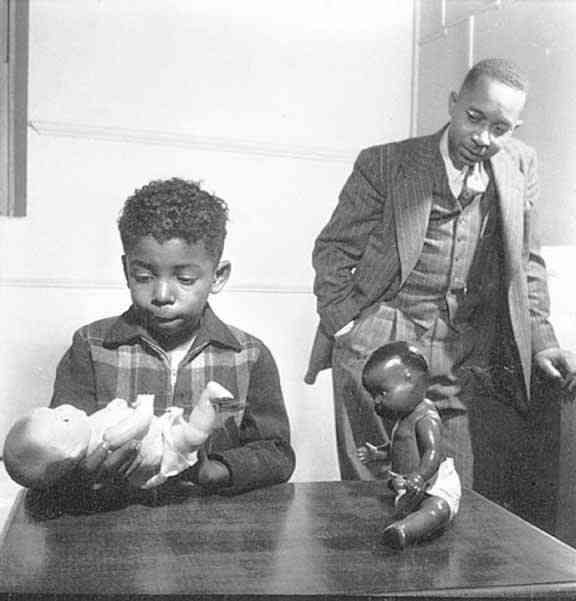
The use and abuse of doll tests

Kenneth Clark supervising a doll test

A 5-year-old girl in Georgia is being asked a series of questions in her school library. The girl, who is white, is looking at pictures of five cartoons of girls, all identical except for skin color ranging from light to dark.

When asked who the smart child is, she points to a light-skinned doll. When asked who the mean child is she points to a dark-skinned doll. She says a white child is good because "I think she looks like me", and says the black child is ugly because "she's a lot darker."

As she answers her mother watches, and gently weeps.
(CNN,
2010)

Light- and dark-colored dolls have long been used to study how children acquire negative attitudes to dark skin. This area of research began in the 1940s through the work of three American psychologists: Mary Ellen Goodman and the couple Kenneth and Mamie Clark. It grew out of the idea that color prejudice is a product of American culture and is passed on very early in life through ‘cultural conditioning’. Just as Ivan Pavlov’s dogs learned to associate food with the tinkling of a bell, American children learn to associate light skin with good qualities and dark skin with bad ones. Eventually, their reaction to skin color becomes as reflexive as the dog’s salivation on hearing a bell.

A doll test typically involves asking a child to choose between a lighter-colored doll and a darker-colored one. In general, the lighter doll is preferred by both white and black children. This preference varies with age, however, as the Clarks found in their studies:

3 years of age - lighter and darker dolls almost equally preferred
4 years of age - lighter doll preferred by 76% of the children
5 to 7 years of age - lighter-doll preference levels off and then declines

The results were similar when the children had to choose “the doll that you like to play with,” “the doll that is a nice doll,” “the doll that is a nice color” and, inversely, “the doll that looks bad” (Clark & Clark, 1947).

Age also seems to interact with gender. Boys and girls make on average the same choices if younger than 6 years of age. But when Asher and Allen (1969) asked children 3 to 8 years old to choose a white-faced puppet or a brown-faced one, the girls were likelier than the boys to choose the brown one, this being true for both white and black American children.

The first doll studies are well known today, even among non-academics. Less is known about later efforts to prove two inferences:

1) light-skin preference is learned, either from the child’s parents or from society in general


2) light-skin preference results from an ethnic division between a dominant light-skinned group and a subordinate dark-skinned group, as in the United States

The first inference has never been proven. No correlation exists between the children’s preference for light skin and their parents’ attitudes to dark-skinned people (Bird et al., 1952; Radke-Yarrow et al., 1952). This is acknowledged in the article on the latest doll study (mentioned in the opening quote):

A 2007 study in the Journal of Marriage and Family found that 75 percent of white families with kindergartners never, or almost never, talk about race. For black parents the number is reversed with 75 percent addressing race with their children.

Po Bronson, author of NurtureShock and an award-winning writer on parenting issues says white parents "want to give their kids this sort of post-racial future when they're very young and they're under the wrong conclusion that their kids are colorblind. ... It's in the absence of messages of tolerance that they will naturally ... develop these skin preferences."
(CNN, 2010)

It is doubtful, in fact, whether any kind of learning is responsible. Smarter children learn more quickly, yet child IQ doesn’t correlate with acquisition of light-skin preference (Williams & Rousseau, 1971; Williams et al., 1975). Learning tends to be accumulative, yet doll studies typically show a sudden rise in light-skin preference at the age of 4 followed by a leveling off and then decline (Clark & Clark, 1947; Williams & Morland, 1979).

The second inference is even more doubtful. Light-skin preference has been documented in children from a wide range of societies, including mono-ethnic ones like Japan (Best et al., 1975; Best et al., 1976; Iwawaki et al., 1978; Munitz et al., 1987). It is not limited to the U.S. and its pattern of race relations. There is nonetheless some variation among human societies, with the level of light-skin preference being higher in white American and light-skinned Israeli children than in black American, Falasha Israeli, Japanese, German, French, and Italian children. Iwawaki et al. (1978) suggest that light-skin preference contains a primary component that is universal to all humans and a secondary component that the local culture may generate. I myself examined light-skin preference in French-Canadian children, using two dolls that differed slightly in complexion (both would have been considered ethnically "white"). The children were more or less evenly split between the two dolls at 3 years of age. At 4 and 5 years of age, the lighter-colored doll was strongly preferred (Frost, 1989).


Faulty understanding of a real phenomenon?

Many wish to believe that light-skin preference is a conditioned reflex. From this standpoint, we can eliminate color prejudice by stopping the “conditioners”, i.e., parents or, more generally, American society. Once this prejudice can no longer propagate, it will wither away and eventually disappear.

Well, perhaps, but don’t point to doll tests as proof. Light-skin preference does not seem to be primarily learned, at least not the kind we see in young children. Nor is it specific to American society. In fact, it seems to be a universal human trait.

My own research led me to conclude that we all have a mental algorithm that responds specifically to differences in human skin color. This algorithm did not come into being to evaluate color differences between different racial or ethnic groups. It arose to evaluate the much smaller difference in complexion between the sexes. Women are the ‘fair sex’. Their skin has visibly less melanin and hemoglobin than does male skin even when both sexes receive the same amount of sunlight (Edwards & Duntley, 1939; Frost, 1988; van den Berghe & Frost, 1986). Complexion is thus one of several visual cues, like face shape and voice pitch, that the human mind uses for sex recognition. This visual cue seems to be hardwired: people can distinguish a man's face from a woman's by complexion alone, even when the image is blurred and offers no other details (Russell, 2003; Russell, 2009; Russell & Sinha, 2007; Russell et al., 2006; Tarr, 2002).

But why would this algorithm operate in sexually immature toddlers? This was the question behind my own doll studies. Unlike the Clarks, I tested 2 year-olds. Most of them preferred the darker doll. There was thus a sharp swing in preference from dark skin to light skin between 2 and 4 years of age. Interestingly, this change in orientation was associated with the child’s loss of baby fat. In each age group, in fact, the children who chose the darker doll were significantly fatter, in terms of body mass index and triceps skinfold, than those who chose the lighter doll (Frost, 1989). This may indicate a hormonal influence, since fatty tissue is the body’s main source of estrogen before puberty.

I tested this hormonal hypothesis by examining skin-color preference in women over the menstrual cycle. Female subjects were presented with pairs of male faces or pairs of female faces, with one face being made to look slightly darker than the other. When male faces were presented, the darker one was likelier to be chosen by subjects in the estrogen-dominant phase of their menstrual cycle (first two-thirds) than by those in the progesterone-dominant phase (last third). This cyclical effect was absent if the subjects were on oral contraceptives or viewing female faces (Frost 1994). My results were later confirmed by a research team at St. Andrews University (Jones et al., 2005). The lead author was unaware of my study and was testing a completely different hypothesis (apparent health of faces).

There thus seems to be a mental algorithm that orients women toward darker complexions and men toward lighter complexions, the guiding mechanism being the ratio of estrogens to androgens in the body. This ratio falls sharply in late infancy with the loss of baby fat, thus giving these children a ‘male orientation’ to sex recognition.

In sum, light-skin preference does exist in children from late infancy onward. It is a real phenomenon. But it doesn’t mean what some researchers want it to mean.

Conclusion

One can ignore my own research. After all, it was done by just one person. But it’s harder to ignore the doll studies from societies whose history and social relations are quite different from those of the U.S. That research was done by teams of professional psychologists and published in leading journals of child psychology.

Yet those studies too are now ignored and, in fact, largely forgotten. The doll test has become a headless horseman that just rides on and on.

One might object that the latest studies examine not only children’s preferences but also their views on intelligence and behavior. The subjects are asked to identify the “smarter” doll and the “meaner” doll. Yet concepts like smartness and meanness have a less precise meaning to a toddler than to an adult. In my own studies, the children readily understood they had to choose one of the dolls, but the choice itself seemed to be made unconsciously. I would ask them afterwards why they chose one doll over the other. They typically answered: “ I don’t know” or “Because I love her!” The Clarks likewise found that phrasing the question differently had little effect on doll choice.

But perhaps it all doesn’t matter. Perhaps finding the truth is no longer the goal. In reading about the latest doll study (see opening quote), I couldn’t help but notice one detail: the child’s mother was present. Yes, there is an ethical obligation to tell the parents the results, but normally this is done after all the data have been collected and analyzed. There is also an ethical obligation to explain the limitations of the data: what may be reasonably inferred and what may not be.

In the latest doll test, however, the parents were made to observe in real time how their children chose. Is this what some people call “a teaching moment”?

References:

Asher, S.R. and V.L. Allen. (1969). Racial preference and social comparison processes, Journal of Social Issues, 25, 157-166.

Best, D.L., J.T. Field, and J.E. Williams. (1976). Color bias in a sample of young German children, Psychological Reports, 38, 1145-1146.


Best, D.L., C.E. Naylor, and J.E. Williams. (1975). Extension of color bias research to young French and Italian children, Journal of Cross-Cultural Psychology, 6, 390-405.

Bird, C., E.D. Monachesi, and H. Burdick. (1952). Infiltration and the attitudes of white and Negro parents and children, Journal of Abnormal and Social Psychology, 47, 688-699.

Clark, K.B. and M.P. Clark. (1947). Racial identification and preference in Negro children, in T.M. Newcomb and E.L. Hartley (ed.) Readings in Social Psychology, pp. 169-178, New York: Henry Holt.

CNN (2010). Kids' test answers on race brings mother to tears, CNN.com, May 18, 2010.
http://ac360.blogs.cnn.com/2010/05/18/kids-test-answers-on-race-brings-mother-to-tears/

Edwards, E.A. and S.Q. Duntley. (1939). The pigments and color of living human skin, American Journal of Anatomy, 65, 1-33.

Frost, P. (1994). Preference for darker faces in photographs at different phases of the menstrual cycle: Preliminary assessment of evidence for a hormonal relationship, Perceptual and Motor Skills, 79, 507-514.

Frost, P. (1989). Human skin color: the sexual differentiation of its social perception, Mankind Quarterly, 30, 3-16.

Frost, P. (1988). Human skin color: a possible relationship between its sexual dimorphism and its social perception, Perspectives in Biology and Medicine, 32, 38-58.

Goodman, M.E. (1946). Evidence concerning the genesis of interracial attitudes, American Anthropologist, 48, 624-630.

Iwawaki, S., K. Sonoo, J.E. Williams, and D.L. Best. (1978). Color bias among young Japanese children, Journal of Cross-Cultural Psychology, 9, 61-73.

Jones, B.C., Perrett, D.I., Little, A.C., et al. (2005). Menstrual cycle, pregnancy and oral contraceptive use alter attraction to apparent health in faces, Proc. R. Soc. B, 272, 347-354.

Munitz, S., B. Priel, and A. Henik. (1987). Color, skin color preferences and self color identification among Ethiopian and Israeli born children, in M. Ashkenazi and A. Weingrod (eds.), Ethiopian Jews and Israel. (pp. 74-84). New Brunswick (U.S.A.): Transaction Books.

Radke-Yarrow, M., H. Trager, and J. Miller. (1952). The role of parents in the development of children’s ethnic attitudes, Child Development, 23, 13-53.

Russell, R.( 2009). A sex difference in facial contrast and its exaggeration by cosmetics, Perception, 38, 1211-1219

Russell, R. (2003). Sex, beauty, and the relative luminance of facial features, Perception, 32, 1093-1107.

Russell, R. and P. Sinha. (2007). Real-world face recognition: The importance of surface reflectance properties, Perception, 36, 1368-1374.

Russell, R., P. Sinha, I. Biederman, and M. Nederhouser. (2006). Is pigmentation important for face recognition? Evidence from contrast negation, Perception, 35, 749-759.

Tarr, M.J., D. Kersten, Y. Cheng, and B. Rossion. (2002). It's Pat! Sexing faces using only red and green, Journal of Vision, 1(3), 337a,
http://journalofvision.org/1/3/337

van den Berghe, P. L. and P. Frost. (1986). Skin color preference, sexual dimorphism, and sexual selection: A case of gene-culture co-evolution?, Ethnic and Racial Studies, 9, 87-113.

Williams, J.E. and J.K. Morland. (1979). Comment on Bank’s White preference in Blacks: A paradigm in search of a phenomenon, Psychological Bulletin, 86, 28-32.

Williams, J.E., D.A. Boswell, and D.L. Best. (1975). Evaluative responses of preschool children to the colors white and black, Child Development, 46, 501-508.

Williams, J.E., D.L. Best, D.A. Boswell, L.A. Mattson, and D.J.Graves. (1975). Preschool racial attitude measure II, Educational and Psychological Measurement, 35, 3-18.

Williams, J.E. and C.A. Rousseau. (1971). Evaluation and identification responses of Negro preschoolers to the colors black and white, Perceptual and Motor Skills, 33, 587-599.