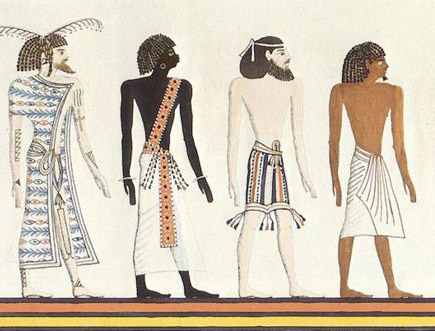
Egyptian
painting of a Libyan, a Kushi, a Syrian, and an Egyptian. In the Middle East, the Egyptians were seen
as the Dark Other (Wikicommons)
Mention
the term ‘skin color’ and people usually think of race or ethnicity. Yet this way
of thinking became dominant only when Europeans began moving out and colonizing
the rest of the world, beginning in the 16th century. Previously, physical
features were less useful as ethnic markers. We knew about and quarrelled with
those groups of people who lived within close range, and they tended to look a
lot like us. People farther away looked more different, but we had less to do
with them. Often, we didn’t even know they existed. So we separated "us"
from "them” mainly on the basis of culture—language, religion, customs,
and so on.
In
those earlier times, skin color was used to distinguish among individuals of the
same people and between the two sexes, women being paler and men ruddier and
browner. A pale color also set infants apart, particularly in those societies
where everyone else was much darker-skinned.
Skin
color thus had meanings related to gender, age, or simply the identity of any
one individual. This was true for all cultures. For example, in pre-Islamic
writings from Arabia:
Human
beings are frequently described by words which we might translate as black,
white, red, olive, yellow, and two shades of brown, one lighter and one darker.
These terms are usually used in a personal rather than an ethnic sense and
would correspond to such words as "swarthy," "sallow,"
"blonde," or "ruddy" in our own modern usage more than to
words like "black" and "white." (Lewis, 1990, p. 22)
Similarly,
the Japanese would use the terms shiroi
(white) and kuroi (black) to describe
their gradations of skin color (Wagatsuma, 1967). The Igbo of precolonial
Nigeria used ocha (white) and ojii (black) in the same way, so that nwoko ocha (white man) merely meant an
African with a yellowish or reddish complexion (Ardener, 1954).
Jews of Antiquity
This
older way of viewing skin color—personal, relativistic, and gender-oriented—has
been studied by David Goldenberg with respect to the Jews of the ancient world.
The
Jews considered their skin to be light brown. A second-century rabbi compared
it to “the boxwood tree, neither black nor white, but in between"
(Goldenberg, 2003, p. 95). In papyri from Ptolemaic Egypt, Jews are almost
always described as "honey-colored" (Cohen, 1999, pp. 29-30).
Nonetheless,
Jewish women were preferentially referred to as "white." This
reflected the naturally lighter complexion of women, which was made lighter still
by sun avoidance and various cosmetics. One rabbinic text advises, "He who
wishes to whiten his daughter's complexion, let him give her milk and young
fowl," while another recommends using olive oil as a body lotion for the
same purpose. A Midrash recounts that after returning from exile in Babylon the
men didn't wish to marry the women who came with them because the sun had
darkened their faces on the long journey home (Goldenberg, 2003, p. 86). This
preference is implicit in a rabbinic discussion of a vow "not to marry a
particular woman who is ugly, but it turns out that the woman is beautiful; or
black (dark; shehorah), but it turns out
that she is white (fair; levanah); or
short, but she is tall. Even if she was ugly, but became beautiful; or black,
and became white" (Goldenberg, 2003, pp. 85-86).
"White"
was also the preferred color of infants. According to a rabbinic tradition, if
a woman was suspected of infidelity and found innocent, she would go through
the following changes: "if she formerly bore ugly babies, she will now
bear beautiful babies; if she formerly bore dark [shehorin] children, she will now bear fair [levanim] children" (Goldenberg, 2003, p. 96).
In
the above cases, the terms "white" and "black" were projected onto individuals
and onto the two sexes in a relative sense that is better translated by
"light" and "dark." This relativism also held true when the
same terms were projected onto ethnic groups. Hence, the Jews often called
themselves "white" in relation to darker-skinned peoples, usually
Egyptians or kushi (black Africans).
For
example, in one parable a kushit
maidservant claims she is the most beautiful of her household. Her matronah (a free woman of good family)
replies: "Come the morning and we'll see who is black [shahor] and who is white [lavan]" (Goldenberg, 2003, p. 88). Interestingly,
the Jews also considered themselves “white” in comparison to Arabs (Goldenberg,2003, pp. 120-124).
There
was also the reverse semantic process: the description of an individual’s skin
color by a word that originally applied to an ethnic group. A lighter-skinned
Jew could for instance be called a germani,
and a darker-skinned Jew a kushi.
There are even cases of the word kushi
being used for inanimate objects, like dark wine (Goldenberg, 2003, p. 116).
Whatever
the case, use of color terms in an ethnic sense tended to carry over values from
the non-ethnic sense, specifically the aesthetic ones associated with the
lighter skin of women and infants. We see this in a commentary on Gen 12:11
where Abraham enters Egypt and, fearing that the Egyptians will covet his wife,
says: "Now I know that you are a beautiful woman." This is explained in
the commentary as meaning: "Now we are about to enter a place of ugly and
dark [people]" (Goldenberg, 2003, p. 86).
The
Egyptians were the Dark Other. Depreciation of their darker skin became
associated with negative values, not only ugliness but also uncleanliness and
servility. In rabbinic writings, Egypt is called "a house of slaves"
and the Pharaoh himself is said to be a "slave." In one text, Jacob
debates whether to go to Egypt: "Shall I go to an unclean land, among
slaves, the children of Ham?" (Goldenberg, 2003, pp. 160-161). This view is
preserved in a homily by the third-century Christian writer Origen:
But
Pharao easily reduced the Egyptian people to bondage to himself, nor is it
written that he did this by force. For the Egyptians are prone to a degenerate
life and quickly sink to every slavery of the vices. Look at the origin of the
race and you will discover that their father Cham, who had laughed at his
father's nakedness, deserved a judgment of this kind, that his son Chanaan
should be a servant to his brothers, in which case the condition of bondage
would prove the wickedness of his conduct. Not without merit, therefore, does
the discolored posterity imitate the ignobility of the race.
Homily on Genesis
XVI
Most
academics argue that dark skin became mentally associated with slavery through
the Atlantic slave trade of the 16th to 19th centuries. Others, like Bernard
Lewis, believe this mental association goes back to the expansion of the Muslim
world into Africa in the seventh century (Lewis, 1990). Actually, it seems to
go even farther back, at least to the third century and perhaps even to the establishment
of Roman rule over the region (Goldenberg, 2003, pp. 155-156, 168-174). From
that time onward, a pigmentocracy took shape in Egypt with Greeks, Jews, and
Romans forming the dominant class. Meanwhile, a trade in slaves grew and
developed between sub-Saharan Africa and the Middle East. Once the Roman Empire
had stopped growing, and stopped taking large numbers of prisoners of war,
trade became the main source of domestic servants. It is perhaps significant
that the kushit maidservant appears
as a recurring motif in rabbinic literature, since that period—Late Antiquity—would
correspond to the time when the black slave trade was slowly but steadily
growing (Goldenberg, 2003, pp. 126-128).
This
trade may have undermined the status of Egyptians as the Dark Other. Initially,
the kushi were often seen as an
especially dark sort of Egyptian, perhaps because they were usually encountered
in the Middle East as subjects of the Pharaoh (Goldenberg, 2003, pp.
17, 109, 301 n111). In Late Antiquity, they emerged more and more as a distinct
category, probably because they were becoming more and more numerous as slaves,
particularly in the eastern provinces of the Empire. It was during this time
that their dark skin came to be explained as a curse on their forefather Kush,
whose father Ham had sinned either by seeing Noah naked or by copulating in the
Ark. In one text, Noah curses Ham with the words: "May your progeny be
dark and ugly" (Goldenberg, 2003, p. 97). This is not a specifically
Jewish tradition, being also attested in early Christian and early Islamic
writings (Goldenberg, 2003, pp. 150-177).
Conclusion
We
perceive human skin color by means of mental algorithms that originally
processed non-ethnic differences in pigmentation: 1) the minor variability that
exists among individuals; 2) the difference between infants (who are born with
little pigmentation) and older humans; and 3) the sex difference, female skin
being paler than male skin because it has less melanisation and less blood
flowing through its outer layers. This is a universal sex difference, although
it is most visible in humans of medium color (Frost, 2007).
Initially,
these algorithms focused on the second source of variability. At some point in evolution,
human skin acquired a new meaning when the adult female body began to mimic the
relative lightness of infant skin, as well as other visible, audible, and
tangible aspects of infants—smoother, more pliable skin, a higher-pitched
voice, and a more childlike face. This mimicry arose apparently as a means to provide
the adult female with the psychological effects that these traits induce in
other adults, particularly males, i.e., a lower level of aggressiveness and a
greater desire to provide care and nurturance (Frost, 2011).
After
being a sign of age difference and then gender difference, skin color took on a
third meaning within historic times—to varying degrees in Antiquity and then
overwhelmingly with the expansion of the European world from the sixteenth
century onward. Today, this new meaning has eclipsed the older ones, at least
at the level of conscious thought.
References
Ardener,
E.W. (1954). Some Ibo attitudes to skin pigmentation, Man, 54, 71-73.
http://www.jstor.org/stable/2793760?seq=1#page_scan_tab_contents
Cohen,
S.J.D. (1999). The Beginnings of Jewishness,
Berkeley.
Frost,
P. (2007). Comment on Human skin-color sexual dimorphism: A test of the sexual
selection hypothesis, American Journal of
Physical Anthropology, 133,
779-781.
http://www.researchgate.net/publication/6480611_Human_skin-color_sexual_dimorphism_A_test_of_the_sexual_selection_hypothesis
Frost,
P. (2011). Hue and luminosity of human skin: a visual cue for gender
recognition and other mental tasks, Human
Ethology Bulletin, 26(2), 25-34.
http://www.researchgate.net/publication/256296588_Hue_and_luminosity_of_human_skin_a_visual_cue_for_gender_recognition_and_other_mental_tasks/file/72e7e5223eb2c3eb3b.pdf
Goldenberg,
D.M. (2003). The Curse of Ham. Race and
Slavery in Early Judaism, Christianity, and Islam, Princeton: Princeton
University Press.
Goldenberg,
D.M. (2009). Racism, Color Symbolism, and Color Prejudice, in M. Eliav-Feldon,
B. Isaac, and J. Ziegler (eds.) The Origins of Racism in the West, Cambridge.
http://www.researchgate.net/profile/David_Goldenberg2/publication/263161501_Racism_Color_Symbolism_and_Color_Prejudice/links/00b7d53a09ef919429000000.pdf
Lewis,
B. (1990). Race and Slavery in the Middle
East, Oxford: Oxford University Press.
Origen
(2010). Homilies on Genesis and Exodus,
transl. by R.E. Heine., Washington D.C.: Catholic University of America Press
https://books.google.ca/books?id=X_mSBavPcq4C&pg=PA214&source=gbs_toc_r&cad=2#v=onepage&q&f=false
Wagatsuma,
H. (1967). The social perception of skin color in Japan, Daedalus, 96, 407-443.
http://www.jstor.org/stable/20027045?seq=1#page_scan_tab_contents 


