I've
published a paper "White Skin Privilege: Modern Myth, Forgotten Past"
in the journal Evolutionary Studies in
Imaginative Culture. Here is the abstract:
European
women dominate images of beauty, presumably because Europe has dominated the
world for the past few centuries. Yet this presumed cause poorly explains
"white slavery"—the commodification of European women for export at a
time when their continent was much less dominant. Actually, there has long been
a cross-cultural preference for lighter-skinned women, with the notable exception
of modern Western culture. This cultural norm mirrors a physical norm: skin
sexually differentiates at puberty, becoming fairer in girls, and browner and
ruddier in boys. Europeans are also distinguished by a palette of hair and eye
colors that likewise differs between the sexes, with women more often having
the brighter hues. In general, the European phenotype, especially its brightly
colored features, seems to be due to a selection pressure that targeted women,
apparently sexual selection. Female beauty is thus a product of social
relations, but not solely those of recent times.
Please
feel free to comment.
Reference
Frost,
P. (2020). White Skin Privilege: Modern Myth, Forgotten Past. Evolutionary Studies in Imaginative Culture
4(2): 63-82.
Iceland
had pre-Columbian contacts with North America. Did they lead to intermarriage?
(Wikicommons)
Did
the Norse have sustained contacts with the indigenous peoples of the Americas,
including intermarriage? Or was Vinland a fleeting encounter?
Steve
Sailer touched on this question in a recent column, citing an Icelandic study.
Although Iceland’s gene pool is overwhelmingly from Scandinavia and the British
Isles, there are also traces of a lineage normally found among the indigenous peoples
of northeast Asia and the Americas. Preliminary genealogical analyses have
shown that this lineage was present in Iceland at least 300 years ago.
This
raised the intriguing possibility that the Icelandic C1 lineage could be traced
to Viking voyages to the Americas that commenced in the 10th century. In an
attempt to shed further light on the entry date of the C1 lineage into the
Icelandic mtDNA pool and its geographical origin, we used the deCODE Genetics
genealogical database to identify additional matrilineal ancestors that carry
the C1 lineage and then sequenced the complete mtDNA genome of 11 contemporary
C1 carriers from four different matrilines. Our results indicate a latest
possible arrival date in Iceland of just prior to 1700 and a likely arrival
date centuries earlier. Most surprisingly, we demonstrate that the Icelandic C1
lineage does not belong to any of the four known Native American (C1b, C1c, and
C1d) or Asian (C1a) subclades of haplogroup C1. Rather, it is presently the
only known member of a new subclade, C1e. (Ebenesersdóttir et al. 2011)
I
doubt the hypothesis of Amerindian admixture. As the authors note, the C1e
subclade has not been found in any indigenous population of the Americas.
Perhaps this is because those populations have not been studied as thoroughly
as the Icelandic one. Perhaps it is present among Amerindians, but at a
frequency too low to be detected by studies done to date.
But
why, then, do we see no other Amerindian subclades in Icelanders? That
population has been studied so exhaustively that even low frequencies of other
subclades should have been detected by now. This point is made by Der
Sarkissian et al. (2014):
Among
other hypotheses including that of a European origin, an American origin was
favoured on the basis that most of the hg C1 diversity is found on the American
continent, despite the fact that no sequence belonging to hg C1e could be
detected in the Americas (or anywhere else). This lack of match was explained
by under-sampling of the American mtDNA genome diversity [10]. In any case, if
admixture between Native Americans and Vikings did occur, it must have been
limited, as no other American-specific lineage (e.g. hg A2, B2, D1, C1b, C1c,
C1d) was detected in Iceland.
The
authors of the same study point out that a sister subclade, C1f, has been found
in human remains from Mesolithic northeast Europe. Moreover, it is not excluded
that these two sister subclades, C1e and C1f, still exist in northeast Europe.
The Icelandic population has been studied much more than almost any other
population, so C1e might still exist somewhere in northeast Europe but hasn't
been found because of its low frequency. The authors conclude:
...
we suggest that the Icelandic-specific C1e sub-clade could have had a recent
origin in northern Europe rather than an American origin. This hypothesis is
relevant with regard to the origins of the Icelandic population, as Iceland was
discovered and first settled by Scandinavian Vikings around 1,130 years ago.
Vikings raids extended as far from their homeland in Scandinavia as France,
Spain and Sicily, but their main expansion range comprised western Russia, the
Baltic region, Scandinavia, and the British Isles.
In
fact, we know that some of Iceland's settlers had trading contacts with Russia
and may have had slaves of Slavic origin:
No
name given in Landnámabók resembles any Slavic form. But the settlers who came
from Sweden and Gotland (e.g. S. 209) must have had various contacts with the
Slavs. This would be the case also with some Norwegians who like Skinna-Bjöm
'used to go trading to Novgorod' before he went to Iceland. His son
Miðjarðar-Skeggi 'went to plunder in the Baltic' (S. 174 and H. 140). Such
people were very likely to have aboard their ships Slavic slaves and/or
companions recruited from among southern Baltic pirates or inhabitants of the
multiethnic emporia like Wolin/Jómsborg or Truso. (Urbanczyk 2002, p. 160)
A
Slavic presence in Iceland is further suggested by the existence of
"sunken huts"—rectangular-like depressions in the ground with
vertical walls, stone ovens placed in one of the corners, and roof
constructions supported by corner posts. To date, the remains of eighteen such
huts have been discovered in Iceland, and they seem to date to the settlement
period. They are also typically Slavic:
Considering
the houses they built there is little alternative to the conclusion that they
were Slavs or, at least, people who grew up among the Slavs which made them
'Slavs' culturally. Such houses, distinctively different from the Germanic
sunken huts are known in thousands from all the lands settled by early Slavs in
Eastern, Southern and Central Europe. (Urbanczyk 2002, p. 163)
It
should be pointed out that the Norse were major players in the early medieval
slave trade, particularly in supplying North African and Middle Eastern clients
with fair-skinned women. One of the largest slave markets was at Hederby, on
what is now the Danish-German border. It was largely to cash in on the demand
for slaves that the Norse began launching their infamous raids across Europe
(Holm 1986; Raffield 2019; Skirda 2010, 143-146). Regular visits by Muslim
merchants likely explain the influx of Middle Eastern silver coins into
Scandinavia during the ninth and tenth centuries (Raffield 2019). Such visits
may also explain the presence of low levels of North African ancestry in the
Icelandic gene pool.Ásmundsdóttir
(2017) argues that this North African ancestry entered the Icelandic gene
pool by way of the initial Scandinavian settlers. It may thus have its origins in
merchants from Muslim Spain and North Africa who regularly came to trading
centers like Hederby.
References
Ásmundsdóttir
R.D. (2017). The African L3e5a haplogroup in the Icelandic population. Skemman repository
of dissertations https://skemman.is/handle/1946/27644
Der
Sarkissian, C., P. Brotherton, O. Balanovsky, J.E. Templeton, B. Llamas, J.
Soubrier, V. Moiseyev, V. Khartanovich, A. Cooper, W. Haak, and Genographic
Consortium (2014). Mitochondrial genome sequencing in Mesolithic North East
Europe Unearths a new sub-clade within the broadly distributed human haplogroup
C1. PloS one 9(2), e87612. https://www.ncbi.nlm.nih.gov/pmc/articles/PMC3913659/
Ebenesersdóttir,
S.S., Á. Sigurðsson, F. Sánchez-Quinto, C. Lalueza-Fox, K. Stefánsson, and A.
Helgason, (2011). A new subclade of mtDNA haplogroup C1 found in icelanders:
Evidence of pre-columbian contact? American
Journal of Physical Anthropology 144: 92-99. https://onlinelibrary.wiley.com/doi/abs/10.1002/ajpa.21419
Holm,
P. (1986). The Slave trade of Dublin, Ninth to Twelfth Centuries. Peritia 5: 317-45.
Raffield,
B. (2019). The Slave Markets of the Viking World: Comparative Perspectives on
an 'Invisible Archaeology'. Slavery &
Abolition 40(4)
The
Babylonian Marriage Market, by Edwin Long (1829-1891). There are too many young
men on the mate market, particularly in the White American community.
It
sucks being young, male, and single. Don't think so? Go to the Interactive Singles Map of the United States and see how it looks for the 20 to 39 age
group. Almost everywhere single men outnumber single women.
And
the real picture is worse. For one thing, the imbalance is greater among singles
without children. This is not a trivial factor, since single mothers are
"single" only in the sense of being available for sexual relations.
They are still raising offspring from a previous relationship and many are not
interested in having more children.
Then
there's polygamy—or "polyamory," to use the preferred term—where a
minority of men controls sexual access to a larger number of women. If we
compare the 1940-1949 and 1970-1979 cohorts of American adults, we find an
increase in the number of median lifetime partners from 2.6 to 5.3 among women
and from 6.7 to 8.8 among men (Liu et al., 2015). Because this figure is more
variable for men than for women, young women are more likely to be sexually
active than young men. This is crudely seen in infection rates for chlamydia—the
most common sexually transmitted disease. Hispanic Americans still show the
traditional pattern of greater sexual activity among men than among women, the
rates being 7.24% of men and 4.42% of women. White Americans display the
reverse: 1.38% of men and 2.52% of women (Miller et al., 2004).
Finally,
there’s a racial angle. This sex ratio is more skewed among White Americans
than among African Americans, mainly because the latter have a lower sex ratio
at birth and a higher death rate among young men.
It's
hard to avoid concluding that a lot of young white men are shut out of the
marriage market ... or any kind of heterosexual relationship. This wife
shortage was once thought to be temporary, being due to baby-boomer men getting
divorced and marrying younger women from the smaller "baby bust" cohort.
With time, they would get too old to compete with young men, and the problem should
resolve itself.
Today,
the crest of the baby boom is entering the seventh decade of life, yet the
update to the Interactive Singles Map shows no change to the gender imbalance.
So what gives? It appears that demographers have focused too much on the
baby-boomer effect and not enough on other factors that matter just as much
and, more importantly, show no signs of going away. These factors can be
summarized as follows.
Re-entry of older
men into the mate market
We
have a mate market where 20 to 50 year old men are competing for 20 to 40 year
old women. That in itself is nothing new. But something else is.
The
baby boom eclipsed an equally important but longer-term trend: more and more
men are living past the age of 40. With or without the baby boom, we’ll still
see large numbers of older men getting divorced and marrying younger women. The
cause isn’t just liberal divorce laws. It’s also the fact we have far more
older guys out there as a proportion of the population.
Sure,
we will also see younger men pairing up with "cougars" but there are
limits to that option, as noted in a New Zealand study:
The
male partner may want to partner up with someone younger or have children,
which may not be possible with an older woman (for physical reasons or because
she chooses not to have (more) children). The younger male partner may not want
to become a step-father to existing children. Research has shown that
childbearing can be the ultimate deal breaker in this kind of relationship.
(Lawton and Callister, 2010)
Persistence of the
imbalanced sex ratio at birth
About
105 males are born for every 100 females among people of European origin. This
sex ratio used to decline to parity during childhood because of higher
infantile mortality among boys. It then declined even farther in early adulthood
because of war, industrial accidents, and other hazards. This isn't the distant
past. If you talk with women who came of age in the postwar era, they will tell
you about their fears of remaining single past the age of thirty. At that age, very
few single men were left to go around.
Well,
things have changed. The skewed sex ratio at birth is now persisting well into
adulthood, thanks to modern medicine and the relative peace that has prevailed
since 1945. Women begin to outnumber men only in the 35-39 age group in the
United States and in the 40-44 age group in the United Kingdom.
Equalization of
male and female same-sex preference
Historically,
same-sex preference was more common among men than among women. This gender gap
appears to be closing, according to a recent study:
The
percent distributions were quite similar for men and women; however, a higher
percentage of men identified as gay (1.8%) compared with women who identified
as gay/lesbian (1.4%), and a higher percentage of women identified as bisexual
(0.9%) compared with men (0.4%). (CDCP, 2014, p. 5)
Disparities in outmarriage
At
present, there are more White American women outmarrying than White American
men, particularly in younger age groups. This disparity is mainly in marriages
with African American men, there being no gender difference in marriages with
Hispanic Americans and the reverse gender difference in marriages with Asian
Americans (Jacobs and Labov, 2002; Passel et al., 2010). Overall, this factor
further skews the ratio of young single men to young single women in the White
American community.
This
disparity isn't new. What is new is its extent, for both legal and common-law
marriages. An idea may be gleaned from statistics on children born to White
American women, specifically the proportion fathered by a non-White partner.
For the U.S. as a whole the proportion in 2013 was between 11% and 20% (the
uncertainty is due to 190,000 births for which the father's race was not
stated). By comparison, the proportion in 1990 was between 5% and 13% (Centers for Disease Control and Prevention, 2013; see also Silviosilver, 2015).
Whenever
this issue comes up for discussion, there are often reassurances that the
disparity will disappear in a post-racial world that has been cleansed of
"White privilege." I'm not so sure. The European female phenotype
seems to be very popular, and this was so even when white folks were
geopolitical weaklings. Today, the term “white slavery” is merely a synonym for
prostitution, but it originally meant the enslavement of fair-skinned women for
sale to clients in North Africa, the Middle East, and South Asia. At the height of this trade, between 1500 and
1650, over 10,000 Eastern Europeans were enslaved each year for export
(Kolodziejczyk, 2006; Skirda, 2010). The overwhelming majority were young women
and pre-pubertal boys who were valued for their physical appearance. And yet
they were powerless.
No,
I don't think this kind of preference will disappear as whites lose
"privilege."
Exit strategies
So
more and more young men are being left on the shelf, particularly in White
America. How do they cope? Mostly by turning to porn from Internet websites,
videocassettes, or magazines. Love dolls are another option and may grow in
popularity as they become more human-like, not only physically but also in
their ability to talk and interact.
Another
option is outmarriage. In the past, this trend largely concerned older men marrying
East Asian or Hispanic women, but we’re now seeing plenty of young men outmarrying via
Internet dating sites. Despite the local supply of single women in the African
American community, there is a much stronger tendency to look abroad, generally
to women in Eastern Europe, South America, or East Asia.
Then
there's gender reassignment, which means either entering the
other side of the mate market or tapping into the lesbian market. It’s a viable
strategy, all the more so because many white boys can be turned into hot trans
women. I'm not saying that some young men actually think along those lines, but
gender reassignment is functioning that way.
Finally,
there's "game." My attitude toward game is like my attitude toward
gender reassignment. Both are attempts to push the envelope of phenotypic
plasticity beyond its usual limits, and neither can fully achieve the desired
result. A lot of boys aren't wired for game, and there are good reasons
why, just as there are good reasons why some people are born male. Male shyness
isn't a pathology. It's an adaptation to a social environment that values
monogamy and high paternal investment while stigmatizing sexual adventurism.
Our war on male shyness reflects our perverse desire to create a society of Don
Juans and single mothers.
But
if game works, why not? Whatever floats your boat.
Conclusion
Ideally,
this gender imbalance should be dealt with at the societal level, but I see
little chance of that happening in the near future. If anything, public policy
decisions will probably worsen the current imbalance. Changes to public policy generally
result from a long process that begins when people speak up and articulate
their concerns, yet it's unlikely that even this first step will be taken any time
soon. Young single men prefer to remain silent and invent nonexistent
girlfriends. They also tend to be marginal in the main areas of discourse
creation, like print and online journalism, TV, film, and radio production,
book writing, etc. Leaf through any magazine, and you'll probably see more stuff
about the problems of single women.
So
this imbalance will likely continue to be addressed at the individual level through
individual strategies.
References
Centers
for Disease Control and Prevention. (2014). Sexual
Orientation in the 2013 National Health Interview Survey: A Quality Assessment,
Vital and Health Statistics, 2(169), December
Kolodziejczyk,
D. (2006). Slave hunting and slave redemption as a business enterprise: The
northern Black Sea region in the sixteenth to seventeenth centuries, Oriente Moderno, 86, 1, The Ottomans and Trade, pp. 149-159.
Lawton,
Z. and P. Callister. (2010). Older
Women-Younger Men Relationships: the Social Phenomenon of 'Cougars'. A Research
Note, Institute of Policy Studies Working Paper 10/02
Liu,
G., S. Hariri, H. Bradley, S.L. Gottlieb, J.S. Leichliter, and L.E. Markowitz.
(2015). Trends and patterns of sexual behaviors among adolescents and adults
aged 14 to 59 years, United States, Sexually
Transmitted Diseases, 42, 20-26.
Miller,
W.C., C.A. Ford, M. Morris, M.S. Handcock, J.L. Schmitz, M.M. Hobbs, M.S.
Cohen, K.M. Harris, and J.R. Udry. (2004). Prevalence of chlamydial and
gonococcal infections among young adults in the United States, JAMA, 291, 2229-2236.
Passel, J.S., W. Wang, and P. Taylor. (2010). One-in-seven new U.S. marriages is interracial or interethnic, Pew Research Center, Social & Demographic Trends,
The year is ending, and it’s time to take stock.
Which posts interested you the most? Here are the five most popular ones, with the number
of visits to each post:
The first two belonged to a five-part series on the
white slave trade (see also Trading in fair-skinned women. Did it happen elsewhere?From Slavs to slaves, From Slavs to slaves. Part II). The existence
of this trade is little known even among the well-educated, who typically react
with disbelief. Surely those white slaves were fewer in number than the black
slaves taken across the Atlantic.And
surely all of that happened long before the Atlantic slave trade.
Wrong on both counts. Europe exported about as many
slaves to the non-European world as were exported from Africa to the Americas.
Eastern Europeans continued to be “harvested” until the mid-1700s and the
population of the Caucasus until the mid-1800s. By comparison, the black slave
trade was banned within the British Empire in 1807 and throughout the Western
Hemisphere by the 1860s. The difference was qualitative and not quantitative.
Black slaves were mostly male; white slaves mostly female.
In writing those posts, I wasn’t driven by a desire
to slander Muslims. Many white slave girls went on to become the wives of
leading men, including sultans (like Roxelana). Their slave status was a
passing thing, as explained by a notable of Tunis, Mohamed Rechid, when the
authorities questioned him in 1891 on his role in slave trafficking:
Q. Do you have any white slave women of Circassian
or other origins?
A. No, I don’t have any. Q. When you went to Constantinople, you didn’t bring
any white slave women back with you? A. I brought two women back with me, this is true,
but they aren’t slaves. They are two sisters, one of whom is my wife. One is
called Zohra and the other Daïde. Q. If they aren’t slaves, how did you get them? A. I bought them in Constantinople, I freed them,
and I married one of them. The other one is my sister-in-law. (Dali, 2012)
In Tunis, the noblest families are partly descended
from such women (Dali, 2012). The same seems true for most of North Africa and
the Middle East, according to this historian of Muslim Spain:
The same convoys of booty also
included women, these Frankish women who were all the more sought after in
Cordova because they were blond and fair-skinned. It was among them, as among
the captive women from Gascony, that the Umayyad princes chose their most
pampered concubines and who, once they became mothers, were themselves raised
to the rank of veritable princesses, of proven sultanesses (umm walad) who were influential and
quick to enter, with the assistance of Slav eunuchs, into secret and
complicated palace intrigues. But the Frankish women did not populate only the
caliph's harems; the dignitaries of the khassa
and the rich burghers of the cities also procured them at lavish prices, like,
in the modern period, the Circassian women who have so curiously tinted the
upper classes of oriental Muslim society. (Lévi-Provençal, 1953, p. 179)
Of course, many white slave women had less fortunate
outcomes, never rising above the level of concubine, singing girl, or
prostitute. But this is not something to feel bitter or guilty about. The past
is another country. We study it so that we may better understand the present.
In this five-part series, I was responding to
Cameron Russell’s argument that she and other top models are cashing in on a
legacy of white privilege. In other words, if Europeans had not become so
dominant socially, economically, and geopolitically, her white skin and facial
features would today seem much less attractive. Well, that alternate reality
did exist. Until five centuries ago, white folks were weaklings on the world
scene, with large areas of their continent under the rule of outsiders. And
yet, European women were greatly admired in Muslim Spain, North Africa, the
Middle East, and South Asia, this being why so many of them were enslaved and
exported to those regions … just because of their looks.
This post was about Karel Kleisner’s study on eye
color and face shape. In sum, blue eyes are associated with less robust and
more feminine faces, but only if the faces are male. It may be that female face
shape is overdetermined, i.e., all girls are exposed to enough estrogen in the
womb to feminize their faces, but only blue-eyed boys reach this level of
estrogenization. Thus, to some degree, blue eyes are a female trait. This
finding is consistent with the view, supported by other findings, that the most
visible features of Europeans are actually female
features, i.e., they are a product of a selection pressure that acted primarily
on women.
I was initially taken aback on seeing the averaged
blue-eyed and brown-eyed male faces that appear in Dr. Kleisner’s first paper
on this subject. Surely some of those photographed subjects were partly Jewish
or Roma. But, then, the brown-eyed men would have been more variable in face
shape, yet they were not. And how would that reason explain why blue eyes
correlated with facial feminization in men but not in women?
Two years ago, the Danish psychologist Helmuth
Nyborg published a paper on his country’s demographic future. He made the
following points:
- Contrary to official statistics, immigrant birth
rates are not falling. In fact, they have been rising since 1980 and were over
twice the ethnic Danish birth rate in 2009. Since 1995, the ethnic Danish birth
rate has been falling.
- After rising for half a century, average national
IQ began to fall in 1997. This decline has also been observed in Norway, even
though average IQ has continued to rise elsewhere in line with the Flynn
effect.
- By 2050, less than one fifth of the population
will have IQs in the 90 to 104 range, and over half in the 70 to 85 range.
Primary schools will mainly have low IQ children of sub-Saharan, Middle
Eastern, North African, Latin American, and Caribbean backgrounds.
- By 2072, ethnic Danes will have fallen to 60% of
the population and 33% of all births. They will become a minority around 2085.
These predictions may or may not be correct (see
Does Nyborg’s study make sense?). Is the rapidity of demographic change
overstated? Are the differences in IQ due to poor upbringing and hence amenable
to improvement? Criticism can and should be made, but that option was passed
over by three of Nyborg’s colleagues. They complained to the Danish Committee for Scientific Dishonesty,
which ruled that he must withdraw his study from the scientific literature. I
denounced this decision in an e-mail to Morten Østergaard, the Danish Minister
for Research, Innovation, and Higher Education, as did many other academics.
I got the following reply (words bolded as in the
original):
Dear Dr. Frost,
The Minister for Science, Innovation and Higher
Education Morten Østergaard acknowledges receipt of your e-mail dated 14
November 2013.
Further to your concern as to the decision (ruling)
dated 28 October 2013 of the Danish Committees on Scientific Dishonesty on
Helmuth Nyborg’s contribution to the article “The Decay of Western
Civilization: Double Relaxed Darwinian Selection” published in the scientific
journal “Personality and Individual Differences”, we are now pleased to invite
you to study the translation into English of the decision. You will find the
translation following this link:
Based on the conclusions of the Committees they recommend that the article be
withdrawn. But, as you will see, the Danish Committees on Scientific Dishonesty
have not in any way considered the
conclusions drawn by Dr. Nyborg, nor have they ordered him to withdraw the article.
The Committees have been established as stipulated
in an act of Parliament to “investigate allegations on research misconduct
only, i.e. falsification, fabrication, plagiarism and other serious violation
of good scientific practice committed wilfully or grossly negligent on
planning, performance or reporting of research results”. The Committees are not
entitled to consider cases involving the validity or truth of scientific
theories or cases involving the research quality of a scientific product.
If you are interested in more information on the
mandate of the Committees, you may find all the relevant regulations translated
into English here:
General Counsel and Head of Secretariat for Danish Committees on
Scientific Dishonesty
Yes, it was just a recommendation, but
recommendations are made to be acted upon by someone in authority. Or maybe the
Committee expected that Dr. Nyborg would just voluntarily purge his study from
the scientific literature? Anyhow, it’s clear that no one in authority wishes
to proceed further.
The scientific community is slowly realizing that
microscopic parasites can manipulate human behavior. Attention is now focused
on the protozoan Toxoplasma gondii,
but only because we already know what it does to cats and mice. There is no
reason to think that human-specific microbes have not also evolved in this
direction. As the Czech biologist Jaroslav Flegr points out: “A large number of
parasitic organisms […] may influence the phenotype of their human host even
more than the Toxoplasma. These
organisms are, however, still waiting for research teams to engage in a
systematic study of their influence on the human host.”
Some of them may be surprisingly commonplace,
organisms like vaginal yeast and bacterial vaginosis. See also Brainwashed by a microbe?
And now for the
duds …
My year-end review would be incomplete unless I
mentioned my least popular posts:
In this post, together with previous ones on the Paekchong of Korea and the Burakumin of Japan, I argued that outcaste groups
are evolutionarily conservative and thus tend to preserve predispositions that
once were prevalent in the general population, e.g., with respect to time
orientation, impulse control, anger threshold, etc.
Such groups exist in many societies, such as those
of East Asia. The existence of stigmatized occupations, notably trades that
involve contact with dead flesh (butchering, leather making, undertaking),
provide lower-class individuals with a protected means of livelihood, but at
the cost of becoming themselves stigmatized. The occupational class becomes a
caste and, hence, no longer participates in the evolutionary changes that
affect the general population. Over time, this caste tends to perpetuate the
same behavioral profile and thus increasingly diverges from the evolving
behavioral profile of the larger society, with the result that social
stigmatization and genetic isolation further increase.
The situation is unlike that of England where, over
the past millennium, the reproductive success of the upper and middle
classes caused a demographic overflow that continually replenished the
ranks of the lower classes, who had negative
natural increase. Today, the population of English background, even in the
lower classes, is composed of lineages that half a millennium ago were
predominantly upper or middle class (Clark, 2007; Clark, 2009).
The Paris
Spring, racism, and antiracism
Time will tell whether anything will come of the
Paris Spring (better known as the French Spring). By “time” I mean the next
year or so. Can antiracism reform itself? I doubt it. Yes, there is a growing
willingness to extend the concept of “hate crime” to cases of interracial
violence where the victim is white, e.g., the knockout game. But such
willingness can never be more than tokenism. First, whites are the victims in most
cases of interracial violence, and overwhelmingly so. Any acknowledgement of
that reality would completely transform antiracism. Second, as antiracists are
right to point out, non-white on white violence is less ideologically motivated
than the reverse. The motive is typically a perception that whites are soft
targets. “Whites don’t fight back.” In particular, they don’t fight back
collectively. The White man has no friends.
In the real world, motives are less important than
consequences. Humans have been ganging up on soft targets for millennia, but
for most of that time they had no conscious ideological motive. Were the Thule
Inuit aware that they were driving the Dorset people to extinction? Not really.
They would first move into Dorset territory and work out a modus vivendi. When
they became more numerous, they would drive those people out. Then they moved
into the next patch of Dorset territory. And the cycle repeated again and again
until the Dorset were no more.
References
Clark, G. (2007). A Farewell to Alms. A Brief Economic History of the World,
Princeton University Press, Princeton and Oxford.
Clark, G. (2009) The indicted and the wealthy:
surnames, reproductive success, genetic selection and social class in
pre-industrial England,
Dali, I.M. (2012). Problématique du phénotype.
Approche comparative des esclavages dans la Tunisie du XIXe siècle, in R. Botte
and A. Stella (eds.) Couleurs de
l’esclavages sur les deux rives de la Méditerranée (Moyen Âge-XXe siècle),
(pp. 337-369), Paris: Éditions Karthala.
Lévi-Provençal, E. (1953). Histoire de l’Espagne musulmane, tome III, Paris: G.P. Maisonneuve.
St. Adalbert freeing Slavic slaves (source). With
the Christianization of Eastern Europe, the trade in fair-skinned women and
boys came to an end.
The white slave trade played a key role in ending
the Dark Ages—this seemingly unending downward spiral that followed the
collapse of the Roman Empire. By the 8th century, the elites of Western Europe
had run out of gold and possessed very little else that could be traded for
luxury Oriental goods. It was at that point in time that the possibility arose
of selling fellow Europeans into slavery, particularly Slavs from the lands
between the Elbe and the Volga.
Yet this historical episode is relatively unknown.
One reason was its semi-illegality. Involuntary servitude wasn’t unlawful in
itself. In fact, most Europeans were bound by long-term ties of submission,
like the serfs who farmed the land. This was an accepted part of life.
Enslavement was even seen as a humane way of dealing with criminals, prisoners
of war, and other people who would otherwise be killed. But this particular form of enslavement meant more
than just inferior status. Some of its aspects contravened both secular law and
Christian morality, notably castration, the breaking up of families, and the
abandonment of individuals who were too old or too young. There was also the
exporting of fellow Europeans to the Muslim world and the prohibition against
letting them learn about the Christian faith. It was for this reason that the
existing term for involuntary servitude—servus—was
felt to be inappropriate. The ethnonym ‘Slav’ thus came to mean a particularly
degraded kind of servant—a slave.
This leads to another reason why this trade is
little talked about. It sheds an unflattering light on our early history. The
end of the Dark Ages was bought at a high moral price, even by medieval
standards. After selling off the family heirlooms, our ancestors began to sell
eunuchs, concubines, and toy boys—all this to get gold and precious fabrics to
adorn their palaces … and churches.
This same price would also make possible the rise of
states in Eastern Europe. When we read that early Polish and Russian kings had
hundreds of wives or concubines, we smile and assume that this sort of thing
was normal in those days. Yet it wasn’t. The slave trade initiated a cultural
revolution that radically transformed social relations throughout pre-Christian
Slavic Europe. Chieftains were previously elected and ruled over small
territories through consensus; now, with Arab gold and silver, some of them had
the means to assert their power unilaterally over much larger territories. A
primitive form of democracy gave way to despotic rule.
Finally, this historical episode sheds an
unflattering light on a group of Jews based in Spain and France who came to be
called Radhanites. Being neither Christian nor Muslim, they were ideal middlemen
for the overland trade route to Muslim Spain. At the other end of this route,
there arose between the 8th and 12th centuries a network of trading posts
across the Slavic lands that stretched from the Elbe in the West to the Volga
in the East.
These trading posts may have eventually given rise
to the Ashkenazi community of Eastern Europe. Admittedly, the usual explanation
is that Jews emigrated to Poland in the wake of
12th-century persecutions in Western Europe. Yet there are earlier references to the presence of Jewish traders in what is now eastern and central Europe:
The appearance of Jews in central
and eastern Europe occurred, it seems, only in the eighth century. It was
linked to two important facts, the first of which was the establishment of a
Jewish cultural and political center in Khazaria, a great Turkish empire whose
center was on the lower Volga. […] The second fact that favored the formation
of Jewish colonies in central and eastern Europe (located east of the Elbe) was
the role played by Jewish merchants in the trade between Western Europe and the
Muslim East.
[…] The Jews of Bohemia are cited
for the first time in the 10th century; the Jews of Prague, in particular, are
mentioned in the biographies of St. Adalbert. The existence of Jewish colonies
in Poland go back only to the early 11th century.
[…] Jewish trade with central and
eastern Europe was from the beginning closely linked to the fact that the
Western Jews, especially the Spanish, French, and Rhineland Jews, played a
major role in the international trade of Western Europe with the Muslim East.
This trade began in the late 8th century at the initiative of Arab and Muslim
traders. Many colonies of Jewish merchants formed along the trading routes that
linked Western Europe to the countries of the Abbasid Caliphate.
[…] We have already mentioned the
existence of Jewish traders in Prague in the late 10th century. The biographies
of St. Adalbert tell us that they trafficked in slaves. There was also in the
early 11th century, we will discuss further, a Jewish establishment at
Przemysl, a town at the crossroads of two trading routes: Prague-Krakow-Kiev
and Hungary-Kiev. The importance of this center is confirmed by the discovery,
made in the mid 19th century of a great treasure of dirhams (Arab silver money)
from the Iranian dynasty of the Samanids, dating from the first half of the
10th century (Lewicki, 1960)
This settlement model is also consistent with the
genetic evidence that Ashkenazi Jews descend from a small founder group of only
300 to 400 individuals who lived about 800 years ago (Carmi et al., 2013).
We should keep in mind that that these merchants
were only a small group within a much larger Jewish community. Moreover, this
trade was shared with at least two other groups: the Vikings, who dominated the
trading routes via the Baltic and the Dnieper, the Don, and the Volga, and the
Khazars, who controlled the Volga trading route. Indeed, the sudden eruption of
Viking raids into Western and Eastern Europe at this time was, to a large
degree, motivated by a desire to cash in on the white slave trade. Captives
from both western and eastern Europe were taken to the trading center at Hedeby
(in present-day Denmark) for sale to Muslim traders (Skirda, 2010, pp. 143-146).
The world was a very different place in the 8th century
and should not be seen through the lens of more recent times. Back then,
Western Europe was a ruined civilization with memories of former grandeur. The
white slave trade offered the ruling classes a way out, either indirectly
through taxation or through direct sale of prisoners of war from the Elbe
frontier. Had Jewish merchants not been available as go-betweens, there would
have been other middlemen. The Vikings and the Khazars, for instance, who
dominated this trade at the eastern and northern ends, would have eventually developed
the overland route through Germany and France to Muslim Spain.
References
Carmi, S., E. Kochav, K. Hui, X. Liu, J. Xue, F.
Grady, S. Guha, K. Upadhyay, S. Mukherjee, B.M. Bowen, V. Joseph, A. Darvasi,
K. Offit, L. Ozelius, I. Peter, J. Cho, H. Ostrer, G. Atzmon, L. Clark, T.
Lencz, and I. Pe'er. (2013). The Ashkenazi Jewish genome, American Society of Human Genetics, Annual Meeting
Lewicki, T. (1961). Les sources hébraïques
consacrées a l'histoire de l'Europe centrale et Orientale et particulièrement a
celle des pays slaves de la fin du IXe au milieu du XIIIe
siècle, Cahiers du Monde russe et soviétique,
2, 228-241. http://www.persee.fr/web/revues/home/prescript/article/cmr_0008-0160_1961_num_2_2_1466
Skirda, A. (2010). La traite des Slaves. L’esclavage des Blancs du VIIIe au
XVIIIe siècle, Paris, Les Éditions de Paris Max Chaleil.
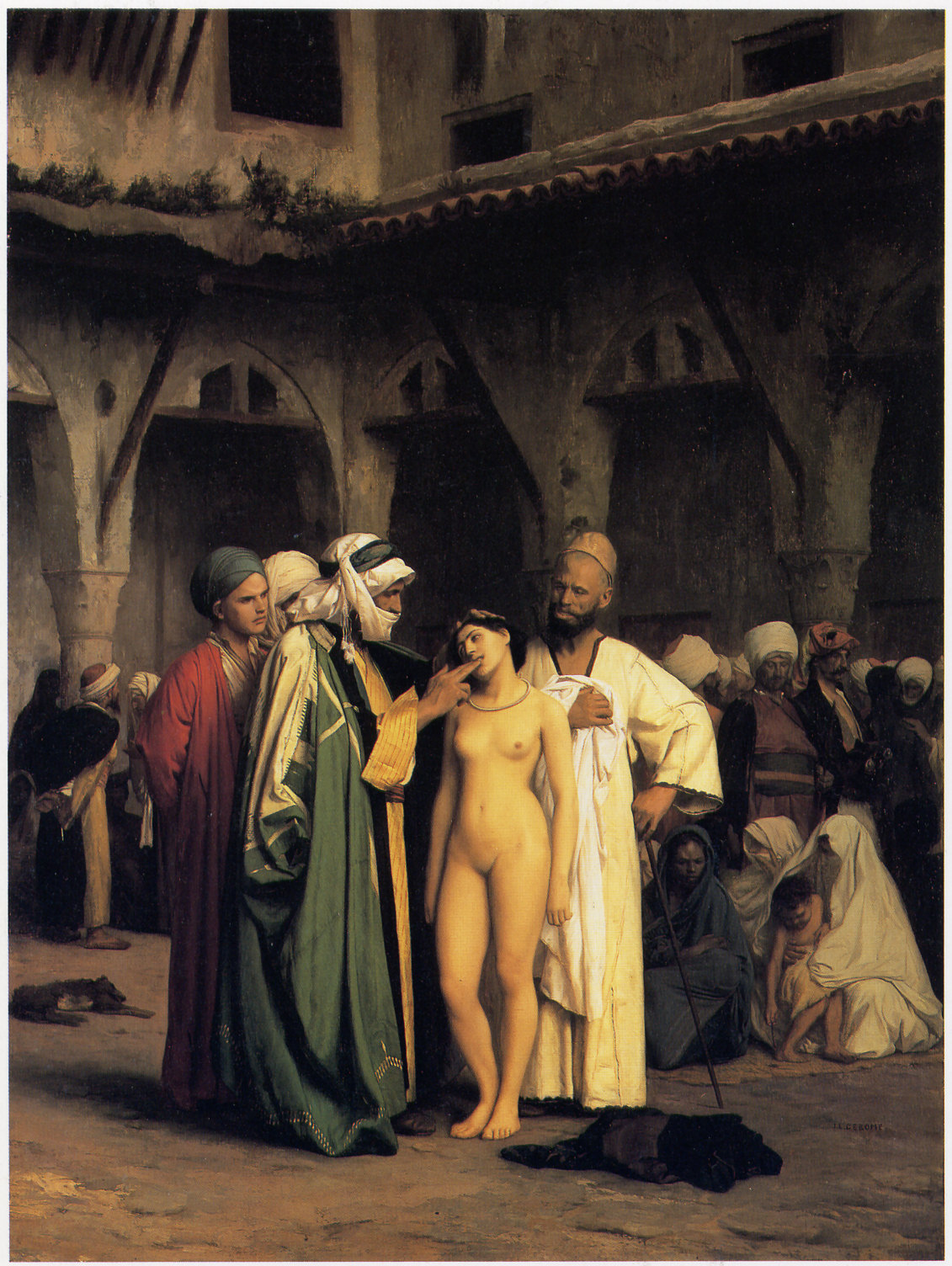
The Slave Market,
painting (c. 1884) by Jean-Léon Gérôme (source)
Can Europeans, and European women in particular,
become objects of trade? The idea seems laughable, since the term ‘slave trade’
almost always brings Africans to mind. Yet there was a time not so long ago
when Europe exported slaves on a large scale. Between 1500 and 1650, Eastern
Europe exported 1.5 million slaves to North Africa, the Middle East, and South
Asia (Fisher, 1972; Kolodziejczyk, 2006). Western Europe exported a little over
a million between 1530 and 1780 (Davis, 2004).
These slaves were taken during hit-and-run raids by
either Crimean Tatar horsemen or North African corsairs. A raiding party would
typically descend on an isolated village and carry away its inhabitants—or
rather those who were commercially useful, particularly young women and young
boys.
There was a time farther back, however, when
Europeans were accomplices in this trade and when it provided most of their
foreign exchange. This was during the Dark Ages and the early Middle Ages,
specifically the 8th to 12th centuries.
The slave trade was a godsend for the elites of
France, Germany, and Italy. With the collapse of the Western Roman Empire in the
5th century, they had to dip into their gold reserves to buy foreign luxury
goods from the Middle East, generally clothing, upholstery, tapestries,
carpets, and other precious fabrics (Skirda, 2010, pp. 56-57). By the 8th
century, these reserves had been almost completely exhausted. Gold was giving
way to silver, and even that medium of exchange was being debased. Western
Europe had largely reverted to an economy of autarky, its shrunken towns and
cities no longer major centers of trade. Most people produced everything they
needed within their local village or manor.
Would Western Europe have eventually returned on its
own to an international trading economy? Perhaps, although revival of trade
would have become more difficult once the elites had become accustomed to
autarky. As things turned out, they found the means to buy foreign luxury goods
almost at the same time their gold reserves ran out. The 8th century brought
the rapid expansion of a new civilization, Islam, into the Middle East, North
Africa, and Spain. Its Arab elite was darker-skinned than the Greco-Roman or Visigothic elites it displaced. It was also more polygynous. A new market had
come into being, a market for wives and concubines. European women were
especially sought after, not because they were exotic but because their fair
skin and fine facial features corresponded to notions of beauty that were
indigenous to Arab culture (see previous post).
And so began the commodification of European women.
Initially, this trade involved prisoners of war captured during the Islamic
wars of expansion. Soon, however, a peaceful trading relationship developed. It
was officially prohibited by Christian emperors and popes alike, but “in
reality, people closed their eyes and everything was tolerated in exchange for
good gold dinars” (Skirda, 2010, p. 75).
The women came from a belt of territory stretching
from the Elbe in the West to the Volga in the East. This territory was
inhabited by Slavic tribes—the ancestors of today’s Poles, Czechs, Slovaks,
Byelorussians, Ukrainians, and Russians. They were typically prisoners of war
who had been taken during fighting either between Germans and Slavs or among
different Slavic tribes:
Only the adolescent boys and girls—the
Slavonici—were spared, enslaved, and immediately sold to the merchants
accompanying the armies. The Barbarian-ruled West, abandoned by major
international trade and bereft of gold, was able to get gold by trading in
slaves, who were almost exclusively Slavs. These objects of servile trade and
commerce would be integrated into harems and used as military slaves or
eunuchs. Adults and children were eliminated for obvious reasons. They did not
correspond to the Muslim demand for young virgin girls and beardless boys and
it was out of the question to gather children and raise them. The traders had
neither the time nor the willingness and more importantly it would not have
been cost-effective. Later, they would spare the lives of more captives, by
selecting them according to their capacities for productive work and by using
them to the limit of their strength at laborious physical tasks (Skirda, 2010,
pp. 85-86).
The captives were taken overland by various routes:
through Germany and France to Muslim Spain; through Venice and by ship to the
Middle East; or down the Dniepr, the Don, or the Volga to the Middle East via
the Black Sea or the Caspian. How many were traded? It’s difficult to say, but
Skirda (2010, p. 6) advances a figure between several tens of thousands and
several hundreds of thousands for the period extending from the 8th to 12th
centuries.
It was this trade, more than any other, that revived
the old trading networks not only between Europe and the Middle East, but also
within Europe itself. The balance of foreign exchange also shifted in Europe’s
favor, thus giving the elites of France, Germany, and Italy the means to buy not
only foreign goods but also local products, thereby stimulating a long economic
recovery that would take Europe out of the Dark Ages. As Skirda notes
ironically:
The Italians who […] were the
“great initiators of Europe” […] became the promoters of trading companies,
creators of credit, restorers of currency. The only major oversight [of
historians]: all of that was accomplished through the trade in Slavs. It is
easier to understand why almost all historians and commentators have silently
observed this phenomenon. It is difficult for them to acknowledge that the
economic renaissance of the West of the 10th and 11th centuries was achieved
through human trafficking! (Skirda, 2010, p. 112)
References
Davis, R. (2004). Christian Slaves, Muslim Masters: White Slavery in the Mediterranean,
the Barbary Coast, and Italy, 1500-1800, Palgrave-Macmillan.
Fisher, A. (1972). Muscovy and the Black Sea slave
trade, Canadian American Slavic Studies,
6, 575-594.
Kolodziejczyk, D. (2006). Slave hunting and slave
redemption as a business enterprise: The northern Black Sea region in the
sixteenth to seventeenth centuries, Oriente
Moderno, 86, 1, The Ottomans and
Trade, pp. 149-159.
Skirda, A. (2010). La traite des Slaves. L’esclavage des Blancs du VIIIe au
XVIIIe siècle, Paris, Les Éditions de Paris Max Chaleil.
L'homme n'est ni ange ni bête, et le malheur veut que qui veut faire l'ange fait la bête — Pascal
Welcome to my blog! For the most part, this page will be an extension of my website, with comments relating to my research. But it will also branch out into more general discussions of human evolution.
Since November 2022 I've been publishing my posts at Peter Frost's Newsletter on Substack. These are longer posts that expand on earlier material I've previously published at Evo and Proud. I'm also contributing articles to Aporia Magazine.