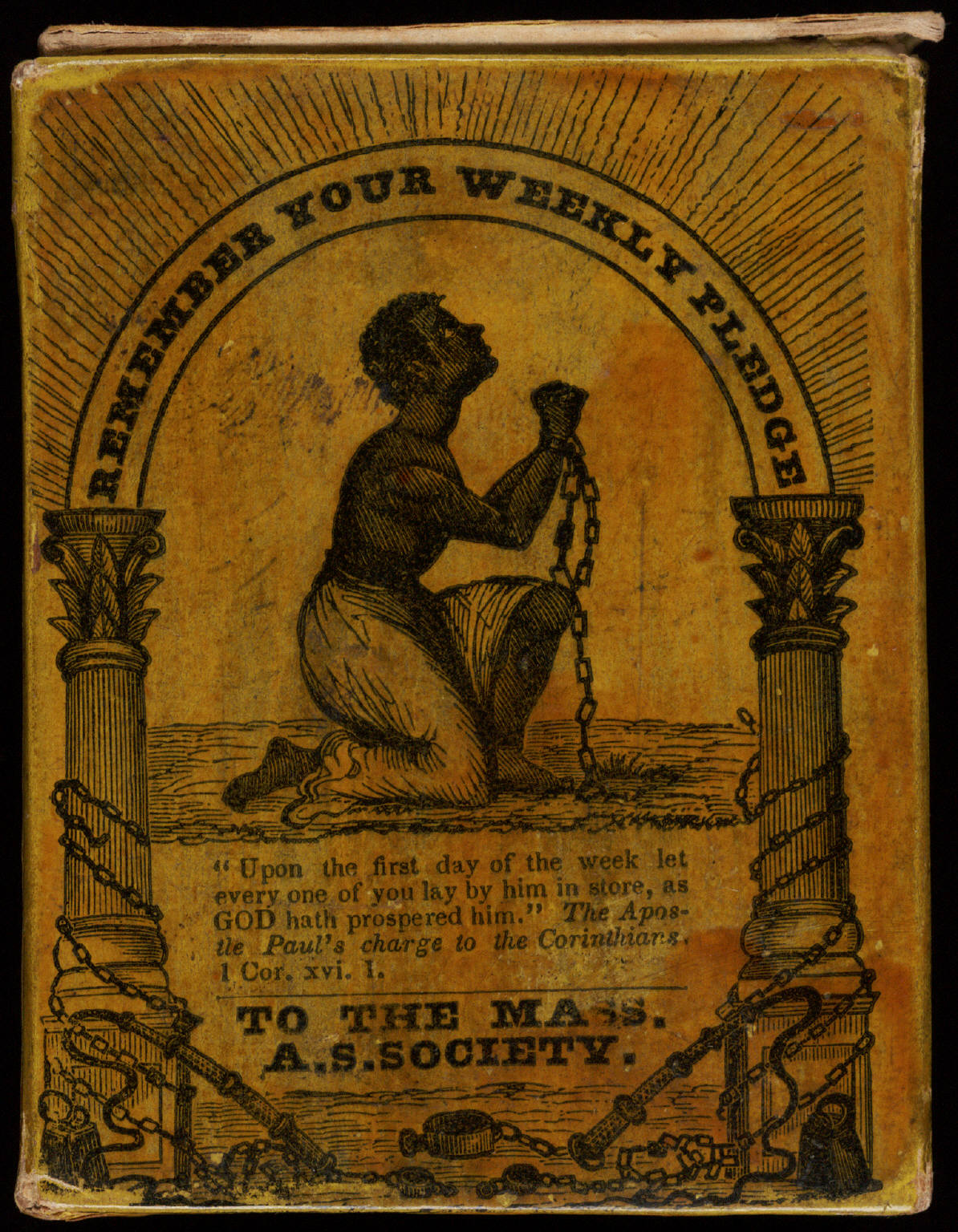
Collection
box for the Massachusetts Anti-Slavery Society, circa 1850 (Wikicommons).
Throughout
the world, kinship used to define the limits of morality. The less related you
were to someone, the less moral you had to be with him or her. We see this in
the Ten Commandments. The phrase "against thy neighbor" qualifies the
commandment against bearing false witness and, implicitly, the preceding ones
against killing, adultery, and stealing. For the modern reader, "thy
neighbor" is helpfully explained as meaning "the children of thy
people" (Leviticus 19:18).
In
some cases, this kin-based morality gradually ceased to apply the farther away
one went from home and from immediate kith and kin. Usually, however, the
limits of one's moral community coincided with some kind of boundary: a
geographic barrier, a political border, and/or an ethnic frontier. Beyond lay
the world of "strangers."
Toward a universal
morality
The
first efforts to universalize morality—to create a single moral system that
could apply to everyone—"arose simultaneously around 500 BCE in various
parts of the world, from China in the Far East to Southern Italy in the
West" (Assmann and Conrad, 2010, p. 121). These efforts were initially
driven by the need to form alliances between different peoples:
Alliance
- the formation of treaties - proved the most important instrument of
internationalism. Forming an alliance required mutual recognition of the
deities which served as patrons. The treaties which these empires formed with
each other and with their vassals had to be sealed by solemn oaths invoking the
gods of both parties. The list of these gods conventionally closes the treaty
[...]. They had to be equal in their function and rank. Intercultural theology
became a concern of international law. (Assmann and Conrad, 2010, p. 125)
As
ancient empires expanded and absorbed different peoples, this intercultural
theology became useful for internal peace, notably with the
Hellenistic empires that arose in the wake of Alexander the Great's conquests.
By affirming that different religions are interchangeable, it became possible
to create a common civic culture for diverse peoples:
Hellenization
had two faces. On the one hand, it referred to the diffusion of Greek language,
ideas and customs all over the Ancient World; on the other hand, it appeared to
be more of a construction of a 'common culture', suggesting a similar change in
Greece as in the other cultures. Flavius Josephus did not speak of 'Greek' but
of 'common culture', ho koinos bios,
as the goal of Jewish assimilation or reform in the Hellenistic age. (Assmann and Conrad, 2010, p. 127)
One
result would be the emergence of a universal religion. We like to associate
this development with the teachings of Jesus, but a kind of proto-Christianity
was already emerging near the end of the pre-Christian era. At that time, many Jews were adapting their
belief in one God to the universal worldview of Hellenistic culture:
Thus,
while biblical universalism was founded on a notion of the mission of Israel to
save all of humanity and bring them to the true worship of the only God,
Hellenistic notions of universalism involved the assumption that all the gods
were really different names for one God. (Boyarin, 1994, chap. 3).
The
two belief-systems merged among the increasingly Hellenized Jews of the eastern
Mediterranean, thus setting the stage for Jesus and making it easier for his
movement to succeed.
The Christian
impulse
This
new religion became a vehicle not only for moral universalism but also for
belief in human equality. For if morality is universal, all humans must have
the same capacity to follow its rules. In Christ, asserted Paul, there is
neither Jew nor Greek, neither slave nor free, neither male nor female (Galatians 3:28).
While
Christianity would steer people in the direction of universalism, there were
limits to how far it could go. Theologians sometimes spoke of the need to set
lower aims for average people and higher aims for saintly men and women. We see
this realism in Augustine's position on prostitution: "If you do away with
harlots, the world will be convulsed with lust" (De Ordine ii, 4). The same could be said for the Church's position
on war, slavery, prejudice, and other manifestations of human inequality. These
were the realities of an imperfect world.
Such
imperfections nonetheless became harder to accept over the following centuries.
First, there was "mission creep." Once the Church had established
certain ideals, there was continual pressure to bring human behavior into line
with them. Second, the geocenter of the Church was shifting away from the
eastern Mediterranean, where the absolute morality of Christianity had been
constrained by the relative morality of kinship. Farther north and west, beyond
the Hajnal Line, kinship ties were weaker and people more receptive to
universal principles. There was thus a "fruitful encounter" between
the Christian faith and these northwest Europeans who were more willing to
internalize such principles and apply them more thoroughly (Frost, 2014a).
Within
this region, Catholicism would radicalize to the point of splitting away and
becoming Protestantism. Here, too, Christian ideals would increasingly be taken
to their logical conclusion.
The Abolitionist
movement
Abolitionism
began in the 17th century among English Quakers as a movement to abolish the
slave trade. Over time, it grew more radical, seeking not only to free black
slaves but also to extirpate racial and ethnic prejudice. Although
"antiracism" did not yet exist as a word, its form and substance were
already recognizable by the early 19th century. This was particularly so in the
American northeast, where radical abolitionists denounced not only slavery but
also fellow abolitionists who wanted to settle freed slaves in Africa. "In
the 1830s, for the first time in American history an articulate and significant
minority of Americans embraced racial equality as both a concept and a
commitment" (Goodman, 1998, p. 1). This militant minority wanted more than
simply an end to slavery:
Believing
that racial prejudice underpinned slavery, abolitionists committed themselves
not just to emancipation [...] "Our prejudice against the blacks is
founded in sheer pride; and it originates in the circumstance that people of
their color, only, are universally allowed to be slaves," Child argued.
"We made slavery, and slavery makes the prejudice." Color phobia,
abolitionists contended, is irrational, wicked, preposterous, and unmanly. It
is contrary to natural rights and Christian teaching, which recognizes no
distinctions based on color. Race prejudice, Elizur Wright Jr. exploded, is
"a narrow, bitter, selfish, swinish absurdity." (Goodman, 1998, p.58)
Decline ... and
resurgence
That
first wave of antiracism subsided in the late 19th century, partly because of
the rise of Social Darwinism and partly because of disillusionment with the
Civil War's aftermath. Radical abolitionists had long set their sights on
ending slavery and crushing the American South, yet achievement of both goals
failed to bring the final goal of human equality any closer. In the face of
growing self-doubt, they lacked the ideological stamina to keep the faith and
push forward, come what may. The movement thus fell into decline, remaining dominant
only in the American northeast.
This
first wave did not die, however. It was resuscitated in the early 1930s and
would give rise to a much more dynamic second wave. The rise of Nazism
convinced many Jewish intellectuals, notably the anthropologist Franz Boas, of
the need to fight "racism" in all its forms, this word being
initially a synonym for Nazism (Frost, 2014b). The war on racism would outlive
the defeat of Nazi Germany, as a result of continuing fears of anti-Semitism in
the postwar era. Moreover, it had now taken on a life of its own, much like its
19th-century predecessor.
Today,
some eighty years later, that war is still being fought. What began as a
reaction to Nazism has become a permanent cultural revolution.
References
Assmann,
A., and S. Conrad. (2010). Memory in a
Global Age. Discourses, Practices and Trajectories, Palgrave Macmillan
Memory Studies, New York
http://archiv.ub.uni-heidelberg.de/propylaeumdok/1831/1/Assmann_Globalization_2010.pdf
Boyarin,
D. (1994). A Radical Jew. Paul and the
Politics of Identity, Berkeley: University of California Press.
http://publishing.cdlib.org/ucpressebooks/view?docId=ft7w10086w;brand=ucpress
Frost,
P. (2014a). A fruitful encounter, Evo and
Proud, September 26
http://evoandproud.blogspot.ca/2014/09/a-fruitful-encounter.html
Frost,
P. (2014b). From Nazi Germany to Middletown: ratcheting up the war on racism, Evo and Proud, July 19
http://evoandproud.blogspot.ca/2014/07/from-nazi-germany-to-middletown.html
Goodman,
P. (1998). Of One Blood. Abolitionism and
the Origins of Racial Equality, Berkeley: University of California Press.
http://books.google.ca/books?hl=fr&lr=&id=Zy47hp0QjFQC&oi=fnd&pg=PR9&ots=f0ONCiUl-T&sig=TDfjRtlGuGRd-kxwZ8fXlL8OpCU#v=onepage&q&f=false


