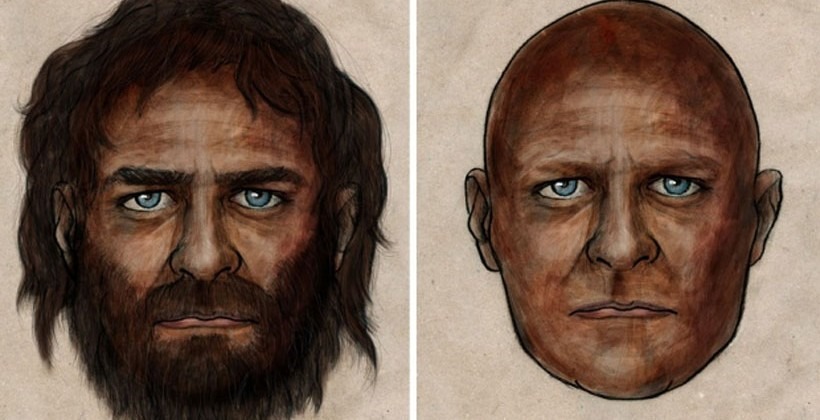
The skin color is about right. Not so sure about the
eyes (source: Spanish National Research Council (CSIC)). There seems to have
been a succession of changes to hair, eye, and skin color within a relatively
restricted area of Europe. These changes then spread outward, the changes to
eye color being apparently the earliest.
Ancient DNA has been retrieved from another
Mesolithic hunter-gatherer, who is dated to 7,000 years ago and comes from La
Braña-Arintero, Spain. We again see a strange combination of dark skin and
light eyes. If we look at the three genes that produce white skin, only one of
them, TYRP1, had the derived ‘European’ allele. The other two had the ancestral
allele. So this Mesolithic individual was a bit lighter-skinned than the one
from Luxembourg, dated to 8,000 BP, who had ancestral alleles at all three
loci:
Of the ten variants, the Mesolithic genome carried the ancestral and non-selected allele as a homozygote in three regions: C12orf29 (a gene with unknown function), SLC45A2 (rs16891982) and SLC24A5 (rs1426654). The latter two variants are the two strongest known loci affecting light skin pigmentation in Europeans and their ancestral alleles and associated haplotypes are either absent or segregate at very low frequencies in extant Europeans (3% and 0% for SLC45A2 and SLC24A5, respectively). We subsequently examined all genes known to be associated with pigmentation in Europeans, and found ancestral alleles in MC1R, TYR and KITLG, and derived alleles in TYRP1, ASIP and IRF4. (Olalde et al., 2014)
Media reports describe the two Mesolithic individuals
from Spain and Luxembourg as blue-eyed, although this is not what either study
actually found. All we know is that their eyes were not brown. They had
blue, gray, hazel, or green eyes:
[The individual had] the associated homozygous haplotype spanning the HERC2–OCA2 locus that is strongly associated with blue eye colour. Moreover, a prediction of eye colour based on genotypes at additional loci using HIrisPlex24 produced a 0.823 maximal and 0.672 minimal probability for being non-brown-eyed (Supplementary Information). The genotypic combination leading to a predicted phenotype of dark skin and non-brown eyes is unique and no longer present in contemporary European populations. Our results indicate that the adaptive spread of light skin pigmentation alleles was not complete in some European populations by the Mesolithic, and that the spread of alleles associated with light/blue eye colour may have preceded changes in skin pigmentation. (Olalde et al., 2014)
These findings seem to conflict with previous
estimates of the time frame when European skin became white: 11,000 to 19,000
years ago according to Beleza et al. (2013) and 7,600 to 19,200 years ago
according to Canfield et al. (2014). I would argue that this was indeed the
time frame when European skin became white; however, white skin was initially confined
to a geographic area that covered only part of Europe, essentially the plains
of the north and east.
It also appears that the changes to hair, eye, and
skin color did not happen simultaneously. First came the diversification of eye
color and then the diversification of hair color. Parallel to these changes,
and extending over a longer time, was the whitening of skin color.
The most surprising—though least commented
on—finding is that this Mesolithic hunter-gatherer had the ancestral allele for
KITLG. According to Beleza et al. (2013), this gene was involved in the first stage of skin lightening that
affected the common ancestors of Europeans and East Asians some 30,000 years
ago. It looks like this first stage, like the second stage over 10,000 years
later, affected Europeans only within part of Europe. The Mesolithic
hunter-gatherers from Spain and Luxembourg thus seem to have belonged to a
population that was peripheral to the evolution of white skin and multi-hued
hair and eyes.
References
Beleza, S., Murias dos Santos, A., McEvoy, B.,
Alves, I., Martinho, C., Cameron, E., Shriver, M.D., Parra E.J., and Rocha, J.
(2013). The timing of pigmentation lightening in Europeans. Molecular Biology and Evolution, 30, 24-35.
http://mbe.oxfordjournals.org/content/30/1/24.shorthttp://www.g3journal.org/content/3/11/2059.full
Lazaridis, I., Patterson, N., Mittnik, A., Renaud,
G., Mallick, S., et al. (2013). Ancient human genomes suggest three ancestral
populations for present-day Europeans, BioRxiv,
December 23.
http://biorxiv.org/content/early/2013/12/23/001552.full-text.pdf+html
Olalde, I., M.E. Allentoft, F. Sanchez-Quinto, G.
Saintpere, C.W.K. Chiang, et al. (2014).
Derived immune and ancestral pigmentation alleles in a 7,000-year-old
Mesolithic European, Nature, early
view