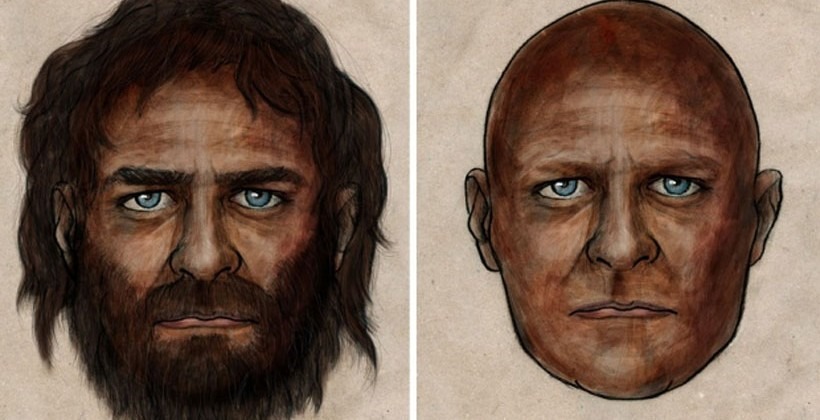
Showing posts with label Victor Canfield. Show all posts

Saturday, March 15, 2014

Did Europeans become white in historic times?


Tătăroaice – Petre Iorgulescu-Yor (source). Today, the steppes north of the Black Sea lie within the European world—politically, culturally, and demographically. Not so long ago, they were home to nomads of Central Asian origin.
 

A new study shows that Europeans underwent strong selection for white skin, non-brown eyes, and non-black hair … during historic times!

Here we present direct estimates of selection acting on functional alleles in three key genes known to be involved in human pigmentation pathways—HERC2, SLC45A2, and TYR—using allele frequency estimates from Eneolithic, Bronze Age, and modern Eastern European samples and forward simulations. Neutrality was overwhelmingly rejected for all alleles studied, with point estimates of selection ranging from around 2-10% per generation. Our results provide direct evidence that strong selection favoring lighter skin, hair, and eye pigmentation has been operating in European populations over the last 5,000 y. (Wilde et al., 2014) 
 
If true, this finding would contradict other recent findings. Two studies have found a much earlier time frame for the whitening of European skin: 11,000 to 19,000 years ago (Beleza et al., 2013) and 7,600 to 19,200 years ago (Canfield et al., 2014). Two studies of ancient DNA indicate that non-brown eyes were already in existence 7,000 years ago in Spain (Olalde et al., 2014) and 8,000 years ago in Luxembourg (Lazaridis et al., 2013). Moreover, the genes responsible are the same as the ones in above quote. 

So who is right and who is wrong? All of these studies are probably right, but only for some early Europeans and not for all. In the latest study, the samples come from a very small part of Europe—the steppes north of the Black Sea:2

Ancient DNA was retrieved from 63 out of 150 Eneolithic (ca. 6,500-5,000 y ago) and Bronze Age (ca. 5,000-4,000 y ago) samples from the Pontic-Caspian steppe, mainly from modern-day Ukraine. […] We also genotyped the three pigmentation-associated SNPs in a sample of 60 modern Ukrainians (28) and observed an increase in frequency of all derived alleles between the ancient and modern samples from the same geographic region (Table 1 and Fig. S1). This implies that the pigmentation of the prehistoric population is likely to have differed from that of modern humans living in the same area.

[…] Inferring natural selection based on temporal differences in allele frequency requires the assumption of population continuity. To this end we compared the 60 mtDNA HVR1 sequences obtained from our ancient sample to 246 homologous modern sequences (29–31) from the same geographic region and found low genetic differentiation (FST = 0.00551; P = 0.0663) (32). Coalescent simulations based on the mtDNA data, accommodating uncertainty in the ancient sample age, failed to reject population continuity under a wide range of assumed ancestral population size combinations. (Wilde et al., 2014)

The authors are placing the burden of proof on the wrong null hypothesis when they state that their simulations “failed to reject population continuity.” The null hypothesis should be population discontinuity. For example, Swedes and Greeks differ in skin tone and eye color, and if we compare their autosomal DNA we get a comparable FST of 0.0084 (Genetic History of Europe, 2014). Admittedly, FST is different with mitochondrial DNA.

I suspect the authors ruled out population discontinuity because their FST seemed incompatible with a non-European population giving way to a European one. If so, they forgot one thing. They were comparing a population of the present with one that existed some 5,000 years ago. If you go farther and farther back in time, any human population will look more and more ancestral to a present-day population. This is especially so in northern Eurasia, where a population ancestral to both Europeans and Amerindians existed some 20,000 years ago. Yes, the FST does seem incompatible with a non-European population giving way to a European one, but this is because the ancient DNA comes from a non-European population that was closer to the time of common origin for all northern Eurasians.

This ancient DNA may come from a mixed European/Central Asian population or an intermediate and now extinct population, perhaps similar to the Lapps. If we look at the derived (European) alleles for the three genes in question (HERC2, SLC45A2, TYR), the frequencies fall halfway between those of Europeans and Asians (see Table 1 in the paper). In any case, this population does not have to be of non-European origin to be noticeably darker in skin color. As shown by the recent Mesolithic findings from Luxembourg and Spain, there used to be apparently native dark-skinned populations in the heart of Europe.
 

Historical background 

The hypothesis of population discontinuity becomes even more plausible if we look at the history of this region. Today, the steppes north of the Black Sea lie within the European world—politically, culturally, and demographically. Not so long ago, they were home to nomads of Central Asian origin. The latest of them, the Tatars, held sway until the 18th century.

The Tatars intermixed extensively with Slavic wives and concubines, so much so that they now look almost as fair as other Europeans. But they were originally quite swarthy, as attested by medieval sources. In a 14th-century romance, The King of Tars, a Tatar Khan converts to Christianity and turns white in the baptismal water. Two other chronicles of the same period describe how a Tatar Khan's Christian concubine bears him a son white on one side and black on the other. When baptized, the child emerges from the water white on both sides (Hornstein, 1941; Metlitzki, 1977, p. 137).

Medieval writers often noticed this difference in skin color. Genoese notaries usually described Tatar slaves as olive-skinned (Plazolles Guillen, 2012, p. 119). Florentine acts of sale give the following numerical breakdown of Tatar slaves by skin color: black 2, brown 18, olive 161, fair 11, reddish 5, white 45 (Epstein, 2001, p. 108). During a trial, a slave tried to regain her freedom by claiming to be Russian and, hence, Christian. Her owner rebuked her, saying: “You’ve lied to me. You look more like a Tatar, not at all like a Russian” (Plazolles Guillen, 2012, p. 119).

The Tatars were preceded by other nomads of Central Asian origin. The Scythians (8th to 2nd century BC) were likewise described as dark-skinned. Hippocrates wrote: “The Scythian race are tawny from the cold, and not from the intense heat of the sun, for the whiteness of the skin is parched by the cold, and becomes tawny” (Hippocrates).

One can find references to the contrary (Scythians, 2014). Keep in mind that the word “Scythian” was often used in the ancient world to encompass all northern peoples:

To the ancient Greeks the Scythians, Sarmatians, Germans, and Goths were the remote northern races of antiquity. Geographically near to one another, they were often grouped together under the term “Scythians,” which by the third century B.C.E. no longer had an ethnic or national connotation and had come to designate the peoples of the remote north. (Goldenberg, 2003, p. 43)

The term “Scythian” may also have subsumed different peoples north of the Black Sea, some of whom came from Central Asia and others from areas farther north and west.
 

Conclusion

Because this region is on the periphery of the European world and has been exposed to migrations from Central Asia, population change is a likelier explanation for the findings of Wilde et al.

These findings are nonetheless interesting. Together with the ancient DNA from Mesolithic hunter-gathers in Spain and Luxembourg, we have further proof that many early Europeans were brown-skinned. Indeed, this seems to have been the physical appearance of all Europeans during their first 20,000 years in Europe. Only later, within the time frame of 20,000 to 10,000 years ago, did some of them become white.

This may seem surprising to those who believe that white skin is an adaptation to weak sunlight at high latitudes. It was thought that Europeans became white because their ancestors no longer needed dark pigmentation to protect themselves against sunburn and skin cancer. Meanwhile, light pigmentation became necessary to maintain synthesis of vitamin D. There was admittedly the example of dark-skinned peoples who have long lived at similar latitudes in Asia and North America, but that counterfactual was attributed to the availability of vitamin D from a marine diet, such as among the Inuit of northern Canada.
 
Wilkes et al. do, in fact, address the apparent contradiction between their findings and the hypothesis that ancestral Europeans became white to maintain adequate production of vitamin D in their skin. In their Discussion section, they suggest that the shift from hunting and gathering to farming led to a decrease in dietary vitamin D (from fatty fish and animal liver). The main problem with this explanation is that farming came late to many parts of Europe: about 2,000 to 3,000 years ago for East Baltic peoples and less than 3,000 years ago for Finnish peoples (and incompletely at that). This leaves a very narrow time frame for evolution from brown skin to white skin. Ultimately, this question will be resolved with retrieval of ancient DNA from these populations.

 
Notes

1. Although Wilde et al. mention hair color, they did not study the main hair-color gene, MC1R.

2. Razib Khan has a great map of the ancient DNA samples.
 

References 

Beleza, S., Murias dos Santos, A., McEvoy, B., Alves, I., Martinho, C., Cameron, E., Shriver, M.D., Parra E.J., and Rocha, J. (2013). The timing of pigmentation lightening in Europeans. Molecular Biology and Evolution, 30, 24-35.
http://mbe.oxfordjournals.org/content/30/1/24.short 

Canfield, V.A., A. Berg, S. Peckins, S.M. Wentzel, K.C. Ang, S. Oppenheimer, and K.C. Cheng. (2014). Molecular phylogeography of a human autosomal skin color locus under natural selection, G3, 3, 2059-2067.
http://www.g3journal.org/content/3/11/2059.full 

Epstein, S.A. (2001). Speaking of Slavery. Color, Ethnicity, & Human Bondage in Italy, Ithaca: Cornell University Press. 

Genetic History of Europe. (2014). Wikipedia
http://en.wikipedia.org/wiki/Genetic_history_of_Europe

Goldenberg, D.M. (2003). The Curse of Ham. Race and Slavery in early Judaism, Christianity, and Islam, Princeton: Princeton University Press. 

Hippocates. On Airs, Waters, and Places, part 20. Translated by Francis Adams
http://classics.mit.edu/Hippocrates/airwatpl.20.20.html

Hornstein, L.H.  (1941). New analogues to the King of Tars, Modern Language Review, 36, 433-442. 

Khan, R. (2014). Descent and selection is a bugger: Black Kurgans, March 12, The Unz Review: An Alternative Media Selection
http://www.unz.com/gnxp/descent-and-selection-is-a-bugger/ 

Lazaridis, I., Patterson, N., Mittnik, A., Renaud, G., Mallick, S., et al. (2013). Ancient human genomes suggest three ancestral populations for present-day Europeans, BioRxiv, December 23.
http://biorxiv.org/content/early/2013/12/23/001552.full-text.pdf+html

Metlitzki, D. (1977). The Matter of Araby in Medieval England, New Haven and London, Yale University Press. 

Olalde, I., M.E. Allentoft, F. Sanchez-Quinto, G. Saintpere, C.W.K. Chiang, et al. (2014).  Derived immune and ancestral pigmentation alleles in a 7,000-year-old Mesolithic European, Nature, early view
http://www.nature.com/nature/journal/vaop/ncurrent/full/nature12960.html

Plazolles Guillen, F. (2012). “Negre e de terra de negres infels …”: Servitude de la couleur (Valence, 1479-1516), in R. Botte and A. Stella (eds.) Couleurs de l’esclavage sur les deux rives de la Méditerranée (Moyen Âge – xxe siècle), pp. 113-158, Paris: Karthala. 

Scythians. (2014). Wikipedia
http://en.wikipedia.org/wiki/Scythians  

Wilde, S., A. Timpson, K. Kirsanow, E. Kaiser, M. Kayser, M. Unterländer, N. Hollfelder, I.D. Potekhina, W. Schier, M.G. Thomas, and J. Burger. (2014). Direct evidence for positive selection of skin, hair, and eye pigmentation in Europeans during the last 5,000 y, Proceedings of the National Academy of Sciences, published ahead of print.
http://www.pnas.org/content/early/2014/03/05/1316513111.full.pdf+html

Saturday, February 8, 2014

A little less brown and not necessarily blue-eyed


The skin color is about right. Not so sure about the eyes (source: Spanish National Research Council (CSIC)). There seems to have been a succession of changes to hair, eye, and skin color within a relatively restricted area of Europe. These changes then spread outward, the changes to eye color being apparently the earliest.


Ancient DNA has been retrieved from another Mesolithic hunter-gatherer, who is dated to 7,000 years ago and comes from La Braña-Arintero, Spain. We again see a strange combination of dark skin and light eyes. If we look at the three genes that produce white skin, only one of them, TYRP1, had the derived ‘European’ allele. The other two had the ancestral allele. So this Mesolithic individual was a bit lighter-skinned than the one from Luxembourg, dated to 8,000 BP, who had ancestral alleles at all three loci:
 

Of the ten variants, the Mesolithic genome carried the ancestral and non-selected allele as a homozygote in three regions: C12orf29 (a gene with unknown function), SLC45A2 (rs16891982) and SLC24A5 (rs1426654). The latter two variants are the two strongest known loci affecting light skin pigmentation in Europeans and their ancestral alleles and associated haplotypes are either absent or segregate at very low frequencies in extant Europeans (3% and 0% for SLC45A2 and SLC24A5, respectively). We subsequently examined all genes known to be associated with pigmentation in Europeans, and found ancestral alleles in MC1R, TYR and KITLG, and derived alleles in TYRP1, ASIP and IRF4. (Olalde et al., 2014)


Media reports describe the two Mesolithic individuals from Spain and Luxembourg as blue-eyed, although this is not what either study actually found. All we know is that their eyes were not brown. They had blue, gray, hazel, or green eyes:
 

[The individual had] the associated homozygous haplotype spanning the HERC2–OCA2 locus that is strongly associated with blue eye colour. Moreover, a prediction of eye colour based on genotypes at additional loci using HIrisPlex24 produced a 0.823 maximal and 0.672 minimal probability for being non-brown-eyed (Supplementary Information). The genotypic combination leading to a predicted phenotype of dark skin and non-brown eyes is unique and no longer present in contemporary European populations. Our results indicate that the adaptive spread of light skin pigmentation alleles was not complete in some European populations by the Mesolithic, and that the spread of alleles associated with light/blue eye colour may have preceded changes in skin pigmentation. (Olalde et al., 2014)


These findings seem to conflict with previous estimates of the time frame when European skin became white: 11,000 to 19,000 years ago according to Beleza et al. (2013) and 7,600 to 19,200 years ago according to Canfield et al. (2014). I would argue that this was indeed the time frame when European skin became white; however, white skin was initially confined to a geographic area that covered only part of Europe, essentially the plains of the north and east.

It also appears that the changes to hair, eye, and skin color did not happen simultaneously. First came the diversification of eye color and then the diversification of hair color. Parallel to these changes, and extending over a longer time, was the whitening of skin color. 

The most surprising—though least commented on—finding is that this Mesolithic hunter-gatherer had the ancestral allele for KITLG. According to Beleza et al. (2013), this gene was involved in the first stage of skin lightening that affected the common ancestors of Europeans and East Asians some 30,000 years ago. It looks like this first stage, like the second stage over 10,000 years later, affected Europeans only within part of Europe. The Mesolithic hunter-gatherers from Spain and Luxembourg thus seem to have belonged to a population that was peripheral to the evolution of white skin and multi-hued hair and eyes.


References
 
Beleza, S., Murias dos Santos, A., McEvoy, B., Alves, I., Martinho, C., Cameron, E., Shriver, M.D., Parra E.J., and Rocha, J. (2013). The timing of pigmentation lightening in Europeans. Molecular Biology and Evolution, 30, 24-35.
http://mbe.oxfordjournals.org/content/30/1/24.short 

Canfield, V.A., A. Berg, S. Peckins, S.M. Wentzel, K.C. Ang, S. Oppenheimer, and K.C. Cheng. (2014). Molecular phylogeography of a human autosomal skin color locus under natural selection, G3, 3, 2059-2067.
http://www.g3journal.org/content/3/11/2059.full 

Lazaridis, I., Patterson, N., Mittnik, A., Renaud, G., Mallick, S., et al. (2013). Ancient human genomes suggest three ancestral populations for present-day Europeans, BioRxiv, December 23.
http://biorxiv.org/content/early/2013/12/23/001552.full-text.pdf+html

Olalde, I., M.E. Allentoft, F. Sanchez-Quinto, G. Saintpere, C.W.K. Chiang, et al. (2014).  Derived immune and ancestral pigmentation alleles in a 7,000-year-old Mesolithic European, Nature, early view

Saturday, February 1, 2014

SLC24A5: Reply to Greg Cochran


Ethiopian manuscript paintings (source: A. Davey). Ethiopians have a self-image that is lighter-skinned than their actual selves. If the prevalence of SLC24A5 is higher in Ethiopia than the degree of admixture from lighter-skinned peoples across the Red Sea, this discrepancy may be explained by social selection for lighter skin.


Greg Cochran has been asking why the “European” allele for SLC24A5 has been so successful, not only in Europe but also elsewhere. He seems to be hinting that this allele has a selective advantage that is unrelated to skin color.

I posted the following comments at his website. References have been inserted for this post.
 

***************************************************


SLC24A5 is one of three genes involved in the whitening of European skin, the other two being SLC45A2 and TYRP1. This whitening occurred over a relatively short time and long after the entry of modern humans into Europe some 40,000 years ago. Sandra Beleza’s team estimates that all three genes “went white” between 11,000 and 19,000 years ago (Beleza et al, 2013). Victor Canfield’s team, working only with SLC24A5, estimates between 7,600 and 19,200 years ago (Canfield et al., 2014).

So, yes, white European skin is not an adaptation to weaker sunlight; otherwise, it would have evolved much earlier. Are we looking at some pleiotropic effect then? In that case, this effect would involve not only SLC24A5 but the other two genes as well. Perhaps, but I’d like to see the evidence.

No, I’m not going to invoke sexual selection to explain the apparent success of the “European” allele for SLC24A5. Sexual selection, especially sexual selection of women, occurs under very limited circumstances.  I believe that there was an episode of very intense sexual selection of women, but this episode was confined to northern and eastern Europe during the time frame of 10,000 to 20,000 years ago, i.e., the last ice age (Frost, 2006; Frost, 2008).

How then do we explain the much greater geographic and historical success of this allele? The answer is part of the larger one of why lighter-skinned folks have done better than darker-skinned folks. Mean temperature is inversely correlated with technological complexity, even going back to the hunter-gatherer stage of cultural evolution. This is partly because colder environments created a greater need for heat conservation (by means of tailored clothing and insulated shelters) and partly because their food resources were more dispersed and typically available for short periods of time. There was thus strong selection in such environments for time budgeting, forward planning, and the ability to manage storage technologies (ice cellars) and untended facilities (traps, snares). Northern hunters were pre-adapted for technological complexity and thus better able to exploit the sort of complex cultural environments that developed much later in time (Hoffecker, 2002, pp. 6-12).

Is this the whole story? You point to Ethiopians as an example where SLC24A5 seems to be present at a higher frequency than Caucasian admixture. This discrepancy can probably be explained by social selection for lighter skin, as indicated by an Israeli study that found light-skin preference among Falasha children (Munitz et al., 1987).  This preference may be learned, although there is evidence that people are predisposed to associate lighter skin with certain good qualities (as a result of a mental algorithm that uses skin tone for identification of women and young infants) (Frost, 2011). For whatever reason, social selection for lighter skin is a reality in Ethiopia, and it probably has had some impact on the prevalence of SLC24A5.
 

Question from ‘RS’: Sexual selection, especially sexual selection of women, occurs under very limited circumstances. So you are equally attracted to all women?
 

Sexual selection is not the same thing as sexual preference. In other words, what you prefer is not necessarily what you will get. It all comes down to the law of supply and demand.

Sexual selection occurs when too many of one sex have to compete for too few of the other. Normally, the males have to compete for the females. The reverse is rare in nature. It happens when (1) males die much earlier than females do and (2) the costs of providing for a second mate are too high for almost all males. In human hunter-gatherers, the ratio of men to women on the mate market declines as one moves away from the equator. It reaches its lowest point in open steppe-tundra environments, where almost all food is obtained by men through hunting and where male mortality is high because men have to pursue mobile herds of game over long distances in a cold environment that offers few alternate sources of food.

Steppe-tundra covered most of northern and eastern Europe during the Late Pleniglacial (25,000 to 10,000 BP). I use the term “last ice age” in order to be better understood. There was a series of ice ages during the Pleniglacial (70,000 to 10,000 BP), but modern humans had to adapt only to the last one. To date, it looks like the most visible features of Europeans (white skin, multi-hued hair and eyes) evolved during the time window of the Late Pleniglacial. If the estimates by Beleza and Canfield are to be believed, the time window is somewhere between 20,000 and 10,000 BP.

These estimates seem to conflict with the recent findings of brown-skinned Mesolithic Europeans from Spain (7,000 BP) and Luxembourg (8,000 BP). I would argue that the changes to hair, eye, and skin color took place within a relatively restricted geographic area (essentially the plains of northern and eastern Europe) and later spread outward. It’s silly to argue that these changes must have originated in the Middle East, since the Middle East was inhabited by an African-like population until at least 12,000 BP. This population (the Natufians) shows no biological continuity with later Middle Easterners.
 

References
 

Beleza, S., Murias dos Santos, A., McEvoy, B., Alves, I., Martinho, C., Cameron, E., Shriver, M.D., Parra E.J., and Rocha, J. (2013). The timing of pigmentation lightening in Europeans. Molecular Biology and Evolution, 30, 24-35.
http://mbe.oxfordjournals.org/content/30/1/24.short 

Canfield, V.A., A. Berg, S. Peckins, S.M. Wentzel, K.C. Ang, S. Oppenheimer, and K.C. Cheng. (2014). Molecular phylogeography of a human autosomal skin color locus under natural selection, G3, 3, 2059-2067.
http://www.g3journal.org/content/3/11/2059.full 

Cochran, G. (2014). Shades of pale, January 27, West Hunter
http://westhunt.wordpress.com/2014/01/27/shades-of-pale/

Frost, P. (2011). Hue and luminosity of human skin: a visual cue for gender recognition and other mental tasks, Human Ethology Bulletin, 26(2), 25-34. http://media.anthro.univie.ac.at/ISHE/index.php/bulletin/bulletin-contents 

Frost, P. (2008). Sexual selection and human geographic variation, Special Issue: Proceedings of the 2nd Annual Meeting of the NorthEastern Evolutionary Psychology Society. Journal of Social, Evolutionary, and Cultural Psychology, 2(4), pp. 169-191.
http://www.jsecjournal.com/articles/volume2/issue4/NEEPSfrost.pdf

Frost, P. (2006). European hair and eye color - A case of frequency-dependent sexual selection? Evolution and Human Behavior, 27, 85-103.

Hoffecker, J.F. (2002). Desolate Landscapes. Ice-Age Settlement in Eastern Europe. New Brunswick: Rutgers University Press.

Munitz, S., B. Priel, and A. Henik. (1987). Color, skin color preferences and self color identification among Ethiopian and Israeli born children, in M. Ashkenazi and A. Weingrod (eds.), Ethiopian Jews and Israel. (pp. 74-84). New Brunswick (U.S.A.): Transaction Books.