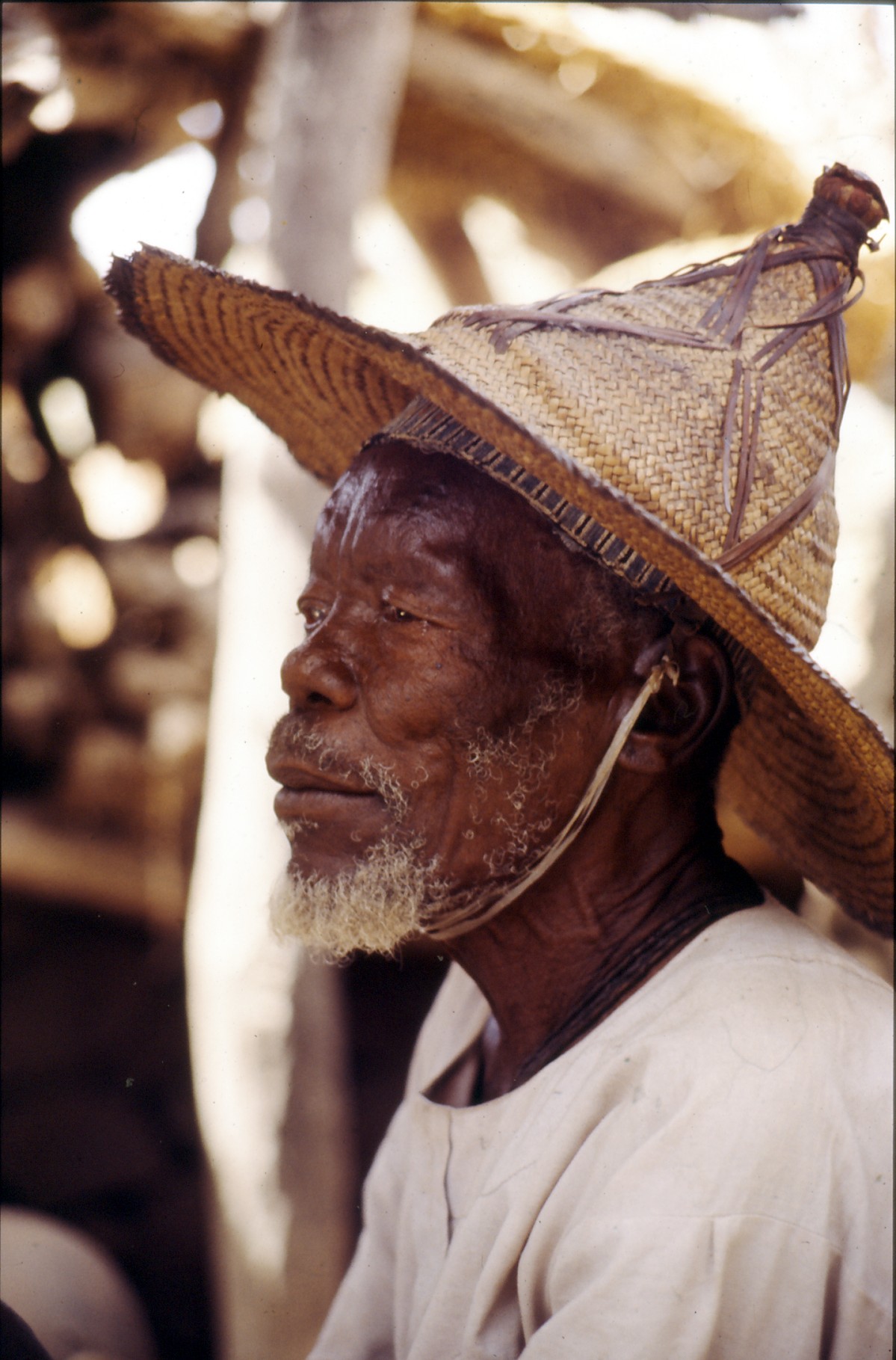
A
village elder of Mogode, Cameroon (Wikicommons - W.E.A. van Beek). African
Americans are more than twice as likely to develop Alzheimer's. They also more
often have an allele that increases the risk of Alzheimer's in Western
societies but not in sub-Saharan Africa. Why is this allele adaptive there but
not here?
Alzheimer's
disease (AD) is unusually common among African Americans. Demirovic et al.
(2003) found it to be almost three times more frequent among African American
men than among white non-Hispanic men (14.4% vs. 5.4 %). Tang et al. (2001)
found it to be twice as common among African American and Caribbean Hispanic
individuals. On the other hand, it is significantly less common among Yoruba in
Nigeria than among age-matched African Americans (Hendrie et al. 2001).
This
past year, new light has been shed on these differences. Weuve et al. (2018)
analyzed data from ten thousand participants 65 years old and over (64% black,
36% white) who had been followed for up to 18 years. Compared to previous
studies, this one had three times as many dementia assessments and dementia
cases. It also had a wider range of data: tests of cognitive performance,
specific diagnosis of Alzheimer's (as opposed to dementia in general),
educational and socioeconomic data, and even genetic data—specifically whether
the participant had the APOE e4
allele, a major risk factor for Alzheimer's.
The
results confirmed previous findings ... with a few surprises.
Incidence
Alzheimer's
was diagnosed in 19.9% of the African American participants, a proportion more
than twice that of the Euro American participants (8.2%).
Cognitive
performance and cognitive decline
Cognitive
performance was lower in the African American participants. "The
difference in global cognitive score, -0.83 standard units (95% confidence
interval [CI], -0.88 to -0.78), was equivalent to the difference in scores
between participants who were 12 years apart in age at baseline."
On
the other hand, both groups had the same rate of cognitive decline with age. In
fact, executive function deteriorated more slowly in African Americans. The
authors suggest that the higher rate of dementia in elderly African Americans is
due to their cognitive decline beginning at a lower level:
[…] on average, white individuals have "farther to fall" cognitively than black individuals before reaching the functional threshold of clinical dementia, so that even if both groups have the same rate of cognitive decline, blacks have poorer cognitive function and disproportionately develop dementia. (Weuve et al. 2018)
Interaction with
education.
Differences
in educational attainment, i.e., years of education, explained about a third of
the cognitive difference between the two groups of participants:
Educational attainment, as measured by years of education, appeared to mediate a substantial fraction but not the totality of the racial differences in baseline cognitive score and AD risk (Table 5). Under the hypothetical scenario in which education was "controlled" such that each black participant's educational level took on the level it would have been had the participant been white, all covariates being equal, black participants' baseline global cognitive scores were an average of 0.45 standard units lower than whites' scores (95% CI, -0.49 to -0.41), a difference smaller than without controlling years of education (-0.69; Table 5), and translating to about 35% of the total effect of race on cognitive performance mediated through years of education. (Weuve et al. 2018)
While educational attainment explains 35% of the cognitive difference between African Americans and Euro Americans, we should keep in mind that educational attainment itself is influenced by genetic factors. These genetic factors vary among African Americans, just as they vary between African Americans and other human populations.
APOE e4
allele
This
allele was more common in the African American participants. It contributed to
their higher risk of Alzheimer's but not to their lower cognitive score.
Black participants were more likely than white participants to carry an APOE e4 allele (37% vs 26%; Table 1). In analyses restricted to participants with APOE data, racial differences in baseline scores or cognitive decline did not vary by e4 carriership (all Pinteraction > 0.16). Furthermore, adjustment for e4 carriership did not materially change estimated racial differences in baseline performance or cognitive decline (eTable 3).
By contrast, the association between race and AD risk varied markedly by APOE ecarriership (Pinteraction = 0.05; Table 4). Among non-carriers, blacks' AD risk was 2.32 times that of whites' (95% CI, 1.50-3.58), but this association was comparably negligible among e4 carriers (RR, 1.09; 95% CI, 0.60-1.97). (Weuve et al. 2018)
Discussion
This
study offers two different explanations: why African Americans have a higher
incidence of Alzheimer's and why they have a higher incidence of dementia in
general. Two different explanations are needed because Alzheimer's seems to be
qualitatively different from other forms of dementia.
First,
African Americans have a higher incidence of Alzheimer’s because they have a
higher incidence of the APOE e4
allele, a risk factor for Alzheimer's. They may also have other alleles, still
unidentified, that similarly favor development of Alzheimer's. This would
explain why, if we look at participants without APOE e4, Alzheimer's was still twice as common among African
Americans as it was among Euro Americans. On the other hand, the two groups had
virtually the same incidence of Alzheimer's if we look at participants with APOE e4.
Second,
African Americans have a higher incidence of dementia in general because they
have a lower cognitive reserve. When cognitive performance begins to
deteriorate in old age, the ensuing decline starts from a lower level and
reaches the threshold of dementia sooner. The rate of decline is nonetheless
the same in both African Americans and Euro Americans. While this explanation
could apply to most forms of dementia, it is hard to see how it applies to
Alzheimer's. Euro Americans have a higher cognitive reserve, and yet the APOE e4 allele is just as likely to
produce Alzheimer's in them as in African Americans.
Why
does the APOE e4 allele exist? It
must have some adaptive value, given its incidence of 37% in African Americans
and 26% in Euro Americans. African Americans also seem to have other alleles,
not yet identified, that likewise increase the risk of Alzheimer’s. Those
alleles, too, must have some adaptive value.
This
value seems to exist in sub-Saharan Africa but not in North America. When
Hendrie et al. (2001) examined Yoruba living in Nigeria, they found no
relationship between APOE e4 and
Alzheimer’s or dementia in general:
In the Yoruba, we have found no significant association between the possession of the e4 allele and dementia or AD in either the heterozygous or homozygous states. As the frequencies of the 3 major APOE alleles are almost identical in the 2 populations, this variation in the strength of the association between e4 and AD may account for some of the differences in incidence rates between the populations, although it is not likely to explain all of it. It also raises the possibility that some other genetic or environmental factor affects the association of the e4 allele to AD and reduces incidence rates for dementia and AD in Yoruba. (Hendrie et al. 2001)
There has been speculation, notably by Greg Cochran, that Alzheimer’s is caused by apoptosis. Because of the blood-brain barrier, antibodies cannot enter the brain to fight infection, so neural tissue is more dependent on other means of defense, like apoptosis. Such a means of defense may be more important in sub-Saharan Africa because the environment carries a higher pathogen load.
If
we pursue this hypothesis, APOE e4
and other alleles may enable neurons to self-destruct as a means to contain the
spread of pathogens in the brain. In an environment with a
lower pathogen load, like North America, this means of defense would become too
inactive. The result would be autoimmune disorders where
apoptosis is triggered in neural tissue for no good reason.
References
Chin,
A.L., S. Negash, and R. Hamilton. (2011). Diversity and disparity in dementia:
the impact of ethnoracial differences in Alzheimer disease. Alzheimer disease and associated disorders.
25(3):187-195.
Cochran,
G. (2018). Alzheimers or did I already say that? West Hunter, July 14
Demirovic, J., R. Prineas, D. Loewenstein,
et al. (2003).
Prevalence of dementia in three ethnic groups: the South Florida program on
aging and health. Ann Epidemiol.
13:472-478.
Hendrie,
H.C., A. Ogunniyi, K.S. Hall, et al. (2001). Incidence of dementia and
Alzheimer disease in 2 communities: Yoruba residing in Ibadan, Nigeria, and
African Americans residing in Indianapolis, Indiana. JAMA. 285:739-47.
Tang, M.X., P. Cross, H.
Andrews, et al. (2001).
Incidence of AD in African-Americans, Caribbean Hispanics, and Caucasians in
northern Manhattan. Neurology
56:49-56.
Weuve,
J., L.L. Barnes, C.F. Mendes de Leon, K. Rajan, T. Beck, N.T. Aggarwal, L.E.
Hebert, D.A. Bennett, R.S. Wilson, and D.A. Evans. (2018). Cognitive Aging in
Black and White Americans: Cognition, Cognitive Decline, and Incidence of
Alzheimer Disease Dementia. Epidemiology
29(1): 151-159.


