Showing posts with label ACE2. Show all posts

Monday, November 30, 2020

The genetics of susceptibility to COVID-19

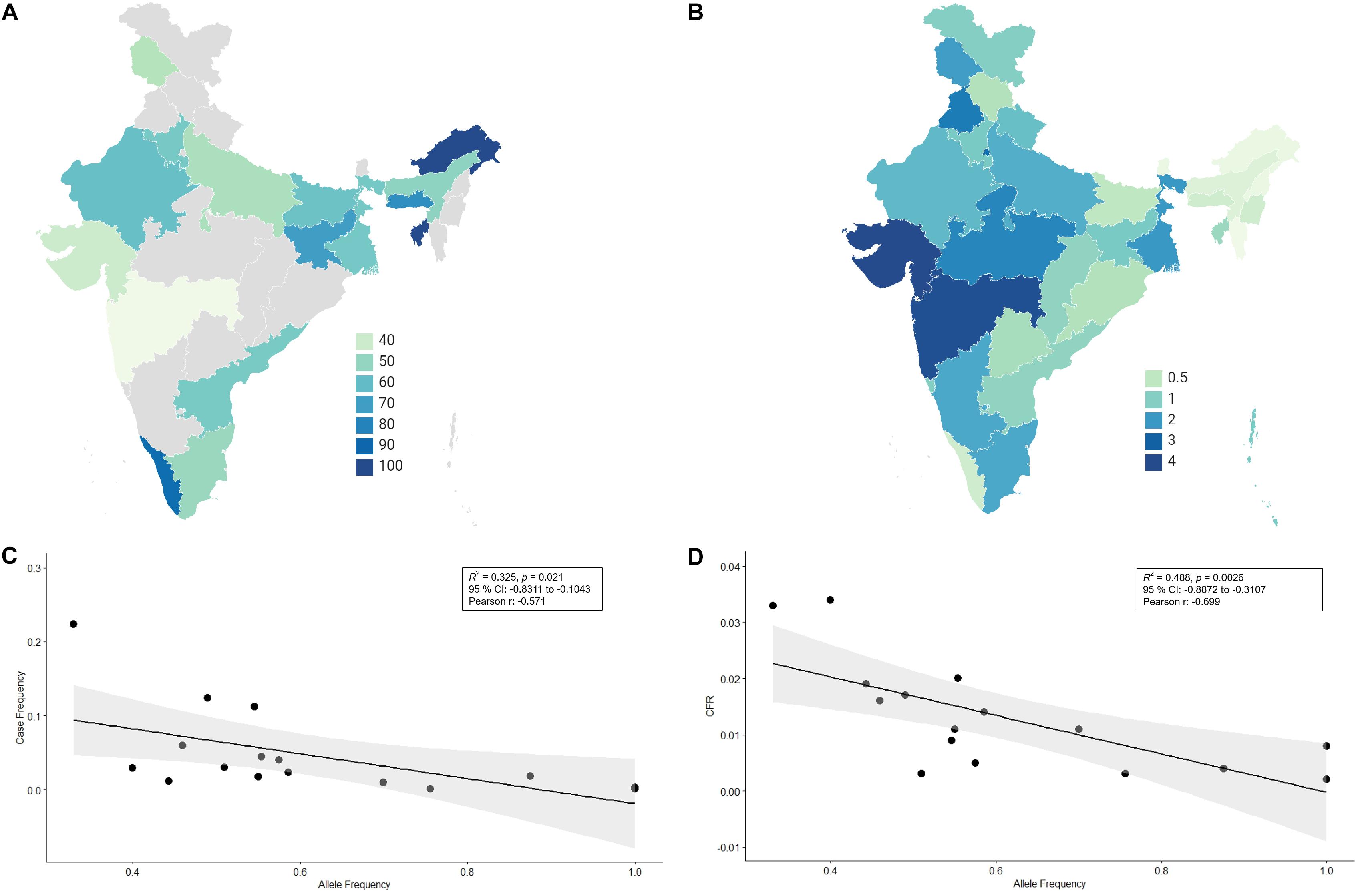
Left: Frequency of an rs2258666 allele in Indian populations (TT-plus strand or AA-minus strand). Right: COVID-19 case-fatality rate (August 2020).


ACE2 is a cell receptor that mediates the infection of lung tissue by coronaviruses, either the one that causes COVID-19 or others that cause the common cold. The ACE2 gene has 1,700 alleles, some of which are associated with increased susceptibility to coronavirus infection (Frost 2020).


This difference in susceptibility has been shown in a recent Indian study (Srivastava et al. 2020). COVID-19 is most fatal in the western states of Gujarat, Maharashtra, Madhya Pradesh, and Punjab. Conversely, it is least fatal in the northeast states of Assam, Arunachal Pradesh, and Nagaland. This pattern closely correlates with genetic variation at the rs2285666 locus of ACE2. The presence or absence of a single allele explains 35% of the variation in the COVID-19 case-fatality rate.


The authors conclude that some kind of selection has been acting on rs2285666. If we look at the map, susceptibility to COVID-19 seems to be strongest in those regions with the longest history of sedentary living and large urban centers. Conversely, it seems to be weakest in the Northeast, which is home to people who, until recent times, belonged to small communities that routinely moved from one cultivable area to another.


These findings are consistent with the hypothesis that the ACE2 receptor has coevolved with human environments. Because respiratory viruses boost the immune response of lung tissue and thereby prevent more serious pulmonary diseases (e.g., tuberculosis, pneumonia, pneumonic plague), some human populations may have gained protection from severe respiratory infections by becoming more susceptible to mild respiratory infections, such as those normally caused by coronaviruses. This commensal relationship would have been especially adaptive where respiratory pathogens could easily propagate, that is, in crowded environments where many people live in proximity not only to each other but also to livestock. In regions that have long had crowded environments, natural selection may have favored susceptibility to infection by coronaviruses, which are normally mild in their effects, as a means to maintain a strong immune response to deadly pulmonary diseases (Frost 2020).


****************************************************


I'm sorry for the break in my posting. When the pandemic first struck, I expected to have a lot of time on my hands, so I began a series of writing projects: four articles and a manuscript for a book. Unfortunately, my free time dried up over the summer, and my workload became overwhelming. I hope I've now found the right balance between my writing projects and my regular work.


References


Frost, P. (2020). Does a commensal relationship exist between coronaviruses and some human populations? Journal of Molecular Genetics 3(2): 1-2.

https://researchopenworld.com/does-a-commensal-relationship-exist-between-coronaviruses-and-some-human-populations/


Srivastava, A., A. Bandopadhyay, D. Das, R.K. Pandey, V. Singh, N. Khanam, N. Srivastava, P.P. Singh, P.K. Dubey, A. Pathak, P. Gupta, N. Rai, G.N.N. Sultana, and G. Chaubey. (2020). Genetic Association of ACE2 rs2285666 Polymorphism with COVID-19 Spatial Distribution in India. Frontiers in Genetics. September 25

https://doi.org/10.3389/fgene.2020.564741


Tuesday, April 7, 2020

COVID-19 update


A dying man, stoned on suspicion of spreading the plague - Felix Jenewein, 1899 (Wikicommons)


SARS-CoV-2, though novel, belongs to a long-existing group of respiratory pathogens: coronaviruses. Until the first appearance of SARS in 2002, these pathogens did little harm to their hosts, usually causing nothing worse than a common cold. So they may have coevolved with us. Furthermore, this coevolution may have taken different forms in different human populations and different cultural environments.

Coronaviruses infect lung tissue via a receptor, ACE2, that varies structurally not only between Asians and other human groups but also between different Asian groups. In particular, the Chinese population has fewer alleles that code for weak binding to the coronavirus S-protein (Cao et al. 2020). Different ACE2 alleles are also associated with differences in susceptibility to diabetic retinopathy, an eye disease with a distinct global pattern of prevalence: 22% in Italy, 23% in China, 30% in the United Kingdom, and 40% in the United States (Adams 2020).

This geographic pattern doesn’t exist because some populations have become more resistant to coronaviruses. Instead, the reverse seems to have happened: some populations have become more susceptible to coronavirus infection, perhaps as a means to prevent more serious pulmonary infections, like tuberculosis and pneumonic plague (Shekhar et al. 2017). Such an effect has been shown with γherpesvirus 68 and cytomegalovirus (Barton et al. 2007; Miller et al. 2019). This crude vaccination boosts the immune response through increased production of IFN-γ and increased activation of macrophages.

Historically, tuberculosis was especially common in crowded environments, where people lived in proximity not only to each other but also to domesticated animals (Comas et al. 2013). Such environments have existed continuously for the longest time in China, as well as in areas like the Indo-Gangetic Plain, the Fertile Crescent, and the Mediterranean Basin. Those areas are where people should be most susceptible to coronavirus infection.

This may explain why COVID-19 has been more severe in southern Europe than in northern Europe. It is surprising that infection tends to become less severe with latitude when one would expect the opposite: respiratory viruses spread more effectively under conditions of lower temperature, lower humidity, and lower solar UV.


Ongoing research?

These geographic differences have caught the interest of a molecular epidemiologist at the University of Hawai'i, Maarit Tiirikainen:

"There have been major differences in the rates of SARS-CoV-2 infection and the severe disease between the different geographic regions since the beginning of the COVID-19 pandemic, even among young individuals," Dr. Tiirikainen said. "Epidemiological studies-so-called Genome Wide Association Studies (GWAS)-indicate that populations carry different variants of the ACE2 gene. This variation in the gene coding for the ACE2 receptor may have an effect on the number of ACE2 receptors on the lung cells, as well as on how effectively the virus binds to the receptor. There may also be genetic differences in immune and other important genes explaining why some people get more sick than others."

She is collaborating with a genomics company, LifeDNA, in a study that will initially focus on Hawai'i's multiethnic inhabitants, specifically their diversity of ACE2 alleles in relation to the latest coronavirus (LifeDNA 2020 – h/t to Steve Sailer).


Parting thoughts

All humans can get infected by coronaviruses, but the infection tends to vary in severity from one population to another. This variance may reflect differences in genetic adaptation in different cultural environments.

Of course, adaptation may also be cultural. Because natural selection acts on the end result, and not on the means to that end, the means may be a purely learned algorithm, like adding spices to food or avoiding physical contact with strangers. One might not have understood why or how such practices worked, but they did work and would be passed on to subsequent generations, thus becoming the traditional way of doing things. Today, we’re likely to reject such practices as outmoded superstitions.

So be modern. Hug a stranger.


References

Adams N. (2020). Cracking the code to the 2019 novel coronavirus (COVID-19): Lessons from the eye. Eye Reports 6(1). 
https://eyereports.org/index.php/eyereports/article/view/97

Barton E.S., White D.W., Cathelyn J.S., Brett-McClellan K.A., Engle M., Diamond M.S., et al. (2007). Herpesvirus latency confers symbiotic protection from bacterial infection. Nature 447: 326-329. 
https://www.nature.com/articles/nature05762

Cao Y., Li L., Feng Z., Wan S., Huang P., Sun X., et al. (2020). Comparative genetic analysis of the novel coronavirus (2019-nCoV/SARS-CoV-2) receptor ACE2 in different populations. Cell Discovery 6(11). 
https://www.nature.com/articles/s41421-020-0147-1%3C/blockquote%3E 

Comas I., Coscolla M., Luo T., Borrell S., Holt K.E., Kato-Maeda M., et al. (2013). Out-of-Africa migration and Neolithic coexpansion of Mycobacterium tuberculosis with modern humans. Nature Genetics 45(10): 1176-1182.
https://www.ncbi.nlm.nih.gov/pmc/articles/PMC3800747/

LifeDNA (2020). COVID-19: LifeDNA and University of Hawai’i Collaborate on Studying Why Certain Populations Are Hit Harder. Research focuses on ACE2 receptor, probing the role of genetics in both susceptibility to infection and severity of response April 2, University of Hawai'i Cancer Center 
https://www.uhcancercenter.org/about-us/newsroom/600-covid-19-lifedna-and-university-of-hawai-i-collaborate-on-studying-why-certain-populations-are-hit-harder

Miller H.E., Johnson K.E., Tarakanova V.L., Robinson R.T. (2019). γ-herpesvirus latency attenuates Mycobacterium tuberculosis infection in mice. Tuberculosis 116: 56-60. 
https://www.ncbi.nlm.nih.gov/pmc/articles/PMC6876742/

Shekhar S., Schenck K., Petersen F.C. (2017). Exploring host-commensal interactions in the respiratory tract. Frontiers in Immunology 8: 1971. 
https://www.frontiersin.org/articles/10.3389/fimmu.2017.01971/full