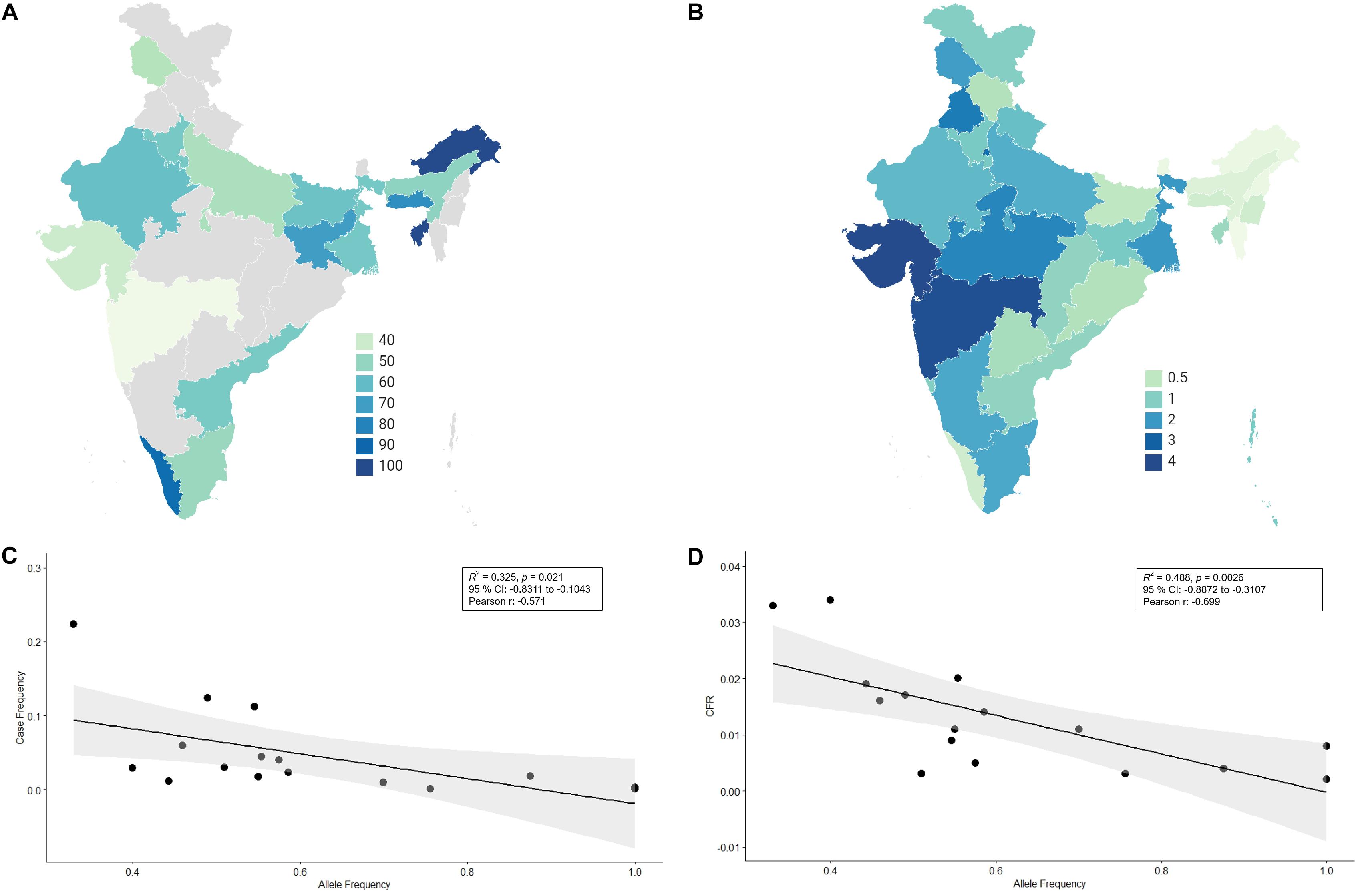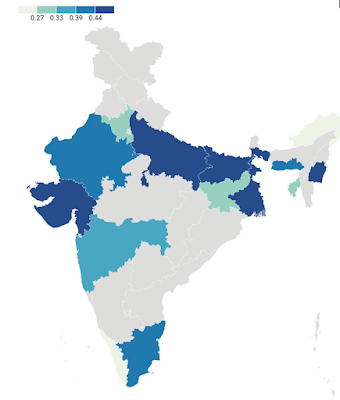
Geographic distribution of the G allele
(TIMPRSS2), which is associated with
a higher death rate from COVID-19. It’s most frequent on the Indo-Gangetic Plain,
which has the longest continuous history of urban settlement in South Asia. Did
that environment select for susceptibility to coronaviruses as a way to boost
resistance to deadlier respiratory viruses?
The
common cold is caused by over 200 strains of rhinoviruses, coronaviruses,
adenoviruses, and enteroviruses. Coronaviruses differ from other respiratory viruses
in one key respect: they can enter lung tissue via the ACE2 receptor. So if that receptor is altered to allow easier
entry, the host would become more susceptible to the common cold but not to
other respiratory diseases, including much deadlier ones that cause
tuberculosis, pneumonia, or pneumonic plague.
The
last point is important because there is evidence that a viral infection can
protect against subsequent infection by respiratory viruses. When mice are
infected with γherpesvirus 68, which is similar to Epstein-Barr virus, there is
production of large quantities of IFN-γ and activation of macrophages that
protect against Listeria monocytogenes
(which causes listeriosis), Mycobacterium
tuberculosis (which causes tuberculosis), and Yersinia pestis (which causes bubonic and pneumonic plague) (Barton
et al., 2007; Miller et al., 2019). A cytomegalovirus infection likewise
protects against Listeria monocytogenes
and Yersinia pestis (Barton et al.,
2007).
Coevolution
between coronaviruses and early urban settlement
Beginning
some 10,000 years ago, hunting and gathering gave way to farming, and nomadism
to sedentism. People began to live in progressively larger settlements along
the Nile in Egypt, the Tigris and the Euphrates in Mesopotamia, the Indus and
the Ganges in northern India, and the Yellow and the Yangtze in China. That is where
large numbers of humans first lived in close proximity to each other, and they
were particularly vulnerable to the spread of respiratory diseases from one
person to another. There may thus have been selection among them for increased
susceptibility to coronaviruses, which are normally mild in their effects, as a
means to increase resistance to deadlier respiratory viruses.
A
recent Indian study by Pandey et al. (2022) suggests that coronavirus
susceptibility may have coevolved with risk of infection by life-threatening
respiratory viruses like tuberculosis, pneumonia, and pneumonic plague, at
least in South Asia. People are more susceptible to infection by coronaviruses
if they have the G allele of the TMPRSS2
gene. The research team found that the G allele is significantly associated
with a higher fatality rate for COVID-19, apparently because it helps coronaviruses
enter lung tissue via the ACE2
receptor.
Pandey
et al. (2022) also charted the geographic distribution of the G allele in South
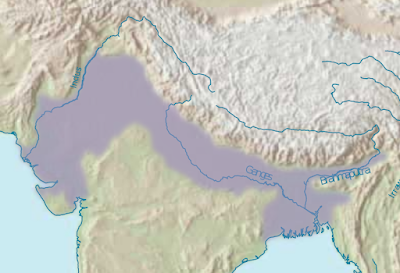
Asia. This allele is most frequent among inhabitants of the Indo-Gangetic Plain,
i.e., the fertile lowlands that border the Indus and Ganges rivers of northern
India and Pakistan. This is also where urbanization has existed for the longest
continuous time in South Asia, specifically since the early first millennium
BCE. The Indo-Gangetic Plain has had "an uninterrupted sequence of
economic development, state formation, and cultural expansion affecting the
entire subcontinent as well as Central, East and Southeast Asia" (Heitzman
2008, pp. 12-13).
These
findings are roughly consistent with an earlier finding by the same research
team. Srivastava et al. (2020) found that an ACE2 allele, at rs2258666, has a negative relationship with the
fatality rate for COVID-19. It is also most frequent in the northeast of India,
which until recent times was sparsely populated, and whose inhabitants lived in
dispersed rural settlements.
References
Barton,
E.S., D.W. White, J.S. Cathelyn, K.A. Brett-McClellan, M. Engle, et al. (2007).
Herpesvirus latency confers symbiotic protection from bacterial infection. Nature
447:
326-329.
https://doi.org/10.1038/nature05762
Frost,
P. (2020). Does a commensal relationship exist between coronaviruses and some
human populations? Journal of Molecular
Genetics 3(2): 1-2.
Heitzman,
J. (2008). The City in South Asia.
London: Routledge
Miller,
H.E., K.E. Johnson, V.L. Tarakanova, and R.T. Robinson. (2019). γ-herpesvirus
latency attenuates Mycobacterium tuberculosis infection in mice. Tuberculosis 116: 56-60.
https://doi.org/10.1016/j.tube.2019.04.022
Pandey,
R.K., A. Srivastava, P.P. Singh, and G. Chaubey. (2022). Genetic association of
TMPRSS2 rs2070788 polymorphism with COVID-19 case fatality rate among Indian
populations. Infection, Genetics and
Evolution 98 https://doi.org/10.1016/j.meegid.2022.105206
Shirato,
K., M. Kawase, and S. Matsuyama. (2018). Wild-type human coronaviruses prefer
cell-surface TMPRSS2 to endosomal cathepsins for cell entry. Virology 517: 9-15.
https://doi.org/10.1016/j.virol.2017.11.012
Srivastava,
A., A. Bandopadhyay, D. Das, R.K. Pandey, V. Singh, N. Khanam, N. Srivastava,
P.P. Singh, P.K. Dubey, A. Pathak, P. Gupta, N. Rai, G.N.N. Sultana, and G.
Chaubey. (2020). Genetic Association of ACE2 rs2285666 Polymorphism with
COVID-19 Spatial Distribution in India. Frontiers
in Genetics. September 25
https://doi.org/10.3389/fgene.2020.564741