Saturday, October 26, 2013

The cagots


Holy water font reserved for cagots, church in Saint-Savin, France (source). Why were the cagots segregated?
 

The cagots were a caste of people who used to live on both sides of the Pyrenees in southwestern France and northern Spain. Notwithstanding speculation to the contrary, it is unlikely that they have a single ethnic origin, since their physical appearance is quite variable. Some are tall and fair-skinned; others, short and olive-skinned.

The cagots are usually said to be descended from lepers, this also being the reason given for shunning them. In the oldest historical references, however, they are called crestians, chrestiaàs, or christianus, an indication that they initially were New Christians, i.e., former Muslims or heretics (Arians, Cathars) who had been christened as adults. The term cagot itself is attested in French as meaning “bigot” or “hypocrite”, i.e., someone who talks excessively about God but is ultimately wrong in his religious beliefs. Furthermore, in a petition to the pope in 1514, a community of cagots mentioned that people said they were of Cathar origin (Wikipédia, 2013).

Both explanations may be partly right. Southwestern France went through profound social and economic change in the 12th to 13th centuries (Guerreau and Guy, 1988; see also Cursente, 1998). Previously, rural life was loosely structured and semi-sedentary, being characterized by subsistence farming and pastoralism, relatively equal access to communal land, and equitable land inheritance. This mode of living changed with the shift to a more feudal society, i.e., intensification of food production, creation of villages, restriction of access to land ownership, and introduction of primogeniture. Since the number of private plots was limited, many people became excluded altogether from farming. Such people tended to be those who were already marginal, like New Christians and lepers, or those who could not settle down on a single plot of land, either because they were younger sons with no inheritance or because they were psychologically unsuited for the monotony of sedentary farm life. Over time, these excluded people became a segregated underclass.

The cagots were segregated socially and spatially in various ways. They had to sit in a separate part of the local church and enter by a separate door. They typically lived in their own quarter on the outskirts of town. They were buried in a separate section of the local cemetery, if not in a separate cemetery. Intermarriage with them was rare and highly stigmatized. There may also have been occupational segregation at one time (Wikipédia, 2013).

Although the academic literature describes these forms of segregation at great length, surprisingly little has been written about behavioral differences between cagots and non-cagots. This is partly because many academics choose to leave out information that would put the cagots in a bad light. The main reason, however, is the reluctance of local people, particularly non-cagots, to discuss this issue:

In Lescun, our first questions on the phenomenon produced hesitations and sudden silences from the former mayor, who had been so talkative on other topics. Long hesitations interrupted the flow of the conversation, which then picked up again on generalities and off-topic points. Embarrassment and evasiveness were systematically encountered during interviews on the subject, and it was often only by roundabout ways that we would get information. (Jolly, 2000, p. 206)

Among the many academics who have written about the cagots, Geneviève Jolly seems to be the only one who has broached the issue of behavioral differences:

Occupations

It is often stated that the cagots were confined to certain occupations. Clearly, they did originate among the landless, and there are records of individuals being forbidden to take up farming and livestock raising. On the other hand, some cagots were tenant farmers and even landowning farmers as far back as the 14th century (Jolly, 2000, pp. 199-200). The first census records (19th century) show overrepresentation in some occupations and underrepresentation in others. According to the 1840 census of the village of Lescun, most residents of the cagot quarter were day laborers (60%), followed by craftsmen (18%), farmers and farmworkers (8%), and shepherds (5%). In the rest of the village, most residents were farmers and farmworkers (55%), followed by shepherds (16%), day laborers (10%), and craftsmen (7%) (Jolly, 2000, p. 211).

Alcohol use

The following comment is reported from a Lescun resident about the laborers he had once known in the cagot quarter:

They would drink lots of wine. If there was no longer any, they would no longer work. But they didn’t do much work that way. All of those laborers died before reaching the age of retirement. (Jolly, 2000, p. 208)

House design

Non-cagot houses, no matter how modest, were symmetrical with evenly spaced windows. Cagot houses were very irregular in appearance, even though a disproportionate number of cagots were craftsmen (Jolly, 2000, pp. 210-211).

Marriage

Because of the rule of primogeniture among non-cagots, only the eldest son could inherit the family home and plot of land. Younger sons would often remain single and take care of older household members. The sole way for a younger son to get his own land would be to marry into a family that only had daughters. In that case, however, he would lose his ostaus—his family name:

Not only will he theoretically not inherit any land, but he will not even be able to pass on his name to any children he may have. As a son-in-law, he will take the name of the home he marries into, and if he creates a new home, a new name will be given to him. (Jolly, 2000, p. 215)

None of these restrictions applied to cagots, who encouraged all of their children to marry and have families of their own.

Geographic mobility

Cagots moved around much more than did non-cagots. Most of them were not bound to a plot of land, and they usually had to seek marriage partners outside their local community:

The cagots seemed to be not tied economically and socially to one community, as were the landowners whose entire strategy rested on defending the integrity of a privately owned collective inheritance. Their [the cagots’] area of concern went beyond the framework of the community, as shown by their geographical movements, the larger areas covered by their mate-seeking, and their associations for defense of their interests. (Jolly, 2000, p. 218)

Conclusion

These differences in behavior clearly arose from different conditions of life. Nonetheless, conditions of life can favor certain personality traits within a population to the detriment of others, particularly traits that involve restraint, time orientation, and monotony avoidance. People with the right behavioral mix will survive longer and reproduce more than those who don’t. Thus, with each generation, certain latent abilities and predispositions will spread at the expense of others. This is the logic of gene-culture co-evolution.

If, for instance, a younger son in a non-cagot family could not tolerate staying celibate until a bride with a plot of land became available, he would marry a girl with no land. With few means to support a family, his psychological traits would be flushed out of the gene pool. There was thus strong selection for sexual restraint and future time orientation. Attachment to a single plot of land also selected for individuals with less monotony avoidance. Such selection would have been much weaker in the cagot community. 

This point bears repeating. The non-cagots were the ones who became more and more different over time. The cagots remained the same. In short, the cagots preserved a behavioral and psychological profile that was normal for everyone until land inheritance became strictly rationed from the 12th to 13th centuries onward. Such a scenario runs counter to the discrimination paradigm, which holds that the excluded group is the one that becomes more and more deviant.


References 

Cursente, B. (1998). La question des “cagots” du Béarn. Proposition d’une nouvelle piste de recherche, Les Cahiers du Centre de Recherches Historiques, 21
http://ccrh.revues.org/2521

Guerreau, A. and Y. Guy. (1988). Les Cagots du Béarn. Recherches sur le développement inégal au sein du système féodal européen, Minerve: Paris.

Jolly, G. (2000). Les cagots des Pyrénées : une ségrégation attestée, une mobilité mal connue, Le Monde alpin et rhodanien, 28, 197-222. 

Wikipédia (2013). Cagots
http://fr.wikipedia.org/wiki/Cagots

Saturday, October 19, 2013

Japan: A north-south cline in mental and behavioral traits


IQ, height, and homicide rate in Japan (red = lowest value, light blue = highest value) (Kura, 2013). The longer and harsher the winter, the greater the need for cognition and male solidarity?


The Japanese are descended from the intermixture 2900 to 1500 years ago of indigenous hunter-gatherers, the Jomon people, with incoming farmers from East Asia, the Yayoi people.  Even today, the Japanese still show an east-west genetic cline, with East Asian haplogroups being most frequent in western regions that face the Korean Peninsula (Kura, 2013).

In addition to this east-west cline, there is also a north-south cline for physical traits like height and skin color. Kura (2013) shows that the Japanese are taller and lighter-skinned the farther north they are. Interestingly, the same study shows a north-south cline in mental and behavioral traits, notably IQ, homicide rate, and divorce rate. In Japan, latitude correlates positively with IQ and negatively with homicide rate and divorce rate.

This north-south cline seems independent of the east-west one. If it likewise has a genetic basis, the reason cannot be varying degrees of Yayoi/Jomon intermixture. The reason must be differences in the way natural selection has acted on the Japanese over the past 1500 years.

Of course, this north-south cline can also be explained on cultural grounds. The climate is milder in southern Japan, and farmers have less need to store food for the lean times of winter and early spring. Consequently, they tend to live more in the present and don’t plan ahead as much. Men are also less necessary as hunters who can bring food when the ground is frozen. Because women are more self-reliant food-wise, they depend less on their male partners. For the same reason, the cost of supporting a second wife is lower for men. There is thus more polygyny, more male-male rivalry for access to females, and less male solidarity. State formation becomes more difficult, and there is no longer a higher authority that can impose a monopoly on violence and thereby pacify social relations.

But this culturalist explanation hardly applies to modern Japan, or even the Japan of the past century or so. To the extent that culture has created this mental/behavioral cline, it has probably done so through gene-culture co-evolution. This is the explanation that Kura (2013) favors. The longer and harsher the winter, the greater the demands on cognition and the sexual bond … and the higher the likelihood of survival and reproduction for those who can meet such demands.

Kura also sees this Japanese north-south cline as evidence that evolution did not stop with the emergence of behaviorally modern humans some 100,000 years ago. Evolution has actually been proceeding at a faster rate: 

This conclusion would be in line with the Hawks, Wang, Cochran, Harpending, and Moyzis (2007) idea of ever-accelerating human evolution. They insist that more and more beneficial mutations swept populations, after the advent of agricultural civilizations with metallurgy, letters and complex hierarchical organizations. The Japanese north–south gradient in height and intelligence can be evidence that modern humans have evolved to higher intelligence within the last two millennia. (Kura, 2013)


References 

Hawks, J., E.T. Wang, G.M. Cochran, H.C. Harpending,  and R.K. Moyzis. (2007). Recent acceleration of human adaptive evolution. Proceedings of the National Academy of Science, 104(52), 20753–20758.
http://www.pnas.org/content/104/52/20753.full 

Kura, K. (2013). Japanese north–south gradient in IQ predicts differences in stature, skin color, income, and homicide rate, Intelligence, 41, 512-516.
http://www.sciencedirect.com/science/article/pii/S0160289613000949
 

Saturday, October 12, 2013

The Paekchong of Korea


An outdoor play where a Paekchong is about to kill a bull. In pre-modern Korea, the Paekchong were outcastes whose occupations tended to involve the taking of life, like butchery, leather making, and capital punishment. (source: Jon Dunbar, link)


Like Japan with its Burakumin, Korea used to have its own outcastes: the Paekchong (or Baekjeong). Today, they no longer exist as an identifiable group, and even their name is largely unknown to younger Koreans (Rhim, 1974). As late as the mid-20th century, however, they still numbered over 50,000, with most living in segregated ghettoes (Passin, 1956).

The Paekchong were considered behaviorally different. This was in fact the original reason for segregating them:

The Paekchong had to live in segregated communities not only by popular custom, but also by law, since the 15th century. According to the provisions of the Compilations of National Laws known as the Kyongguk-taejon, the Paekchong were limited to residence in only certain areas of the capital as well as in certain areas throughout the provinces. The rationale for these laws was that the Paekchong were originally vicious and uncivilized, and they enjoyed killing animals. They were, therefore, kept apart from the ordinary people in order to maintain public peace and public morals. (Rhim, 1974)

This view appears in the recollections of a Korean from a small farming town: 

I remember very well," he told me, "that when our parents scolded us for improper behavior, they used to call us 'paekchong’. […] We thought of them as vulgar, unrefined. Not many of them went to school however, because even though there was no law against it, somehow they didn't seem to have ambitions of that kind, or else they were afraid [of being insulted or beaten up]. […] "One of the things I remember especially is that they used to kill stray dogs. These were the people who would catch your favorite pet dog if you weren't careful and cut him up. I remember one of them used to carry a long curved knife, rather than a straight one, and I was always afraid of it. He used to steal around the streets carrying a heavy stick and searching for dogs. When he caught one, he would beat it to death on the spot, its blood dripping right in front of our eyes. You can imagine how we felt about that. I still cannot get over the feeling that a man who kills dogs is the worst kind of human being there is. Killing cattle may be unpleasant, but it is a necessary profession. (Passin, 1956)

Today, such deviancy is put down to the effects of discrimination. Because the Paekchong were segregated, they ended up developing atypical and often dysfunctional behaviors. Because they were confined to ‘unclean’ professions that involved the taking of life, like butchery, they became insensitive to the shedding of blood and no longer felt revulsion at the idea of killing.

If we look at the historical record, however, the arrow of causality seems to point in the other direction. Ancestral Paekchong were already behaving differently at a time when they had not yet been segregated and when, in fact, much was being done to integrate them into Korean society.

Historical outline

When the Paekchong first enter history, they seem to have been a nomadic hunting people called by such names as Kolisuchae or Yangsuchuk:

In an entry in the annals of the Koryo dynasty for the year 1217, there appears an important new term—the kolisuchae—referring to the outcastes of the Silla period "The kolisuchae," it says, "are the remnants of the Paekche tribes that T'aejoe (the founder of the Koryo dynasty in 918) found it hard to subdue. They have always been unregistered and exempt from tribute, and they like the nomadic life, changing their residence frequently. They engage only in hunting or in the making and selling of willow baskets. Also dancing girls come from these families." (Passin, 1956)

[…] before the 13th century, the kolisuchae had specialized in basketmaking, hunting, and what might be called "entertaining", that is acting, prostitution, etc. But by the beginning of the 13th century, hunting becomes less important, and slaughtering comes to the fore as a distinctive occupation of theirs. (Passin, 1956)

Being an alien people from Tartar, the Yangsuchuk were hardly assimilated into the general population. Consequently, they wandered through the marshlands along the northwest coast. They were engaged in the making and selling of willow baskets. They were also proficient in slaughtering animals and had a liking for hunting. Selling their wives and daughters was part of their way of life. (Rhim, 1974)

This population may have later absorbed other nomadic groups that drifted into the Korean Peninsula, particularly during the Mongol invasions: 

[…] even these scholars who see the connection between the Paekchong and the Hangsuchuk of Koryo period do not argue that all of today's Paekchong are descendants of the Yangsuchuk. They maintain that the alien tribe known as the Yangsuchuk is part of today's Paekchong. Since the Koryo period, other alien peoples, such as the Manchurian Kitans and foreign captives taken during the wars, might have entered the Yangsuchuk. (Rhim, 1974)

Beginning in the 14th century, the authorities tried to integrate these nomads by forbidding them to wander, by making them take up farming, and by forcing them to intermarry. It was at this time that they were renamed Paekchong (‘common people’) with a view to making their integration easier:

Some time in the reign of King Sejong (1419-1450), it is ordered that the outcastes be called paekchong, that is "common people", and that they be registered, settled down into fixed communities, transformed into agriculturalists, and even made to intermarry with the common people. But in spite of the efforts of the authorities, the outcastes themselves fail to cooperate—we read constant complaints of their backsliding, refusal to engage in farming, thievery, nomadism, etc.—and the common people and officials both refuse to accept them into their ranks. An extremely revealing entry of 1442 notes: "... it has been ordered that the name of the hwachae-chaein be changed to the paekchong, but officials and the people call them the 'new paekchong' and look down upon them, saying that they engage in hunting. (Passin, 1956)

[…] But all along there are disquieting signs that the new policy is not working. The people will not accept them, they do not intermarry, they do not give up their bad habits of wandering, thieving, and illegal slaughtering. In 1435, we read that "most of the thefts in Kyonggyib are committed by the new paekchong. They rely on their horses and do no agriculture." The Governor (Kamsa) of Ch'ungch'ong requests in 1437 that the "new paekchong", who are causing a great deal of disturbance in his locality, be restrained. They enter the capital illegally and commit robberies, and they also slaughter cattle illegally. […] By 1451, we learn from the statement of a prison official that of the 380-some thieves and murderers held in all the provinces, half are chaein-paekchong (Passin, 1956)

By the end of the 15th century, this attempt at integration was recognized as a failure. Through official ordinances and popular custom, the Paekchong became confined to certain areas, usually on the outskirts of towns. They were now systematically shunned and spoken to as one would speak to children (Rhim, 1974). On the other hand, “they were left pretty much to their own devices, just so long as they did not disturb outsiders” (Passin, 1956). They were allowed to run their own communities and resolve internal disputes, except for serious crimes. They were also exempt from taxation, compulsory labor, and military service. Finally, they were given a monopoly over occupations that involved the taking of life (and which were considered ‘unclean’ by Buddhists), like butchery, leather making, dog catching, and capital punishment (Passin, 1956). These occupations often paid well, as one observer noted in the 1960s: “The Paekchong were not necessarily poor, and the butchers especially, maintaining good price controls and profit margins, are today comparatively well-off" (Henderson, 1968, pp. 53-54).

Conclusion

In contemporary social science, the Paekchong are seen through the lens of the discrimination paradigm. Discrimination excluded them from normal Korean life and thus kept them from becoming ‘normal.’

But normality wasn’t so wonderful in pre-modern Korea. It typically meant living in the same place year-round, doing the same kind of laborious farm work, and using violence only in self-defense or on behalf of the king. Although such an arrangement does bring some tangible benefits, it wouldn’t necessarily interest all humans, particularly those from a nomadic hunting background. Hunters have to move around continually because the land can support only so much wildlife. Hunters must also kill and get their hands bloody on a regular basis, be it the blood of animals or the blood of fellow humans. Indeed, each adult male is expected to defend himself and his kinfolk, since no police and no army exist for that task.

Such a social arrangement is very different from the one that had developed in Korea by the early Middle Ages. The shift to agriculture, serfdom, and a State-pacified society had created a new cultural environment that selected for a new type of human, one who was willing to stay put in one location, perform repetitive work, and forego violence.

This behavioral change can be understood in purely culturalist terms, i.e., the acquisition of a new personality type through learning and social conditioning. On the other hand, all of the relevant behavioral traits are highly heritable, e.g., monotony avoidance, time orientation, and ideation of violence (Horn et al., 1976; Jang et al., 2006; Saudino et al., 1999; see also JayMan, 2012). This is what gene-culture co-evolution is all about. We make new cultural environments, and these environments remake us. Culture has made us participants in the evolutionary process. Our manmade environment has thus been no less important than our natural environment in determining how we’ve evolved.

Indeed, it may have been even more important. We know that human genetic evolution began to accelerate 40,000 years ago, with the fastest evolutionary change taking place during the last 10,000 years (Hawks et al., 2007). This was not a time when our ancestors were adapting to new climates, landscapes, and ecosystems. Humans had already spread over the entire surface of the earth, from the tropics to the polar regions. Now they were moving into niches of their own making and having to adapt to new technologies, social structures, and behavioral norms.

References 

Hawks J., E.T. Wang, G.M. Cochran, H. Harpending, & R.K. Moyzis. (2007). Recent acceleration of human adaptive evolution, Proceedings of the National Academy of Sciences (USA), 104, 20753-20758.
http://www.ts-si.org/files/RecentAccelerationHumanAdaptiveEvolutionPnas.pdf 

Henderson, G. (1968). Korea, the Politics of the Vortex, Cambridge: Harvard University Press.

Horn, J.M., R. Plomin, and R. Rosenman. (1976). Heritability of personality traits in adult male twins, Behavior Genetics, 6, 17-30.
http://link.springer.com/article/10.1007/BF01065675 

Jang, K.L., W.J. Livesley, and P.A. Vemon. (2006). Heritability of the big five personality dimensions and their facets: a twin study, Journal of Personality, 64, 577-592.
http://onlinelibrary.wiley.com/doi/10.1111/j.1467-6494.1996.tb00522.x/abstract?deniedAccessCustomisedMessage=&userIsAuthenticated=false 

JayMan (2012). All human behavioral traits are heritable, December 31, JayMan’s Blog
http://jaymans.wordpress.com/2012/12/31/all-human-behavioral-traits-are-heritable/

Passin, H. (1956). The Paekchong of Korea. A brief social history, Monumenta Nipponica, 12 (3/4), 195-240.
http://www.jstor.org/discover/10.2307/2382752?uid=3737720&uid=2&uid=4&sid=21102740088661 

Rhim, S.M. (1974). The Paekchong: “Untouchables” of Korea, Asian Studies, 12, 137-158.
http://www.asj.upd.edu.ph/mediabox/archive/ASJ-12-1-1974/rhim-paekchong%20untouchables%20of%20korea.pdf 

Saudino, K.J., J.R. Gagne, J. Grant, A. Ibatoulina, T. Marytuina, I. Ravich-Scherbo, and K. Whitfield. (1999). Genetic and environmental influences on personality in adult Russian twins, International Journal of Behavioral Development, 23, 375-389.
http://jbd.sagepub.com/content/23/2/375.short

Saturday, October 5, 2013

French Canadians: The unexplained genetic diversity


Interior of a magasin général (source: photographiquement Frank). Wherever there was less competition from British or American merchants, it was easier for French Canadians to go into business. These same regions also have unusually high rates of neurological disorders, including Tay-Sachs. Coincidence?


French Canadians have a unique demographic history. From a founding population of some 10,000 settlers who came in the 17th and 18th centuries, they today number over ten million in Canada alone. This rapid growth shows what humans can do when war is absent, land plentiful, and government reasonably good.

Over those past three centuries, French Canadians have diverged from their cousins in France, not only culturally and politically but genetically as well. This is the finding of a recent study:

[…] in less than 20 generations of genetic isolation from the French population, the genetic pool of French-Canadians shows reduced levels of diversity, higher homozygosity, and an excess of rare variants with low variant sharing with Europeans. Furthermore, the French-Canadian population contains a larger proportion of putatively damaging functional variants, which could partially explain the increased incidence of genetic disease in the province. (Casals et al., 2013)

The authors try to explain this genetic divergence in terms of two causes: (1) a genetic bottleneck that allowed in only a small sample of France’s gene pool; and (2) relaxation of natural selection due to better living conditions, with a consequent accumulation of new genetic variants, i.e., people survived and reproduced who otherwise wouldn’t have back in Europe.

Clearly, there was a bottleneck. This is obvious from historical records and also from the degree of genetic homogeneity:

Compared to French individuals, French-Canadians have lower levels of heterozygosity (on average 19.2% and 11.5% of the variants per individual are heterozygous in French and French-Canadians, respectively) and have lower average nucleotide pairwise diversity. (Casals et al., 2013)

Despite this relative homogeneity, rare genetic variants are more frequent in French Canadians than in French people from France: 

The French-Canadian population also exhibits an excess of low frequency variants in comparison to the French population, and the proportion of variants with MAF [minor allele frequency] less than 5% is significantly higher in the French-Canadian population (p less than 0.01). The excess is not a consequence of different sample sizes; if we resample the same number of individuals from each population and include only sites where all individuals pass identical quality filters, we observe a similar excess of rare variants in the French-Canadian population compared to the French population. (Casals et al., 2013)

Why would French Canadians be less diverse for common alleles but more diverse for rare ones? The authors suggest relaxation of selection. As new mutations appeared in this new population, there was less selection than in France to weed out the bad ones.

Even so, the frequency of minor alleles seems to be higher than can be explained by relaxation of selection alone: “the shift observed in the empirical data, which shows an increase of 9.8% of variants with MAF less than 5% in the French-Canadian population compared to the French population when using the same sample sizes […], is larger than that generated by simulations” (Casals et al., 2013). The authors suggest that current theoretical models might underestimate the effects of relaxed selection, particularly under conditions of rapid population growth. Or perhaps this unexplained genetic diversity has some other cause. 

That other cause might be selection pressures that developed in some French Canadian subgroups and not in others. The authors themselves seem to raise this possibility when they go on to state that “the French-Canadian population is genetically stratified into subpopulations with differentiated demographic histories” (Casals et al., 2013).

Demographically and historically, there was a difference between frontier regions, where land was more available, and settled regions, where it was less so. Moreau et al. (2011) have shown that settlers on the wave front of colonization enjoyed a reproductive advantage over other French Canadians and thus contributed more to the current gene pool. Such settlers also seem to have been selected for higher fertility, according to a study of one French Canadian community. Between 1800 and 1940, the community of Île aux Coudres saw its mean age of first reproduction (AFR) fall by four years, not through a lowering of the mean age of marriage (which remained stable) but through a shortening of the mean interval between marriage and first birth. The study’s authors rule out better nutrition as a possible explanation, since infantile and juvenile survival rates should have likewise improved, yet they failed to do so during this period (Milot et al., 2011). 

There was also a demographic and historical difference between regions where French Canadians co-existed with American or British settlers and regions where they formed almost the entire population. In the first type of region, English-speakers dominated occupations that required business skills, i.e., numeracy, literacy, merchandising, bookkeeping, etc. In the second type of region, which covered most of eastern Quebec, these mercantile niches were much more open to any suitable French Canadian.

It is also in the second type of region that we see unusually high rates of neurological disorders. Of the top ten disorders in eastern Quebec, six are primarily neurological and two secondarily so. By comparison, only three of the top ten genetic disorders in the United Kingdom are primarily or secondarily neurological (Frost, 2012). These eastern French Canadian disorders also include two forms of Tay-Sachs: one on the south shore of the St. Lawrence and another on the north shore. In the town of Rimouski, the heterozygote frequency of Tay-Sachs is 7.6%, versus 4.2% among Ashkenazi Jews and 0.3% among French Canadians in Montreal (De Braekeleer et al., 1992). Relaxation of selection alone cannot account for this high incidence, nor can it explain the emergence of two different forms of Tay-Sachs within the same geographic area.

Instead of relaxation of selection, these eastern Quebec disorders may attest to intense selection for individuals who could exploit mercantile niches that were less available to French Canadians elsewhere. These niches were much more numerous than might seem from the relatively few people who identified themselves as ‘merchants’ to census takers. There was in fact a much larger number of ‘farmers’ who nonetheless had mercantile sidelines of one sort or another (note #1 and Frost, 2012). In eastern Quebec, the payoff for going into business, and the requisite mental skills, was so lucrative that it may have favored alleles, like Tay-Sachs, that seem to improve mental processing in the heterozygous state while being deleterious in the homozygous state (Cochran et al., 2006).

This last point bears repeating. What is harmful in the homozygote may still be adaptive in the far more numerous heterozygotes. A high prevalence of genetic disorders might just mean that a very strong selection pressure was acting for a very short time … and that there was nothing better to work with. Natural selection does its best with whatever genetic variants are available. Eventually, through random mutation, there will appear more suitable variants that provide the same benefits with fewer adverse effects, and these genetic solutions will replace the ‘rough-and-ready’ ones that had initially been favored. 

Conclusion

French Canadians are genetically unique for several reasons. First, they descend from a small founder group. Second, they had high rates of population growth over a period of some three centuries. Third, they adapted to a very different environment and a very different set of selection pressures. In France, their ancestors lived almost under steady state conditions: land scarcity, small family size, late marriage for men and women alike, rigid class distinctions, and limited geographic mobility. In Quebec, those limitations were weaker if not absent altogether. Because land was much more plentiful, the opportunities were accordingly greater for marrying younger and having larger families. This freer and less limiting environment foiled attempts to transplant feudalism to Quebec even during the French Regime, with the result that the term paysan never caught on. People called themselves habitants. Finally, in comparison to other French Canadians within the same region, business-minded individuals had more chances for economic betterment in those areas, like eastern Quebec, where competition from American or British merchants was relatively weak.

Note

1. Gustave Papillon, the founder of one of Quebec’s leading cement plants, started off as a poultry producer and probably identified himself as such to census takers. Yet he also had two sidelines: installing elevators and escalators; and reselling pharmaceutical products to local drugstores. His decision to start up a cement plant grew out of this pre-existing entrepreneurial mindset (Gadbois and Papillon, 2013).

References 

Casals, F., A. Hodgkinson, J. Hussin, Y. Idaghdour, V. Bruat, T. de Maillard, J-C. Grenier, E. Gbeha, F.F. Hamdan, S. Girard, J-F. Spinella, M. Larivière, V. Saillour, J. Healy, I. Fernandez, D. Sinnett, J.L. Michaud, G.A. Rouleau, E. Haddad, F. Le Deist, and P. Awadalla. (2013). Whole-exome sequencing reveals a rapid change in the frequency of rare functional variants in a founding population of humans. PLoS Genet 9(9): e1003815. doi:10.1371/journal.pgen.1003815
http://www.plosgenetics.org/article/info%3Adoi%2F10.1371%2Fjournal.pgen.1003815 

Cochran, G., J. Hardy, and H. Harpending. (2006). Natural history of Ashkenazi intelligence, Journal of Biosocial Science, 38, 659-693.
http://web.mit.edu/fustflum/documents/papers/kim-beder.pdf 

De Braekeleer, M., P. Hechtman, E. Andermann, and F. Kaplan. (1992). The French Canadian Tay-Sachs disease deletion mutation: Identification of probable founders, Human Genetics, 89, 83-87.
http://link.springer.com/article/10.1007/BF00207048#page-1

Frost, P. (2012). Tay-Sachs and French Canadians: A case of gene-culture co-evolution? Advances in Anthropology, 2 (3), 132-138. http://www.scirp.org/journal/PaperInformation.aspx?paperID=21701

Gadbois, M-E. and L. Papillon. (2013). Gustave Papillon. Building Ciment Québec, Ciment Québec.

Milot, E., F.M. Mayer, D.H. Nussey, M. Boisvert, F. Pelletier, and D. Réale. (2011). Evidence for evolution in response to natural selection in a contemporary human population, Proceedings of the National Academy of Sciences (USA), 108, 17040–17045.
http://www.ncbi.nlm.nih.gov/pmc/articles/PMC3193187/pdf/pnas.201104210.pdf

Moreau, C., C. Bherer, H. Vezina, M. Jomphe, D. Labuda, and L. Excoffier. (2011). Deep human genealogies reveal a selective advantage to be on an expanding wave front, Science, 334, 1148–1150.
http://www.sciencemag.org/content/334/6059/1148.short

Saturday, September 28, 2013

Brainwashed by a microbe?


Toxoplasma gondii (source: A.J. Cann)

It’s long been known that many organisms are parasites, i.e., they survive by living off a host. In recent years we’ve learned that some of them can improve on their life strategy by manipulating their host’s behavior. A fungus, Ophiocordyceps unilateralis, will invade an ant’s brain and direct its host to go to the right height above ground, lock itself into position … and die (Ophiocordycepsunilateralis, 2013). A tapeworm, Schistocephalus solidus, will infect a fish and cause its host to turn white and prefer the water surface, thereby making it an easy prey for a passing bird—the next stage in the worm’s life cycle (Fish diseases and parasites, 2013). A protozoan, Toxoplasma gondii, after being excreted in cat feces and then picked up by a mouse, will infiltrate the brain of its new host and neutralize the fear response to the smell of cat urine. The host thus becomes a way to get back into a cat’s gut—the only place where this protozoan can sexually reproduce (Ingram et al., 2013). 

Ants, fish, mice … The sequence is troubling. What about us? Have some microbes evolved to manipulate our brains? Perhaps, but it would be hard to prove. For one thing, we’re continually being infected by seemingly benign microbes that trigger no symptoms of infection, i.e., fever, pus formation, immune response, etc. They go about their business without our knowing they’re inside us.

For another thing, a microbe can permanently alter our mental wiring and then be removed from our body. The culprit vanishes from the scene of the crime and leaves only a few ambiguous clues. This is the conclusion of a recent study on Toxoplasma gondii. When mice were infected with a weakened strain of this protozoan, they were able to overcome the infection and clear all traces of it from their brains. Yet the behavioral change remained:

[…] our data indicate that infection with all three major North American T. gondii clonal lineages results in loss of innate, hard-wired aversion to feline predator urine in mice. […] permanent interruption of mouse innate aversion to feline urine is a general trait of T. gondii infection that occurs within the first three weeks, independent of parasite persistence and ongoing brain inflammation. (Ingram etal., 2013)

It seems that T. gondii moves around the host’s brain and alters many neurons without actually taking up residence in them, apparently by injecting specific proteins through the cell wall.

Although we’re not a natural host, T. gondii does appear to alter human behavior: 

Toxoplasma-infected subjects differ from uninfected controls in the personality profile estimated with two versions of Cattell’s 16PF, Cloninger’s TCI and Big Five questionnaires. Most of these differences increase with the length of time since the onset of infection, suggesting that Toxoplasma influences human personality rather than human personality influencing the probability of infection. Toxoplasmosis increases the reaction time of infected subjects, which can explain the increased probability of traffic accidents in infected subjects reported in three retrospective and one very large prospective case-control study. […] Toxoplasma-infected male students are about 3 cm taller than Toxoplasma-free subjects and their faces are rated by women as more masculine and dominant. These differences may be caused by an increased concentration of testosterone. Toxoplasma also appears to be involved in the initiation of more severe forms of schizophrenia. At least 40 studies confirmed an increased prevalence of toxoplasmosis among schizophrenic patients. Toxoplasma-infected schizophrenic patients differ from Toxoplasma-free schizophrenic patients by brain anatomy and by a higher intensity of the positive symptoms of the disease. (Flegr, 2013)

T. gondii is being studied for possible behavioral effects mainly because it has attracted so much attention. But we’re probably being manipulated by other parasites. “A large number of parasitic organisms probably exist in helminths, protozoa, fungi, bacteria, archea and viruses that may influence the phenotype of their human host even more than the Toxoplasma. These organisms are, however, still waiting for research teams to engage in a systematic study of their influence on the human host” (Flegr, 2013).

Where to look? Cherchez la femme. Sexually transmitted diseases have much to gain from altering host behavior. I would especially look at bacterial vaginosis, chlamydia, and vaginal yeast.

References 

Fish diseases and parasites. (2013). Wikipedia
http://en.wikipedia.org/wiki/Fish_diseases_and_parasites

Flegr, J. (2013). Influence of latent Toxoplasma infection on human personality, physiology and morphology: pros and cons of the Toxoplasma–human model in studying the manipulation hypothesis, The Journal of Experimental Biology, 216, 127-133. http://jeb.biologists.org/content/216/1/127.full 

Ingram, W.M., L.M. Goodrich, E.A. Robey, and M.B. Eisen (2013). Mice infected with low-virulence strains of Toxoplasma gondii lose their innate aversion to cat urine, even after extensive parasite clearance. PLoS ONE 8(9): e75246. doi:10.1371/journal.pone.0075246
http://www.plosone.org/article/info%3Adoi%2F10.1371%2Fjournal.pone.0075246

Ophiocordyceps unilateralis. (2013). Wikipedia

Sunday, September 22, 2013

From Slavs to slaves. Part II


St. Adalbert freeing Slavic slaves (source). With the Christianization of Eastern Europe, the trade in fair-skinned women and boys came to an end.


The white slave trade played a key role in ending the Dark Ages—this seemingly unending downward spiral that followed the collapse of the Roman Empire. By the 8th century, the elites of Western Europe had run out of gold and possessed very little else that could be traded for luxury Oriental goods. It was at that point in time that the possibility arose of selling fellow Europeans into slavery, particularly Slavs from the lands between the Elbe and the Volga.

Yet this historical episode is relatively unknown. One reason was its semi-illegality. Involuntary servitude wasn’t unlawful in itself. In fact, most Europeans were bound by long-term ties of submission, like the serfs who farmed the land. This was an accepted part of life. Enslavement was even seen as a humane way of dealing with criminals, prisoners of war, and other people who would otherwise be killed. But this particular form of enslavement meant more than just inferior status. Some of its aspects contravened both secular law and Christian morality, notably castration, the breaking up of families, and the abandonment of individuals who were too old or too young. There was also the exporting of fellow Europeans to the Muslim world and the prohibition against letting them learn about the Christian faith. It was for this reason that the existing term for involuntary servitude—servus—was felt to be inappropriate. The ethnonym ‘Slav’ thus came to mean a particularly degraded kind of servant—a slave.

This leads to another reason why this trade is little talked about. It sheds an unflattering light on our early history. The end of the Dark Ages was bought at a high moral price, even by medieval standards. After selling off the family heirlooms, our ancestors began to sell eunuchs, concubines, and toy boys—all this to get gold and precious fabrics to adorn their palaces … and churches.

This same price would also make possible the rise of states in Eastern Europe. When we read that early Polish and Russian kings had hundreds of wives or concubines, we smile and assume that this sort of thing was normal in those days. Yet it wasn’t. The slave trade initiated a cultural revolution that radically transformed social relations throughout pre-Christian Slavic Europe. Chieftains were previously elected and ruled over small territories through consensus; now, with Arab gold and silver, some of them had the means to assert their power unilaterally over much larger territories. A primitive form of democracy gave way to despotic rule.

Finally, this historical episode sheds an unflattering light on a group of Jews based in Spain and France who came to be called Radhanites. Being neither Christian nor Muslim, they were ideal middlemen for the overland trade route to Muslim Spain. At the other end of this route, there arose between the 8th and 12th centuries a network of trading posts across the Slavic lands that stretched from the Elbe in the West to the Volga in the East.

These trading posts may have eventually given rise to the Ashkenazi community of Eastern Europe. Admittedly, the usual explanation is that Jews emigrated to Poland in the wake of 12th-century persecutions in Western Europe. Yet there are earlier references to the presence of Jewish traders in what is now eastern and central Europe:

The appearance of Jews in central and eastern Europe occurred, it seems, only in the eighth century. It was linked to two important facts, the first of which was the establishment of a Jewish cultural and political center in Khazaria, a great Turkish empire whose center was on the lower Volga. […] The second fact that favored the formation of Jewish colonies in central and eastern Europe (located east of the Elbe) was the role played by Jewish merchants in the trade between Western Europe and the Muslim East.

[…] The Jews of Bohemia are cited for the first time in the 10th century; the Jews of Prague, in particular, are mentioned in the biographies of St. Adalbert. The existence of Jewish colonies in Poland go back only to the early 11th century.

[…] Jewish trade with central and eastern Europe was from the beginning closely linked to the fact that the Western Jews, especially the Spanish, French, and Rhineland Jews, played a major role in the international trade of Western Europe with the Muslim East. This trade began in the late 8th century at the initiative of Arab and Muslim traders. Many colonies of Jewish merchants formed along the trading routes that linked Western Europe to the countries of the Abbasid Caliphate. 

[…] We have already mentioned the existence of Jewish traders in Prague in the late 10th century. The biographies of St. Adalbert tell us that they trafficked in slaves. There was also in the early 11th century, we will discuss further, a Jewish establishment at Przemysl, a town at the crossroads of two trading routes: Prague-Krakow-Kiev and Hungary-Kiev. The importance of this center is confirmed by the discovery, made in the mid 19th century of a great treasure of dirhams (Arab silver money) from the Iranian dynasty of the Samanids, dating from the first half of the 10th century (Lewicki, 1960)

This settlement model is also consistent with the genetic evidence that Ashkenazi Jews descend from a small founder group of only 300 to 400 individuals who lived about 800 years ago (Carmi et al., 2013).

We should keep in mind that that these merchants were only a small group within a much larger Jewish community. Moreover, this trade was shared with at least two other groups: the Vikings, who dominated the trading routes via the Baltic and the Dnieper, the Don, and the Volga, and the Khazars, who controlled the Volga trading route. Indeed, the sudden eruption of Viking raids into Western and Eastern Europe at this time was, to a large degree, motivated by a desire to cash in on the white slave trade. Captives from both western and eastern Europe were taken to the trading center at Hedeby (in present-day Denmark) for sale to Muslim traders (Skirda, 2010, pp. 143-146). 

The world was a very different place in the 8th century and should not be seen through the lens of more recent times. Back then, Western Europe was a ruined civilization with memories of former grandeur. The white slave trade offered the ruling classes a way out, either indirectly through taxation or through direct sale of prisoners of war from the Elbe frontier. Had Jewish merchants not been available as go-betweens, there would have been other middlemen. The Vikings and the Khazars, for instance, who dominated this trade at the eastern and northern ends, would have eventually developed the overland route through Germany and France to Muslim Spain.

References 

Carmi, S., E. Kochav, K. Hui, X. Liu, J. Xue, F. Grady, S. Guha, K. Upadhyay, S. Mukherjee, B.M. Bowen, V. Joseph, A. Darvasi, K. Offit, L. Ozelius, I. Peter, J. Cho, H. Ostrer, G. Atzmon, L. Clark, T. Lencz, and I. Pe'er. (2013). The Ashkenazi Jewish genome, American Society of Human Genetics, Annual Meeting
http://www.ashg.org/2013meeting/abstracts/fulltext/f130120972.htm 

Lewicki, T. (1961). Les sources hébraïques consacrées a l'histoire de l'Europe centrale et Orientale et particulièrement a celle des pays slaves de la fin du IXe au milieu du XIIIe siècle, Cahiers du Monde russe et soviétique, 2, 228-241.
http://www.persee.fr/web/revues/home/prescript/article/cmr_0008-0160_1961_num_2_2_1466

Skirda, A. (2010). La traite des Slaves. L’esclavage des Blancs du VIIIe au XVIIIe siècle, Paris, Les Éditions de Paris Max Chaleil.

Saturday, September 14, 2013

From Slavs to Slaves


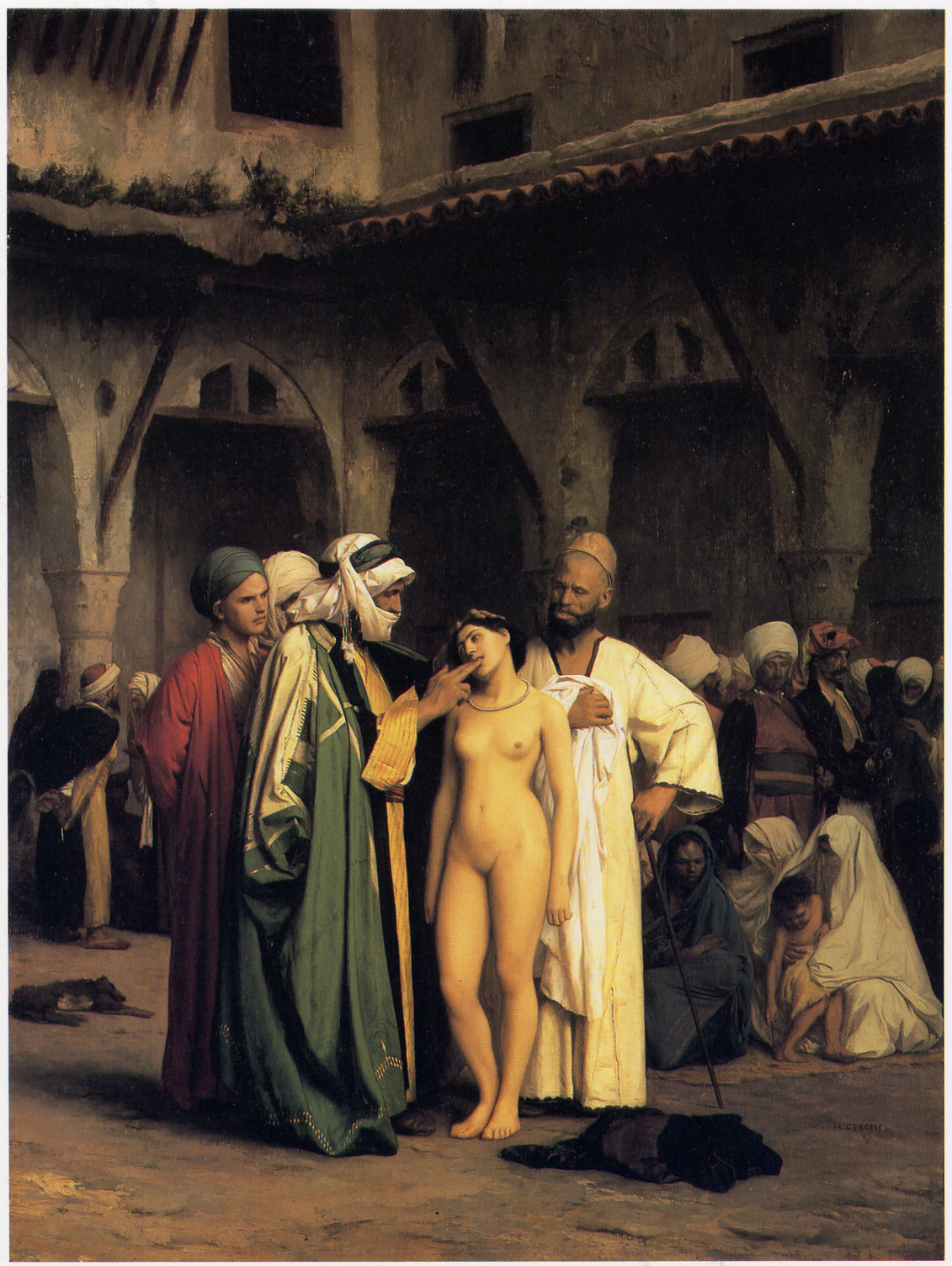
The Slave Market, painting (c. 1884) by Jean-Léon Gérôme (source)

Can Europeans, and European women in particular, become objects of trade? The idea seems laughable, since the term ‘slave trade’ almost always brings Africans to mind. Yet there was a time not so long ago when Europe exported slaves on a large scale. Between 1500 and 1650, Eastern Europe exported 1.5 million slaves to North Africa, the Middle East, and South Asia (Fisher, 1972; Kolodziejczyk, 2006). Western Europe exported a little over a million between 1530 and 1780 (Davis, 2004).

These slaves were taken during hit-and-run raids by either Crimean Tatar horsemen or North African corsairs. A raiding party would typically descend on an isolated village and carry away its inhabitants—or rather those who were commercially useful, particularly young women and young boys.

There was a time farther back, however, when Europeans were accomplices in this trade and when it provided most of their foreign exchange. This was during the Dark Ages and the early Middle Ages, specifically the 8th to 12th centuries.

The slave trade was a godsend for the elites of France, Germany, and Italy. With the collapse of the Western Roman Empire in the 5th century, they had to dip into their gold reserves to buy foreign luxury goods from the Middle East, generally clothing, upholstery, tapestries, carpets, and other precious fabrics (Skirda, 2010, pp. 56-57). By the 8th century, these reserves had been almost completely exhausted. Gold was giving way to silver, and even that medium of exchange was being debased. Western Europe had largely reverted to an economy of autarky, its shrunken towns and cities no longer major centers of trade. Most people produced everything they needed within their local village or manor.

Would Western Europe have eventually returned on its own to an international trading economy? Perhaps, although revival of trade would have become more difficult once the elites had become accustomed to autarky. As things turned out, they found the means to buy foreign luxury goods almost at the same time their gold reserves ran out. The 8th century brought the rapid expansion of a new civilization, Islam, into the Middle East, North Africa, and Spain. Its Arab elite was darker-skinned than the Greco-Roman or Visigothic elites it displaced. It was also more polygynous. A new market had come into being, a market for wives and concubines. European women were especially sought after, not because they were exotic but because their fair skin and fine facial features corresponded to notions of beauty that were indigenous to Arab culture (see previous post).

And so began the commodification of European women. Initially, this trade involved prisoners of war captured during the Islamic wars of expansion. Soon, however, a peaceful trading relationship developed. It was officially prohibited by Christian emperors and popes alike, but “in reality, people closed their eyes and everything was tolerated in exchange for good gold dinars” (Skirda, 2010, p. 75).

The women came from a belt of territory stretching from the Elbe in the West to the Volga in the East. This territory was inhabited by Slavic tribes—the ancestors of today’s Poles, Czechs, Slovaks, Byelorussians, Ukrainians, and Russians. They were typically prisoners of war who had been taken during fighting either between Germans and Slavs or among different Slavic tribes:

Only the adolescent boys and girls—the Slavonici—were spared, enslaved, and immediately sold to the merchants accompanying the armies. The Barbarian-ruled West, abandoned by major international trade and bereft of gold, was able to get gold by trading in slaves, who were almost exclusively Slavs. These objects of servile trade and commerce would be integrated into harems and used as military slaves or eunuchs. Adults and children were eliminated for obvious reasons. They did not correspond to the Muslim demand for young virgin girls and beardless boys and it was out of the question to gather children and raise them. The traders had neither the time nor the willingness and more importantly it would not have been cost-effective. Later, they would spare the lives of more captives, by selecting them according to their capacities for productive work and by using them to the limit of their strength at laborious physical tasks (Skirda, 2010, pp. 85-86).

The captives were taken overland by various routes: through Germany and France to Muslim Spain; through Venice and by ship to the Middle East; or down the Dniepr, the Don, or the Volga to the Middle East via the Black Sea or the Caspian. How many were traded? It’s difficult to say, but Skirda (2010, p. 6) advances a figure between several tens of thousands and several hundreds of thousands for the period extending from the 8th to 12th centuries.

It was this trade, more than any other, that revived the old trading networks not only between Europe and the Middle East, but also within Europe itself. The balance of foreign exchange also shifted in Europe’s favor, thus giving the elites of France, Germany, and Italy the means to buy not only foreign goods but also local products, thereby stimulating a long economic recovery that would take Europe out of the Dark Ages. As Skirda notes ironically:

The Italians who […] were the “great initiators of Europe” […] became the promoters of trading companies, creators of credit, restorers of currency. The only major oversight [of historians]: all of that was accomplished through the trade in Slavs. It is easier to understand why almost all historians and commentators have silently observed this phenomenon. It is difficult for them to acknowledge that the economic renaissance of the West of the 10th and 11th centuries was achieved through human trafficking! (Skirda, 2010, p. 112)

References

Davis, R. (2004). Christian Slaves, Muslim Masters: White Slavery in the Mediterranean, the Barbary Coast, and Italy, 1500-1800, Palgrave-Macmillan.

Fisher, A. (1972). Muscovy and the Black Sea slave trade, Canadian American Slavic Studies, 6, 575-594.

Kolodziejczyk, D. (2006). Slave hunting and slave redemption as a business enterprise: The northern Black Sea region in the sixteenth to seventeenth centuries, Oriente Moderno, 86, 1, The Ottomans and Trade, pp. 149-159.

Skirda, A. (2010). La traite des Slaves. L’esclavage des Blancs du VIIIe au XVIIIe siècle, Paris, Les Éditions de Paris Max Chaleil.